Font size
 Worksheets
BCP7 SYI
Total questions: 75
Worksheet time: 2hrs 29mins
What is DIFFUSION?


Which is the correct equation for aerobic respiration in humans?
Glucose + Oxygen -> Carbon Dioxide + Water
Glucose + Oxygen -> Carbon Dioxide
Glucose -> Carbon Dioxide + Water
Glucose -> Lactic Acid

Where the exchange of gases actually occur?
Bronchi
Trachea
Oxygen
Alveoli

The way gases move between the capillaries and alveoli is called...?
Osmosis
Diffusion
Atmosphere
Pressure
Which of these are adaptations of alveoli?
Long, finger-like structure increases surface area
The membrane is only one cell thick which means gases have a short diffusion distance
Lots of tiny capillaries so gases can pass easily into the blood stream
Moist
Lots of enzymes so there are tiny molecules suitable for diffusion

Respiration takes place in
the cells
the lungs
the heart
the brain
Which organism would have the smallest SA:V
mouse
human
bacteria
ameoba
The gas which the body exhales as waste is called...
carbon dioxide
argon
oxygen
nitrogen
Which of these is a way in which alveoli are adapted to work well?
They are very large
They have thick walls
They have thin walls
There are only a few of them
What is the purpose of transport systems in humans?
To increase the surface area to volume ratio
To decrease the surface area to volume ratio
To increase the volume
To transport substances to the parts of the body that need them
What is the effect of diffusion distances on larger organisms?
Diffusion becomes faster
Diffusion becomes slower
Diffusion remains the same
Diffusion stops
Protease enzymes break down protein into...
Fatty Acids
Amino Acids
Stomach Acid
Muscles
Fats are broken down by lipase into...
Glycerol and Fatty Acids
Lard
Amino Acids
Starch


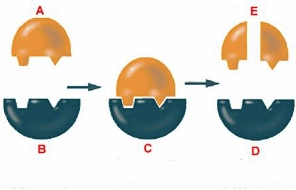
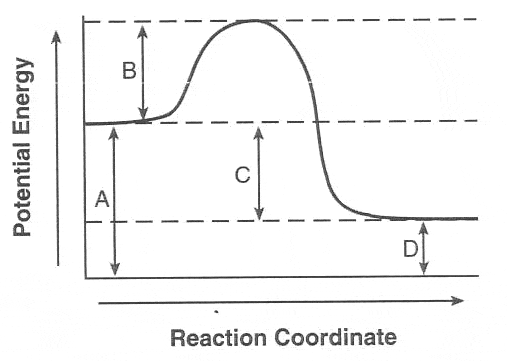
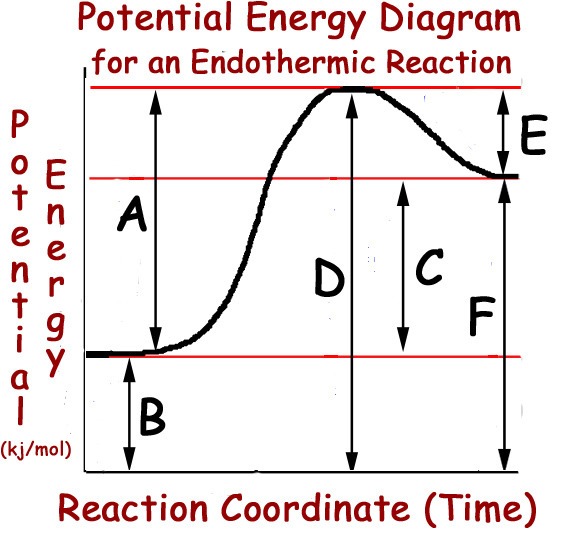
Which letter represents the Product ?
B
C
D
E
This organ pumps blood through your body.
heart
artery
vein
capillaries

Which light bulb(s) will never light up?
A
B, C, D
A, B, C, D
None
What is used to measure electric current?
Voltmeter
Ammeter
Wattmeter
pH meter

What type of circuit is this?
Series
Parallel
Simple
The unit for current is:
Volt
Ohm
Electron
Amp

Which statement is true?
The light bulb will light up because the circuit is complete.
The light bulb will light up because the circuit is broken.
The light bulb will not light up because the circuit is complete.
The light bulb will not light up because the circuit is broken.
What does an ammeter measure?
Coulombs
Current
Charge
Amperes
Complete the equation: ________ = potential difference / resistance
Charge
Current
Resistance
Coulomb

Calculate the voltage across the 8Ω resistor.
4 V
16 V
9 V
4.5 V

Examine the circuits in the diagram. In which circuit will the bulb be brighter?
Circuit A
Circuit B
Both circuits, the bulbs will have the same brightness.
If the voltage is increased and the resistance stays the same, the current will:
Increase
Decrease
Stay the same
X

Based on the graph, which of the following would be true regarding the relationship between voltage and current?
As voltage increases, current decreases.
Voltage will not affect current.
As voltage decreases, current increases.
As voltage increases, current also increases.
Which best describes a parallel circuit?
Electricity flows along one pathway.
The flow of electricity comes from one source.
Electricity flows along more than one pathway.
The flow of electricity comes from more than one source.
What does a voltmeter measure?
potential difference
resistance
charge
current
How many volts are produced by three cells of 3 V each in series?
3V
1.5V
9V
27V
A circuit contains two resistors in series. One is 5 ohms and the other is 10 ohms. What is the total resistance of the circuit?
5 ohms
10 ohms
15 ohms
A circuit contains two resistors in series. One is 5 ohms and the other is 10 ohms. What is the total resistance of the circuit?
5 ohms
10 ohms
15 ohms

If the cell above has a potential difference of 8V, what is the potential difference across one bulb?
8V
4V
16V
2V

If the cell in the circuit above has a potential difference of 8V, what is the potential difference across one of the bulbs?
8V
4V
16V
2V

Look at figure 4. Ammeters A2 and A3 read the same value at 0.4 Amps. What is the reading on Ammeter A1?
0.4A
0.2A
0.8A

Arrows are close together on a force field when the force is
stronger
weaker
opposite
What THREE ways are electromagnets different from permanent magnets?
they can be turned off and on
they can increase in strength by increasing the current in the wire
they are smaller in size
they can change which is the north and south pole

Which electromagnet will pick up LESS paper clips?
A
B
Iron + copper oxide =
Iron + copper oxide
Iron oxide + copper oxide
Iron oxide + copper
Magic

Which of the following is more reactive?
Calcium
Potassium
Zinc
Magnesium
Which one of the following combinations result in a displacement reaction?
Iron with magnesium chloride
magnesium with iron chloride
Iron with Zinc Sulphate
gold with silver nitrate
What will the products of this reaction be?
calcium + zinc nitrate --------->
Calcium + zinc nitrate
Zinc + calcium nitrate
there will be no reaction
Zinc + calcium chloride
What is the product of the reaction between magnesium and copper sulphate?
Magnesium sulphate + copper
Magnesium + copper
Magnesium oxide + copper sulphate
No reaction
Acid + Alkali --> Salt + Water
neutralization reaction
synthesis
decomposition
single displacement
Name the salt produced from the reaction of calcium hydroxide and hydrochloric acid
(a)
Name the salt produced from the reaction of nitric acid and lithium hydroxide
(a)
When a metal reacts with water what gas is produced?
Nitrogen
Carbon dioxide
Hydrogen
Helium
When a metal reacts with an acid what gas is made?
Hydrogen
Oxygen
Nitrogen
Helium
Magnesium + hydrochloric acid-->
Magnesium chloride + water
Magnesium chloride + hydrogen
Magnesium hydrochloride + hydrogen
Magnesium chloride + water + carbon dioxide
Calcium carbonate + hydrochloric acid -->
Calcium chloride + hydrogen
Calcium choride + water
Calcium chloride + carbon dioxide + water
Calcium sulfate + carbon dioxide + water
Which of the following is a common characteristic of a precipitation reaction?
A) Release of energy
B) Formation of a gas
C) Formation of a precipitate
D) Decrease in temperature
What is the solid formed in a precipitation reaction called?
A) Residue
B) Catalyst
C) Precipitate
D) Solvent