
 Worksheets
sem 1 review
Total questions: 134
Worksheet time: 1hrs 7mins
Name
Class
Date
1.
Which method of thermal energy transfer can travel through matter?
a)
A. conduction
b)
B. convection
c)
C. radiation
d)
D. all of the above
2.
When light is soaked up by a material and does not bounce or bend its called ____________.
a)
wavelength
b)
reflect
c)
absorb
3.
Which of the following is NOT a type of electromagnetic wave?
a)
Visible Light
b)
Microwaves
c)
Sound Waves
d)
X-Rays
4.
What are 3 different sources of light energy?
a)
The Sun
b)
Fire
c)
Electricity
d)
The Moon
5.
A curved glass of water bends the light. A stick placed in the glass appears to bend and distort too.
a)
reflection
b)
refraction
c)
both
6.
A rainbow forms when light bends as it passes through water droplets in the clouds then bounces back to our eyes.
a)
reflection
b)
refraction
c)
both
7.
The moon appears to glow because sunlight bounces off its surface.
a)
reflection
b)
refraction
c)
both
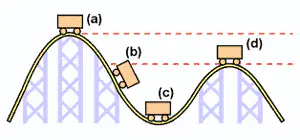
8.
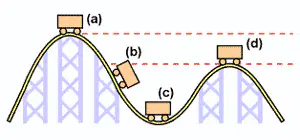
When you hit a drum, ____ energy changes into sound
energy.
a)
heat energy
b)
light energy
c)
mechanical
9.
Sound energy can only travel through matter.
a)
True
b)
False
10.
You can see sound energy but you can’t feel it.
a)
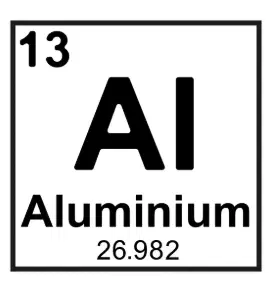
true
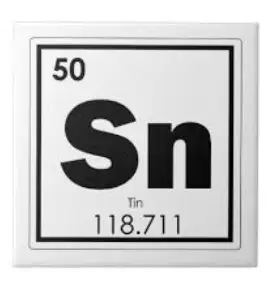
b)
false
11.
Sound travels the fastest through ___.
a)
solids
b)
liquids
c)
gases
12.
The frequency of the sound waves changes the ___ of the sound.
a)
volume
b)
pitch
c)
color
13.
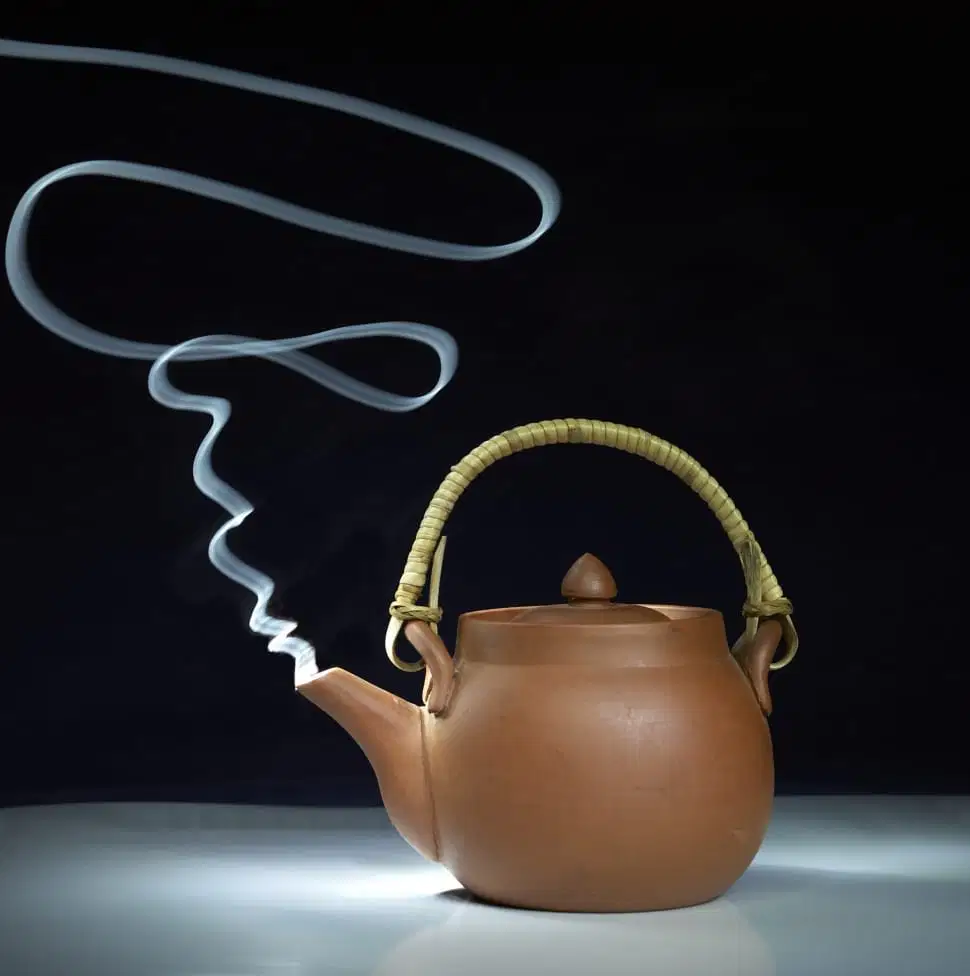
Does a tea kettle whistle have a high frequency or a low frequency
a)
high
b)
low
14.

Does a helicopter have a high frequency or a low frequency
a)
high
b)
low
15.
Light can travel at different speeds depending on what
type of matter it passes through.
a)
True
b)
False
16.
Materials that allow some light to pass through are called _____________.
a)
Opaque
b)
Transparent
c)
Translucent
17.
The moon appears to glow because sunlight bounces off its surface.
a)
reflection
b)
refraction
c)
both
18.
When you hit a drum, ____ energy changes into sound
energy.
a)
heat energy
b)
light energy
c)
mechanical
19.
All of the following are producers of light except _____________
a)
the sun
b)
a lightbulb
c)
fire
d)
the moon
20.
A student place a ruler into a glass of water and observes that the ruler looks broken. What is occurring?
a)
The force of the water has broken the ruler.
b)
Light is refracted as it enter the water, making the ruler look broken.
c)
The ruler is broken before it is put in the water.
d)
Water in the cup reflects light around the ruler in a different direction than the air.
21.
Which is an example of a vibration?
a)
A cat running as fast as it can
b)
Up and down movement of a motor
c)
A light going on and off
22.
What is pitch?
a)
the back and forth movement of matter
b)
how high or low a sound is
c)
how loud a sound is
d)
the number of vibrations per second
23.
Sound travels the fastest through ___.
a)
solids
b)
liquids
c)
gases
24.

Does thunder have a high frequency or a low frequency
a)
high
b)
low
25.

Does a bird chirping have a high frequency or a low frequency
a)
high
b)
low
26.
Nonrenewable resource made of fossilized carbon
a)
nuclear
b)
natural gas
c)
coal
d)
oil
27.
Nonrenewable resource that is also called petroleum
a)
nuclear
b)
natural gas
c)
coal
d)
oil
28.
Nonrenewable resource that is made of methane and other hydrocarbons
a)
nuclear
b)
natural gas
c)
coal
d)
oil
29.
Energy that is generated during nuclear fission
a)
nuclear
b)
natural gas
c)
coal
d)
oil
30.
Which of the following is NOT a fossil fuel?
a)
coal
b)
crude oil
c)
nuclear fission
d)
natural gas
31.
Energy from any material that comes from plants or microorganisms that were recently living
a)
A. wind
b)
B. solar
c)
C. hydroelectric
d)
D. geothermal
e)
E. biomass
32.
Energy that is produced by moving air
a)
A. wind
b)
B. solar
c)
C. hydroelectric
d)
D. geothermal
e)
E. biomass
33.
energy made by flowing water
a)
A. wind
b)
B. solar
c)
C. hydroelectric
d)
D. geothermal
e)
E. biomass
34.
heat energy from deep within Earth
a)
A. wind
b)
B. solar
c)
C. hydroelectric
d)
D. geothermal
e)
E. biomass
35.
energy from the sun
a)
A. wind
b)
B. solar
c)
C. hydroelectric
d)
D. geothermal
e)
E. biomass
36.
Which of the following is NOT an example of biomass energy?
a)
A. trees
b)
B. scraps of bark
c)
C. an animal that died millions of years ago
d)
D. recycled paper
37.
Ethanol comes from what type of renewable energy source?
a)
A. hydroelectric
b)
B. biomass
c)
C. solar
d)
D. wind
38.
Which renewable resource needs a dam to produce electricity?
a)
A. hydroelectric
b)
B. wind
c)
C. solar
d)
D. geothermal
39.
Which renewable reusable resource uses steam from Earth to turn turbines?
a)
A. geothermal
b)
B. biomass
c)
C. hydroelectric
d)
D. wind
40.
____ are needed to create energy from wind.
a)
A. Turbines
b)
B. Pinwheels
c)
C. Dams
d)
D. Kites
41.
In geothermal energy, water is warmed by ____ and pumped to the surface.
a)
A. magma
b)
B. lava
c)
C. the Sun
d)
D. No one knows how the water is warmed.
42.
Which of the following is a disadvantage to using wind energy?
a)
A. Pesticides cause pollution.
b)
B. It is efficient and cheap.
c)
C. It is inconsistent.
d)
D. Cloud cover reduces the amount of energy collected.
43.
Which statements are true about hydroelectric energy? Choose THREE correct answers.
a)
The amount of water sent through tunnels to the turbines is controlled.
b)
It is cheap to build a dam for hydroelectric energy.
c)
It’s a reliable source of energy because engineers can control the flow of water.
d)
Hydroelectric energy is relatively inexpensive to collect.
e)
Damming a river is great for the environment.
44.
Which of the following is NOT an advantage of using solar energy?
a)
A. It is free energy after the initial purchase of solar panels.
b)
B. It converts 100% of the Sun’s energy into electricity.
c)
C. It requires little maintenance to maintain.
d)
D. It is a reliable source of energy.
45.
What method of thermal energy transfer occurs because of temperature differences between gasses or liquids?
a)
A. conduction
b)
B. convection
c)
C. radiation
d)
D. all of the above
46.
What method of thermal energy transfer travels in the form of electromagnetic
waves?
a)
A. conduction
b)
B. convection
c)
C. radiation
d)
D. all of the above
47.
What method of thermal energy transfer is the direct transfer of heat between particles within a substance that are in direct contact?
a)
A. conduction
b)
B. convection
c)
C. radiation
d)
D. all of the above
48.
Select THREE options below that are examples of convection.
a)
a cooking pan on a burner becoming hot to the touch
b)
warm air in a home rising to the ceiling
c)
hot water moving from the heat source to the top of the container
d)
cool ocean water sinking below warmer water
49.
Select THREE options below that are examples of conduction.
a)
using a spoon to stir hot tea
b)
turning on the heated seats in a car
c)
feeling the warm Sun on a bright day
d)
putting a hand warmer inside your glove
e)
warm bath water resting above cool water
50.
Select THREE options below that are examples of radiation.
a)
feeling the warmth of a campfire from a distance
b)
a cooking pan on a burner becoming hot to the touch
c)
using an infrared heater to warm a room
d)
sunlight warming a dark-colored car
e)
touching a metal handle on a hot pot
51.
When you do work, you are exerting ____________.
a)
A. push
b)
B. pull
c)
C. energy
d)
D. power
52.
The unit of measure for potential and kinetic energy is the ____________.
a)
A. newton
b)
B. meter
c)
C. watt
d)
D. joule
53.
Distance (height) and mass determine the amount of ____________ energy in an object.
a)
A. kinetic
b)
B. potential
c)
C. solar
d)
D. thermal
54.
Speed and mass determines the amount of ____________ energy in an object.
a)
A. kinetic
b)
B. potential
c)
C. solar
d)
D. thermal
55.
An object falling from 50 meters will have ____________ potential energy than an object falling from 30 meters.
a)
A. more
b)
B. less
c)
C. equal
d)
D. lower
56.
If you have two objects with different masses about to fall from the same height, which one will have the greatest potential energy?
a)
A. smallest
b)
B. flattest
c)
C. largest
d)
D. roundest
57.
The amount of kinetic energy in an object is determined by its _________.
a)
A. speed and mass
b)
B. height and mass
c)
C. speed and velocity
d)
D. height and Velocity
58.
The faster an object moves, the greater its ____________ energy is.
a)
A. kinetic
b)
B. potential
c)
C. solar
d)
D. electrical
59.
An object’s potential energy will increase with ____________.
a)
A. speed and mass
b)
B. height and mass
c)
C. speed and velocity
d)
D. height and velocity
60.
Which situations best describe potential energy? Choose THREE correct answers.
a)
A basketball sits on the rim before falling into the hoop.
b)
A diver stands on the edge of the 30-meter diving platform.
c)
A baseball is just about to be released by the pitcher.
d)
A bobsled is moving at its fastest speed around the final turn.
e)
A golf ball has just been hit by the driver.
61.
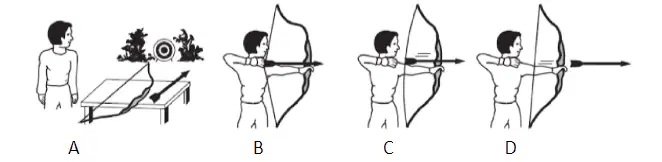
A person uses a bow to shoot an arrow at a target. In which diagram does the bow and arrow have the greatest amount of potential energy
a)
A
b)
B
c)
C
d)
D
62.

A ball rolled three times. In which of the following situations does the ball have the MOST POTENTIAL energy as it rolls?
a)
A
b)
B
c)
C
63.
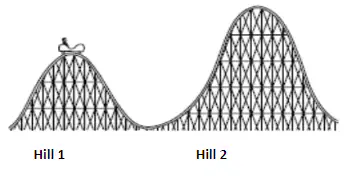
The roller coaster in the picture will not make it over the second hill. Pick the answer that best describes why getting over the second hill would be impossible.
a)
The potential energy gained when climbing the first hill is greater than the kinetic energy required to climb the second hill.
b)
The potential energy gained when climbing the first hill is equal to the kinetic energy required to climb the second hill.
c)
Energy is destroyed as the roller coaster car travels on the track.
d)
The potential energy gained when climbing the first hill is less than the kinetic energy required to climb the second hill.
64.
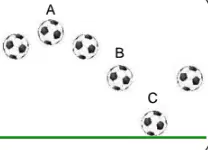
Which point has greatest kinetic energy?
a)
A
b)
B
c)
C
d)
none
65.
On a roller coaster, where is maximum kinetic energy?
a)
At the bottom of a big hill
b)
At the top of a big hill
c)
When going around a corner
66.
Which is the best example of kinetic energy?
a)
A car sitting on top of a hill
b)
A wagon rolling down the hill
c)
A skateboard sitting on a sidewalk
d)
A parked car
67.
Levels of kinetic energy are most influenced by:
a)
Mass
b)
Speed
c)
Distance
d)
Time
68.
Which of the following statements about a skier skiing down a steep slope is true?
a)
His kinetic energy decreases and his potential energy increases
b)
His chemical energy increases
c)
His potential energy decreases and his kinetic energy increases
d)
Both his potential and kinetic energy increases
69.
What kind of energy does the car have at Point (a)?
a)
Potential
b)
Kinetic
70.
What kind of energy does the car have at Point (b)?
a)
Potential
b)
Kinetic
71.
When an object has balanced forces acting on it, the object ___________.
a)
A. moves to the right
b)
B. stays still
c)
C. moves to the left
d)
D. can move in any direction
72.
Which of the following is NOT a change in motion caused by unbalanced forces?
a)
A. position
b)
B. time
c)
C. direction
d)
D. speed
73.
____ pull(s) objects downward toward Earth’s center.
a)
A. Force
b)
B. Gravity
c)
C. Newtons
d)
D. Net force
74.
Which of the following is an example of a protective lab equipment?
a)
Safety goggles
b)
Pencil
c)
Calculator
d)
Notebook
75.
When he finished his lab, James cleaned up his station and waited for more directions.
Is this safe or unsafe?
a)
safe
b)
unsafe
76.
A Flask is a tool used to mix, heat, or approximate the volume of a liquid.
a)
TRUE
b)
FALSE
77.
What is the function of a microscope in a science lab?
a)
To measure temperature
b)
To magnify small objects for observation
c)
'To mix chemicals
d)
To store lab equipment
78.
Which lab tool is used to find precise volumes of liquids?
a)
test tube
b)
graduated cylinder
c)
funnel
d)
flask
79.
What should you do if you accidentally break a glass beaker in the science lab?
a)
Leave it as it is and continue with your experiment
b)
Ignore it and inform your teacher at the end of class
c)
Clean it up immediately and dispose of broken glass properly
d)
Ask your lab partner to clean it up for you
80.
Why is it important to read and follow instructions in the science lab?
a)
To waste time
b)
To confuse your lab partners
c)
To ensure that experiments are done safely and accurately
d)
To show off your reading skills
81.
A Test Tube is a tool used to Mix, Heat, or Hold a Substance.
a)
TRUE
b)
FALSE
82.
Which variable STAYS THE SAME throughout the entire experiment?
a)
control
b)
Independent variable
c)
dependent variable
83.
What is the first step of the scientific method?
a)
Analyzing data
b)
Forming a hypothesis
c)
Conducting experiments
d)
Making observations
84.
Which variable IS AFFECTED BY THE CHANGES throughout the experiment?
a)
control
b)
Independent variable
c)
dependent variable
85.
Which variable IS CHANGED BY THE SCIENTIST throughout the experiment? (think "I" change)
a)
control
b)
Independent variable
c)
dependent variable
86.
_________ are substances consisting of a single type of atom. Each has a symbol on the periodic table.
a)
element
b)
molecule
c)
compound
87.
How many protons are in an atom of Aluminum?
a)
27
b)
11
c)
9
d)
13
88.
How many Neutrons are in the element Tin? (Remember the formula to find out how many neutrons M-A=N)
Don't forget to round the decimal!!
(a)
89.
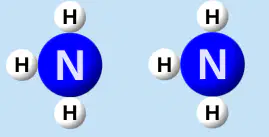
In the diagram below, how many molecules are there?
a)
8
b)
10
c)
2
d)
4
90.

How many ATOMS are present in the formula below?
a)
3
b)
4
c)
5
d)
2
91.
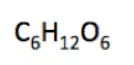
How many DIFFERENT ELEMENTS are there in the formula below?
a)
12
b)
30
c)
24
d)
3
92.
If an element has an atomic number of 15, how many protons does it have?
a)
13
b)
14
c)
15
d)
16
93.
If an element has 45 electrons, what is the atomic #?
a)
5
b)
4
c)
45
d)
54
94.
How do you find the number of neutrons in an element?
a)
look at the mass
b)
look at the atomic number
c)
mass- atomic number
95.
How do you find the number of protons in an element?
a)
look at the mass
b)
look at the atomic number
c)
mass- atomic number
96.

What is arrow "a" pointing to?
a)
Element Name
b)
Chemical Symbol
c)
Mass
d)
Atomic Number
97.

What is arrow "b" pointing to?
a)
Element Name
b)
Chemical Symbol
c)
Mass
d)
Atomic Number
98.

What is arrow "c" pointing to?
a)
Element Name
b)
Chemical Symbol
c)
Mass
d)
Atomic Number
99.

What is arrow "d" pointing to?
a)
Element Name
b)
Chemical Symbol
c)
Mass
d)
Atomic Number
100.
A chemical reaction occurs when two or more molecules interact and molecules ___________________.
a)
change into a new substance.
b)
changes the elements.
c)
stay the same.
101.
Which two colors had the same number of votes?
a)
red
b)
green
c)
yellow
d)
blue
e)
purple
102.
How many students voted for their favorite color?
(a)
103.
true/false: Yellow got half as many votes as red.
a)
True
b)
False
104.
Two students were absent from class when the chart was made. They both voted for purple. How many votes would purple have with those 2 extra votes?
(a)
105.
What is a physical change?
a)
a change in the form or appearance of a substance.
b)
when two or more substances make a new substance with new properties.
c)
a chemical reaction that generates heat and/or light
106.
What is a chemical change?
a)
a change in the form or appearance of a substance.
b)
when two or more substances make a new substance with new properties.
c)
a chemical reaction that generates heat and/or light
107.
_________ are substances consisting of a single type of atom. Each has a symbol on the periodic table.
a)
element
b)
molecule
c)
compound
108.
Where are electrons located in an atom?
a)
nucleus
b)
electron cloud
c)
Hogwarts
d)
Hawaii
109.
Where are neutrons located in an atom?
a)
electron cloud
b)
Florida
c)
nucleus
d)
Wherever Mrs. Wagner's last brain cell went.
110.
A ________ is a chemical substance formed when two or more DIFFERENT elements bond in a specific proportion.
a)
molecule
b)
element
c)
compound
111.
_______ is a material that allows energy to pass through easily.
a)
Insulator
b)
Solution
c)
Conductor
112.
The amount of matter in an object is ____________.
a)
Matter
b)
Mass
c)
Element
113.
A ________ is a chemical substance formed when two or more DIFFERENT elements bond in a specific proportion.
a)
molecule
b)
element
c)
compound
114.
What is a chemical change?
a)
a change in the form or appearance of a substance.
b)
when two or more substances make a new substance with new properties.
c)
a chemical reaction that generates heat and/or light
115.
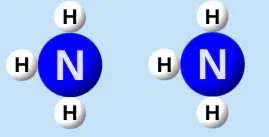
In the diagram below, how many MOLECULES are there?
a)
8
b)
10
c)
2
d)
4
116.
If an element has 45 electrons, what is the atomic #?
a)
5
b)
4
c)
45
d)
54
117.
_______ is a material that allows energy to pass through easily.
a)
Insulator
b)
Solution
c)
Conductor
118.
The amount of matter in an object is ____________.
a)
Matter
b)
Mass
c)
Element
119.
What is a physical change?
a)
a change in the form or appearance of a substance.
b)
when two or more substances make a new substance with new properties.
c)
a chemical reaction that generates heat and/or light
120.
A chemical reaction occurs when two or more molecules interact and molecules ___________________.
a)
change into a new substance.
b)
changes the elements.
c)
stay the same.
121.
If an element has an atomic number of 15, how many protons does it have?
a)
13
b)
14
c)
15
d)
16
122.
What holds atoms together in a molecule?
a)
Chemical Bonds
b)
Gravity
c)
Physical Bonds
d)
Density
123.
A student brings three containers to school to show her class. Container one has soil from her backyard, container two has a salad her mom made for dinner, and container three has sugar water.
What do all three containers represent?
a)
Elements
b)
Compounds
c)
Mixtures
d)
Solutions
124.
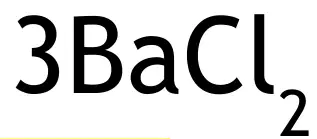
What elements are in this formula? Select all that apply.
a)
Boron (B)
b)
Chlorine (Cl)
c)
Barium (Ba)
d)
Calcium (Ca)
125.
If an element has 56 electrons, what is the atomic #?
a)
5
b)
6
c)
56
d)
64
126.
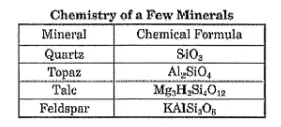
All these minerals belong to the same group in the Periodic Table because each contains the element:
a)
silicon (Si)
b)
aluminum (Al)
c)
Hydrogen (H)
d)
Potassium (K)
127.
Protons have a ________ charge.
a)
positive
b)
negative
c)
neutral
128.
Where are electrons located in an atom?
a)
nucleus
b)
electron cloud
c)
Hogwarts
d)
Hawaii
129.
What is the chemical symbol for Aluminum?
(a)
130.

What is arrow "c" pointing to?
a)
Element Name
b)
Chemical Symbol
c)
Mass
d)
Atomic Number
131.

What is arrow "a" pointing to?
a)
Element Name
b)
Chemical Symbol
c)
Mass
d)
Atomic Number
132.

What is arrow "b" pointing to?
a)
Element Name
b)
Chemical Symbol
c)
Mass
d)
Atomic Number
133.

What is arrow "d" pointing to?
a)
Element Name
b)
Chemical Symbol
c)
Mass
d)
Atomic Number
134.
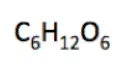
How many DIFFERENT ELEMENTS are there in the formula below?
a)
12
b)
30
c)
24
d)
3
100 %

