
 Worksheets
Physical Science Honors Review
Total questions: 100
Worksheet time: 3hrs 41mins
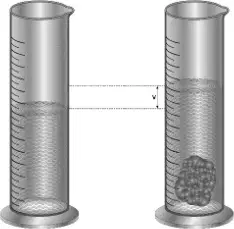
A rock was placed in a graduated cylinder containing 80 ml of water. The water level rose by 20 ml. The density of the rock is 19.3 g/ml. Using the formula, Density = Mass/Volume, what is the mass of the rock?
0.97g
1.04g
5.18g
386.0g
Breakfast cereal manufacturers hire Chemists that specialize in studying the properties and safety of materials used to package cereal for public consumption. Which of the following pieces of evidence is not useful to a Chemist constructing an explanation that a material is negatively impacting public safety?
The glue used to seal the cereal box and plastic bag is flammable.
The pH of the plastic bag becomes acidic over time while exposed to sugar in cereal.
The local government has imposed regulations to restrict the volume of cardboard cereal boxes.
The concentration of toxins in the cereal has increased due to the breakdown of the plastic over time.
The density of water is 1.00 g/cm³. The density of ethanol is 0.80 g/cm³. What is the volume of ethanol, in cm³ that has the same mass as 100 cm³ of water?
80 cm³
100 cm³
125 cm³
180 cm³
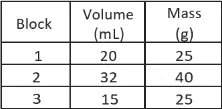
A student measured the volumes of three waterproof blocks by dropping them into a graduated cylinder containing water. He then determined the mass of each block on his balance and recorded the data in the table below. Which blocks could be made of the same material?
A. 1 and 2 only
B. 1 and 3 only
C. 2 and 3 only
D. None of them
The Safe Drinking Water act was created to ensure that the level of toxins in our water supply remains low. How did chemists use their hypotheses to influence the Safe Drinking Water Act?
Chemists shared hypotheses with lawmakers that produced evidence about safe and unsafe drinking water volumes.
Chemists shared hypotheses with lawmakers that produced evidence about the density of toxins used to treat the water.
Chemists shared hypotheses with lawmakers that produced evidence about the safe concentrations of toxins in drinking water.
Chemists shared hypotheses with lawmakers that produced evidence about the disposal methods used for water that was not safe to drink.
Jocelyn’s uncle’s fence company wants to test how resistant the metal they use is to corrosion or rust, which occurs when metal is exposed to water and oxygen. Which of the following is an example of an outcome variable they might use?
The length of the fence.
The source of the water.
The time and exposure to oxygen.
The surface coverage of the rust.
Lamar tested five solutions to identify which ones are acids, which ones are bases, and which ones are water. He hypothesized that solution number three was Windex, a strong cleaning product. For Lamar’s hypothesis to be supported by his data, which of the following pH values must solution number three be near?
1.0
7.0
9.0
12.0
Mrs. Harris was preparing her students to conduct an experiment with a new chemical. She reviewed the Material Safety Data Sheet (MSDS) below to ensure she was planning to use it safely. Using logical reasoning, what kinds of precautions should she ensure her students are taking when conducting their lab?
Keep the chemical away from an open flame.
Wear goggles and gloves to protect their eyes and hands.
Choice A and B are both needed for safe handling of the chemical.
Only answer choice B is needed for safe handling of the chemical.
You and a friend have been asked to separate the contents of a barrel. The barrel contains sand, motor oil, iron filings, small rubber pieces, water, and pieces of cork. Looking at your friend’s procedure below, which step(s) would you tell your friend needed to be corrected? Barrel Separation Procedure Step 1: Put on goggles and safety gloves. Step 2: Remove cork with tweezers. Step 3: Use dropper to remove top layer of oil. Step 4: Pour the water off the solid. Step 5: Use tweezers to separate the sand pieces. Step 6: Use filter paper to remove the iron filings from the rubber pieces. Step 7: Label each part and keep it in a separate container.
Step 6 because a magnet would work better at picking up all the small pieces of metal.
Step 5 because sand particles are too small for tweezers and a sifter would work better.
Step 5 because you should remove the sand first since there is a lot more pieces to remove.
Step 5 and 6 because magnets are better to remove iron filings and a sifter would be faster to separate the sand from the remaining mixture.
Jen measures the mass of a block to be 11.3 g. Then she measures the mass of another block of the same material to be 19.2 g. What other physical property of the second block Jen measured will be greater than the first block she measured?
Density
Volume
Electrical Conductivity
Thermal Conductivity
16. The wooden cube below has a mass of 9 grams. Will it sink or float in water? Explain your thinking.
It will float because wood is less dense than water.
It will sink because it is heavy.
It will float because it is small.
It will sink because its mass is 9 grams.
If you cut a wooden block in half, will each half sink or float in water?
Each half will float in water.
Each half will sink in water.
One half will float, the other will sink.
Both halves will neither sink nor float.
If a a liquid has a density of 3 g/mL and a mass of 9 g. What is the volume? Use the density triangle to solve the problem
24 mL
18 mL
3 mL
12 mL

Objects that are less dense than the water
float
sink
Why does oil float when pour into the water?
Oil is more dense than the water.
Oil is less dense than the water.
Oil has equal density with water.
Both oil and water has no density.

A characteristic of a pure substance that can be observed without changing it into another substance
physical property
mass
volume
solubility

A characteristic of a pure substance that describes its ability to change into different substances
chemical property
physical property
matter
density
1. _____________________ – the ability of one substance to dissolve in another substance (salt, sugar)
thermal conductivity
melting point
solubility
oxidation
Which of these physical properties CANNOT be used to identify a substance?
electrical conductivity
reactivity to an acid
melting point
volume
Which is an example of a chemical change?
melting
dissolving
rusting
condensation
When water changes from a solid to a liquid to a gas, it is an example of a
physical change.
chemical change
mass is destroyed.
mass is created.
Sometimes when a new substance is being formed,
the substance melts.
the substance dissolves.
a gas is formed and the container gets hotter.
mass decreases.

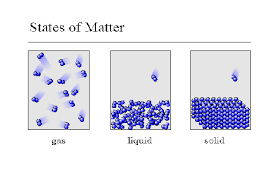
What state of matter is the model showing?
solid
liquid
gas
none of the above

What is this picturing representing?
The mass of the reactants is the same to the mass of the products.
The mass of the reactants is less than the mass of the products.
The mass of the reactants is more the mass of the products.
The mass of the reactants is different of the products.
There are more than 100 known elements. Which of the following best describes these elements?
Most of the elements are metals.
Most of the elements are nonmetals.
Most of the elements are metalloids.
Most of the elements are noble gases.
Which group on the periodic table does NOT like to form bonds with other elements?
Alkali metals
Transition metals
Halogens
Noble gases
The elements in a column of the periodic table all have …
The same chemical symbol
The same number of energy levels
The same number of electrons
The same number of valence electrons
What do elements in the same group on the periodic table have in common?
They have similar chemical symbols
They have similar chemical properties
They have the same atomic number
They have the same average atomic mass
Sodium and chlorine atoms combine in a 1:1 ration to form sodium chloride (NaCl). Chlorine will also combine in the same ratio with any element that has similar properties to sodium. Which of these sets of elements will also combine with chlorine (Cl) in the same ratio?
F, Br, I, At
H, Li, K, Rb
O, S, Se, Te
Mg, Al, Si, P
Two major categories of compounds in living systems are lipids and carbohydrates. Both types of compounds are made up of carbon, hydrogen, and oxygen. There are many different types of compounds in each category. What can you conclude from this information?
Most elements can be found in nature
Elements can combine in many different ways
Nonliving things are made up of other elements
Living things contain only carbon, hydrogen, and oxygen
When six atoms of carbon are combined with twelve atoms of hydrogen and six atoms of oxygen, the combination is a simple sugar. Which answer below best describes that combination of atoms?
Element
Solution
Mixture
Compound
Which pair of elements listed below has properties that are the most similar to each other?
Boron (B) and Carbon (C)
Krypton (Kr) and Xenon (Xe)
Phosporous (P) and Aluminum (Al)
Arsenic (As) and Argon (Ar)
Chlorine is a greenish-yellow corrosive gas at room temperature. A second element on the periodic table is a pale-yellow corrosive gas under the same conditions. Which element is most likely to be the second element and why?
Aluminum because it is in the same period as Chlorine
Fluorine because it is in the same group as Chlorine
Bromine because it is about twice the mass as Chlorine
Argon because it has a similar mass to Chlorine
The periodic table is organized into groups and periods of elements. The characteristics of a certain group of elements are listed below.
Is liquid at room temperature
Has atoms with seven valence electrons
Which of these elements is in this group?
Lithium
Potassium
Zirconium
Bromine
Potassium (K) is found in group 1 of the periodic table. Which group would it most likely bond with?
Group 1
Group 2
Group 7
Group 8
Which of the following does NOT contain hydrogen?
Water (H2O)
Hydrogen Peroxide (H2O2)
Ammonia (NH4)
Sodium Chloride (NaCl)
What is the difference between a solute and a solvent?
A solute is a solid substance, while a solvent is a liquid substance.
A solute is the substance being dissolved, while a solvent is the substance doing the dissolving.
A solute is the substance doing the dissolving, while a solvent is the substance being dissolved.
A solute and a solvent are the same thing.
How does temperature affect the solubility of a solute in a solvent?
Increasing temperature increases the solubility of a solute in a solvent.
Decreasing temperature increases the solubility of a solute in a solvent.
Increasing temperature decreases the solubility of a solute in a solvent.
Temperature has no effect on the solubility of a solute in a solvent.
What is the concentration of a solution?
The concentration of a solution is the amount of solute present in a given amount of solvent or solution.
The concentration of a solution is the amount of solute present in a given amount of solvent only.
The concentration of a solution is the amount of solvent present in a given amount of solute or solution.
The concentration of a solution is the amount of solute present in a given amount of solution only.


During a chemical reaction, atoms ________.
can appear
can disappear
get rearranged
stop moving and vibrating
H2 + O2 --> H2O
2H2 + O2 --> 2H2O
2H2 + O2 --> 2H2O
How many atoms of aluminum are on each side of the following equation: 4Al + 3O2 --> 2Al2 O3
2
6
1
4
4Ca(OH)2

The small numbers in a chemical formula:
(the BLUE numbers)
Subscripts
Coefficients
Numbers
Molecules
Balance this equation:
H2 + Cl2 ---> HCl
It is balanced.
H2 + Cl2 ---> 2HCl
3H2 + Cl2 ---> 6HCl
H2 + 3Cl2 ---> 6HCl
If 20g of sugar is stirred into a beaker containing 100g of water. What would the mass of the dissolved solution be after the sugar is dissolved fully?
20g
100g
80g
120g
Suppose you have 15g of baking soda and mix it with 15g of vinegar. When they are combined they bubble and fizz a lot. The final solution has a mass of 25g. What happened to the "lost" 5g?
it dissappears
it is still there just not weighted
it is in the gas that is formed
nothing happened
How many oxygen atoms are in the products for the chemical reaction below?
4Fe + 3O2 → 2Fe2O3
2
3
5
6
Hint: It may change as a result of your testing.

vanilla ice cream
vanilla ice cream with sprinkles
vanilla ice cream with hot fudge & caramel


__________ are negatively charged particles that are in the orbitals around the nucleus.
protons
nucleus
neutrons
electrons
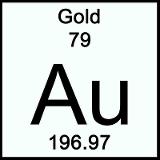


Which element is this?
Lithium
Carbon
Oxygen
Boron

How many energy levels does this element have?
6
2
4
5

How many Valence Electrons does this element have?
3
2
1
4
How many electrons in the outer energy level are in elements in group 13, 3A?
13
14
6
3
How many valence electrons are in elements in group 17, 7A?
7
17
8
5


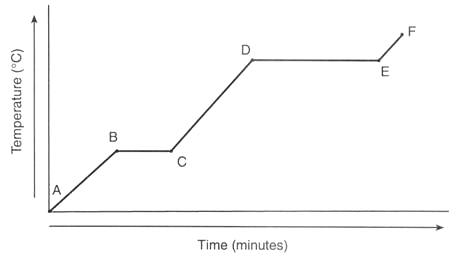
What state/phase is the object likely from points A to B?
Solid
Liquid
Gas
Plasma
What is happening to the particles in the substance between points A and B?
Melting
Freezing
Speeding Up
Slowing Down



