
 Worksheets
Life Science Semester Exam Study Prompt Fall 2025
Total questions: 86
Worksheet time: 43mins
Grace, David, and William are exploring the forest and notice different relationships between animals. Can you help them figure out the difference between mutualism, commensalism, and parasitism?
Mutualism is a relationship where both organisms benefit, commensalism is where one benefits and the other is unaffected, and parasitism is where one benefits and the other is harmed.
Mutualism is where one organism is harmed, commensalism is where both benefit, and parasitism is where both are unaffected.
Mutualism is where both organisms are harmed, commensalism is where one is harmed and the other benefits, and parasitism is where both benefit.
Mutualism is where one benefits and the other is harmed, commensalism is where both are harmed, and parasitism is where both are unaffected.
Ava, Jackson, and Samuel are curious about the scientist who is called the father of genetics because of his experiments with pea plants. Who is this famous scientist?
Gregor Mendel is known as the father of genetics for his work on pea plant inheritance.
Gregor Mendel is known as the inventor of the microscope.
Gregor Mendel is famous for developing the theory of relativity.
Gregor Mendel is known for discovering the structure of DNA.
Aria, Grace, and James are curious about what makes a population grow or shrink. Can you help them figure out what affects population size?
Population size is affected by birth rate, death rate, immigration, and emigration.
Population size is affected only by the amount of available food.
Population size is affected only by climate changes.
Population size is affected only by the number of predators.
David, Benjamin, and William are exploring a mysterious forest! They notice some things are alive, like animals and plants, while others, like rocks and sunlight, are not. What is the difference between biotic and abiotic factors in their adventure?
Biotic factors are living components of an ecosystem, while abiotic factors are non-living components.
Biotic factors are non-living components, while abiotic factors are living components.
Both biotic and abiotic factors are living components of an ecosystem.
Both biotic and abiotic factors are non-living components of an ecosystem.
Kai, Zoe, and Charlotte are exploring a forest. They wonder, what amazing things does the ecosystem provide for all the living creatures there?
The ecosystem provides food, shelter, water, and space for organisms.
The ecosystem provides only sunlight for organisms.
The ecosystem provides only air for organisms.
The ecosystem provides only rocks for organisms.
Olivia, Anika, and Harper are exploring the wonders of nature! Can you help them arrange the following in order from smallest to largest as they journey from a single living thing to the entire planet? Organism, Population, Community, Ecosystem, Biosphere.
Organism > Population > Community > Ecosystem > Biosphere
Biosphere > Ecosystem > Community > Population > Organism
Community > Population > Organism > Ecosystem > Biosphere
Population > Organism > Community > Ecosystem > Biosphere
Label the parts of a microscope as shown in the diagram.
Eye Piece
Eye Piece
Body Tube
Body Tube
Arm
Arm
Base
Base
Illuminator
Illuminator
Henry and Aria are learning about genetics in class. Henry says he is heterozygous for a trait, while Aria claims she is homozygous. What does this mean?
Heterozygous means having two different alleles for a trait, homozygous means having two identical alleles.
Heterozygous means having two identical alleles for a trait, homozygous means having two different alleles.
Heterozygous and homozygous both mean having two identical alleles for a trait.
Heterozygous and homozygous both mean having two different alleles for a trait.
William, Grace, and Mia are curious explorers on a journey inside the human body! Can you help them discover how things like oxygen and nutrients travel to every part of the body?
Things are transported throughout the body by the circulatory system (blood vessels, heart).
Things are transported throughout the body by the digestive system (stomach, intestines).
Things are transported throughout the body by the respiratory system (lungs, trachea).
Things are transported throughout the body by the nervous system (brain, nerves).
Isla, Ethan, and Avery are exploring their school garden. They spot a tree, a rabbit, some bacteria in the soil, and feel the warm sunlight. Which of these is an example of an abiotic factor in the ecosystem?
Tree
Rabbit
Bacteria
Sunlight
Aria and Arjun are curious about how their bodies work! Can you help them discover the main function of the respiratory system?
To send electrical signals to muscles
To break down food into nutrients
To transport nutrients throughout the body
To exchange gases such as oxygen and carbon dioxide
Imagine Michael and Mia are exploring the jungle. They notice a tick on a dog, and Michael asks, "Which type of relationship is this, where one organism benefits and the other is harmed?" What is the answer?
Parasitism
Mutualism
Symbiosis
Commensalism
Ethan, Aria, and Olivia are exploring the forest for their science project. They notice many different animals and plants living together and interacting. Which of the following best describes what they are observing as a community in an ecosystem?
The entire planet and all its ecosystems
All the non-living things in an area
All the populations of different species living and interacting in an area
All the organisms of a single species in an area
Ethan and Abigail are curious about how their bodies get energy from the food they eat. Which system in the human body helps them by breaking down food into nutrients?
Circulatory system
Nervous system
Digestive system
Respiratory system
Elijah and Nora are exploring a garden. They notice a bee visiting flowers and wonder about different relationships in nature. Which of the following is an example of mutualism?
A bee pollinating a flower while collecting nectar
A tick feeding on a dog
A bird building a nest in a tree without affecting the tree
A lion hunting a zebra
Priya, Avery, and Arjun are exploring their school garden. They spot grass, fungi, water, and insects. Which of these is NOT a biotic factor in the ecosystem?
Grass
Fungi
Water
Insects
Nora, Jackson, and Maya are exploring a forest together. They notice how animals, plants, rocks, and streams all interact in this area. What term describes all the living and non-living things interacting in a particular area?
Ecosystem
Community
Biosphere
Population
Abigail, Aiden, and Anika are exploring a forest for their science project. Which of the following best describes a population in the ecosystem they are studying?
All the organisms of one species living in an area
All the non-living things in an area
All the different species living together
The entire planet
Luna, Anika, and Grace are on a science adventure! They want to know: which system in the human body acts like a delivery service, transporting oxygen and nutrients to all the cells?
Circulatory system
Nervous system
Respiratory system
Digestive system
Hannah is fascinated by ocean life! She notices a barnacle hitching a ride on a whale without causing any harm. Which of the following best describes this relationship?
A barnacle attaching to a whale without harming it
A mosquito feeding on human blood
A bee pollinating a flower
A wolf hunting a deer
Abigail, Hannah, and Rohan are exploring a park filled with animals, plants, and insects. They wonder: Which level of organization includes all the populations of different species in an area?
Organism
Community
Ecosystem
Biosphere
Imagine William, Abigail, and Aiden are all trying to grab the last slice of pizza at lunch! What does this situation represent in an ecosystem?
When organisms fight for the same resources such as food, water, or space
When one organism lives on or inside another and harms it
When organisms work together for mutual benefit
When organisms do not interact with each other
Benjamin and Zoe are on a safari, watching animals in the wild. Which of the following is an example of competition that they might spot?
Two lions hunting the same zebra
A bee pollinating a flower
A fish cleaning a shark's teeth
A bird building a nest in a tree
Imagine Oliver, Aiden, and William are animals living in the same ecosystem, all trying to get the tastiest food. How does this competition between them affect the population size in their ecosystem?
It always leads to extinction of all species involved
It can limit the population size by reducing access to resources
It has no effect on population size
It increases the population size of all species
Ethan, Lily, and Rohan are learning about different relationships in nature. Which of the following is an example of parasitism?
A tapeworm living in a human's intestine
A butterfly pollinating a flower
A squirrel gathering nuts from a tree
Two birds sharing a nest
Mia and Nora are learning about how our bodies breathe in oxygen and get rid of carbon dioxide. Can you help them figure out which system in the human body is responsible for this important exchange?
Digestive system
Respiratory system
Nervous system
Circulatory system
Henry, Benjamin, and Evelyn are exploring a mysterious forest for their science project. They need to identify which of the following is a biotic factor in the ecosystem. Can you help them choose the right answer?
Temperature
Water
Soil
Grass
Daniel and Abigail are exploring a garden and notice different animals interacting with each other. Which of the following is an example of mutualism?
Bees collecting nectar from flowers while pollinating them
A lion hunting a zebra
A tick feeding on a dog
A barnacle attaching to a whale
Emma and James are exploring the ocean for their science project. They spot different animal interactions. Which of the following best illustrates commensalism?
A wolf hunting a deer
A remora fish riding on a shark without affecting the shark
A mosquito feeding on human blood
A bee pollinating a flower
Samuel, Aria, and Anika are exploring the wonders of nature! Which pair of organisms below shows a relationship where one benefits at the expense of the other (parasitism)?
A bird eating fruit from a tree
A clownfish living among sea anemone tentacles
A butterfly pollinating a flower
A tapeworm living in a human's intestine
Anika and Maya are exploring a garden. They notice a bee buzzing around a flower, a tick on a dog, a lion chasing a zebra, and a mushroom growing on a dead log. Which of these is an example of mutualism?
A bee collecting nectar from a flower while pollinating it
A tick feeding on a dog
A lion hunting a zebra
A mushroom growing on a dead log
Priya and Mason are curious about how their bodies work. What is the main function of the circulatory system in humans?
To break down food into nutrients
To transport oxygen, nutrients, and waste throughout the body
To control body movements
To exchange gases with the environment
Liam, Oliver, and Benjamin are having a snack after school. Which system in their bodies is working hard to break down their food into nutrients?
Digestive system
Respiratory system
Nervous system
Circulatory system
Henry, Mia, and Sophia are exploring a forest together. They notice how animals, plants, rocks, and streams all interact in this area. What term describes all the living and non-living things interacting in a particular area?
Population
Biosphere
Community
Ecosystem
Avery, Ava, and Arjun are learning about different relationships in nature. Which of the following is NOT an example of parasitism?
A mosquito feeding on human blood
A tick feeding on a dog
A bee pollinating a flower
A tapeworm living in a human's intestine
Imagine Mason and Lily are exploring a forest and spot some green plants. Which of the following best describes what these producers do in the ecosystem?
They make their own food through photosynthesis
They compete for resources with other species
They break down dead organisms
They consume other animals for energy
Lily, Ava, and Nora are curious about how their bodies get energy from the food they eat. What is the main function of the digestive system in humans?
To transport oxygen throughout the body
To break down food into nutrients for absorption
To send electrical signals to muscles
To exchange gases with the environment
Scarlett, Nora, and Benjamin are exploring a forest ecosystem. Which of the following is an example of an abiotic factor that could affect their adventure?
Predation by wolves
Competition between plants
Amount of sunlight received
Mutualism between bees and flowers
Daniel, Aria, and Michael are exploring a forest ecosystem together. Which of the following best describes a community in the ecosystem they are studying?
The largest level of ecological organization
All the living and non-living things in an area
All the organisms of one species in an area
All the populations of different species living together in an area
Abigail, Priya, and Aiden are exploring the ocean and spot some interesting animal interactions! Which of the following is an example of commensalism?
A bee pollinating a flower
Two wolves hunting together
A remora fish attaching to a shark for transportation
A tick feeding on a dog
Noah, Mason, and Avery are exploring a mysterious forest for their science project. They wonder, what is the primary source of energy that keeps most ecosystems alive and thriving?
Oxygen
Water
Soil nutrients
Sunlight
Grace and William are using a microscope in their science class. Which part should they use to focus the image by moving the stage up and down?
Eyepiece
Stage clips
Coarse adjustment knob
Objective lens
Aria and Daniel are learning about the human respiratory system in class. Can you help them answer this: What is the main job of the alveoli in our lungs?
To filter blood
To exchange oxygen and carbon dioxide
To digest food
To pump blood
Jackson, Daniel, and James are observing different animals at the zoo. Which of the following best describes what they are looking at when they notice the animals' colors, shapes, and sizes?
The number of chromosomes in a cell
The process of cell division
The genetic makeup of an organism
The physical appearance or traits of an organism
Aria and Samuel are curious about how their bodies get oxygen and nutrients delivered to every cell. Which system in the human body is responsible for this important job?
Respiratory system
Circulatory system
Nervous system
Digestive system
Aria, Harper, and Emma are curious about how their bodies work. Can you help them figure out what the main function of the nervous system is?
To exchange gases with the environment
To pump blood
To send and receive signals throughout the body
To break down food into nutrients
Avery and Mia are learning about how our bodies stay clean inside! Can you help them figure out which organ is the superstar at filtering waste from the blood?
Lung
Liver
Kidney
Heart
Emma and Henry are curious about animal cells! Can you help them figure out which part of an animal cell controls all the activities inside the cell?
Nucleus
Vacuole
Cell membrane
Cytoplasm
Daniel, Mia, and Isla are exploring the wonders of an animal cell in their science class. They come across the mitochondria and wonder what its main job is. Can you help them figure it out?
They store genetic information.
They control what enters and leaves the cell.
They help in cell division.
They produce energy for the cell.
Charlotte and Maya are exploring the animal cell in their science class. They discover a structure that acts like a post office, packaging and transporting proteins to where they are needed. Which structure are they learning about?
Golgi apparatus
Endoplasmic reticulum
Ribosome
Lysosome
Benjamin and Lily are curious about how plants make their own food. Which part of a plant cell helps them perform photosynthesis?
Chloroplast
Vacuole
Nucleus
Cell membrane
What is the main function of the plant cell wall?
To produce energy
To provide structure and support to the cell
To control what enters and leaves the cell
To store water and nutrients
Which of the following is found in plant cells but not in animal cells?
Mitochondria
Nucleus
Chloroplast
Cytoplasm
During which phase of mitosis do the chromosomes line up in the center of the cell?
Prophase
Metaphase
Telophase
Anaphase
What is the main purpose of mitosis in multicellular organisms?
To break down nutrients
To produce gametes
To repair and grow tissues
To exchange genetic material
Which structure is responsible for pulling the sister chromatids apart during anaphase of mitosis?
Cell membrane
Spindle fibers
Nucleus
Chloroplast
What is the main function of the epiglottis in the human body?
To produce sound
To prevent food from entering the windpipe during swallowing
To filter air before it enters the lungs
To digest food
Where is the epiglottis located?
Inside the stomach
At the base of the tongue, above the larynx
In the small intestine
In the nasal cavity
What could happen if the epiglottis does not function properly?
Breathing will stop completely
Digestion will be faster
Blood circulation will be affected
Food may enter the trachea and cause choking
Which of the following shows the correct order of organs that food passes through in the human digestive system?
Esophagus → Mouth → Stomach → Large intestine → Small intestine
Mouth → Stomach → Esophagus → Large intestine → Small intestine
Mouth → Esophagus → Stomach → Small intestine → Large intestine
Stomach → Mouth → Esophagus → Small intestine → Large intestine
After leaving the stomach, where does partially digested food travel next in the digestive system?
Small intestine
Mouth
Large intestine
Esophagus
What is the main function of the large intestine in the pathway of food through the digestive system?
Breaking down proteins
Absorbing water and forming waste
Producing digestive enzymes
Absorbing nutrients from food
Which organelle is responsible for controlling what enters and leaves an animal cell?
Vacuole
Mitochondria
Nucleus
Cell membrane
What is the main role of decomposers in an ecosystem?
To consume other animals for energy
To compete for resources
To break down dead organisms and recycle nutrients
To produce food through photosynthesis
Which of the following best describes the relationship between a clownfish and a sea anemone?
Commensalism
Competition
Parasitism
Mutualism
Which of the following best describes commensalism in an ecosystem?
One organism benefits and the other is harmed
Both organisms benefit from the relationship
Both organisms are harmed
One organism benefits while the other is neither helped nor harmed
What is the main role of decomposers in an ecosystem?
They produce their own food using sunlight
They break down dead organisms and recycle nutrients
They transport oxygen throughout the body
They compete with other species for resources
Which system in the human body is responsible for sending and receiving signals?
Digestive system
Respiratory system
Circulatory system
Nervous system
What is homeostasis?
The process of breaking down food into nutrients
The process by which organisms maintain a stable internal environment
The process of exchanging gases with the environment
The process of sending electrical signals throughout the body
Which organ system is primarily responsible for regulating body temperature in humans?
Digestive system
Respiratory system
Circulatory system
Nervous system
What happens if homeostasis is not maintained in the human body?
All systems stop working immediately
The body becomes stronger
Diseases or disorders may occur
The body continues to function normally
Which of the following is equal to 1,000 milliliters?
1 liter
10 liters
100 liters
0.1 liter
How many centimeters are there in 2.5 meters?
25 centimeters
250 centimeters
2,500 centimeters
0.25 centimeters
What is the correct conversion for 5 kilograms to grams?
0.5 grams
5,000 grams
500 grams
50 grams
Which organelle is responsible for carrying out cellular respiration in plant and animal cells?
Nucleus
Chloroplast
Vacuole
Mitochondria
What is the main purpose of photosynthesis in plants?
To absorb carbon dioxide from the air
To break down glucose for energy
To convert sunlight into chemical energy
To produce oxygen for animals
Which of the following is a product of cellular respiration?
Glucose
Oxygen
Carbon dioxide
Sunlight
Which of the following is the correct formula for photosynthesis?
6O2 + 6H2O → 6CO2 + C6H12O6
6CO2 + 6O2 → C6H12O6 + 6H2O
C6H12O6 + 6O2 → 6CO2 + 6H2O
6CO2 + 6H2O → C6H12O6 + 6O2
What is the main difference between the formulas for photosynthesis and cellular respiration?
Photosynthesis uses oxygen and produces carbon dioxide, while cellular respiration uses carbon dioxide and produces oxygen.
Photosynthesis converts light energy into chemical energy, while cellular respiration releases chemical energy from food.
Photosynthesis produces glucose and oxygen, while cellular respiration uses glucose and oxygen to produce carbon dioxide and water.
Photosynthesis and cellular respiration have identical formulas.
Which of the following is the correct formula for cellular respiration?
6CO2 + 6O2 → C6H12O6 + 6H2O
6O2 + 6H2O → 6CO2 + C6H12O6
6CO2 + 6H2O → C6H12O6 + 6O2
C6H12O6 + 6O2 → 6CO2 + 6H2O
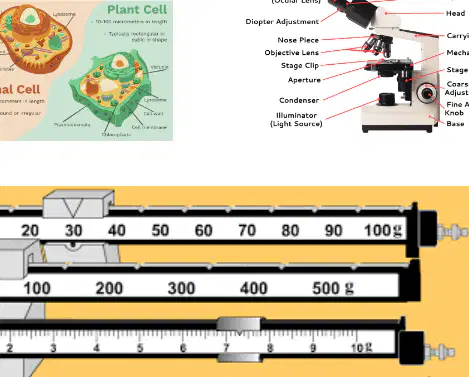
Which part of a triple beam balance is adjusted to achieve balance and determine the mass of an object?
The base
The riders
The pan
The pointer
When reading the volume of a liquid in a graduated cylinder, at which point should you read the measurement?
At the bottom of the meniscus
At the top of the meniscus
At any visible line
At the side of the cylinder
What is the correct way to use a meter stick to measure the length of an object?
Start measuring from any random point
Start measuring from the middle of the stick
Start measuring from the end of the stick, aligning with 0 cm
Start measuring from the 1 cm mark
Olivia and Ethan are conducting an experiment to see if plants grow faster with music. What is the first step they should take in the scientific method?
Make an observation and ask a question
Share their results
Analyze the data
Draw a conclusion
Grace and Mason want to test if sunlight affects how quickly ice melts. Which of the following is the best example of a hypothesis they could use?
Sunlight makes ice melt faster than shade
Ice is cold
Ice melts faster in the dark
Sunlight is bright
After collecting data from their experiment, what should Abigail and Liam do next according to the scientific method?
Draw a conclusion based on their results
Ask a new question
Make an observation
Form a hypothesis

