
 Worksheets
PT - Toe / Foot Injuries
Total questions: 18
Worksheet time: 9mins
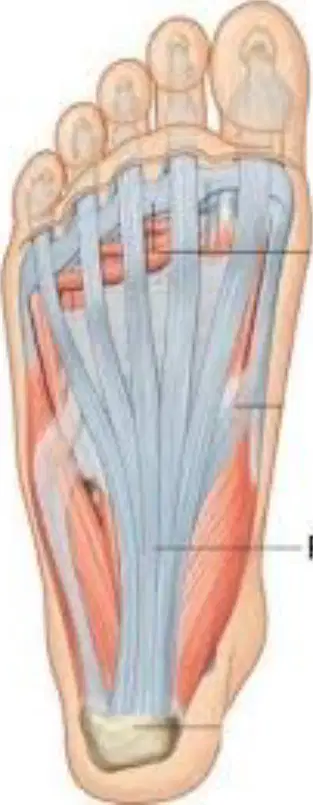
Fill in the blank: The ________ is a thick band of tissue on the bottom of the foot, as shown in the right diagram.
Plantar Fascia
Achilles Tendon
Patellar Ligament
Deltoid Muscle
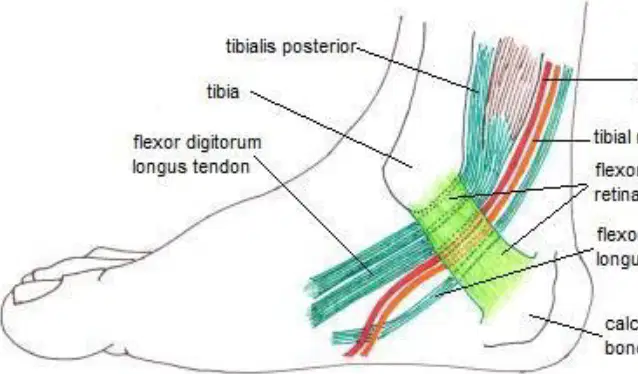
Fill in the blank: The ________ tunnel contains the tibial nerve, tibial artery, and flexor tendons, as shown in the left diagram.
Tarsal
Carpal
Inguinal
Femoral
What is a common mechanism of injury (MOI) for Plantar Fasciitis?
Overuse (chronic injury), poor shoes, poor walking mechanics
Direct trauma to the heel from a fall
Sudden twisting of the ankle
Infection of the plantar fascia
Which of the following is a sign or symptom (S/S) of Plantar Fasciitis?
Pain in the foot or heel, worse in the morning (first step out of bed)
Headache
Stomach pain
Blurred vision
The use of a night splint is a non-invasive treatment for plantar fasciitis as shown in the image.
True
False
What is Tarsal Tunnel Syndrome?
Ankle pain caused by a compressed (tibial) nerve.
A condition causing shoulder instability.
A disorder affecting the knee joint cartilage.
A fracture of the metatarsal bones.
What is the mechanism of injury (MOI) for Tarsal Tunnel Syndrome?
History of prior ankle injury (medial).
Direct trauma to the lateral malleolus.
Overuse of the Achilles tendon.
Fracture of the fifth metatarsal.
What are the signs and symptoms (S/S) of Tarsal Tunnel Syndrome?
Pain, numbness, and tingling at the base of the foot, weak toe flexion.
Swelling and redness over the Achilles tendon, difficulty walking uphill.
Sharp pain in the heel with first steps in the morning, visible heel spur.
Bruising and swelling around the ankle after a sudden twist.
What is the treatment for Tarsal Tunnel Syndrome?
Orthotics, anti-inflammatory treatment and medication.
Surgical removal of the tarsal bone.
Application of heat packs only.
Complete immobilization of the ankle joint.
What causes stress fractures?
Overuse causes small micro fractures.
Lack of calcium in the diet.
Sudden impact injuries only.
Genetic disorders.
Jones fracture involves which bone and what is usually required?
Fx of the 5th metatarsal, surgery required.
Fx of the 1st metatarsal, casting only.
Fx of the tibia, physical therapy required.
Fx of the fibula, no treatment needed.
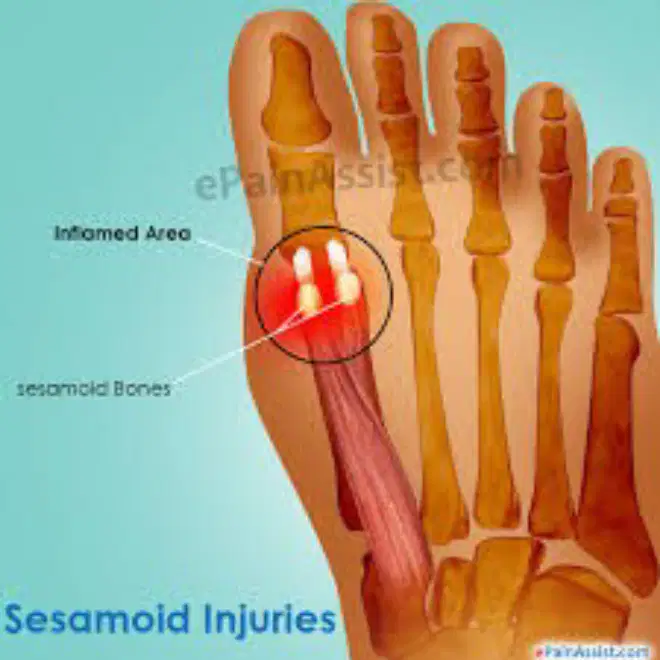
Fill in the blank: The small bones located under the big toe joint, as shown in the diagrams, are called ________ bones.
sesamoid
metatarsal
phalangeal
tarsal
What is the mechanism of injury (MOI) for a sprain?
Direct blow
Twist / Pivot motion
Overuse
Infection
Which of the following is a sign or symptom (S/S) of a sprain?
Pain and tenderness near arch of foot
Swelling
Inability to bear weight
All of the above
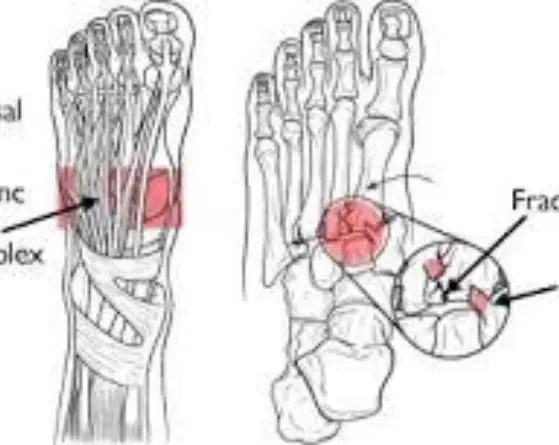
What is a Lisfranc injury?
Displacement of one or more of the metatarsal bones
Displacement of the femur
Displacement of the tibia
Displacement of the patella
What is Turf Toe?
Sprain of the big toe joint
Fracture of the ankle
Dislocation of the knee cap
Bruise on the heel
What is the mechanism of injury (MOI) for Turf Toe?
Excessive upward bending of the big toe joint caused from repetitive pushing off when running or jumping
Direct blow to the side of the foot
Twisting injury of the ankle
Falling directly on the heel
What are the signs and symptoms (S/S) of Turf Toe?
Pain, swelling and limited joint motion at the base of the big toe
Redness and itching between the toes
Numbness and tingling in the heel
Blisters on the sole of the foot

