
 Worksheets
2025 Environmental Science Fall Final Exam Review
Total questions: 57
Worksheet time: 29mins
What is the correct order of levels of ecological organization from smallest to largest?
population, ecosystem, biosphere, community, biome, individual
individual, ecosystem, population, community, biome, biosphere
biosphere, biome, community, ecosystem, individual, population
individual, population, community, ecosystem, biome, biosphere
This level of ecological organization defines a group of individuals of the same species living in a given area at a given time.
Community
Population
Ecosystem
Biome
Match the description to the level of ecological organization: Elephants interacting with gazelle and lions.
Community
Organism
Population
Ecosystem
Match the description to the level of ecological organization. A pack of elephants.
Population
Community
Ecosystem
Biosphere
Match the description to the level of ecological organization. All the living and nonliving things on earth.
Biosphere
Population
Community
Ecosystem
Match the description to the level of ecological organization. An elephant.
Individual/Organism
Population
Community
Ecosystem
Match the description to the level of ecological organization. Examples include boreal forest, grassland and desert.
Biome
Population
Community
Organism
Match the description to the level of ecological organization. Elephants, gazelles, lions, grasses, rainfall, soil, water and heat of the savannah.
Ecosystem
Population
Organism
Community
A civil engineering firm is trying to determine which type of landscaping is best to absorb water runoff from highways. They test four main landscaping types; native grasses, wildflowers, maple trees, and ferns. Each landscaping type is planted along a quarter-mile stretch of I-70 on the westside of Indianapolis. Five hours after a rainstorm, the remaining amount of standing water on the highway is measured. What is the dependent variable for this experiment?
The type of landscaping planted.
The amount of standing water remaining after a rainstorm.
The length of highway the landscaping is planted along.
The amount of cars driving on the highway.
A civil engineering firm is trying to determine which type of landscaping is best to absorb water runoff from highways. They test four main landscaping types; native grasses, wildflowers, maple trees, and ferns. Each landscaping type is planted along a quarter-mile stretch of I-70 on the westside of Indianapolis. Five hours after a rainstorm, the remaining amount of standing water on the highway is measured.
What is the independent variable for this experiment?
The type of landscaping planted.
The amount of standing water remaining after a rainstorm.
The length of highway the landscaping is planted along.
The amount of cars driving on the highway.
A civil engineering firm is trying to determine which type of landscaping is best to absorb water runoff from highways. They test four main landscaping types; native grasses, wildflowers, maple trees, and ferns. Each landscaping type is planted along a quarter-mile stretch of I-70 on the westside of Indianapolis. Five hours after a rainstorm, the remaining amount of standing water on the highway is measured.
What would be a reasonable control group for this experiment?
A quarter-mile stretch of undisturbed highway near the 4 test sites.
A quarter-mile stretch of undisturbed highway in a different city.
A half-mile stretch of highway with all 4 landscaping types combined together.
A grocery store parking lot.
Which ecosystem below would you expect to have high ecosystem resilience?
A field that is planted with one species of corn.
An arctic tundra that only has 50-60 days in its growing season.
A coral reef that thrives in a very small range of water temperatures.
A pond that supports many different species of algae.
Which action below would NOT lower an individual's carbon footprint?
Turning the air conditioning to a lower power setting when away from home.
Keeping a computer running all hours of the day to accumulate Bitcoin (aka cryptocurrency).
Taking a bus to work instead of a car.
Eating less meat and animal products.
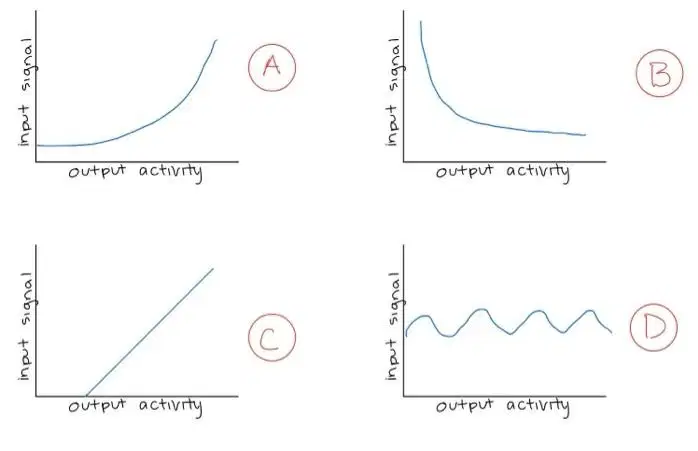
Match the following graph to this description: As global temperatures begin to rise, some regions experience increased cloud formation due to higher evaporation rates. These thicker, more reflective clouds bounce a larger portion of incoming solar radiation back into space. Because less sunlight reaches Earth's surface, temperatures in those regions cool slightly. This cooling reduces evaporation rates, which then leads to fewer reflective clouds forming. Over time, this cycle helps stabilize temperatures by counteracting the initial warming.
A
B
C
D
Biomes are defined by what two abiotic components?
precipitation and soil type
temperature and sunlight
temperature and precipitation
soil type and sunlight
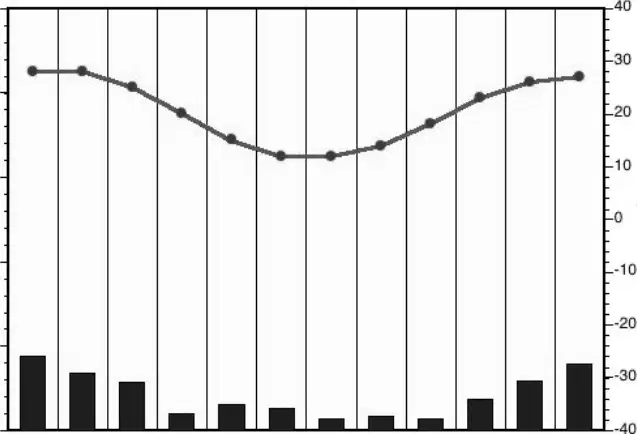
What hemisphere does the climatogram above represent?
Northern
Southern
Eastern
Western

The average temperature in the climatogram is 22.7 °C and the total precipitation is 25.2 cm. What biome does it represent?
Boreal Forest
Temperate seasonal forest
Tundra
Subtropical desert
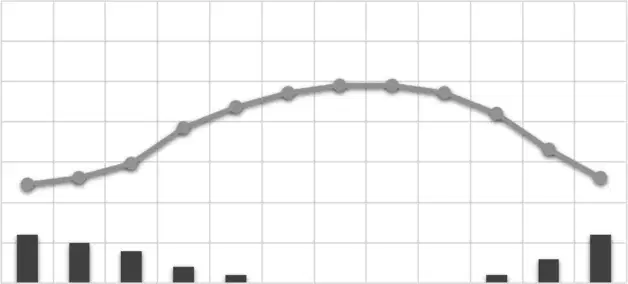
Which biome does this diagram most likely represent:
Desert
Rainforest
Shrubland
Tundra
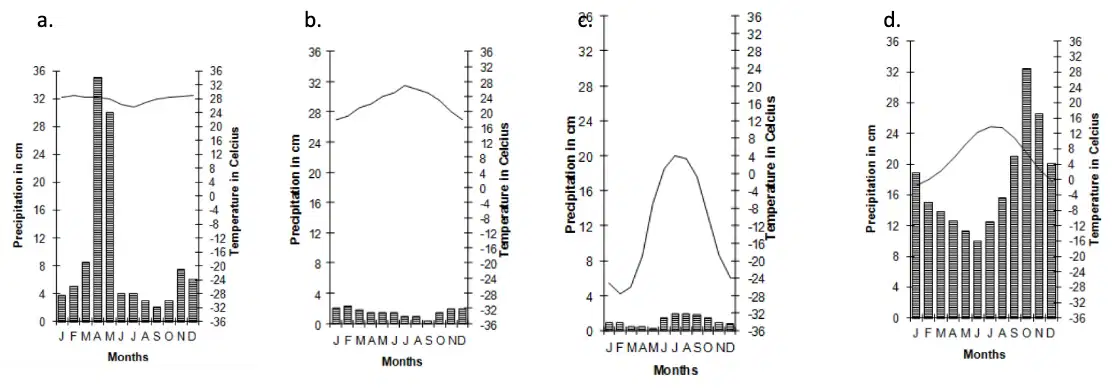
Which climatogram below is located in the southern hemisphere?
(Climatogram a)
(Climatogram b)
(Climatogram c)
(Climatogram d)
Match each natural disturbance with the correct description: Wildfires
Sudden shaking of the ground caused by movement of tectonic plates
A large rotating storm with strong winds and heavy rain forming over warm ocean waters
Intense heat and flames that often clears old biomass and triggers secondary succession
Molten rock, ash, and gases released from Earth’s interior
Match each natural disturbance with the correct description: Hurricanes
Sudden shaking of the ground caused by movement of tectonic plates
A large rotating storm with strong winds and heavy rain forming over warm ocean waters
Intense heat and flames that often clears old biomass and triggers secondary succession
Molten rock, ash, and gases released from Earth’s interior
Match each natural disturbance with the correct description: Earthquake
Sudden shaking of the ground caused by movement of tectonic plates
A large rotating storm with strong winds and heavy rain forming over warm ocean waters
Intense heat and flames that often clears old biomass and triggers secondary succession
Molten rock, ash, and gases released from Earth’s interior
Match each natural disturbance with the correct description: Volcanic Eruption
Sudden shaking of the ground caused by movement of tectonic plates
A large rotating storm with strong winds and heavy rain forming over warm ocean waters
Intense heat and flames that often clears old biomass and triggers secondary succession
Molten rock, ash, and gases released from Earth’s interior
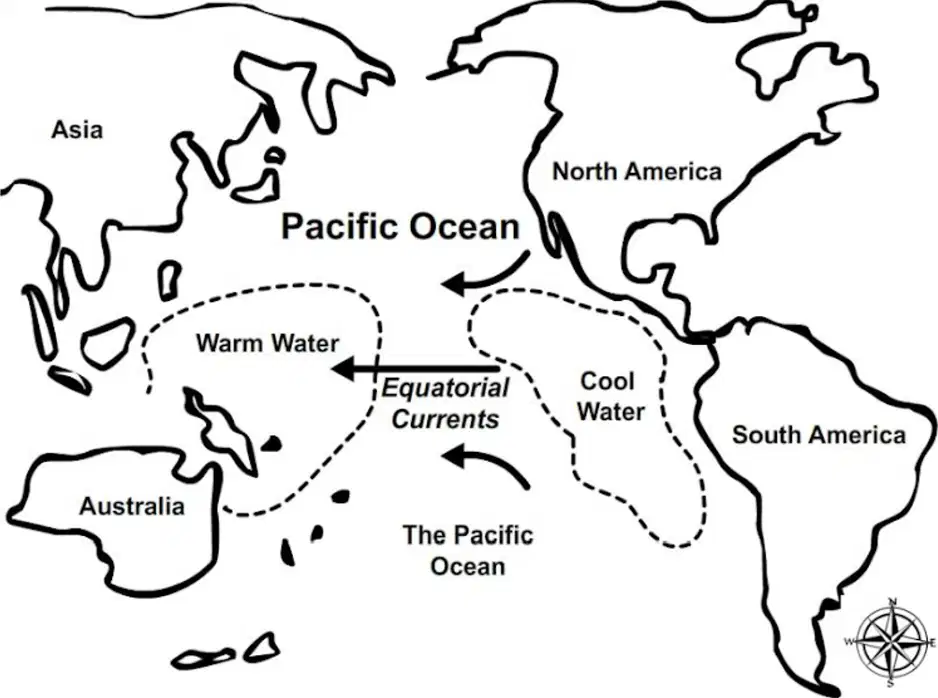
This diagram shows
El Niño Conditions
La Niña Conditions
Normal Conditions
None of the above
Which of the following is NOT true of an El Niño-Southern Oscillation (ENSO) event?
It causes increased upwelling on the coast of South America
It causes wetter conditions in the southern United States.
It can last for several weeks to several years
It includes a reversal in tropical ocean currents
It often begins near Christmas
High productivity and nutrient availability in the ocean occurs in areas with:
Gyres
Upwelling
Warm waters
El Niño
Dead zones are areas found in the oceans and some large lakes where there is not enough oxygen to support life. Algae blooms occur when excess nutrients, such as Nitrogen and Phosphorus are introduced as pollutants from fertilizers, sewage-treatment plants, and the burning of fossil fuels. When the algae die and undergo decay, bacteria rapidly use up the oxygen in the area. Which human activity would most likely result in a decrease in the size and number of dead zones?
Irrigating fields and lawns to increase runoff into the ocean and rivers
Reducing the use of chemical fertilizers on farm fields or golf courses
Building more coal fired power plants
Constructing more sewage-treatment plants on the shores of lakes and rivers.
Match each cycle with the correct description: Carbon Cycle
This cycle redistributes a substance essential for weathering rocks, forming sediments, and supporting long-term energy storage in ecosystems; it rarely enters the atmosphere.
This cycle involves the conversion of a gas into forms usable by living things, often requiring the help of specialized microorganisms.
This cycle moves a molecule that can change state (solid, liquid, gas) and plays a major role in shaping climate and transferring heat around the planet.
This cycle transfers an element that forms the backbone of organic molecules, moving through living organisms, dissolved materials, and long-term storage underground.
Match each cycle with the correct description: Nitrogen Cycle
This cycle redistributes a substance essential for weathering rocks, forming sediments, and supporting long-term energy storage in ecosystems; it rarely enters the atmosphere.
This cycle involves the conversion of a gas into forms usable by living things, often requiring the help of specialized microorganisms.
This cycle moves a molecule that can change state (solid, liquid, gas) and plays a major role in shaping climate and transferring heat around the planet.
This cycle transfers an element that forms the backbone of organic molecules, moving through living organisms, dissolved materials, and long-term storage underground.
Match each cycle with the correct description: Phosphorus Cycle
This cycle redistributes a substance essential for weathering rocks, forming sediments, and supporting long-term energy storage in ecosystems; it rarely enters the atmosphere.
This cycle involves the conversion of a gas into forms usable by living things, often requiring the help of specialized microorganisms.
This cycle moves a molecule that can change state (solid, liquid, gas) and plays a major role in shaping climate and transferring heat around the planet.
This cycle transfers an element that forms the backbone of organic molecules, moving through living organisms, dissolved materials, and long-term storage underground.
Match each cycle with the correct description: Water Cycle
This cycle redistributes a substance essential for weathering rocks, forming sediments, and supporting long-term energy storage in ecosystems; it rarely enters the atmosphere.
This cycle involves the conversion of a gas into forms usable by living things, often requiring the help of specialized microorganisms.
This cycle moves a molecule that can change state (solid, liquid, gas) and plays a major role in shaping climate and transferring heat around the planet.
This cycle transfers an element that forms the backbone of organic molecules, moving through living organisms, dissolved materials, and long-term storage underground.
The herring in this food chain are…
producers
primary consumers
secondary consumers
tertiary consumers
An organism that must get nutrients by eating other organisms is called a
Producer
Consumer
Decomposer
Nitrifying bacterium
The deer consumes only trees and grasses which makes it a _________________________.
Producer
Primary Consumer
Secondary Consumer
Decomposer
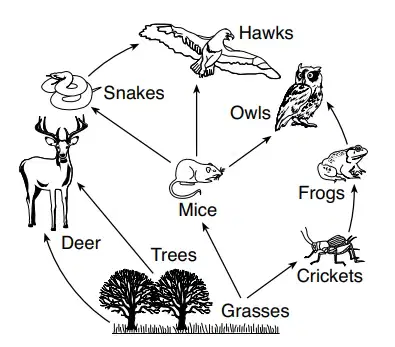
Which statement is TRUE based on the food web to the right?
Mice eat crickets and grasses.
Snakes eat hawks.
Hawks eat mice and snakes.
Owls are the only tertiary consumers in this food web.
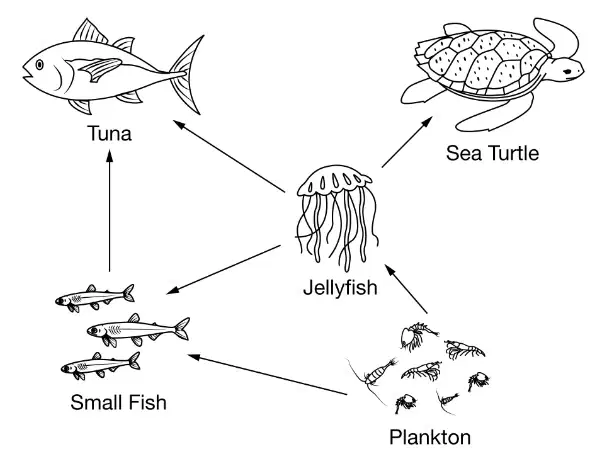
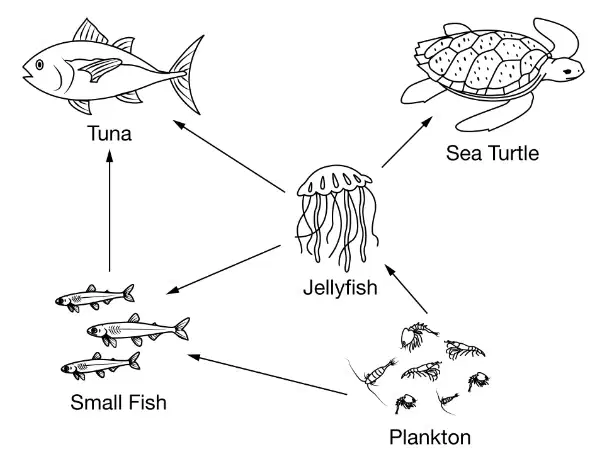
Based on the diagram, which of the following best describes the most likely direct effect of a decline of the small fish population on the marine food web?
The jellyfish population will increase because of decreased predation.
The jellyfish population will experience local extinction because of a lack of food resources.
The jellyfish population will migrate to an area with more available habitat for eggs.
The jellyfish population will decrease from the increase in the sea turtle and tuna populations.
Whales and barnacles live in a symbiotic relationship. Barnacles are provided with a free ride, access to plenty of food, and a stable place to live. There is no biological impact on the whale. What kind of symbiotic relationship do whales and barnacles maintain?
Mutualism
Commensalism
Parasitism
Predation
Which of the following is NOT a fossil fuel?
Coal
Nuclear
Oil
Natural Gas
Which fossil fuel is typically used to make fuel for vehicles?
Oil
Coal
Nuclear
Natural Gas
This type of fossil fuel is formed from the remains of trees, ferns, and other plant materials from prehistoric swamps. It is also the ‘dirtiest’ burning of fossil fuels when combusted.
Oil
Natural Gas
Coal
Uranium
Which of the following is an example of a carbon source?
Rainforest
Car exhaust
Ocean
Lake
Hydraulic fracturing, or fracking, is the pumping of highly pressurized water with a mixture of sand and chemicals into boreholes to…
pulverize the rock in order to let gas and oil rise through the soil
reopen old mine shafts, from which gas and oil can be collected
create artificial earthquakes to liberate gas and oil
Create cracks within the rock in order to provide pathways for the release of gas and oil
Tailings are most likely to be a concern when extracting which energy source?
Natural Gas
Uranium
Oil
Geothermal energy
Which of the following energy resources does not produce CO₂, but does produce radioactive waste that must be disposed of?
Wind
Biomass
Solar
Nuclear
Which of the following is considered an advantage of using nuclear power to generate electricity?
No waste is generated
There is no CO₂ emitted from the nuclear reaction.
There is a limitless supply of the raw material (uranium) needed for the process of generating energy.
Nuclear power plants are inexpensive to build and maintain
Which process below is the most energy efficient?
831 kWh output with a 900 kWh input
100 BTU output with 175 BTU input
89 kJ output with 375 kJ input
3 calories output with a 10 calorie input
The overall efficiency of most processes that convert an energy source to electricity is about 35%, the remaining 65% is lost to the surroundings as heat. This is a consequence of…
The law of limiting factors
The first law of thermodynamics
The second law of thermodynamics
The law of conservation of matter
For questions 48 - 52, match the type of renewable energy to its description. Each energy type will be used only once. 48. The source that is converted directly into electrical energy by photovoltaic cells.
c) Solar
a) Wind
b) Geothermal
d) Biomass
This type of renewable energy uses the kinetic energy of moving air to spin a turbine and generate electricity.
d) Wind
a) Solar
b) Geothermal
c) Biomass
For questions 48 - 52, match the type of renewable energy to its description. Each energy type will be used only once. 50. This type of renewable energy can be produced from corn, sugar cane, and even manure.
b) Biomass
a) Solar
c) Wind
d) Geothermal
For questions 48 - 52, match the type of renewable energy to its description. Each energy type will be used only once. 51. This type of renewable energy uses the kinetic energy of moving water to spin a turbine and generate electricity.
e) Hydroelectric
a) Solar
b) Geothermal
c) Biomass
This type of renewable energy is only viable at locations where magma is close to the surface of the earth.
a) Geothermal
b) Solar
c) Wind
d) Hydroelectric
Which of the following renewable energy resources is/are considered nondepletable?
I. Wind
II. Solar
III. Biomass
IV. Nuclear
I only
I and II only
I and III only
I, II, III, and IV
Why is biomass, which releases carbon dioxide when burned, considered carbon neutral and fossil fuels are not?
The carbon released from biomass was recently a part of the carbon cycle, while fossil fuels were not.
Countries ensure that all biomass use is recorded and trees are planted to counter the effects of burning that biomass.
The carbon dioxide released by biomass is less harmful than the carbon dioxide released from fossil fuels.
The use of biomass actually results in more carbon dioxide release than fossil fuels because the plants can no longer sequester carbon from the atmosphere.
What is the source of geothermal energy?
UVA and UVB sun rays.
Chemical energy stored in rocks.
Nuclear fission of Uranium-235
Radioactive decay of elements in the Earth's core.
What is NOT a major environmental impact of building dams?
Dams disrupt the migration of fish and other species.
Dams can flood surrounding ecosystems.
Dams release lots of carbon dioxide into the atmosphere.
Dams change the flow rate of rivers, causing stagnant waters and algae blooms.
Some solar energy systems produce high-temperature water for industrial applications and produce steam to run turbines that generate electricity. What type of solar energy system is needed for these kinds of applications?
A photovoltaic solar panel.
A passive solar system that uses building design to block summer sunlight
A passive solar system that uses building design to collect winter sunlight
A solar collector system using mirrors or lenses to concentrate sunlight

