
 Worksheets
Term 2 Final Review 2 - Momentum and Wave
Total questions: 56
Worksheet time: 1hrs 15mins
Calculate the impulse on the ball.

In order for an object to have momentum it must be ________
moving
motionless
alive
asleep
Momentum is represented with which letter?
b
m
v
p
If an object velocity is 0 m/s which of the is true.
The object has momentum
The object's momentum is changing
The object has NO momentum

What do all waves transfer?
Matter
Heat
Electricity
Energy

Which of the following can waves transfer energy through?
solid
liquid
gas
empty space
all of the above

What are the two types of waves?
longitudinal and transverse
sound and light

What is the number of complete waves passing a fixed point in a given amount of time?
Amplitude
Intensity
Wavelength
Frequency

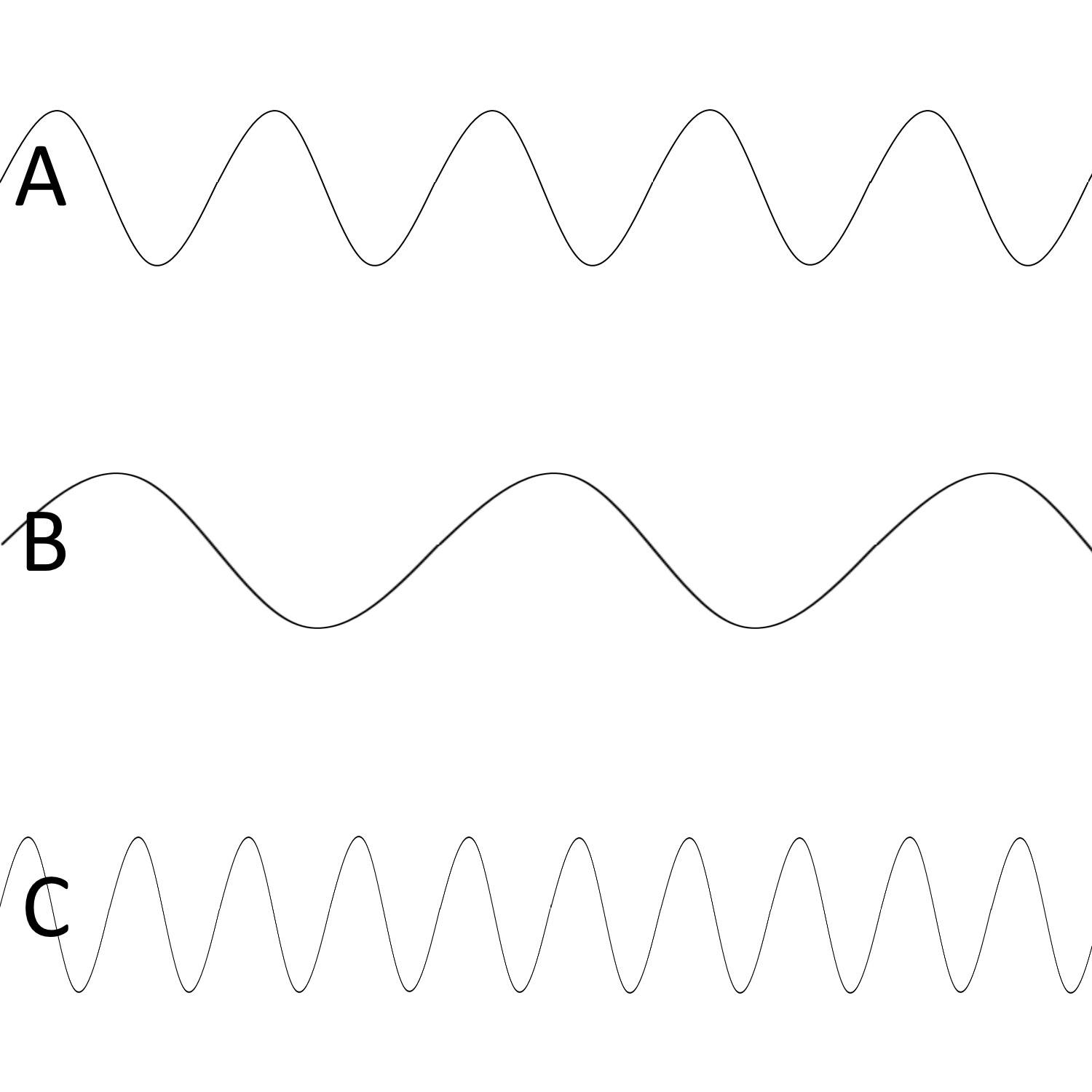
What is the frequency of this wave? You must count the number of complete waves.
1 Hz
5 Hz
10 Hz

What is frequency measured in?
Milliseconds
Miles
Hertz
Kilograms

Period of a wave refers to...
how long it takes for the event to repeat.
how strong a wave is.
how long a wave is.
how much energy a wave has.

Which type of waves have the longest wavelength?
Visible light
Radio waves
X-rays
Gamma-Rays

Wavelengths are usually measured in ....
seconds
Hz
inches
meters

Shorter wave lengths can carry more energy. Which of these probably carries the MOST energy:
Infrared light
Visible light
X-rays
UV light

What does #1 represent?
Period
Frequency
Wavelength
Amplitude

What does #2 represent?
Period
Frequency
Wavelength
Amplitude

What does #3 represent?
Period
Frequency
Wavelength
Amplitude
The lowest part of a transverse wave are the
crests
troughs
wave points
low nodules
The highest part of a transverse wave is
the crest
the trough
the wave point
the hotel transylvania
The distance between two corresponding parts of a wave is its
amplitude
frequency
wavelength
velocity
The height of the wave from its resting point is called its
wavelength
amplitude
velocity
frequency
A wave that needs a medium to travel is called a(n)
electromagnetic wave
mechanical wave
ocean wave
any way can do this
A wave that can travel with or without a medium is called a(n)
electromagnetic wave
mechanical wave
surface wave
all waves can travel in any way
Longitudinal waves have:
crests and troughs
crests and compressions
compressions and rarefactions
troughs and rarefactions
Transverse waves have:
crests and troughs
troughs and rarefactions
compressions and contractions
rarefactions and crests
True or False: Amplitude can increase or decrease wavelength
True, amplitude can increase or decrease wavelength
False, frequency can increase or decrease wavelength
False, crests can increase or decrease wavelength

What is the amplitude of this wave?
3
-3
6
4

What is the wavelength of this wave?
3
10
4
8
What happens to the frequency of a wave when the amplitude is tripled?
the frequency is tripled
the frequency is a third of what it was
amplitude does not affect frequency
What would happen to the wavelength if the frequency was doubled?
the wavelength would be halved
the wavelength would be doubled
the wavelength would stay the same
frequency does not affect wavelength
What would happen to the frequency is the wavelength was tripled?
the frequency would be a third of what it was
the frequency would be 3 times larger
the frequency would stay the same
the wavelength does not affect the frequency of a wave
What is the amplitude of this wave?
3
-3
6
4
What is the wavelength of this wave?
3
8
10
4


What type of waves do not require a medium to travel?
Sound
Mechanical
Electromagnetic
Longitudinal
What is different about the speed of sound waves vs. the speed of light?
sound waves are the FASTEST in solids (high density), while light waves are the FASTEST in gas (or no molecules)
sound waves are the FASTEST in gas (low density), while light waves are the FASTEST in solids
Both have the same speed all the time
Both are the FASTEST in the air or gas (low density)
If a satellite or spaceship explodes in outer space, you can see the explosion from a distance but you cannot hear it. Why?
Light waves travel very slow and sound waves travel much faster.
Sound waves transmit energy while light does not transmit energy.
Sound is a mechanical wave and needs a medium to travel through while light is an electromagnetic wave.
Light is a mechanical wave and needs a medium to travel through while sound is an electromagnetic wave.

Which image represents a longitudinal wave?
A
B

