
 Worksheets
Final Exam Review - Part III: Recognizing Sport Injuries
Total questions: 24
Worksheet time: 12mins
Define the term acute injury.
Injury caused by trauma such as getting hit by a pitch
Injury that develops slowly over time due to repetitive stress
A chronic condition that lasts for years
A psychological response to pain
Define the term dislocation.
At least one bone in a joint is forced completely out of its normal and proper alignment.
A muscle is stretched beyond its normal range of motion.
A ligament is partially torn due to excessive force.
A bone is fractured into two or more pieces.
Subluxations occur most often in which parts of the body?
Most commonly occur in the patella and shoulder, bone comes partially out of its normal articulation, but then goes right back into place
Most commonly occur in the wrist and ankle, bone comes partially out of its normal articulation, but then goes right back into place
Most commonly occur in the spine and hip, bone comes partially out of its normal articulation, but then goes right back into place
Most commonly occur in the elbow and fingers, bone comes partially out of its normal articulation, but then goes right back into place
Define the term chronic injury.
Results from overuse and occurs with repetitive dynamics of running, throwing, and/or jumping
Occurs suddenly due to a single traumatic event
Is always caused by genetic factors
Is only related to bone fractures
A cross country runner reports to the athletic training room complaining of pain in her Achilles tendon that feels achy and hurts when running and at rest. You advise the athlete that she should take 2 weeks off from actively running. The athlete ignores your advice and continues to run anyways. What is the athlete likely to develop in their Achilles tendon if they continue?
Tendinosis
Achilles rupture
Shin splints
Plantar fasciitis
Define the term contusion:
An Impact from an external force that causes soft tissue to be compressed against hard bone underneath
A break in the continuity of a bone
A stretching or tearing of ligaments
An infection of the skin and underlying tissues
What is the medical term for a “burner” or “stinger” injury?
Neuropraxia
Contusion
Sprain
Fracture
List the signs and symptoms of inflammation
Redness, swelling, warmth, pain, loss of function
Fever, chills, cough, headache, nausea
Itching, rash, sneezing, watery eyes, sore throat
Dizziness, fainting, blurred vision, chest pain, palpitations
An athlete was wrestling when he was being picked up and body slammed "being returned to the mat" his left arm, wrist, and hand was fully extended, and it absorbed the impact first. Athlete heard a pop in his left elbow and was in immediate sharp pain. Upon evaluation you could clearly see a deformity in the elbow joint. What is the likely injury?
Dislocation
Sprain
Fracture
Contusion
An offensive lineman is attempting to block the defensive lineman in front of him. The defensive linemen attempts a maneuver to get by him and the offensive linemen's right arm and shoulder are forced back behind him as the linemen blows by and sacks the quarterback. The offensive linemen complains of numbness, tingling, and burning along his shoulder and arm and into his fingers. What injury is the offensive linemen likely to have sustained?
Could have been a burner/stinger, neuritis
Rotator cuff tear
Ulnar collateral ligament sprain
Biceps tendon rupture
Where are myofascial trigger points most likely to occur in the body?
Upper back
Feet
Forearm
Abdomen
What is the difference between a strain and a sprain?
Sprain is to a ligament and strain is to a muscle.
Sprain is to a muscle and strain is to a ligament.
Sprain and strain are both injuries to bones.
Sprain and strain are both types of fractures.
What are the indications of a grade 3 ligament sprain?
Complete instability of the joint and separation of the ligament and nerve fibers.
Mild pain and slight swelling with minimal loss of function.
Partial tearing of the ligament with moderate joint instability.
No visible signs and full range of motion.
Delayed onset muscle soreness goes away approximately how long after it sets in?
Between 72-96 hrs.
Within 12 hours.
After 1 week.
After 24 hours.
The most common grade 3 muscle strain occurs to which muscles?
Achilles Tendon
Hamstring
Quadriceps
Biceps
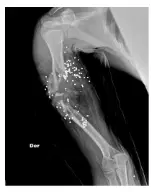
Identify the type of fracture below:
Comminuted fx
Greenstick fx
Transverse fx
Oblique fx
What are the 5 main categories of nutrients on My Plate?
Fruits, Vegetables, Grains, Protein, Dairy
Fruits, Vegetables, Oils, Sweets, Dairy
Grains, Protein, Dairy, Fats, Sugars
Vegetables, Fruits, Meats, Sweets, Dairy
What are the 6 types of nutrition?
Protein, Carbs, Fats, Vitamins, Minerals, Water
Protein, Carbs, Fats, Fiber, Sugar, Water
Protein, Carbs, Fats, Vitamins, Fiber, Water
Protein, Carbs, Fats, Minerals, Fiber, Water
What are the three major types of eating disorders?
Anorexia, Bulimia, Binge Eating
Obesity, Diabetes, Hypertension
Anorexia, Orthorexia, Pica
Bulimia, Pica, Diabetes
Could an unhealthy diet increase blood pressure?
Yes
No
One way nutrition can impact sports performance is:
by providing energy for physical activity
by increasing the size of sports equipment
by changing the rules of the game
by making uniforms more comfortable
Why is water important for your diet?
It makes up about 70% of your body weight.
It provides most of your daily vitamins.
It is the main source of carbohydrates.
It helps your body produce hormones.
Define anorexia?
an eating disorder that involves severe calorie restriction and often a very low body weight. It causes a fear of gaining weight and a distorted body image.
a type of exercise that helps build muscle mass.
a vitamin deficiency that leads to hair loss.
a digestive disorder that causes frequent heartburn.
What is protein and why does your body need it?
a vital macronutrient made of amino acids, essential for building/repairing tissues (muscles, bones, skin), creating enzymes/hormones, and supporting immunity
a type of carbohydrate that provides quick energy for the body
a mineral that helps in bone formation and nerve function
a vitamin responsible for vision and skin health

