wayground logo

Free Printable Worksheets

NEW

Font size

S
M
L
XL
Worksheets

Semester Test Review- Earth and Physical Science

Total questions: 62

Worksheet time: 37mins
Name
Class
Date
1.
The theory of plate tectonics states that:
a)
The Earth’s plates are stationary
b)
The Earth’s plates move slowly over the mantle
c)
Volcanoes form only in the middle of continents
d)
Earthquakes only happen underwater
2.
Which type of plate boundary occurs when two plates move away from each other?
a)
Convergent
b)
Transform
c)
Divergent
d)
Subduction
3.
At a convergent boundary, what often forms?
a)
Mid-ocean ridges
b)
Large plains
c)
Rift valleys
d)
Mountains and volcanoes
4.
Which type of rock forms from cooling and solidification of magma or lava?
a)
Igneous
b)
Sedimentary
c)
Metamorphic
d)
Fossil
5.
Why do earthquakes most often occur along plate boundaries?
a)
Plates move past, collide with, or pull away from each other, causing stress to build up and release
b)
Earth’s core is extremely hot
c)
Weathering breaks rocks apart
d)
Volcanoes form only at boundaries
6.
Which type of rock forms when sediments are pressed and cemented together?
a)
Igneous
b)
Metamorphic
c)
Sedimentary
d)
Mineral
7.
Why is there a chain of islands like Hawaii in the middle of the Pacific Plate?
a)
The Pacific Plate is breaking apart
b)
A hot spot in the mantle stays in one place while the plate moves over it
c)
Two plates are colliding under the ocean
d)
Earthquakes push land upward
8.
Why did the Mariana Trench form?
a)
Two oceanic plates are moving away from each other
b)
A hot spot melted the crust
c)
Sediment built up over time
d)
One oceanic plate is subducting beneath another plate at a convergent boundary
9.
Which type of rock forms when heat and pressure change existing rocks?
a)
Igneous
b)
Sedimentary
c)
Metamorphic
d)
Fossil
10.
The Ring of Fire is located around which ocean?
a)
Atlantic Ocean
b)
Pacific Ocean
c)
Indian Ocean
d)
Arctic Ocean
11.
The supercontinent that existed millions of years ago is called:
a)
Eurasia
b)
Pangea
c)
Gondwana
d)
Laurasia
12.
Minerals are naturally occurring, inorganic, solid substances with:
a)
A definite shape only
b)
A crystalline structure
c)
No chemical formula
d)
Only metallic properties
13.
Which process changes igneous rock into sedimentary rock?
a)
Heat and pressure
b)
Melting and cooling
c)
Weathering and erosion
d)
Folding and faulting
14.
What happens when a bath bomb is placed in water?
a)
A physical change only occurs because the bath bomb dissolves.
b)
A chemical change occurs because gas is produced and new substances form.
c)
The water changes state from liquid to solid.
d)
The bath bomb becomes a solid.
15.
You pour oil and water into a cup and notice they do not mix. This is an example of a:
a)
Chemical change
b)
Physical property
c)
Chemical property
d)
Flammability
16.
Why is a closed system important in experiments?
a)
It lets substances escape
b)
It keeps matter from entering or leaving
c)
It increases density
d)
It causes chemical changes
17.
Which is a chemical property of matter?
a)
Density
b)
Color
c)
Flammability
d)
Shape
18.
True or False: Mass and Weight are the same thing.
a)
True
b)
False
19.
Which of the following best describes matter?
a)
Anything that can be seen with the naked eye
b)
Anything that has mass and takes up space
c)
Anything that produces light
d)
Anything that moves
20.
Which example best represents a closed system?
a)
An open pot of boiling water
b)
A sealed jar of soda
c)
A lake exposed to air
d)
A tree growing in the forest
21.
The Law of Conservation of Mass states:
a)
Energy cannot be created nor destroyed, it can only change form.
b)
Mass cannot be created nor destroyed, it can only change form.
c)
Mass can be created or destroyed, it cannot change form.
22.
During a chemical reaction, the total number of each type of atom:
a)
Increases
b)
Decreases
c)
Remains the same
d)
Doubles
23.
If something floats in water, it is ______ dense than water.
a)
more
b)
less
c)
equally
24.
Which property measures how much matter is in a certain space?
a)
solubility
b)
weight
c)
length
d)
density
25.
Density can be found using the following formula: d=m/v where d is density, m is mass, and v is volume. If a substance has a mass of 12g and a volume of 3 cm cubed, what is it's density?
a)
2 g/cm
b)
4 g/cm
c)
8 g/cm
d)
12 g/cm
26.
Which statement best describes a physical change in matter?
a)
A change that creates a completely new substance with different properties
b)
A change in the form or appearance of a substance without changing what it is made of
c)
A reaction that produces gas, light, or heat
d)
A process in which atoms combine to form new molecules
27.
Which statement best describes a chemical change?
a)
A change that only affects the size or shape of a substance
b)
A change in state, such as melting or freezing
c)
A change that creates one or more new substances with new properties
d)
A change that can always be easily reversed
28.
Physical or Chemical Change? Ice cubes melting in a drink of water.
a)
Physical Change
b)
Chemical Change
29.
Physical or Chemical Change? Shredding paper.
a)
Physical Change
b)
Chemical Change
30.
Physical or Chemical Change? Hydrogen Peroxide and Potassium Iodide mixed together. (ingredients in Elephant toothpaste)
a)
Physical Change
b)
Chemical Change
31.
Physical or Chemical Change? Chopping vegetables.
a)
Physical Change
b)
Chemical Change
32.
Physical or Chemical Change? Toast browning in a toaster.
a)
Physical Change
b)
Chemical Change
33.
Physical or Chemical Change? Fireworks exploding.
a)
Physical Change
b)
Chemical Change
34.
Physical or Chemical Change? A copper-colored penny is heated with zinc and turns silver (and later gold-colored when heated again).
a)
Physical Change
b)
Chemical Change
35.
Physical or Chemical Change? Water boiling and becoming steam/water vapor.
a)
Physical Change
b)
Chemical Change
36.
_____________ are the building blocks of all matter. They are the smallest basic units of matter that still have the properties of an element.
a)
Molecules
b)
Cells
c)
Compounds
d)
Atoms
37.
___________ are two or more atoms that are chemically bonded together and act as a single unit.
a)
molecules
b)
protons
c)
mixtures
d)
cells
38.
What coefficient should be used, on the product side, to balance this equation? N₂ + O₂ → NO
a)
1
b)
2
c)
4
d)
it is already balanced
39.
How many total atoms are in Al₂O₃?
a)
5
b)
1
c)
2
d)
3
e)
4
40.
How many atoms are in 2H₂O?
a)
6
b)
1
c)
2
d)
3
e)
4
41.
Is the following equation balanced? Ca + O₂ → CaO
a)
Yes, it is balanced
b)
No
42.
Which statement best explains why this equation is not balanced? Al + O₂ → Al₂O₃
a)
There are more aluminum atoms on the left (reactant side)
b)
There are more aluminum atoms on the right (product side)
c)
There are more oxygen atoms on the left (reactant side)
d)
There are equal numbers of atoms on both sides
43.
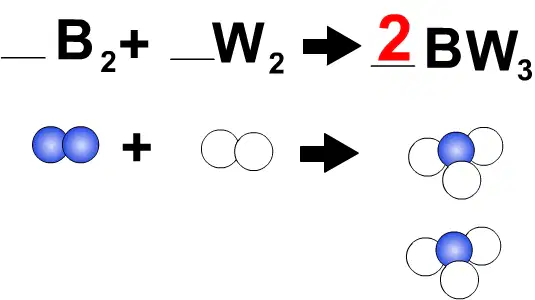
Is this chemical equation balanced?
a)
yes
b)
no
44.
How many oxygen atoms are in 3 molecules of CO₂?
a)
2
b)
3
c)
6
d)
9
45.
Carbon has a mass of 12 amu and oxygen has a mass of 16 amu. (amu= atomic mass unit) What is the total mass of one molecule of carbon monoxide (CO)?
a)
12 amu
b)
16 amu
c)
28 amu
d)
44 amu
46.

The Ring of Fire is an area where a large number of earthquakes and volcanic eruptions occur. What claim can be made about the Ring of Fire from this information?

a)

It is the only place on Earth where earthquakes can happen.

b)

The edges of the tectonic plates are moving in this area.

c)

It represents the areas where tectonic plates are the thickest.

d)

It has been getting larger since Earth first formed.

47.
What is Magma when it reaches the surface of Earth?
a)
Lava
b)
Mafic Magma
c)
Felsic Magma
d)
None of these
48.
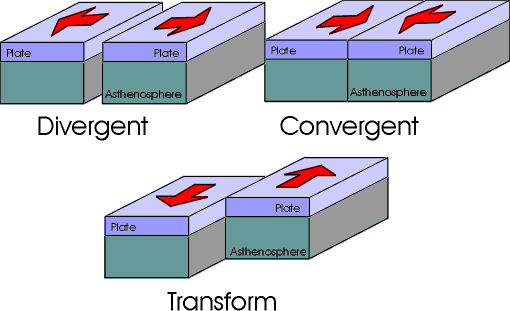
The diagram below shows a model of the movement of two tectonic plates.  When the plates collide, one plate often moves below the other plate.  The rising magma that can result from this type of plate movement may produce – 
a)
Seafloor spreading
b)
Deep-sea sediment
c)
Volcanic islands
d)
Fossil layers
49.
This rock started as molten magma. What type of rock is this?
a)
Sedimentary
b)
Igneous
c)
Metamorphic
50.

Which type of rock is formed when layers of sediment are compacted and cemented together?

a)

Metamorphic Rock

b)

Sedimentary Rock

c)

Igneous Rock

d)

Quartz

51.
Something that takes up space and has mass.
a)
volume
b)
matter
c)
mass
d)
density
52.

A physical property can be observed with your

a)
Eyes
b)
Ears
c)
Tastes
d)
All of the above
53.
The model below shows two continental   plates.  The folded mountains in this   model form at which type of plate   boundary?
a)
Divergent boundary
b)
Convergent boundary
c)
Transform boundary
d)
Subduction boundary
54.

The process by which the ocean floor sinks beneath a deep-ocean trench and back into the mantle is known as _______

a)

convection.

b)

continental drift.

c)

subduction.

d)

conduction.

55.
____________ is the theory that the lithosphere is divided into plates that are always moving.
a)
Plate tectonics
b)
Mid-Ocean ridge
c)
Divergent
d)
Fault
56.
The San Andrea's Fault in California is which type of boundary?
a)
Convergent
b)
Divergent
c)
Subductive Zone
d)
Transform
57.

Which process is an example of a chemical change?

a)

Breaking glass

b)

Melting ice

c)

Dissolving sugar in water

d)

Burning wood

58.

What is the main difference between igneous and sedimentary rocks?

a)

Igneous rocks contain fossils, while sedimentary rocks do not

b)

Igneous rocks form from cooling magma, while sedimentary rocks form from compacted sediments

c)

Igneous rocks are always soft, while sedimentary rocks are always hard

d)

Sedimentary rocks form from lava, while igneous rocks form from sediments

59.

Which statement best describes the law of conservation of mass in a chemical reaction?

a)

The total mass of reactants equals the total mass of products

b)

Mass is destroyed during a chemical reaction

c)

The mass of products is always greater than the mass of reactants

d)

Mass is created during a chemical reaction

60.

Which scale is commonly used to measure the magnitude of earthquakes?

a)

Beaufort scale

b)

Fahrenheit scale

c)

Decibel scale

d)

Richter scale

61.

What is the main cause of most earthquakes?

a)

Human activities

b)

Heavy rainfall

c)

Movement of tectonic plates

d)

Volcanic eruptions

62.

True or False: Earthquakes can occur under the ocean as well as on land.

a)

False

b)

True