
 Worksheets
Biology Midterm
Total questions: 114
Worksheet time: 57mins
Name
Class
Date
1.
All of the following pieces of equipment EXCEPT for _____________ could be useful for transferring a liquid from one container to another.
a)
beaker
b)
funnel
c)
petri dish
d)
graduated cylinder
2.
Micah needs 25 mL of motor oil to test his combustion engine. Which tool would give him the most precise measurement?
a)
Beaker
b)
Flask
c)
Test tube
d)
Graduated cylinder
3.
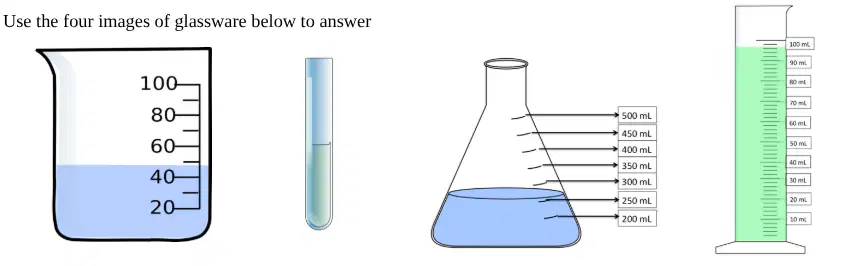
Which of the following measurements is the most accurate?
a)
Graduated cylinder - 80.6 mL
b)
Erlenmeyer flask – 325 mL
c)
Beaker – 48 mL
d)
Beaker – 400 mL
4.
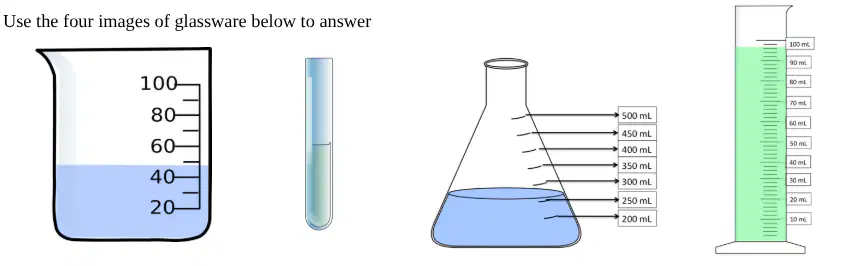
Which of the following measurements is the most precise?
a)
Graduated cylinder - 80.6 mL
b)
Erlenmeyer flask – 325 mL
c)
Beaker – 48 mL
d)
Beaker – 400 mL
5.
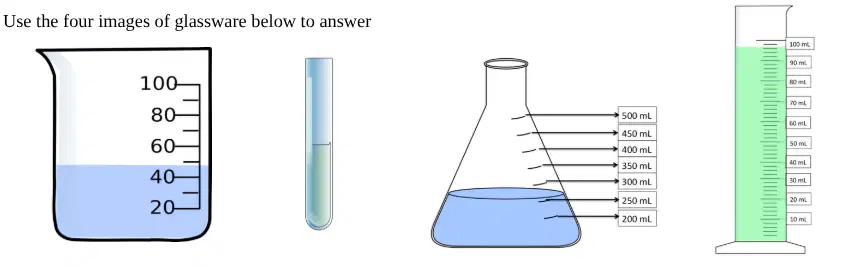
Which piece of glassware is never used for taking measurements?
a)
Graduated cylinder
b)
Beaker
c)
Test Tube
d)
Erlenmeyer flask
6.
When leaving a movie theater, a person notices that the sidewalk is now wet. If the person assumes it rained during the movie, the person is making ______.
a)
a hypothesis.
b)
an inference.
c)
an observation.
d)
a prediction.
7.
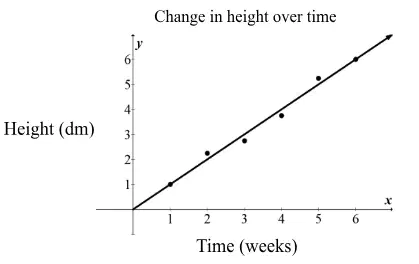
Alexander was studying the effect of playing rock music on plant growth. One of the plants was exposed to rock music for 24 hours a day for a period of 6 weeks. Data on the growth of the plant was collected at the end of each week and plotted in a graph. Based on the data, which would be the MOST reasonable measurement at the end of an 8 week period?
a)
2 dm
b)
6 dm
c)
8 dm
d)
16 dm
8.
When designing an experiment, scientists will test a relationship between a "cause" and an "effect." The "effect," also represented by what the scientist measures and records, is known as the ______.
a)
dependent variable
b)
constant
c)
independent variable
d)
control group
9.

In this experiment, the independent variable they are testing is ______________.
a)
a change in the mass of the eggs.
b)
the ending mass of the eggs.
c)
the amount of time they were in the solution.
d)
the type of solution the egg is placed in.
10.

This group also recorded a dependent variable, which is represented by ________.
a)
a change in the mass of the eggs.
b)
the ending mass of the eggs.
c)
the amount of time they were in the solution.
d)
the type of solution the egg is placed in.
11.

Based on the data this group gathered, the most appropriate hypothesis would be _________.
a)
"If an egg is placed in corn syrup, then it will gain weight."
b)
"If an egg is placed in vinegar overnight, then its shell will dissolve."
c)
"If three eggs are each placed in three different solutions, then the egg in distilled water will lose weight."
d)
"If an egg is placed in a pure water solution, then the egg will gain weight."
12.
Ada and Elijah have decided to do an experiment testing how sunlight affects plant growth. The students choose the same type of plants, soil, pots and amount of water they give the plants. They also make sure each plant is put in their designated area for the same amount of time each day. One plant is placed outside; one in front of a window that only gets light for 1/2 the day, and one in a closet. The students collect data every day for two weeks. Their results show that the plant outside grew the most and the plant in the closet had the least amount of growth.
What are the constant variables that Ada and Elijah used in their experiment?
a)
type of plants
b)
type of soil
c)
the amount of light
d)
the type of plants and the type of soil
13.
In a hypothesis the _______ variable is what is being tested, while the _______ variable is the one being measured in response.
a)
control; dependent
b)
independent; control
c)
dependent; independent
d)
independent; dependent
14.
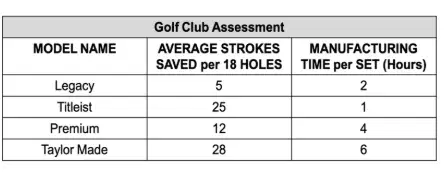
A golf club company has four models of golf clubs. Average strokes saved per 18 holes is a positive indicator of quality (the more strokes saved, the better the golf clubs). The manufacturing time per set is a measure of how long it takes to manufacture one set of clubs. If the company wishes to produce a lot of golf clubs quickly, which set would be the best choice to meet their criteria, based on the data table?
a)
Legacy
b)
Titleist
c)
Premium
d)
Taylor Made
15.
What must be considered when designing a solution for a problem with technology?
a)
Cost
b)
Time
c)
Materials
d)
Cost, Time, and Materials
16.
Which of the following terms represents the smallest part of an element that still has the properties of that element?
a)
cell
b)
matter
c)
atom
d)
molecule
17.
Life can exist under frozen surfaces in polar seas because _________.
a)
water is less dense as a solid.
b)
water is a terrific solvent.
c)
water has a high surface tension.
d)
water has a high specific heat.
18.
When placed in water, oil does not dissolve and stays separate. This means oil is _____ and ______.
a)
hydrophilic and polar
b)
hydrophilic and nonpolar
c)
hydrophobic and polar
d)
hydrophobic and nonpolar
19.
The macromolecules that make up the majority of the cell membrane's structure are ____________.
a)
lipids
b)
proteins
c)
enzymes
d)
carbohydrates
20.
Which category of carbon-based molecules includes sugars and starches?
a)
unsaturated fatty acids
b)
proteins
c)
enzymes
d)
carbohydrates
21.
The macromolecules that would most likely be involved in contracting muscles would be ______.
a)
lipids
b)
proteins
c)
enzymes
d)
carbohydrates
22.
Animals store most of their excess energy reserves as _____ because _______,
a)
glucose; it is easy to break down.
b)
fat; they store twice as much energy per gram.
c)
protein; it is a compact source of energy in their bodies.
d)
carbohydrates; they store twice as much energy per gram of glucose.
23.
We obtain all of the macromolecules from the food that we eat except for _______.
a)
carbohydrates
b)
proteins
c)
lipids
d)
nucleic acids
24.
Which of the following is found in a eukaryotic cell, it is not found in a prokaryotic cell?
a)
cytoplasm
b)
cell membrane
c)
nucleus
d)
flagella
25.
Which plant cell organelle uses light energy to produce sugar?
a)
chloroplast
b)
mitochondria
c)
nucleus
d)
ribosome
26.
Which of the following organelles would you not find in a plant cell?
a)
chloroplast
b)
centrioles
c)
central vacuole
d)
cell wall
27.
Which principle of cell theory best supports the idea that new cells will replace damaged cells in a scraped knee?
a)
All living things are made of one or more cells.
b)
Cells are the basic unit of life.
c)
All cells come from other cells.
d)
The nucleus of cells in animals reproduces when exposed to air.
28.
Which of the following serves as the cell's boundary from its environment and controls what goes in and out of the cell?
a)
mitochondria
b)
cell membrane
c)
chloroplast
d)
golgi apparatus
29.
Which characteristic is not common to both prokaryotic cells and eukaryotic cells?
a)
genetic material
b)
cell membrane
c)
cytoplasm
d)
multicellular organisms
30.
Cells often store materials like water, salts, proteins, and carbohydrates in sac-like structures called ______.
a)
chloroplasts
b)
lysosomes
c)
mitochondria
d)
vacuoles
31.
According to cell theory, _________.
a)
all multicellular organisms are composed of prokaryotic cells.
b)
only cells like the eukaryote can carry out the functions of life.
c)
single celled organisms are only capable of asexual reproduction.
d)
even primitive cells, like the prokaryote, can carry out the functions of life.
32.
In a hypotonic solution, water will move ____ the cell, causing the cell to ______.
a)
into; shrivel
b)
out of; lyse/swell
c)
out of; shrivel
d)
into; lyse/swell
33.
What type of cellular transport requires a cell to use energy?
a)
facilitated diffusion
b)
active transport
c)
diffusion
d)
osmosis
34.
If an animal cell were placed in a solution of salt water taken from the ocean, what would happen to the cell?
a)
The cell would swell because the water solution is hypotonic.
b)
The cell would swell because the water solution is hypertonic.
c)
The cell would shrivel because the water solution is hypotonic.
d)
The cell would shrivel because the water solution is hypertonic.
35.
Which of the following best describes an isotonic solution?
a)
There is more solute outside the cell than inside the cell.
b)
There is less solute outside the cell than inside the cell.
c)
The concentration is equal on both sides of the membrane.
d)
None of the options.
36.
This process occurs when the cell uses energy to bring something in from outside the cell.
a)
endocytosis
b)
exocytosis
c)
osmosis
d)
diffusion
37.
Which level of organization is represented by a group of different tissues working together to perform a complex function?
a)
cell
b)
tissue
c)
organ
d)
organism
38.
Which of the following is an example of internal regulation during the cell cycle?
a)
A gap outside of the cell (caused by skateboarding accident) triggers cell division.
b)
A cell receives a signal from the cell's own nucleus to divide.
c)
Tumor cells continue to divide without receiving a signal.
d)
Hormones in the blood cause cell growth in a growing teenager.
39.
Organize the parts of this body system in the CORRECT order (starting with the organism level) according to the levels of organization in a multicellular organism.
a)
human being -> central nervous system -> brain -> nerve tissue -> neurons (brain cell)
b)
human being -> neurons (brain cell) -> brain -> central nervous system -> nerve tissue
c)
human being -> central nervous system -> neurons (brain cell) -> nerve tissue -> brain
d)
human being -> brain -> central nervous system -> nerve tissue -> neurons (brain cell)
40.
Which of the following is true of malignant tumors?
a)
They do not require treatment.
b)
They are easily removed through surgery.
c)
They can cause tumors in other parts of the body.
d)
They contain cells that stay clustered together.
41.
If a cell has 8 chromosomes, how many chromosomes will each of its daughter cells have after mitosis?
a)
4
b)
6
c)
8
d)
16
42.
During interphase, a cell grows, duplicates organelles, and _____.
a)
divides the nucleus
b)
doubles its DNA
c)
divides the cytoplasm
d)
produces a new cell
43.
Which organelle is critical for cell division?
a)
centrioles
b)
cilia
c)
vacuoles
d)
vesicles
44.
Why is it important for cells of multicellular organisms to undergo mitosis?
a)
Mitosis allows for reproduction with male and female gametes.
b)
Mitosis increases variation within an organism.
c)
Mitosis produces cells that are different from the original dividing cell.
d)
Mitosis produces cells that are identical to the original dividing cell.
45.
By the end of prophase, all of the following has occurred EXCEPT ________.
a)
The nuclear membrane has broken down.
b)
centrioles and spindle fibers have appeared.
c)
chromosomes have lined up in the middle of the cell.
d)
DNA has become more tightly coiled into rod-shaped structures.
46.
What makes stem cells different from other cells in the body?
a)
They are larger than other cells, and can absorb broken cells to repair them.
b)
They repair cells by breaking open and making their cell parts available for absorption into other cells.
c)
They are undifferentiated cells that can turn into a number of different kinds of cells as needed.
d)
They are cells that grow uncontrollably.
47.
Substances known to produce or promote cancer are called _______.
a)
carcinogens
b)
kinases
c)
cyclins
d)
malignancies
48.
One difference between a cancer cell and a normal cell is that ____________.
a)
Cancer cells divide uncontrollably.
b)
Normal cells divide uncontrollably.
c)
Cancer cells cannot make copies of DNA.
d)
Normal cells cannot make copies of DNA.
49.
Research has shown that uncontrolled cell growth and development can lead to which of these diseases?
a)
AIDS
b)
Cancer
c)
Hemophilia
d)
Down Syndrome
50.
While in the womb, the webbed fingers of the embryo undergo programmed cell death, also known as _____.
a)
apoptosis
b)
cytokinesis
c)
carcinogen
d)
stem cells
51.
Which phrase best describes an exothermic chemical reaction?
a)
Does not absorb energy.
b)
Forms products with higher bond energy than reactants.
c)
Is in a state of equilibrium.
d)
Releases more energy than it absorbs.
52.
Identify the products in this reaction: 6H2O + 6CO2 🡪 C6H12O6 + 6O2.
a)
6H2O and 6CO2
b)
6CO2 and C6H12O6
c)
6H2O, C6H12O6, and 6O2
d)
C6H12O6 and 6O2
53.
Chemical reactions that absorb more energy than they release are considered to be _______.
a)
exothermic
b)
catalyzed
c)
endothermic
d)
anabolic
54.
The activation energy needed for a chemical reaction is decreased by the presence of a ________.
a)
catalyst
b)
reactant
c)
product
d)
substrate
55.
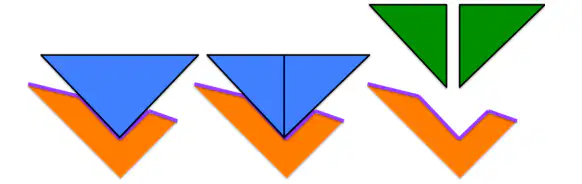
In the enzyme-substrate complex pictured below, what is happening during the second picture?
a)
The catalyzed reaction is releasing a product.
b)
The enzyme is breaking bonds in the substrate.
c)
The enzyme is keeping the bonds the same in the substrate.
d)
The substrate is beginning to bind to the enzyme.
56.
If the activation energy of a biochemical reaction is lowered, then ______.
a)
the reaction will happen faster.
b)
the reaction will happen more slowly.
c)
more energy will need to be absorbed.
d)
the rate of the reaction will be uneffected.
57.
The molecule that an enzyme binds to is known as its _______.
a)
substrate
b)
monomer
c)
polymer
d)
complimentary base
58.
Reactants bind to enzymes at the _______.
a)
substrate
b)
product
c)
activation energy
d)
active site
59.
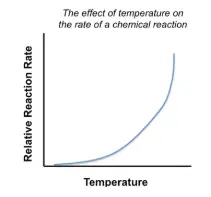
In the graph below, an increase in temperature results in ______.
a)
a decrease in the required activation energy.
b)
an increase in reaction rate.
c)
a decrease in the reaction rate.
d)
an increase in both the reaction rate and activation energy.
60.
Which macromolecule found in the food you eat will your cells break down first to get ATP?
a)
carbohydrates
b)
lipids
c)
proteins
d)
nucleic acids
61.
Which phrase best describes the function of the ATP molecule?
a)
absorbs energy
b)
increases energy
c)
stores energy
d)
creates energy
62.
Energy is released from an ATP molecule for cellular processes when it _____.
a)
converts a phosphate group to ADP.
b)
attaches an extra phosphate group.
c)
loses a phosphate group.
d)
produces a sugar molecule.
63.
Which of the following reactions directly provides chemical energy for most cell functions?
a)
ADP -> ATP + P
b)
ADP + P -> ATP
c)
ATP + P -> ADP
d)
ATP -> ADP + P
64.
Where does your body get the energy for reattaching a third phosphate to ADP, creating ATP?
a)
from the sun
b)
usually from carbs
c)
from nucleic acids
d)
from breaking ATP
65.
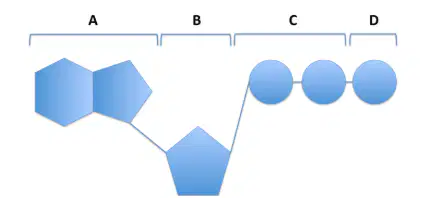
All of the following parts make up an ADP molecule EXCEPT:
a)
structure A
b)
structure B
c)
structure C
d)
structure D
66.
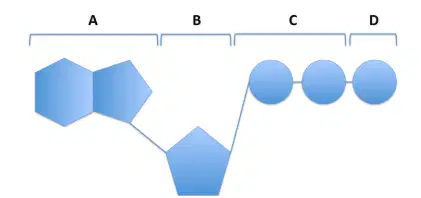
Which structures pictured would make up an ATP molecule?
a)
A and B only
b)
A, B, and C
c)
C and D only
d)
A, B, C and D
67.
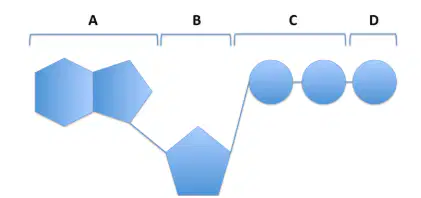
Between which two letters is the bond the most unstable and easiest to break?
a)
A and B
b)
B and C
c)
C and D
d)
B and C and C and D
68.
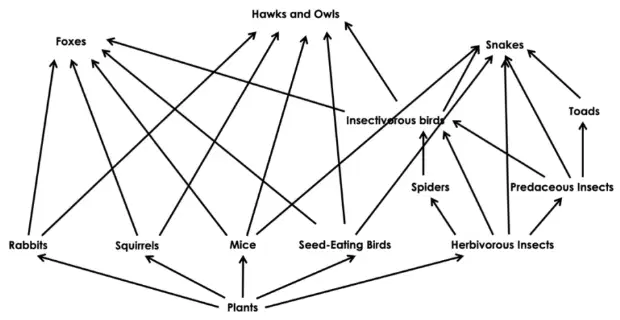
In the food web below, the insectivorous birds would be classified as ______.
a)
carnivores
b)
decomposers
c)
herbivores
d)
omnivores
69.
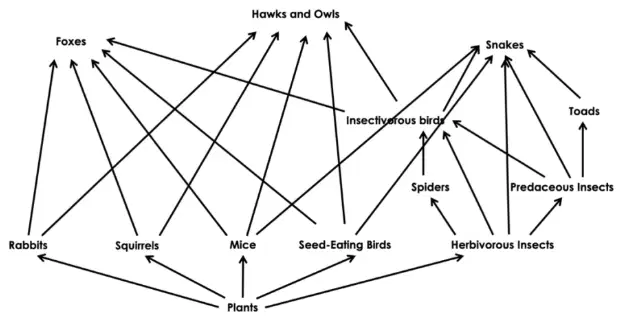
In the food web below, what would be a direct impact of an increase in the amount of toads in the ecosystem?
a)
an increase in the population of squirrels
b)
a decrease in the population of owls
c)
an increase in the population of snakes
d)
a decrease in the rabbit population
70.
Organisms that use energy from the sun to make their own food are called _______.
a)
detritivores
b)
consumers
c)
omnivores
d)
producers
71.
What will MOST LIKELY happen if a new producer is introduced into a food web?
a)
The omnivores will decrease.
b)
The herbivores will increase.
c)
The carnivores will decrease.
d)
The decomposers will decrease.
72.
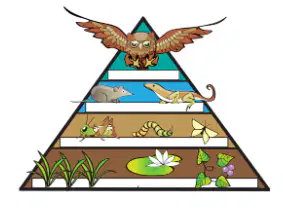
The figure below shows a tropic pyramid for an ecosystem. What happens to the amount of energy in the pyramid as it moves up through the different levels?
a)
Energy increases by 10% each level.
b)
Energy decreases by 90% each level.
c)
Energy decreases by 10% each level.
d)
Energy increases by 90% each level.
73.
In food chains, the flow of energy is ALWAYS _______.
a)
one-way
b)
reversible
c)
two-way
d)
uncontrolled
74.
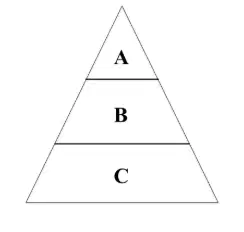
The following organisms make up a food chain: algae -> fish -> bear. If you were to place the bear into the trophic pyramid to the right, the bear would go on level _____ and have _______ amount of energy available to it.
a)
A; the least
b)
C; the least
c)
A; the greatest
d)
B; an intermediate
75.
The purpose of photosynthesis is to _____.
a)
make ATP for humans.
b)
build proteins in plants.
c)
store solar energy in sugar.
d)
make ATP for humans and store solar energy in sugar.
76.
In which organelle does photosynthesis occur?
a)
mitochondria
b)
chloroplast
c)
lysosome
d)
nucleus
77.
NADPH and ATP are produced during what part of photosynthesis?
a)
light-dependent reaction
b)
Calvin Cycle
c)
light-independent reaction
d)
Citric Acid Cycle
78.
Overall, photosynthesis is a reaction that ____.
a)
absorbs energy, and is exothermic.
b)
absorbs energy, and is endothermic.
c)
releases energy, and is exothermic.
d)
releases energy, and is endothermic.
79.
After photosynthesis is finished inside of a plant, six molecules of oxygen have been produced, as well as a single molecule of C6H12O6 otherwise known as ____.
a)
carbon dioxide
b)
water
c)
oxygen
d)
glucose
80.
Photosynthesis occurs in two stages: light-dependent reactions and light-independent reactions. During the light-dependent reactions, ______.
a)
water molecules are split by sunlight.
b)
carbon dioxide is absorbed.
c)
reactions occur in the stroma.
d)
a molecule of sugar, glucose, is made.
81.
During photosynthesis, different gases move in and out of plant cells. Which phrase best represents the net flow of gases involved in photosynthesis?
a)
Carbon dioxide moves in; oxygen moves out
b)
Oxygen moves in; carbon dioxide moves out
c)
Carbon dioxide moves in; nitrogen moves out
d)
Oxygen moves in; nitrogen moves out
82.
Why is the presence of chlorophyll in plants important?
a)
It assembles the sugar.
b)
It creates ATP to power the process.
c)
It captures water to be used in the process.
d)
It absorbs the solar energy needed to create the sugar.
83.
Which process can produce the most energy for a cell?
a)
Lactic acid fermentation
b)
Aerobic respiration
c)
Anaerobic respiration
d)
Alcohol fermentation
84.
At the beginning of cellular respiration _____ occurs, where glucose is broken down into pyruvate and ATP. This step does not require any oxygen.
a)
Glycolysis
b)
Krebs/Citric acid cycle
c)
Electron Transport Chain
d)
Alcohol fermentation
85.
Akshay is in a weight-lifting program for one hour a day several days a week. During his workout, each exercise last only a minute or so because of how difficult the work is. A few hours after the exercise, he notices that his muscles are sore and slightly swollen. His muscle cells have experienced ____ that led to production of ______.
a)
fermentation; alcohol
b)
nitrogen fixation; water
c)
anaerobic respiration; lactic acid
d)
aerobic respiration; carbon monoxide
86.
Which process takes place in the inner membrane of mitochondria?
a)
Krebs Cycle
b)
Electron Transport Chain
c)
Citric Acid Cycle
d)
Calvin Cycle
87.
Energy from food must be transformed into the bonds of _____ before it can be used by cells.
a)
ATP
b)
FADH2
c)
NADP
d)
sugar
88.
In humans, where does DNA replication take place?
a)
Cytoplasm
b)
Nucleus
c)
Ribosome
d)
Vacuole
89.
RNA from a bear is compared to RNA from a sunflower. Both will contain the _______.
a)
sugar deoxyribose and the base thymine.
b)
sugar deoxyribose and the base uracil.
c)
sugar ribose and the base thymine.
d)
sugar ribose and the base uracil.
90.

A scientist is doing an experiment to identify different molecules. Some components of these molecules are listed in this table. Which of the four molecules is DNA, based on the table to the right?
a)
Molecule 1
b)
Molecule 2
c)
Molecule 3
d)
Molecule 4
91.
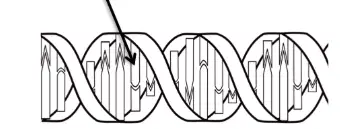
The diagram shown here represents a portion of a nucleic acid molecule. The part indicated by the arrow could be _____.
a)
adenine.
b)
uracil.
c)
deoxyribose.
d)
phosphate.
92.
A DNA nucleotide could contain the following molecules:
a)
deoxyribose, cytosine, and a lipid .
b)
deoxyribose, thymine, and a phosphate group.
c)
ribose, uracil, and a polypeptide.
d)
ribose, adenine, and thymine.
93.
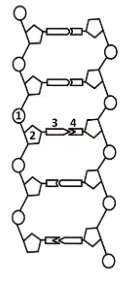
Use the diagram to the below AND your knowledge of biology to answer this question. Structures 3 and 4 are held together by
a)
weak peptide bonds.
b)
strong hydrogen bonds.
c)
weak hydrogen bonds.
d)
strong peptide bonds.
94.
In nucleotides, the letters A, G, C, and T represent _____.
a)
phosphate groups.
b)
deoxyribose sugars.
c)
nitrogen bases.
d)
ribose sugars.
95.
The cellular process of creating two new DNA molecules from one original copy is called replication. Which statement is the BEST description of this process?
a)
DNA opens up and RNA copies it.
b)
DNA opens up and completely unwinds to make two new molecules.
c)
DNA opens up and each strand is used as a template for making a new strand.
d)
RNA opens up the DNA and uses each strand as a template for a new strand.
96.
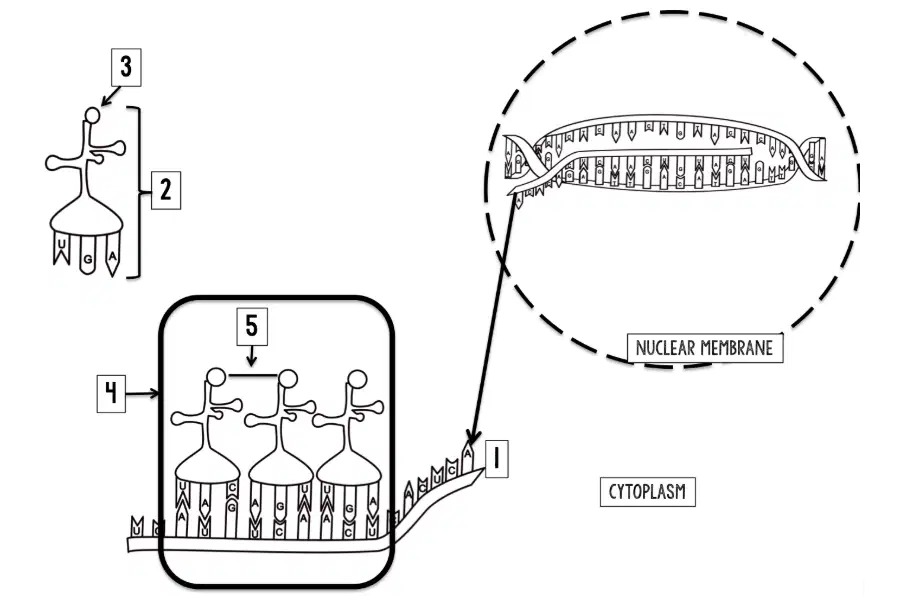
The molecule copied directly from DNA is represented by number .
a)
1
b)
2
c)
3
d)
4
97.
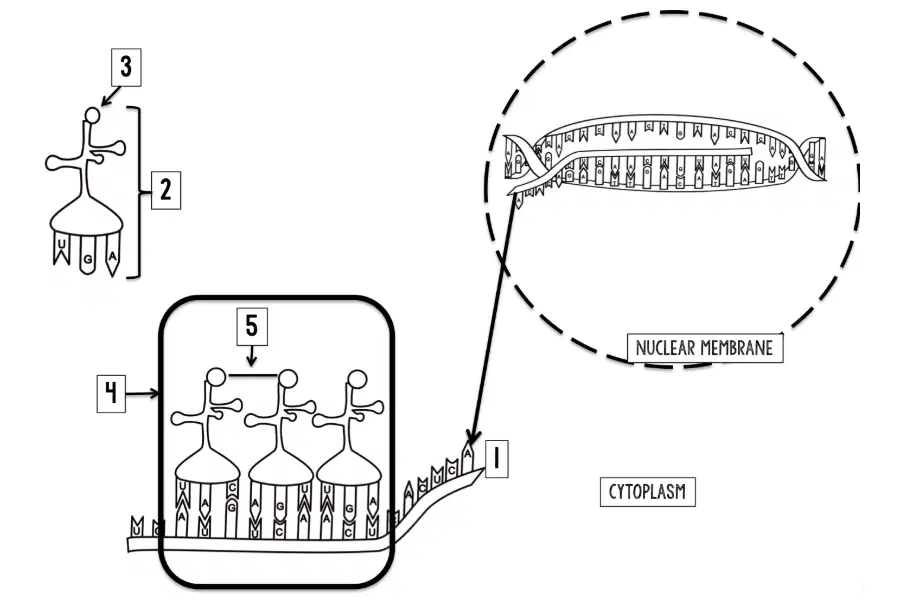
What is an example of a molecule produced by the process shown below?
a)
Glucose
b)
Glycogen
c)
Fatty acid
d)
Polypeptide
98.
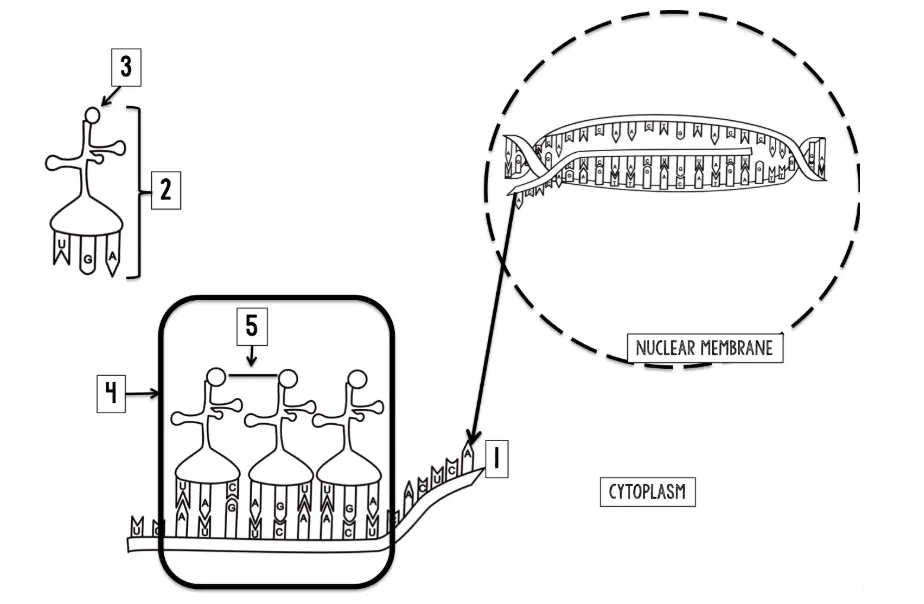
Structure number 2 represents a .
a)
tRNA
b)
rRNA
c)
mRNA
d)
ribosome
99.
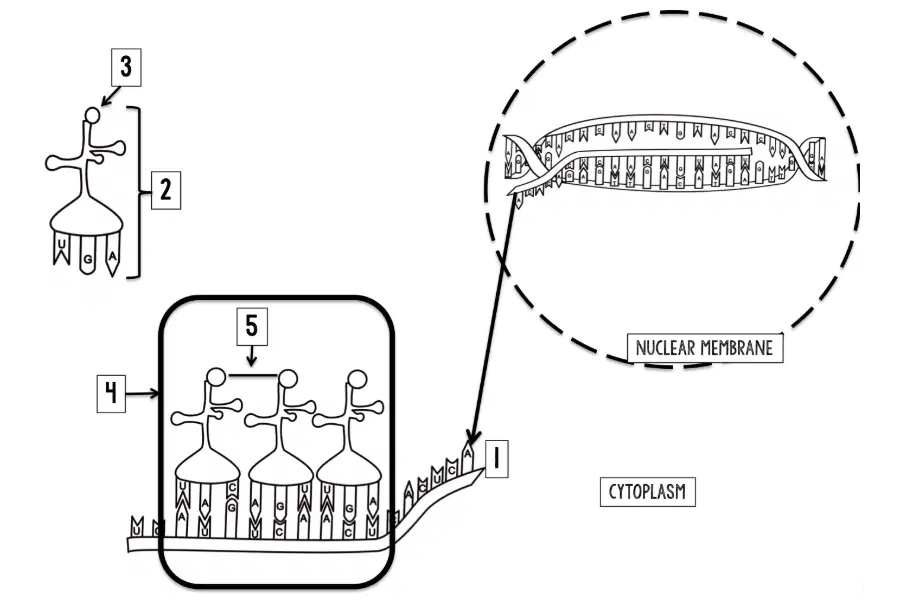
The bond represented by number 5 is a ____ bond.
a)
covalent
b)
hydrogen
c)
ionic
d)
peptide
100.
If a portion of a messenger RNA molecule contains the base sequence A-A-U, then the corresponding anti-codon on the tRNA base sequence is .
a)
A-A-U
b)
G-G-T
c)
T-T-A
d)
U-U-A
101.
The sequence of ________________ in a DNA molecule determines the protein that will be produced.
a)
lipids
b)
nucleotides
c)
proteins
d)
sugars
102.
During _____________, the cell uses information from messenger RNA to make polypeptides.
a)
replication
b)
translation
c)
transcription
d)
meiosis
103.
How many amino acids are coded for by the strand of mRNA shown here? Assume the reading frame begins with the first nucleotide.
A U G U A C
a)
1
b)
2
c)
3
d)
4
104.
During protein synthesis, what does mRNA do?
a)
It delivers DNA’s instructions for making proteins to the ribosome.
b)
It constructs proteins out of amino acids.
c)
It strings together two complementary RNA strands.
d)
It delivers amino acids to assemble the polypeptide.
105.
A sperm cell of an octopus has 14 chromosomes. What is the total number of chromosomes that should be present in a stomach cell of the same octopus?
a)
7
b)
14
c)
28
d)
46
106.
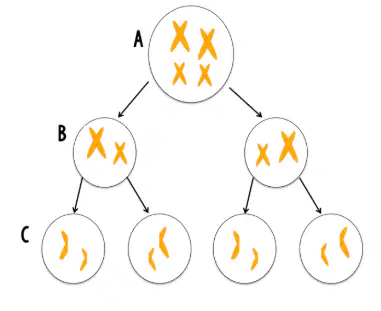
The distribution of chromosomes in one type of cell division is shown in the diagram to the right. Which process is being represented in the diagram?
a)
Asexual reproduction
b)
Meiosis
c)
Mitosis
d)
DNA replication
107.
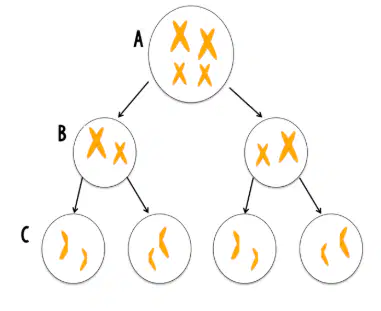
Which letter(s) in the diagram pictured below correspond to cells that are haploid?
a)
A
b)
B
c)
C
d)
A and B
e)
B and C
108.
Compared to the number of chromosomes contained in a body cell, how many chromosomes would normally be contained in a gamete?
a)
The same number
b)
Twice as many
c)
1/4th as many
d)
Half as many
109.
In which phase of meiosis would certain gene segments of the homologous pairs of chromosomes "crossover" and exchange genetic information?
a)
Prophase I
b)
Metaphase I
c)
Anaphase I
d)
Telophase I
110.
Which cells are NOT formed during meiosis?
a)
Somatic cells
b)
Gametes
c)
Sex cells
d)
Sperm cells
111.
Two similar chromosomes that you inherit from your parents (one from your mother and one from your father) are called _________.
a)
homologous chromosomes.
b)
sister chromatids.
c)
sex chromosomes.
d)
homozygous alleles.
112.
Which event takes place during anaphase II of meiosis?
a)
nuclear membrane breaks down
b)
sister chromatids separate
c)
spindle fibers break down
d)
cytoplasm divides
113.
Somatic cells in humans contain ____ chromosomes and an example is ______.
a)
30; skin cells
b)
23; heart cells
c)
46; liver cells
d)
46; sperm cells
114.
Chromosomes line up in the middle of the cell single file during which phase?
a)
Telophase I
b)
Telophase II
c)
Metaphase I
d)
Metaphase II
100 %

