
 Worksheets
6th grade year review for 8th grade staar
Total questions: 164
Worksheet time: 3hrs 44mins
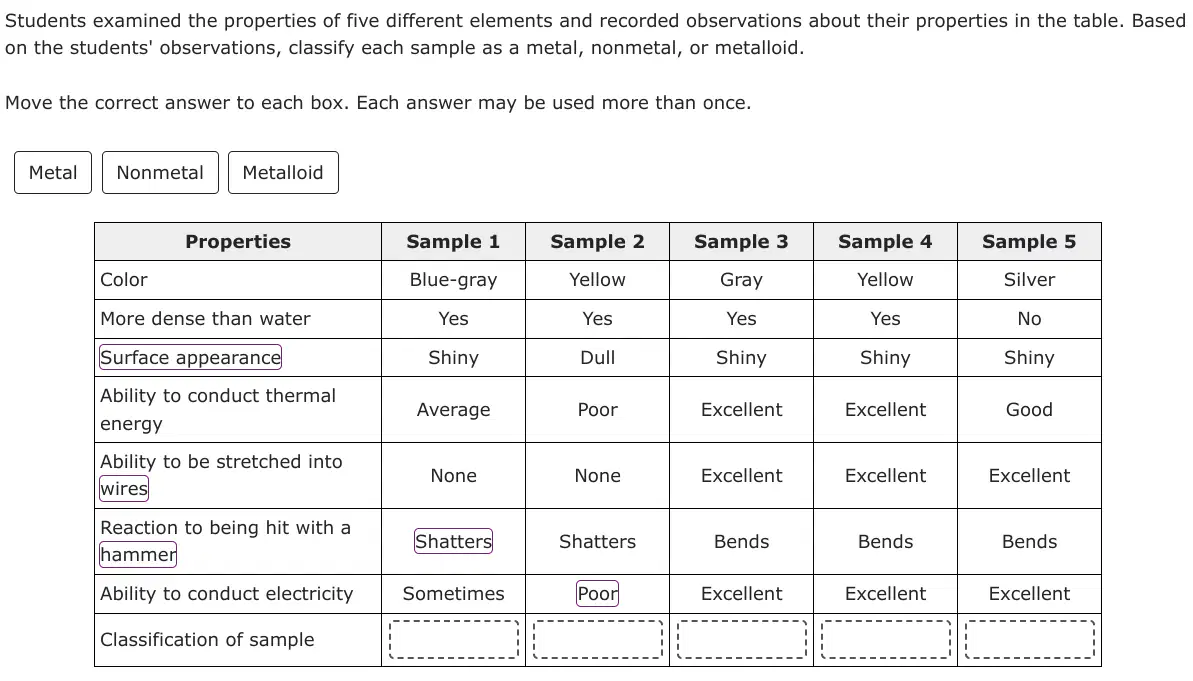
Students examined the properties of five different elements and recorded observations about their properties in the table. Based on the students' observations, classify each sample as a metal, nonmetal, or metalloid. Select the correct answer for each box. Each answer may be used more than once.
Sample 1 (a)
Sample 2 (b)
Sample 3 (c)
Sample 4 (d)
Sample 5 (e)
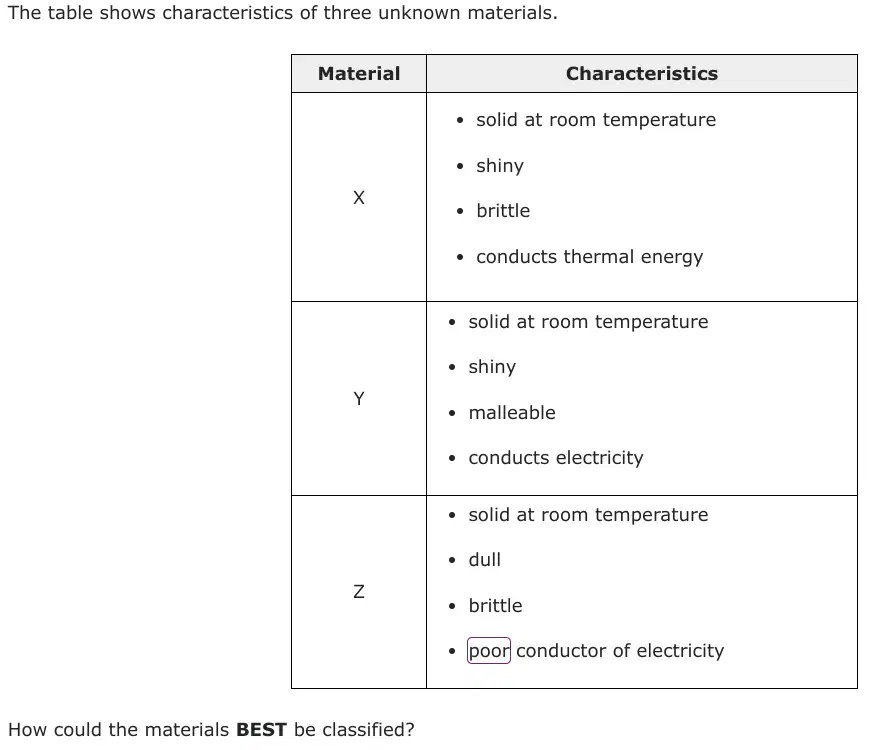
The table shows characteristics of three unknown materials.
How could the materials BEST be classified?
X: Metal
Y: Metalloid
Z: Nonmetal
X: Nonmetal
Y: Metal
Z: Nonmetal
X: Metalloid
Y: Metalloid
Z: Nonmetal
X: Metalloid
Y: Metal
Z: Nonmetal
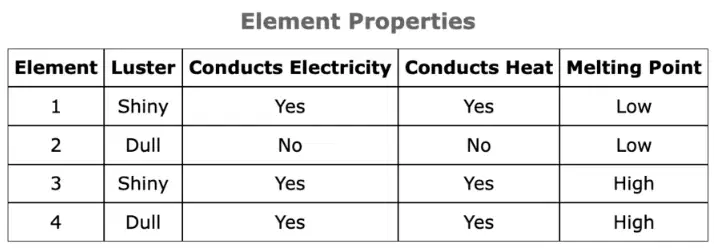
The chart shows properties of four elements.
Based on these properties, which element is most likely a nonmetal?
Element 1
Element 2
Element 3
Element 4
Aluminum, sulfur, and chlorine are elements found on the periodic table. Tests involving these three elements would show that at normal room temperature —
sulfur is malleable and aluminum conducts electricity
chlorine is malleable and conducts electricity
aluminum is malleable and conducts electricity
all three elements are malleable and conduct electricity
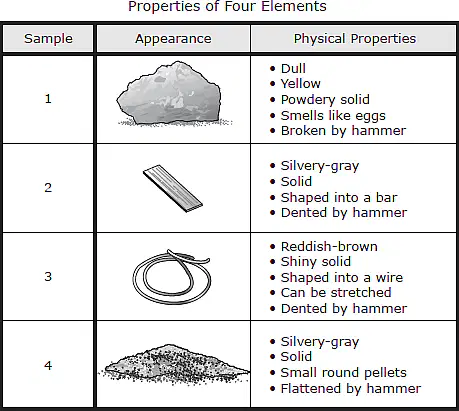
Some students conducted a laboratory investigation to learn more about the physical properties of different elements. They observed four samples and recorded their observations in the table below.
Based on these observations, which sample is most likely a nonmetal?
Sample 1
Sample 2
Sample 3
Sample 4
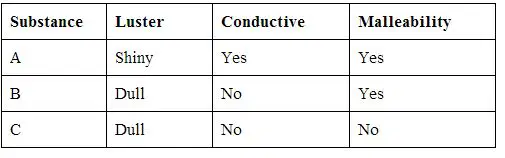
Students in a science class are separating substances into metals, nonmetals, and metalloids. A student is given three samples and they collect the following data.
Based on the data collected, how should the student classify substance A?
nonmetal
metalloid
metal
Not enough information is given to classify the substance
Students were given a variety of materials to use to complete a simple electrical circuit. They discovered that paper clips, pennies, and nickels worked well, but that paper, erasers, and wooden pencils didn't. What physical property were the students testing?
Malleability
Luster
Conductivity
Magnetism
How is "luster" used as a physical characteristic of elements listed as metals on the Periodic Table of Elements?
Luster is not one of the physical characteristics used to classify metals.
Luster means that metals can be considerably shinier than non-metals.
Luster means that metals can be pounded into sheets without breaking.
Luster means that metals can be pulled and twisted into thin wires.
All elements classified as metals on the Periodic Table of Elements conduct electrical energy. Which element listed below is the poorest conductor?
During a science discovery lesson, students learned that copper, aluminum, gold, and chromium can be bent, rolled out, or hit with a hammer and not shatter. What physical property were the students testing?
Which of the tables gives the best explanation of the physical properties of the metals, nonmetals and metalloids found on the Periodic Table of Elements?


In science class today, a student describes the physical properties of metals, metalloids, and nonmetals. The statement reflects an accurate description of the properties of metals, metalloids, and nonmetals. Nonmetals (a) shiny, (b) good conductors and are brittle solids or gases. Metals are shiny luster, (c) good conductors of heat and electricity and (d) malleable. Metalloids can have the physical properties of (e) .
When comparing the three types of elements, which statement gives the best explanation of the physical properties of metals, metalloid and nonmetals?
Metals have a shiny luster and are bendable. Nonmetals are fair conductors of heat and electricity. Metalloids have properties of both metals and nonmetals.
Metalloids have properties of both metals and nonmetals. Metals do not conduct heat and electricity as well as nonmetals. Nonmetals have a dull appearance and are brittle solids and gases.
Nonmetals are brittle solids or gases. Metals are shiny, good conductors of heat and are malleable. Metalloids can have the physical properties of both metals and nonmetals.
Metals, metalloids and nonmetals have similar physical properties.
When placed outside on a hot summer day, which of the following substances would feel the hottest to touch?
Sand
Gold
Which is not a property of metals in a solid state?
Two students make hot chocolate. One student pours the hot chocolate into a white foam cup. The other student pours the hot chocolate into a silver metal cup. The metal cup becomes too hot to touch, but the foam cup can be held comfortably. The best explanation for this difference in temperature is that the foam cup —
heats up much faster than the metal cup
is a better insulator than the metal cup
is a better conductor of heat than the metal cup
has a specific heat that is similar to that of the metal cup
What process must be used in order to find the density of an irregular shaped object?
Lenght X Width X Height
Mass divided by volume
Volume divided by mass
Displacement
True or False? The volume of an object determines if it will float or sink in a specific liquid?
True
False
What is the density of an object that sinks in water?
More than 1g/mL
More than 1g/mL
Right at 1g/mL
Right at 0g/mL
What is the density of a tennis ball with a mass of 54g and a volume of 9cm³
5 g/cm3
0.17 g/cm3
6 g/cm3
8 g/cm3
Water is displaced when a rock is placed in a graduated cylinder. The level of the water rises from 50mL to 78mL. What is the volume of the rock?
50 mL
28 mL
78 mL
54 mL
Is a rock considered a regular or irregular shaped object?
Regular
Irregular
What is the formula for density?
d = L x W x H
d = M/D
d = D x V
d = M/V
What tool is used to measure mass?
Graduated Cylinder
Ruler
Triple Beam Balance
Beaker
Oak wood has a volume of 200cm³ and a mass of 148g. Will it float or sink in water?
Sink
Float
The amount of space taken up by a substance.
Volume
Mass
Density
Weight
What tool can be used to measure the volume of an irregular shaped object?
Graduated Cylinder
Ruler
Triple Beam Balance
Beaker
What is the density of an object that floats on water?
Less than 1 g/mL
More than 1 g/mL
Less than 2g/mL
More than 1g/mL
Calculate the density of an object that has a mass of 10g and a volume of 5cm³.
1 g/cm3
0.5 g/cm3
2 g/cm3
6 g/cm3
Corn Syrup has a mass of 4g and a volume of 60mL. Will it float or sink in water?
Float
Sink
What tool can be used to measure the volume of regular shaped objects?
Graduated Cylinder
Ruler
Triple Beam Balance
Beaker
The density of water is-
1.5 g/mL
1 g/mL
2 g/mL
0.5 g/mL
Is a tissue box considered a regular or irregular shaped object?
regular
irregular
True or False? All solids, liquids, and gases have density.
True
False
What is the formula for finding the volume of regular shaped objects?
Mass/Density
Mass/Volume
Length x Width X Height
Mass x Volume
The amount of mass in a given volume.
Volume
Mass
Density
Weight
What is a precipitate?
A gas that forms during a chemical reaction.
A solid that forms and settles out of a liquid mixture during a chemical reaction.
A liquid that evaporates during a chemical reaction.
A color change that occurs during a chemical reaction.
What is the role of energy in chemical reactions?
Energy is always released during chemical reactions.
Energy is absorbed or released during chemical reactions, which can cause temperature changes.
Energy has no effect on chemical reactions.
Energy is only released in exothermic reactions.
What is a chemical change?
A process where substances combine or break apart to form new substances with different properties.
A physical change that does not alter the chemical composition of a substance.
A reaction that only occurs at high temperatures and pressures.
A method of separating mixtures into their individual components.
What is the difference between a physical change and a chemical change?
A physical change alters the form of a substance without changing its chemical composition.
A chemical change involves only the physical properties of a substance.
A physical change results in the formation of new substances.
A chemical change can be easily reversed.
What happens to the mass of substances during a chemical reaction?
The mass of the substances increases due to the formation of new compounds.
The mass of the substances decreases as energy is released.
The mass of the substances before and after a chemical reaction remains the same, according to the law of conservation of mass.
The mass of the substances is only conserved in closed systems.
What is an indicator of a chemical reaction involving color change?
A color change indicates that new substances with different properties have formed.
A color change means the temperature has increased.
A color change shows that the reaction is exothermic.
A color change signifies that the reaction is reversible.
What is an example of a gas being produced in a chemical reaction?
The production of oxygen gas when hydrogen peroxide decomposes.
The production of nitrogen gas when ammonium nitrate is heated.
The production of carbon dioxide gas when vinegar reacts with baking soda.
The production of helium gas when a balloon is inflated.
What are some signs that a chemical reaction has occurred?
Formation of a gas
Change in the speed of light
Increase in mass
Formation of a solid without a chemical change
How can temperature changes indicate a chemical reaction?
A temperature change suggests that energy is being absorbed or released, indicating a chemical change.
Temperature changes have no relation to chemical reactions.
Temperature changes only occur in physical changes, not chemical reactions.
Temperature changes are always a sign of a physical reaction.
What is the significance of observing a solid forming in a solution?
It indicates that the solution is saturated with solute.
It suggests that a chemical reaction has occurred, resulting in a precipitate.
It means that the temperature of the solution has increased.
It shows that the solution is becoming more concentrated.
What is the importance of observing changes in state during a reaction?
Changes in state indicate that a chemical reaction has occurred, as new substances may have formed.
Changes in state are irrelevant to chemical reactions and do not provide any useful information.
Changes in state only occur in physical reactions, not chemical reactions.
Observing changes in state helps to determine the temperature of the reaction.
What does it mean for a substance to dissolve?
Dissolving is a chemical change that creates a new substance.
Dissolving is a physical change where a substance mixes uniformly with a liquid, but does not form a new substance.
Dissolving occurs only when a solid is mixed with another solid.
Dissolving is the process of a gas turning into a liquid.
What does it mean when a gas is formed during a reaction?
It indicates that a chemical reaction has occurred, often resulting in new substances being produced.
It means that the reaction is exothermic and releases heat.
It suggests that the reactants are in a gaseous state before the reaction.
It implies that the reaction is reversible and can go in both directions.
What is an example of a chemical change?
The reaction of vinegar and baking soda, which produces carbon dioxide gas.
Melting ice into water.
Boiling water to produce steam.
Dissolving sugar in water.
What is rusting?
A chemical reaction that occurs when iron reacts with oxygen and moisture, forming iron oxide (rust).
A process of painting iron to prevent corrosion.
A method of heating iron to increase its strength.
A type of metal alloy that includes iron and carbon.
Match each term to the correct definition.
An attractive force on objects with mass
Gravity
The push or pull on one object by another
Applied Force
A force opposing an object on a surface
Normal Force
A force that attracts or repels ob
Magnetism
A force that causes resistance when two objects slide across one another
Friction
Use the clues provided to complete the questions.
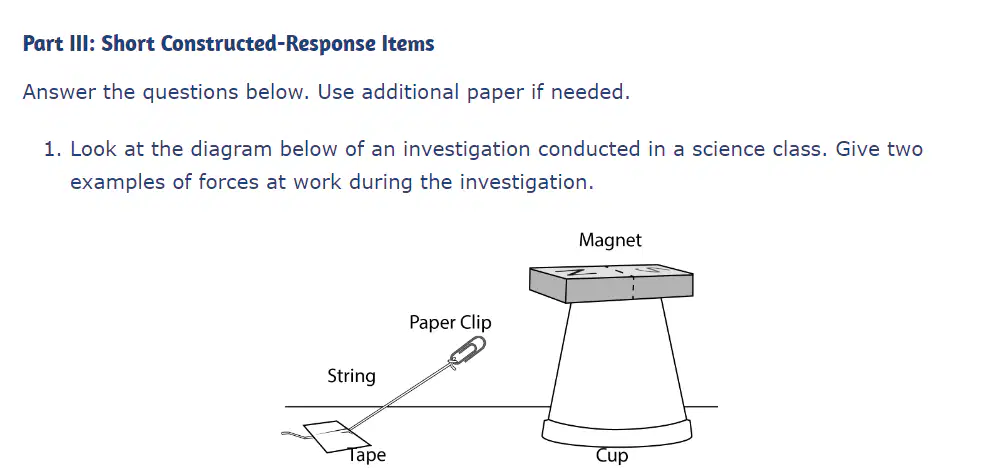
Look at the diagram below of an investigation conducted in a science class. Give two examples of forces at work during the investigation.
Describe at least two forces at work in a situation where two dogs pull on either end of a rope toy.
What is an applied force?
A force exerted by magnets only
A force that opposes motion
A force that is applied by one object unto another object
An attraction between two objects
A force between two objects that are TOUCHING is a
Non-contact Force
Contact Force
Gravitational Force
Jedi Force
Magnetic Force is
A force of attraction between any two objects in the universe
A force that acts between objects that are electrically charged
The force of attraction or repulsion between unlike or like poles
A contact force that resist motion between two objects that are touching
What is an example of a non-contact force?
Magnetic force
Frictional force
Tension force
Normal force
Give an example of a contact force.
Friction
Gravity
Magnetism
Electric Force
What is normal force?
The force that pulls objects towards the center of the Earth.
The support force exerted upon an object that is in contact with another stable object, acting perpendicular to the surface.
The force that opposes the motion of an object in a fluid.
The force that acts parallel to the surface of contact.
What is a force?
A force is a type of energy that can be stored in objects.
A force is a push or pull that can cause an object to move, change direction, or change shape.
A force is a measurement of the weight of an object.
A force is a type of friction that opposes motion.
______ is a force of attraction that causes magnetic material to move
gravity
pull
push
magnetism
SpongeBob is pushing a box to the right with a force of 10 N, while Patrick is pushing it to the left with a force of 5 N. What is the net force acting on the box?
5 N to the left
5 N to the right
15 N to the right
15 N to the left
SpongeBob is holding a book on a table. The force of gravity acting on the book is 20 N downward, and the normal force from the table is 20 N upward. Are the forces balanced or unbalanced?
Balanced
Unbalanced
Cannot be determined
None of the above
SpongeBob is pushing a cart to the right with a force of 50 N and experiences a frictional force of 20 N to the left. What is the net force on the cart?
70 N to the right
30 N to the right
30 N to the left
70 N to the left
SpongeBob is holding a box with forces of 8 N to the right and 8 N to the left. Determine if the forces are balanced or unbalanced and explain why.
Balanced, because the forces cancel each other out
Unbalanced, because the forces are in opposite directions
Balanced, because the forces are equal in magnitude
Unbalanced, because the forces are not equal
SpongeBob is holding a box with a force of 12 N upward while Patrick is pushing it down with a force of 5 N. Calculate the net force and determine the direction.
7 N upward
7 N downward
17 N upward
17 N downward
SpongeBob is pushing a box with forces of 10 N to the right, 5 N to the left, 3 N upward, and 3 N downward. Calculate the net force and determine if the forces are balanced or unbalanced.
Net force is 5 N to the right, unbalanced
Net force is 5 N to the left, unbalanced
Net force is 0 N, balanced
Net force is 8 N to the right, unbalanced
SpongeBob is pushing a box with a force of 20 N to the right and experiences a frictional force of 20 N to the left. Draw a free-body diagram and determine if the forces are balanced or unbalanced. Explain your reasoning.
Balanced, because the forces are equal and opposite
Unbalanced, because the forces are in opposite directions
Balanced, because the net force is zero
Unbalanced, because the forces are not equal

SpongeBob is pushing a boat with a force of 10 N to the right, while Patrick is pushing it with a force of 10 N to the left. What is the net force?
10 N
0 N
25 N
1 N
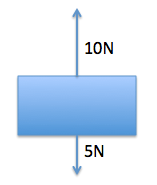
What is the net force on the block that SpongeBob is pushing? (click on the words to view the picture)
5 Newtons up
5 Newtons down
15 Newtons up
15 Newtons down

SpongeBob is pushing a box with his net. How much net force is being applied to this box?
2 N
4 N
6 N
8 N
What type of energy transformation occurs in a flashlight?
Chemical to electrical to light
Mechanical to light to chemical
Sound to light to electrical
Electrical to chemical to sound
Which of the following shows energy being transferred in a food web?
A fox eating a rabbit
A plant growing
A fish swimming
A rock falling
What energy transformation occurs during photosynthesis?
Light to chemical
Chemical to mechanical
Thermal to sound
Electrical to kinetic
What is the primary energy transformation in an electric fan?
Electrical to mechanical
Mechanical to thermal
Light to sound
Chemical to light
When a toaster is in use, which energy transformations occur?
Electrical to thermal
Chemical to mechanical
Light to chemical
Mechanical to light
How is energy conserved when riding a roller coaster?
Potential energy changes to kinetic energy
Kinetic energy disappears
Energy is created
Energy is destroyed
In a circuit, what happens when a light bulb turns on?
Electrical energy is transformed into light and thermal energy
Mechanical energy becomes chemical
Sound energy becomes electrical
Thermal energy is stored as chemical energy
What energy transformation occurs when you eat food and ride a bike?
Chemical to mechanical
Mechanical to light
Electrical to thermal
Light to sound
What energy transformation happens when wood burns?
Chemical to thermal and light
Thermal to chemical
Mechanical to sound
Sound to electrical
Which transformation happens in a battery-powered toy car?
Chemical to electrical to mechanical
Light to thermal to chemical
Thermal to sound to electrical
Mechanical to light to sound
What type of energy is transferred when the sun warms your skin?
Radiant to thermal
Mechanical to thermal
Chemical to light
Electrical to kinetic
How is energy conserved in a pendulum swing?
Kinetic and potential energy transform into each other
Energy is lost as heat
Only kinetic energy exists
Energy disappears at the top
What happens to energy in a closed system like a roller coaster loop?
It is conserved and changes forms
It is destroyed
It disappears
It only stays potential
What kind of energy transformation occurs in photosynthesis in plants?
Light to chemical
Chemical to electrical
Mechanical to light
Thermal to mechanical
Which of these best demonstrates energy conservation?
A person eats food, then runs
A light bulb burns out
A rock sits on a shelf
A car engine breaks
What type of wave is a sound wave?
Longitudinal
Transverse
Electromagnetic
Light
Which type of wave moves particles perpendicular to the direction the wave travels?
Transverse
Longitudinal
Mechanical
Thermal
Which of the following is an example of a transverse wave?
Light wave
Sound wave
Seismic P-wave
Compressed spring
How do particles move in a longitudinal wave?
Back and forth in the same direction as the wave
Up and down
In circles
Side to side only
What is transferred by a wave?
Energy
Matter
Air
Mass
What is the highest point of a transverse wave called?
Crest
Trough
Compression
Rarefaction
What is the lowest point of a transverse wave called?
Trough
Crest
Amplitude
Compression
In a longitudinal wave, the areas where particles are closest together are called:
Compressions
Rarefactions
Troughs
Crests
Which wave type requires a medium to travel through?
Sound wave
Light wave
Radio wave
Microwave
What kind of wave is created when you flick a rope up and down?
Transverse
Longitudinal
Circular
Radio
Which wave can travel through the vacuum of space?
Light wave
Sound wave
Seismic wave
Water wave
The distance between two crests on a wave is called the:
Wavelength
Amplitude
Frequency
Period
What does amplitude measure in a wave?
Wave energy
Wavelength
Speed
Temperature
Which wave property affects how loud a sound is?
Amplitude
Wavelength
Frequency
Speed
Which wave property affects the pitch of a sound?
Frequency
Amplitude
Crest
Trough

what season is the southern hemisphere experiencing at position K.
winter
fall
summer
spring

Alaska is in the northern part of North America. According to the diagram, which season is Alaska experiencing?
Winter
Spring
Summer
Fall

We experience summer when the part of Earth we are living on ______________ the Sun.
tilts away
tilts toward
rotates away
rotates toward

Which season is taking place in the Northern Hemisphere in Position 1?
Winter
Spring
Summer
Fall

The earth is a tilted planet. What is the degree of tilt?
Approximately 25 degrees
Exactly 25 degrees
23.5 degrees
90 degrees with respect to the sun
How does Earth's axial tilt affect the seasons?
It causes the Earth to rotate faster.
It changes the distance between the Earth and the Sun.
It causes different parts of Earth to receive varying amounts of sunlight throughout the year.
It affects the gravitational pull of the Moon.
What happens to the length of days and nights when the Northern Hemisphere is tilted away from the Sun?
Days are longer than nights.
Days and nights are of equal length.
Nights are longer than days.
There is no change in the length of days and nights.
What is the primary reason for the occurrence of different seasons on Earth?
The Earth's distance from the Sun changes significantly.
The Earth's axial tilt.
The Earth's rotation speed.
The Earth's orbit is a perfect circle.
If the Earth's axial tilt were to increase, what would likely happen to the seasons?
Seasons would become less distinct.
Seasons would become more extreme.
There would be no change in the seasons.
Seasons would disappear completely.
What would happen if the Earth had no tilt? (1-2 sentences)
If it is Summer in the Northern Hemisphere, then it is __________ in the Southern Hemisphere.
Summer
Winter
Fall
Spring
If it is Winter in the Northern Hemisphere, then it is ___________ in the Southern Hemisphere.
Summer
Winter
Fall
Spring
If it is Fall in the Northern Hemisphere, then it is ___________ in the Southern Hemisphere.
Summer
Winter
Fall
Spring
If it is Spring in the Northern Hemisphere, then it is __________ in the Southern Hemisphere.
Summer
Winter
Fall
Spring
Which of the following has the greatest effect on the Earth’s tides?
The Sun’s gravitational pull
The gravitational pull of Mars
The gravitational pull of Venus
The Moon’s gravitational pull
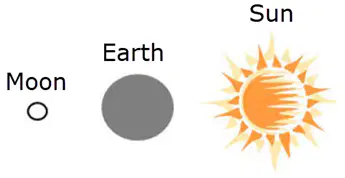
Students used pictures of the Sun, Earth, and Moon to model positions during tides.
Which of the following diagrams best represents a spring tide?


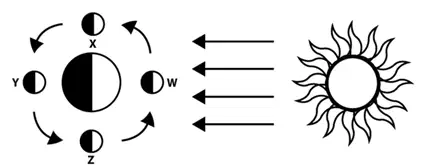
The diagram below depicts the lunar cycle.
Which of the following Moon phases would be present during a neap tide?
Full
Gibbous
Quarter
New
The diagram below depicts the lunar cycle. Which of the following Moon phases would be present during a neap tide?
Refer to the diagram above. A neap tide occurs at (a) while a spring tide occurs at (b) .
Which one of the following models represents the lowest low tides at Position X?

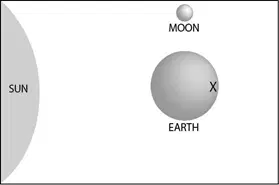
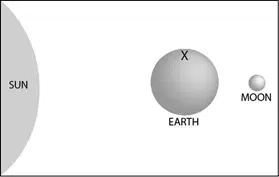
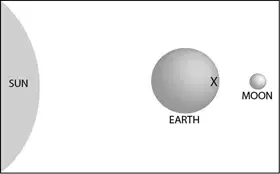
How are the Sun and Moon similar and different in regards to their effect on the ocean tides?
Both the Sun and Moon have their own gravity which means the gravitational pull from both pull on the oceans causing tides. The difference is the Sun is (a) than the Moon, but it is very far away. The (b) does not affect the ocean tides as strongly as the (c) does for that reason. The (d) has about two times the effect on tides as the (e) .

The diagram shows the alignment of Earth, the moon, and the sun on one day in May 2019. The table shows tide heights for a coastal city on four different days in May 2019.
Based on the table, on which date were Earth, the moon, and the sun MOST LIKELY arranged as shown in the diagram?
May 15
May 18
May 22
May 26
The diagram models four lunar phases.
During which lunar phase is the tide highest?
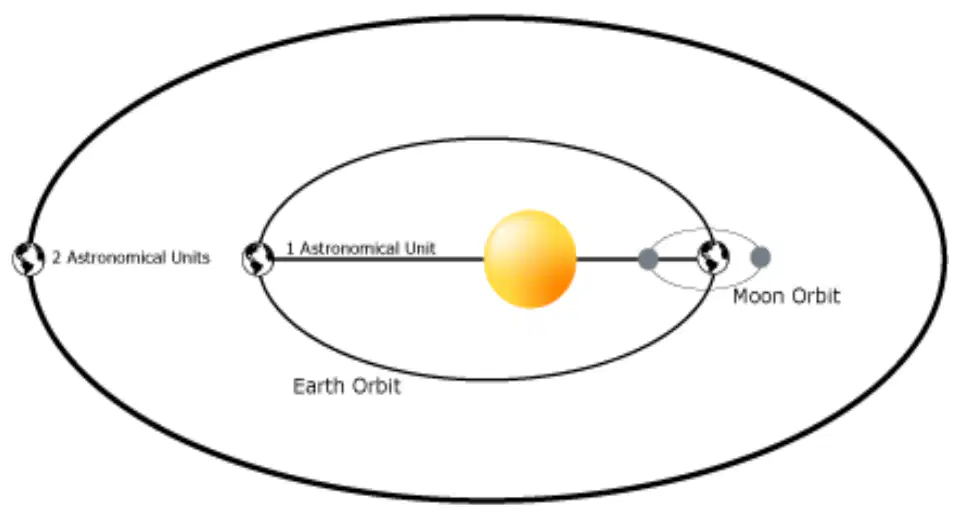
Hypothesize the effect on spring tides if the Earth orbited the Sun at a distance of 2 Astronomical Units.
Spring tides would be slightly lower at high tide levels. The Sun’s gravitational pull would be reduced, but it does not impact the tides as much as the Moon’s gravitational pull.
Spring tides would be dramatically higher. The Sun’s gravitational pull would be expressed over a greater distance causing more of the Earth’s water to react.
Spring tides would be dramatically lower. The Sun’s gravitation pull is the dominant influence on water levels on Earth as a result of its large mass. With this mass further away from the Earth, the inverse square law describes a dramatic reduction in Earth’s high tides.
Spring tides would be slightly higher at high tide. The Moon’s gravity would have greater influence without the competing gravitational field of the more-massive Sun.
The Gulf of Mexico experiences high and low tides twice each day. Which of the following is most likely the cause?
The force of the Earth spinning on its axis.
The gravitational pull of the Moon on the Earth.
The upward pressure of volcanoes erupting on the ocean's floor.
All of the above statements are correct.
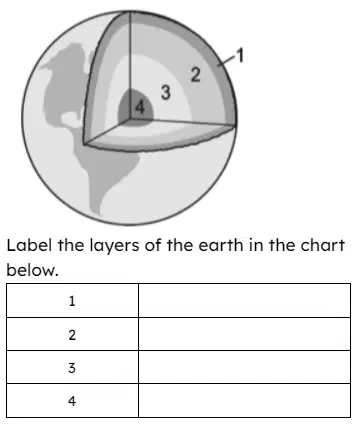
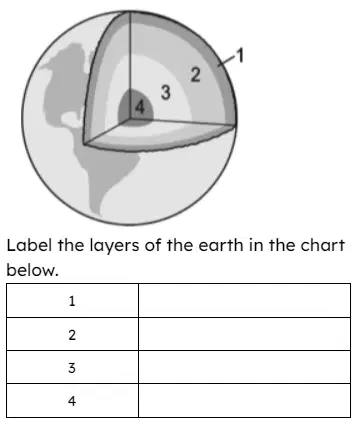
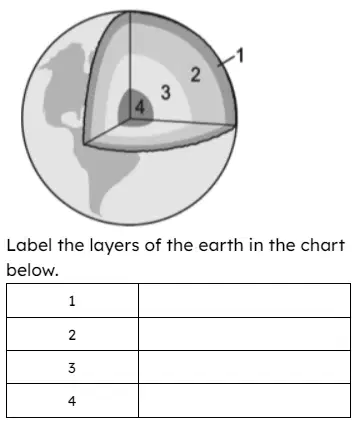
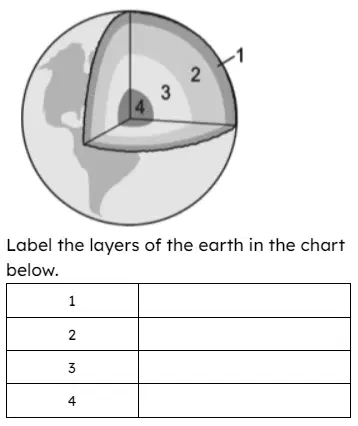
Jamal makes a scale model of Earth for a school project. In his model, he uses different materials to show each layer of Earth. Which layer in his model should be the thinnest? Write your answer in the space provided.
(a)

The thickest layer of Earth made up of semi-solid, molten rock. What is the name of that layer?
(a)
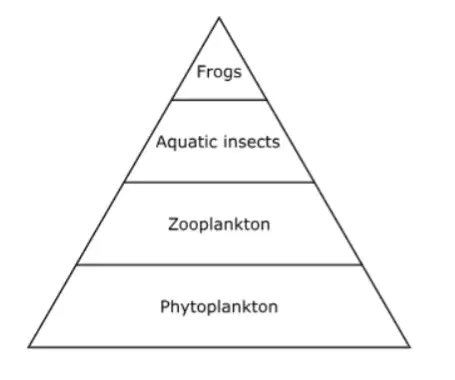
Which statement BEST describes the flow of energy through this pyramid?
Producers provide energy directly to the organisms in all the trophic levels above them.
Primary consumers transfer energy to the trophic level above them and the trophic level below them.
Secondary consumers represent the most organisms, and they have the greatest amount of energy in their trophic level.
Tertiary consumers do not receive all the energy from the trophic level below them, because some energy is lost to the environment.
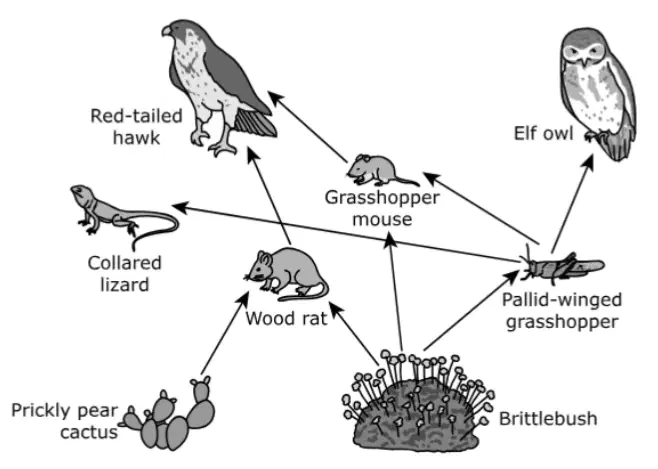
Based on the food web, which types of organisms would the grasshopper mouse most likely compete with for food sources?
Producers and carnivores
Producers and decomposers
Herbivores and carnivores
Herbivores and decomposers
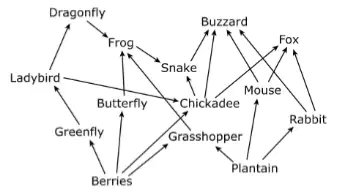
A forest food web is shown.
Which change would most likely cause a decrease in the frog population?
An increase in the ladybird population
An increase in the butterfly population
An increase in the snake population
An increase in the number of producers.
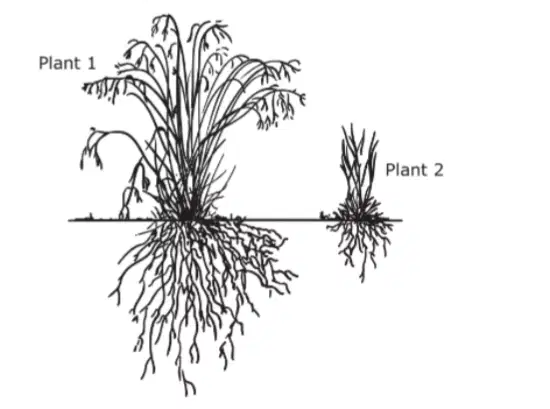
Two plant species that grow in the same area are shown.
Which statement best explains the difference between Plant 1 and Plant 2?
Plant 1 obtains more water from the soil because of its root surface area and root depth.
Plant 1 obtains more sunlight because of its root surface area and root depth.
Plant 2 obtains more water from the soil because of its root surface area and root depth.
Plant 2 obtains more sunlight because of its root surface area and root depth.
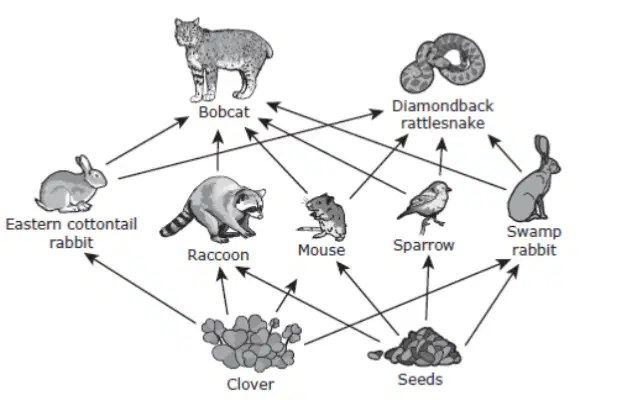
A Texas Gulf Coast food web is shown.
According to this food web, which organisms would the bobcat and diamondback rattlesnake compete for if the mouse population and swamp rabbit population decreased?
Raccoon and sparrow
Raccoon and Eastern cottontail rabbit
Sparrow and seeds
Sparrow and Eastern cottontail rabbit
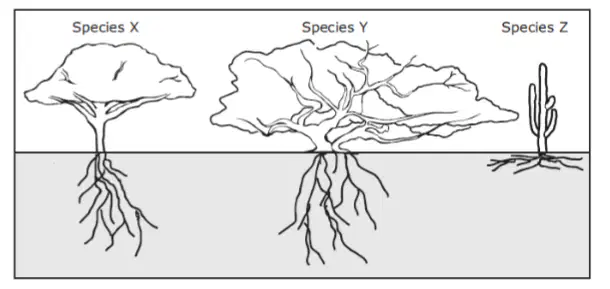
Three different species of plants that live in the desert are shown. Species Z can successfully share the same environment with the other plants shown because species Z absorbs water —
found deep underground, and species X absorbs water near the soil surface
found deep underground, and species X absorbs water found deep underground
near the soil surface, and species Y absorbs water near the soil surface
near the soil surface, and species Y absorbs water found deep underground
Plants that live on the floors of densely populated forests must compete for sunlight.
Which type of leaves are most likely found on plants that are best suited to living on the floor of a dense forest?
Leaves that are needle-shaped
Leaves that are smallest
Leaves that store the greatest amount of water
Leaves with the greatest amount of surface area
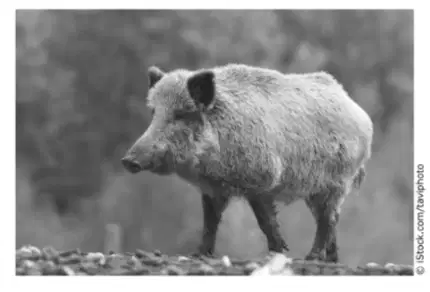
Wild hogs introduced to Texas from Europe became feral after the hogs escaped from the ranches where they lived. Feral hogs are omnivores that feed on native plants, crops, and small animals. Feral hogs can damage an ecosystem by rooting through the soil to look for food and trampling small plants.
Which types of native organisms do feral hogs most likely compete with for food sources?
Carnivores and producers
Herbivores and carnivores
Producers and decomposers
Decomposers and herbivores
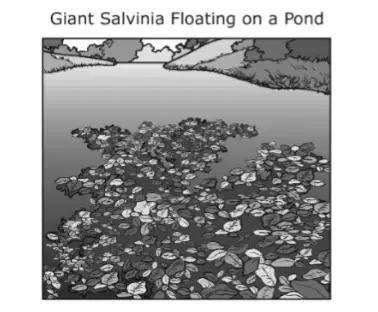
Giant salvinia is an aquatic plant that floats on water and reproduces rapidly. When these plants die, decomposition by bacteria affects oxygen levels in the water. As more plants die, less oxygen is available in the water. Students observe a pond covered by giant salvinia.
Which statement is the best prediction the students can make about the immediate future of the pond?
The depth of the water in the pond will increase.
Fish populations in the pond will begin to decrease.
The amount of bacteria in the pond will suddenly decrease.
The number of different types of plants around the pond will increase.
Plants grow in many different shapes and sizes. Much of their shape depends on an internal structure that is composed of carbon-containing molecules such as cellulose and lignin. Plants that have a strong internal structure can grow larger than other plants because their structure can support their size.
Plants obtain the majority of the carbon necessary for building these structural molecules from —
air
microorganisms
soil
water
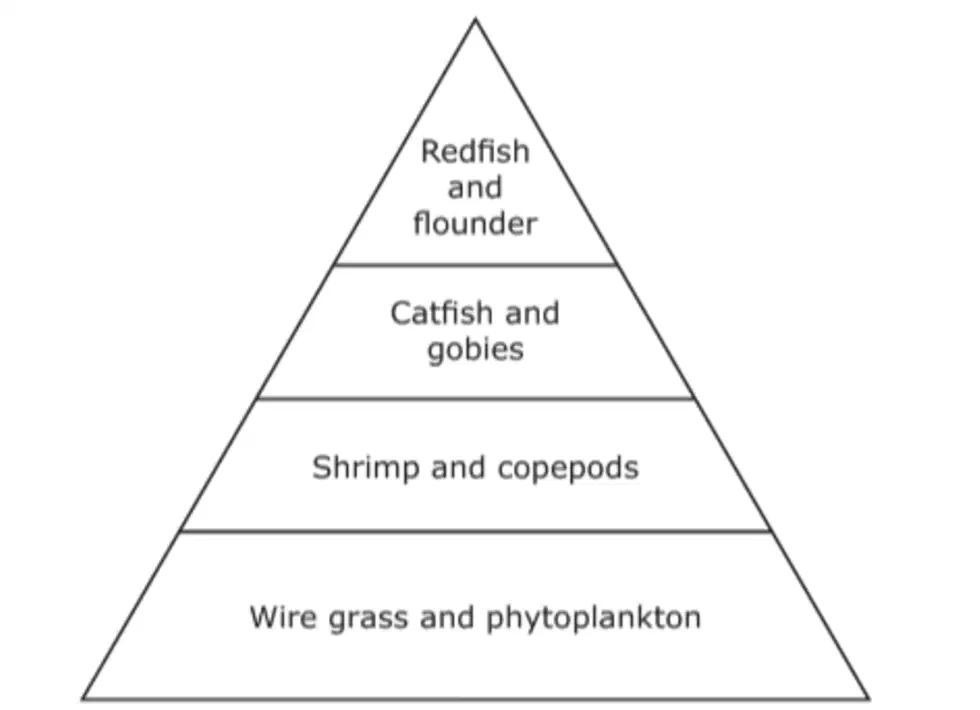
A Texas Gulf Coast energy pyramid is shown with representative organisms at each trophic level.
Which statement best describes the flow of energy through this pyramid?
The trophic level represented by catfish and gobies receives energy directly from the producers.
The trophic level represented by shrimp and copepods receives energy directly from the tertiary consumers.
The trophic level represented by redfish and flounder receives energy directly from the secondary consumers.
The trophic level represented by wire grass and phytoplankton receives energy directly from the primary consumers.

Students are investigating the characteristics of different plants. They record the characteristics in a table.
Which plant would best compete for sunlight in a rain forest environment?
Plant 1
Plant 2
Plant 3
Plant 4
Sea anemones and clown fish live together in the ocean.
Which statement best describes one way sea anemones depend on clown fish for an abiotic factor in an ecosystem?
Clown fish protect sea anemones from predatory fish.
Clown fish decrease competition among sea anemones.
Clown fish consume the remains of organisms paralyzed by sea anemones.
Clown fish move water near sea anemones when dissolved oxygen levels are low.
Immediately after a forest fire, the primary consumers in the area will compete most for which biotic factor?
Food
Space
Oxygen
Sunlight
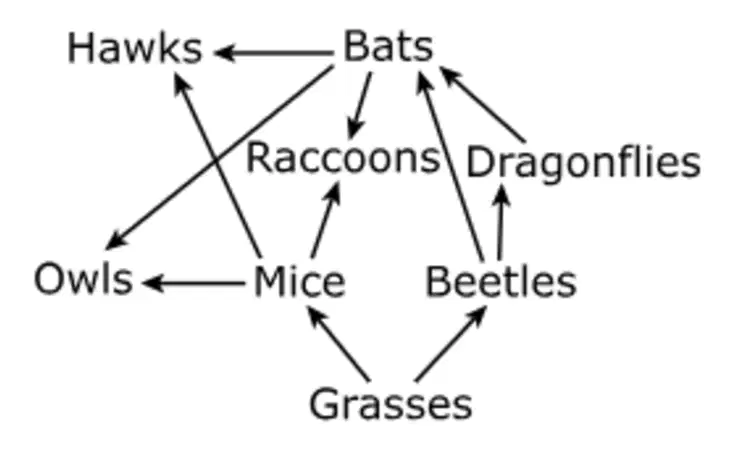
A food web is shown.
What is the total number of organisms that eat primary consumers?
Five
Six
Seven
Eight
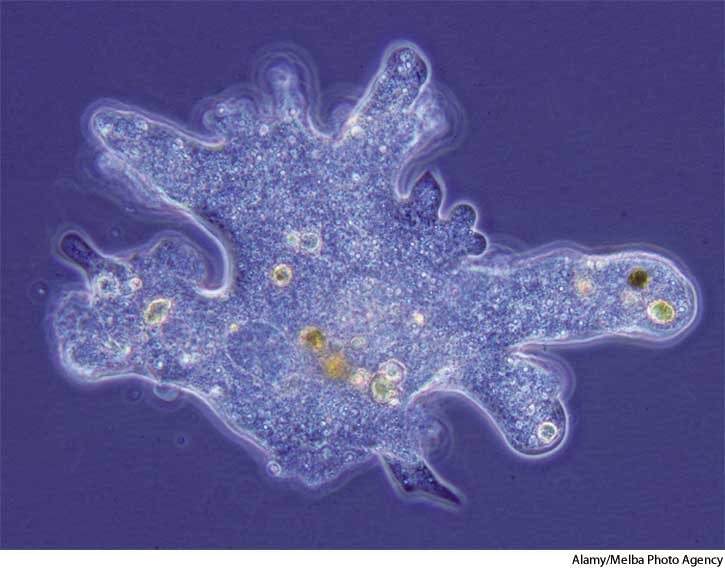
An amoeba is a unicellular, animal-like protist that lives in ponds and streams. According to cell theory, where did this cell come from?
another pre-existing amoeba cell
energy from sun that allowed the protist to reproduce
a multicellular organism
the nonliving environment
Which of the following is NOT a part of cell theory?
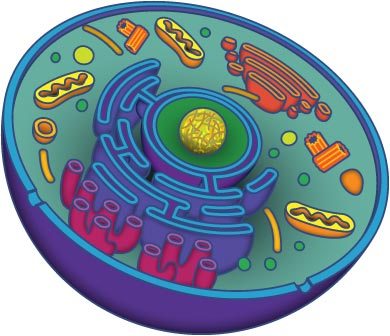
organs
What is the basic structural and functional unit of all living things?
from pre-existing and deceased cells
Cells can come from anywhere, as long as there is energy from the sun.
from a chemical reaction between atoms or molecules

All living things can move by their own power.
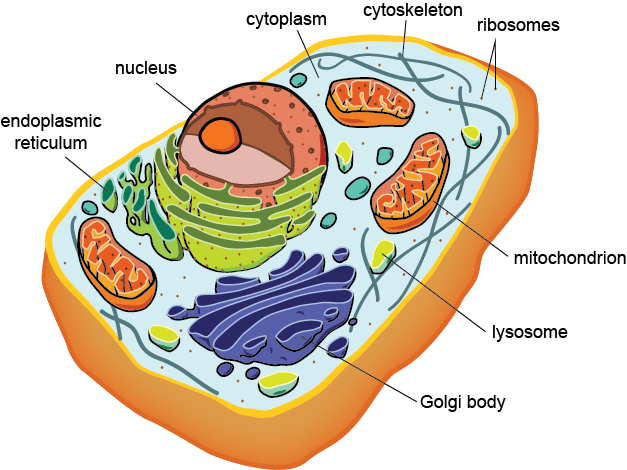
Which of the following statements is NOT part of the cell theory?
Only animals are composed of cells.
They are classified as eukaryotes.

