Wayground logo

Free Printable Worksheets

Font size

S
M
L
XL
Worksheets

Bio Fall Semester Review

Total questions: 55

Worksheet time: 44mins
Name
Class
Date
1.
Which of the following answers links a biomolecule with one of its proper functions?
a)
Lipids - Store genetic information
b)
Carbohydrates - short term energy storage
c)
Nucleic Acids - Catalyze reactions
d)
Proteins - long term energy storage
2.
Which biomolecule is made of nucleotides and include your DNA? (Hint: they carry genetic information)
a)
Carbohydrate
b)
Lipids
c)
Protein
d)
Nucleic Acid
3.
This organelle acts like a gatekeeper, allowing some materials to pass through it, but not others. 
a)
Cytoplasm
b)
Cell Membrane
c)
Mitochondria
d)
Vacuole
4.
What structure is in plant cells but not animal cells?
a)
Cell Membrane
b)
Mitochondria
c)
Cell Wall
d)
Vacuole
5.
Where is the genetic material found in the cell? 
a)
Nucleolus
b)
Cytoplasm
c)
Nucleus
d)
Chloroplast
6.

Organelles where photosynthesis occurs, are green due to chlorophyll pigment found in them.

a)

Chloroplasts

b)

Cell Wall

c)

Cell Membrane

d)

Cytoplasm

7.
Animal and Plant cells are both this type of cell.
a)
Eukaryote
b)
Prokaryote
8.
Humans shiver when they are cold to maintain
a)
cytolysis
b)
turgor pressure
c)
limbo
d)
homeostasis
9.

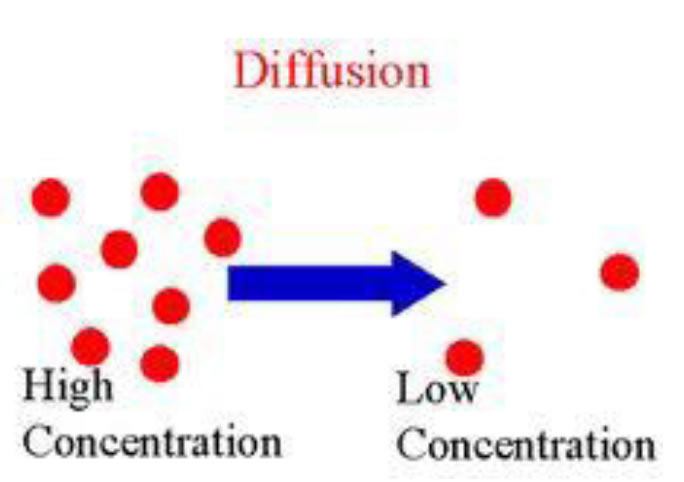
The movement of particles from an area of high to low concentration is known as--

a)

Passive Transport

b)

Active Transport

10.

Cell membrane transport that occurs without energy is called--

a)

active transport

b)

endocytosis

c)

passive transport

d)

exocytosis

11.
Osmosis is the movement of _____ across a membrane.
a)
food
b)
energy
c)
oxygen
d)
water
12.
Cellular respiration is the process by which 
a)
cells use oxygen to create energy from food
b)
plant cells create glucose
c)
cells grow and reproduce
d)
cells breakdown food without using oxygen
13.
The end products of cellular respiration are
a)
carbon dioxide, water, and ATP
b)
ATP and light energy
c)
glucose and oxygen
d)
oxygen and carbon dioxide
14.

Enzymes are an example of

a)

Lipids

b)

Carbohydrate

c)

Protein

d)

Nucleic Acid

15.
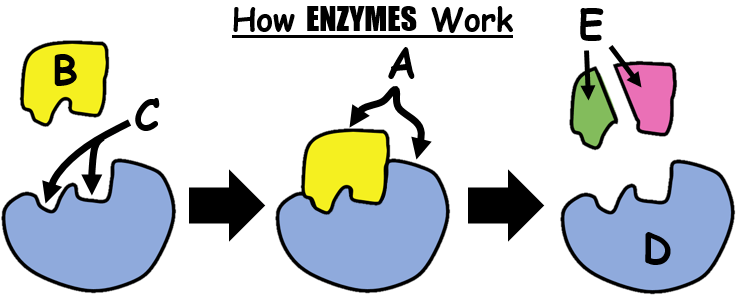
Letter D...
a)
active site
b)
enzyme
c)
substrate
d)
products
16.
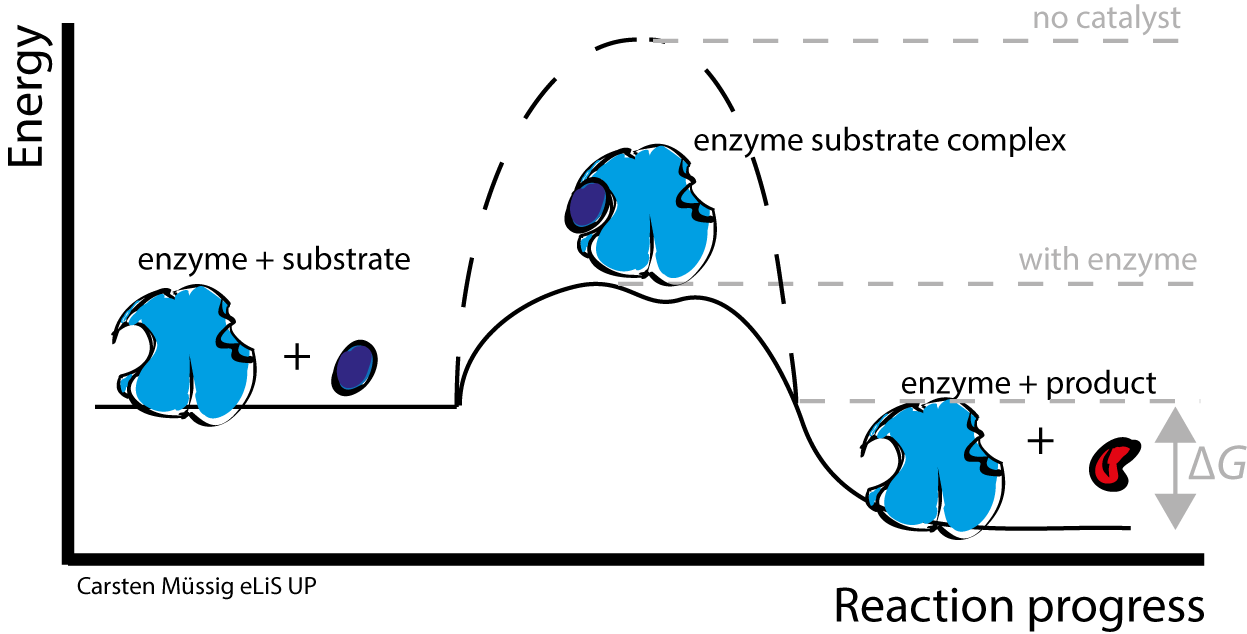
An enzyme speeds up a reaction by
a)
lowering the activation energy.
b)
raising the activation energy.
c)
releasing energy.
d)
absorbing energy.
17.

What happens when enzymes are heated to a high temperature?

a)

The enzymes die.

b)

The shape of the enzyme are changed and it denatures

c)

The enzymes' amino acid sequence changes.

d)

The enzymes remain the same

18.
What is the function of an enzyme?
a)
enzymes break themselves into small pieces
b)
enzymes slow down chemical reactions
c)
enzymes speed up chemical reactions
d)
enzymes combine products to form reactants 
19.
The picture illustrates a
a)
Prokaryotic Plant Cell
b)
Prokaryotic Animal Cell
c)
Eukaryotic Plant Cell
d)
Eukaryotic Animal Cell
20.
Which is present only in eukaryotic cells?
a)
cell membrane
b)
cytoplasm
c)
DNA
d)
nucleus
21.
How does a virus cause a person to develop the common cold?
a)
invades the host cell to reproduce
b)
removes energy from the host cell
c)
produces toxins in the host cell
d)
protects the host cell from bacteria
22.

How does a cell maintain homeostasis?

a)

By controlling what enters and leaves the cell

b)

Flexibility

c)

Protective barrier

d)

Structure and support

23.
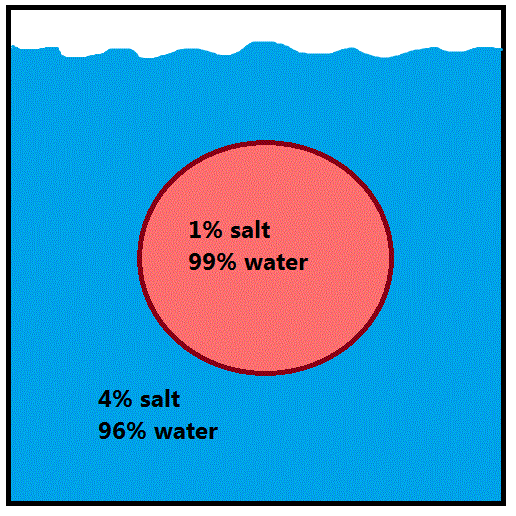
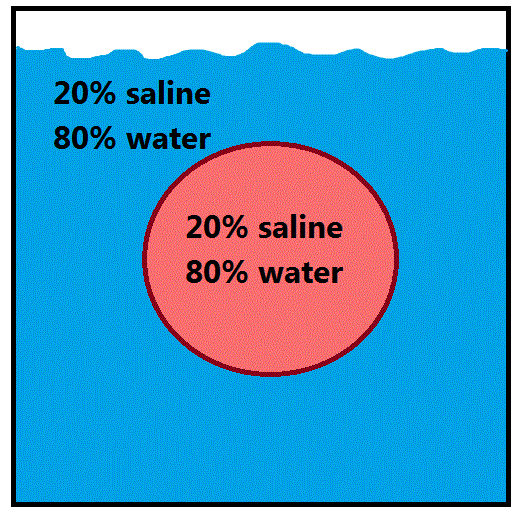
Where will the water go?
a)
Into the cell
b)
Out of the cell
c)
Equally in & out - it's isotonic
d)
There is no water
24.
A blood cell is placed into the jar, as seen. Where will the water go?
a)
Into the cell
b)
Out of the cell
c)
Equally in & out - it's isotonic
d)
The water is a lie
25.

What is the purpose of photosynthesis?

a)

To release energy

b)

To create glucose

c)

To grow

d)

To get oxygen for respiration

26.
Any change in the sequence of DNA is...
a)
transgenic shift
b)
Single Genotype
c)
Monohybrid Trait
d)
Mutation
27.
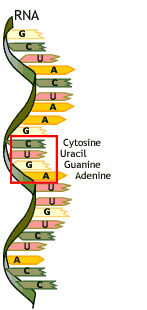
In RNA, Uracil pairs with ______. 
a)
cytosine
b)
adenine
c)
guanine
d)
thymine
28.
The process to go from DNA to mRNA is _______
a)
translation
b)
transcription
c)
replication
29.
The process to go from mRNA to a protein is called ____
a)
transcription
b)
rRNA
c)
replication
d)
translation
30.
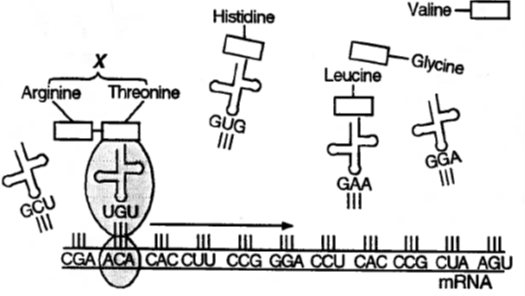
What process is going on in this photo? 
a)
Transcription 
b)
Translation 
c)
Replication 
d)
All the above 
31.
Which component of DNA determines the traits of an organism? 
a)
Nitrogen Bases
b)
Sugar-Phosphate Backbone
c)
Hydrogen bonds
32.
What is a way to become immune to a disease without first having the disease?
a)
antibiotics
b)
Anti-retroviral drugs
c)
Vaccinations
d)
Exposure Therapies
33.
Antibiotics kill viruses
a)
True
b)
False
34.
What do viruses need to reproduce?
a)
they need genetic material
b)
They need a host cell
c)
They need  bacteria
d)
They need insulin
35.
The cell spends most of it's life in ________________.
a)
Mitosis
b)
Cytokinesis
c)
Interphase
d)
None of the above
36.
In the S stage of interphase....
a)
The cell grows
b)
The nucleus divides
c)
The cell membrane divides
d)
The DNA is replicated
37.
Which of the following is the correct order for the phases of the cell cycle?
a)
G1, M, G2, C, S
b)
S, G1, G2, M, C
c)
G1, G2, S, M, C
d)
G1, S, G2, M, C
38.
a)
Anaphase
b)
Cytokinesis
c)
Telophase
d)
Metaphase
39.
a)
Cytokinesis
b)
Interphase
c)
Anaphase
d)
Metaphase
40.

What is the purpose of the cell cycle?

a)

Growth of an organism and Repair of damaged tissue

b)

To help the body get rid of extra cells

c)

To increase the amount of classwork you have to do

d)

To get rid of the nucleus

41.
During which part of the cell cycle does the cell divide?
a)
Interphase
b)
Mitosis
c)
S phase
42.

What happens during the stage labeled C?

a)

S Phase - DNA is copied

b)

G2 Phase - DNA is copied

c)

Metaphase - chromosomes line up in the middle of the cell

d)

S Phase - cell makes organelles for division

43.

What is the purpose of the checkpoints in the cell cycle? Select all that apply:

a)

To regulate the process and check for abnormalities

b)

Prevent water from entering the cycle

c)

Prevent unhealthy cells from continuing on the the cycle

d)

Prevent uncontrolled growth

44.

What causes cancer?

a)

Errors in the regulatory process of the cell cycle that results in uncontrolled cell growth

b)

There is no known cause for cancer

c)

Viruses and other pathogens

d)

Catching it from someone you know that has cancer

45.

Substances or radiation that is known to produce or promote cancer are called

a)

carcinogens

b)

kinases

c)

cyclins

d)

malignancies

46.

What is the main focus of cancer treatments?

a)

Destroying cancer cells with radiation

b)

Targeting cells that divide frequently

c)

Promoting cell communication

d)

Increasing cell growth

47.

What is mitosis?

a)

The splitting of the cytoplasm

b)

The replication of DNA

c)

The growth of cells

d)

The division of cells to make more cells

48.

Which one leaves the nucleus?

a)

mRNA

b)

tRNA

c)

DNA

49.
Which of the following units are repeatedly joined together to form a strand of DNA? (This is the MONOMER of DNA.) 
a)
amino acids
b)
nucleotides
c)
fatty acids
d)
polysaccharides
50.
A process in which DNA has the unique ability to make an exact copy of itself.
a)
Replication
b)
Translation
c)
Transcription
51.
What are the three components of a nucleotide?
a)
sugar, hydrogen, nitrogen base
b)
sugar, oxygen, nitrogen base
c)
sugar, phosphate, nitrogen base
d)
sugar, phosphate, protein
52.
One difference between DNA and RNA is that RNA....
a)
is double stranded 
b)
contains the base Thymine
c)
contains the base Uracil 
d)
contained the base Guanine
53.
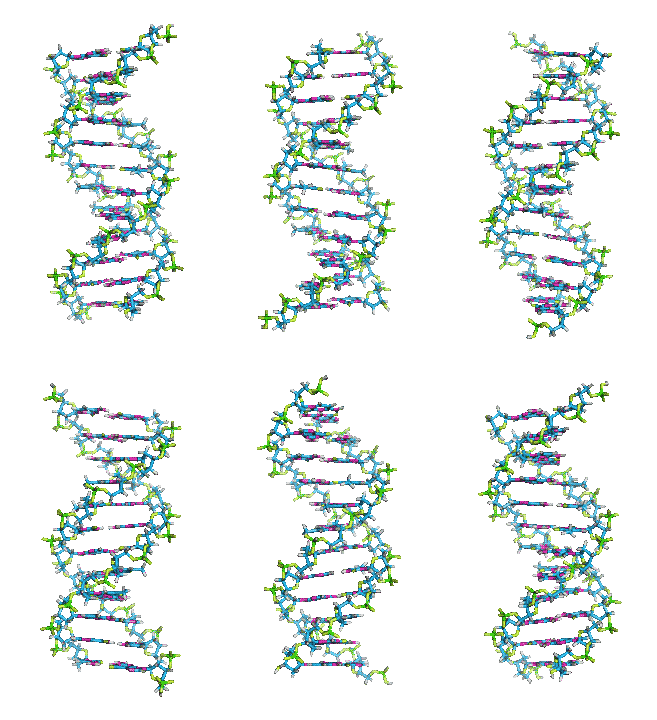
Which process is happening in this picture?
a)
Transcription
b)
Translation
c)
Replication
54.
Which of the following molecules is created during TRANSCRIPTION?
a)
Protein
b)
DNA
c)
mRNA
d)
tRNA
55.

A type of nucleic acid found in the nucleus that is responsible for an organism's traits.

a)

DNA

b)

RNA

c)

protein

d)

lipid