
 Worksheets
MI Semester 1 Final Exam Practice Test
Total questions: 80
Worksheet time: 40mins
Name
Class
Date
1.
Most vaccinations attempt to provide immunity by exposing you to a(n) ____.
a)
pathogen
b)
B-cell
c)
antibody
d)
memory cell
2.
Most vaccinations are administered via _______.
a)
a gene gun
b)
an injection
c)
a nasal spray
d)
a transdermal patch
3.
Covers the opening of the cochlea, receives vibrations from the ossicles
a)
oval window
b)
auditory canal
c)
cochlea
d)
pinna
e)
eustachian tube
4.
Which of the following is an example of qualitative data?
a)
height in cms
b)
weight in lbs
c)
color
d)
number of patients with a disease
5.
Which of the following is quantitative data?
a)
observations
b)
texture
c)
intensity of color change
d)
number of patients with a disease
6.
What is the first step in the ELISA testing process?
a)
adding substrate
b)
getting a sample from the patient
c)
adding primary antibody
d)
washing away unbound proteins
7.
What is the purpose of adding detergent in the ELISA process?
a)
to bind the secondary antibody
b)
to cause a color change
c)
to wash out unbound proteins
d)
to bind the primary antibody
8.
In a serial dilution, which tube will have the lowest concentration?
a)
Tube 1
b)
Tube 2
c)
Tube 3
d)
Tube 4
9.
What does ELISA stand for?
a)
Enzyme-Linked Immunosorbent Assay
b)
Enzyme-Limited Isolation and Synthesis Assay
c)
Enzyme-Lateral Immunosorben Assay
d)
Enzyme-Lateral Isolation and Synthesis Analysis
10.
How can serial dilutions be used in an outbreak investigation?
a)
to identify the source of the outbreak
b)
to determine the pathogen's genome
c)
quantify the concentration of a pathogen
d)
to enhance the color change in ELISA
11.
Which of the following best describes an outbreak?
a)
a single case of a rare disease
b)
widespread occurrence of a disease in a community
c)
a genetic disorder passed through generations
d)
a disease with no known cause
12.
Which of the following best defines genome?
a)
a type of vaccine
b)
an immune response trigger
c)
a cellular enzyme
d)
complete set of genes or genetic material
13.
What is bioinformatics used primarily for in medical research?
a)
collecting environmental data
b)
analyzing biological data
c)
treating bacterial infections
d)
developing medical devices
14.
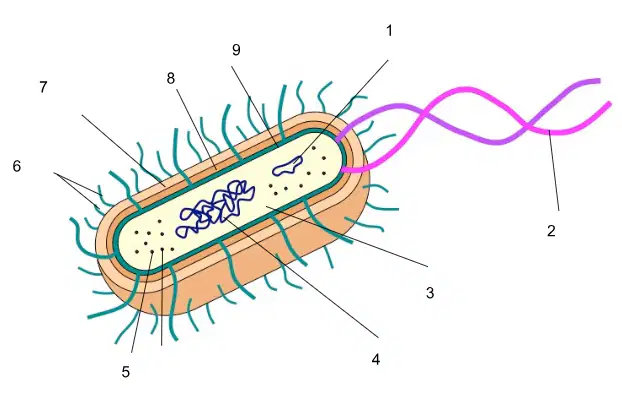
Use this picture to answer questions for this section. What is 1 pointing to?
a)
plasmid
b)
pili
c)
capsule
d)
cell wall
e)
cell membrane
15.
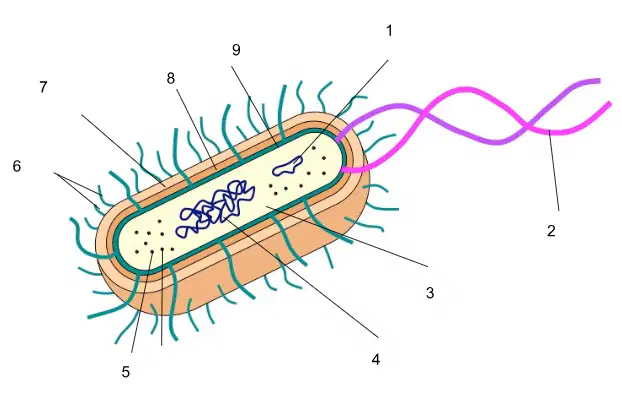
What is 2 pointing to?
a)
flagellum
b)
pili
c)
capsule
d)
cell wall
e)
cell membrane
16.
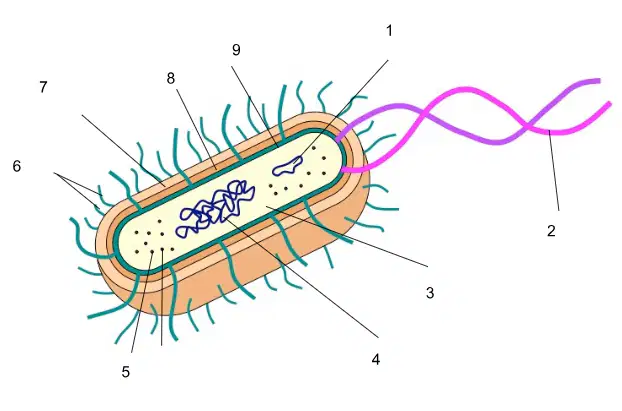
What is 3 pointing to?
a)
cytoplasm
b)
pili
c)
capsule
d)
cell wall
e)
cell membrane
17.
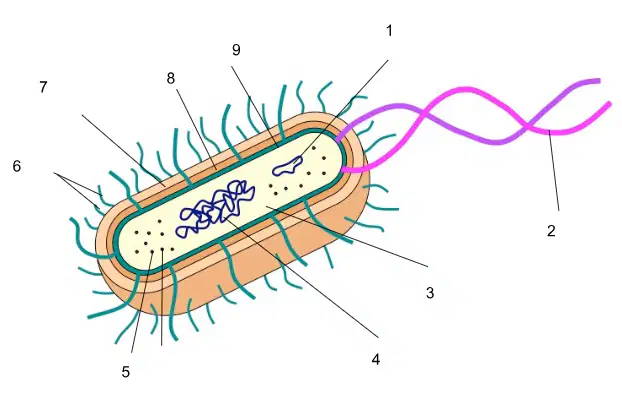
What is 4 pointing to?
a)
nucleoid
b)
pili
c)
capsule
d)
cell wall
e)
cell membrane
18.
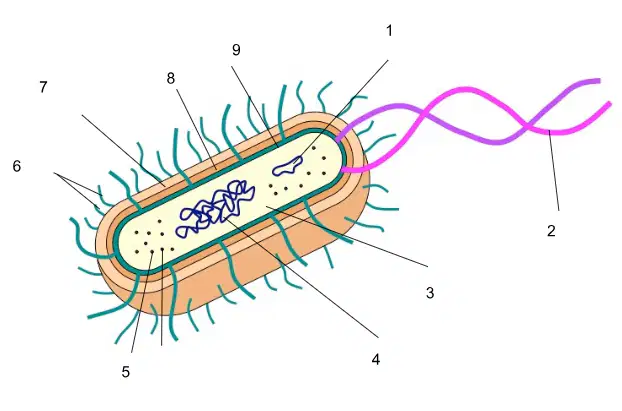
What is 5 pointing to?
a)
ribosome
b)
pili
c)
capsule
d)
cell wall
e)
cell membrane
19.
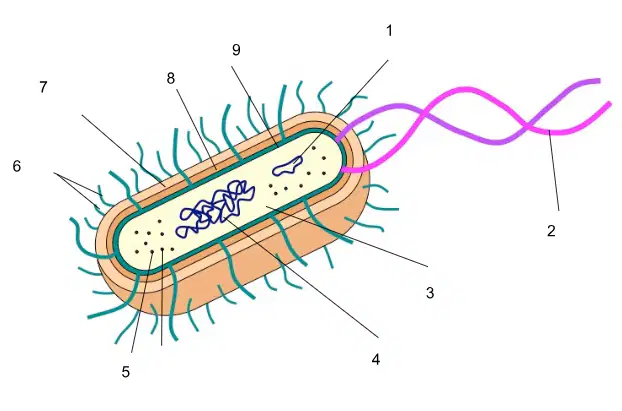
What is 7 pointing to?
a)
capsule
b)
pili
c)
cell wall
d)
cell membrane
e)
plasmid
20.
This is a rigid structure that provides support for the cell.
a)
cell wall
b)
pili
c)
plasmid
d)
flagellum
e)
ribosome
21.
This is a small ring of DNA separate from the majority of the DNA inside the cell.
a)
plasmid
b)
capsule
c)
cell wall
d)
cell membrane
e)
cytoplasm
22.
These are used to synthesize (make) proteins.
a)
ribosome
b)
pili
c)
capsule
d)
cell wall
e)
cell membrane
23.
This is the very outside of the bacterial cell. It allows things in and out of the cell.
a)
capsule
b)
pili
c)
cell wall
d)
plasmid
e)
cytoplasm
24.
This is a long tail on the cell that moves to provide movement for the cell.
a)
flagellum
b)
pili
c)
capsule
d)
cell wall
e)
cell membrane
25.
This is the innermost protective layer of the cell. All cells contain one of these.
a)
pili
b)
cell membrane
c)
plasmid
d)
flagellum
e)
ribosome
26.
This is the liquid goo that all organelles float around in on the inside of the cell.
a)
cytoplasm
b)
pili
c)
capsule
d)
cell wall
e)
cell membrane
27.
Which of these shows up dark purple?
a)
gram -
b)
gram +
28.
Which of these is more common?
a)
gram -
b)
gram +
29.
Which of these is more antibiotic resistant?
a)
gram -
b)
gram +
30.
These work by inhibiting enzymes that help produce the cell wall.
a)
B-lactams
b)
Tetracyclines
c)
Fluoroquinolones
d)
Sulfonamides
31.
Pressure regulator of the middle ear, also acts as a drainage system for excess fluid
a)
eustachian tube
b)
cochlea
c)
oval window
d)
pinna
e)
tympanic membrane
32.
Small bones in the ear that pass along a vibration
a)
eustachian tube
b)
ossicles
c)
cochlear nerve
d)
vestibular nerve
e)
sensory hair cells
33.
spiral shaped cavity in the ear that translates vibrations into electrical impulses
a)
cochlea
b)
auditory canal
c)
oval window
d)
pinna
e)
cochlear nerve
34.
Filled with liquid and maintains the body's equilibrium and balance
a)
vestibule
b)
cochlea
c)
pinna
d)
ossicles
e)
cochlear nerve
35.
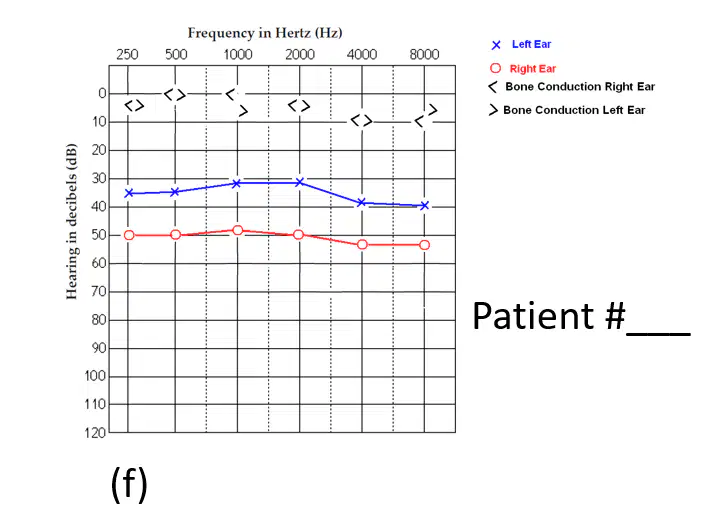
What type of hearing loss does the patient below have?
(Red: Right Ear, Blue: Left Ear)
Normal Hearing Loss: 0-20 dB
Mild Hearing Loss: 21-40 dB
Moderate Hearing Loss: 41-55 dB
Moderate to Severe Hearing Loss: 56-70 dB
Severe Hearing Loss: 71-90 dB
Profound Hearing Loss: >90 dB
a)
Mild to moderate sensorineural hearing loss in both ears
b)
Severe conductive hearing loss in both ears
c)
Mild to moderate conductive hearing in both ears
d)
Moderate sensorineural hearing loss in both ears
36.
___________ hearing loss results from interference with the transmission of sound waves.
a)
Sensorineural
b)
Conductive
37.
A hearing aid _______.
a)
is the same as a cochlear implant.
b)
amplifies the sounds from the environment.
c)
works the same way for everyone.
38.
A case-control study is also called a(n) ____.
a)
retrospective study
b)
prospective study
c)
epidemiology study
d)
cohort study
39.
Epidemiologists are primarily responsible for:
a)
creating vaccinations
b)
administering vaccinations
c)
treating diseased patients
d)
designing disease treatment and prevention strategies
40.
A mother passes immunity to her infant child through the act of breast feeding; this is classified as what type of immunity?
a)
active
b)
inherited
c)
passive
d)
acquired
41.
___________ is the type of gene therapy when a dysfunctional gene is turned off, eliminating the impact of the protein.
a)
Insertion
b)
Disable
c)
Repair
42.
An image of an individual's chromosomes is called a _____.
a)
Amniocentesis
b)
Karyotype
c)
CVS
d)
PAPP-A
43.
This test involves using a large needle to extract and test part of the placenta.
a)
Chorionic Villi Sampling
b)
hCG
c)
Cell-free DNA Analysis
44.
What genetic disorder can be revealed by Nuchal Translucency (NT Ultrasound) testing?
a)
Down Syndrome
b)
Gestational Diabetes
c)
Spina Bifida
d)
Preclampsia
45.
What is hCG testing used for?
a)
Confirm pregnancy
b)
Detect ectopic pregnancy
c)
Confirm gestational age
d)
All of these
46.
Blood drawn from the mother's arm is tested for PAPP-A (Pregnancy-Associated Plasma Protein-A). Why?
a)
Screens for chromosome disorders such as Trisomy 21 and 18.
b)
Screens for the likelihood of developing gestational diabetes
c)
Confirms gestational diabetes
47.
This second-trimester test helps determine the risk of spina bifida, anencephaly, and other neural tube defects.
a)
AFP (Alpha Fetoprotein)
b)
Chorionic Villi Sampling
c)
Amniocentesis
d)
Glucose test
48.
This second-trimester test involves sampling the fluid around the fetus.
a)
Amniocentesis
b)
Anatomy ultrasound
c)
AFP
d)
Glucose test
49.
What is the advantage of cell-free DNA analysis?
a)
Does not pose a risk to the fetus
b)
Gives results within minutes
c)
Determines gestational diabetes risk in minutes
d)
Uses a smaller needle for amniocentesis
50.
Mara has a genetic code of AAAGGGCCC. Piotr has a genetic code of TAAGGGCCC. Most people have the code GAAGGGCCC What is this?
a)
Multi-start allele
b)
Single-nucleotide polymorphism
c)
Poly-start alternating alleles
51.
What career would involve speaking with people about their genetic information and how it could affect them or their children?
a)
DNA analyst
b)
genetic counselor
c)
genome coordinator
d)
head cat wrangler at the moscow zoo
52.
What is the name for the project that sequenced all the human genes?
a)
Total DNA Library
b)
Human Genome Project
c)
Sue's Cells
d)
HeLa Complete Sequencing Coordination
53.
What is a characteristic of a genetic disease?
a)
it can show up in a child whose parents seem normal
b)
it is the result of mutations in the genes
c)
it can be inherited
d)
all of the above
54.
What can be tested BEFORE a baby is born?
a)
Both the parents' and the baby's DNA
b)
Only the Mother's DNA
c)
Only the parents' DNA
d)
Only the baby's DNA
55.
What does PCR (polymerase chain reaction) do?
a)
cuts DNA at a specific site
b)
makes many copies of a piece of DNA
c)
combines many separate pieces of DNA into a larger piece
d)
unzips DNA to make two strands that are half as wide
56.
What does a gene do?
a)
creates new cells
b)
contains the instructions to make a protein
c)
causes a cell to create (make) DNA
d)
None of these
57.
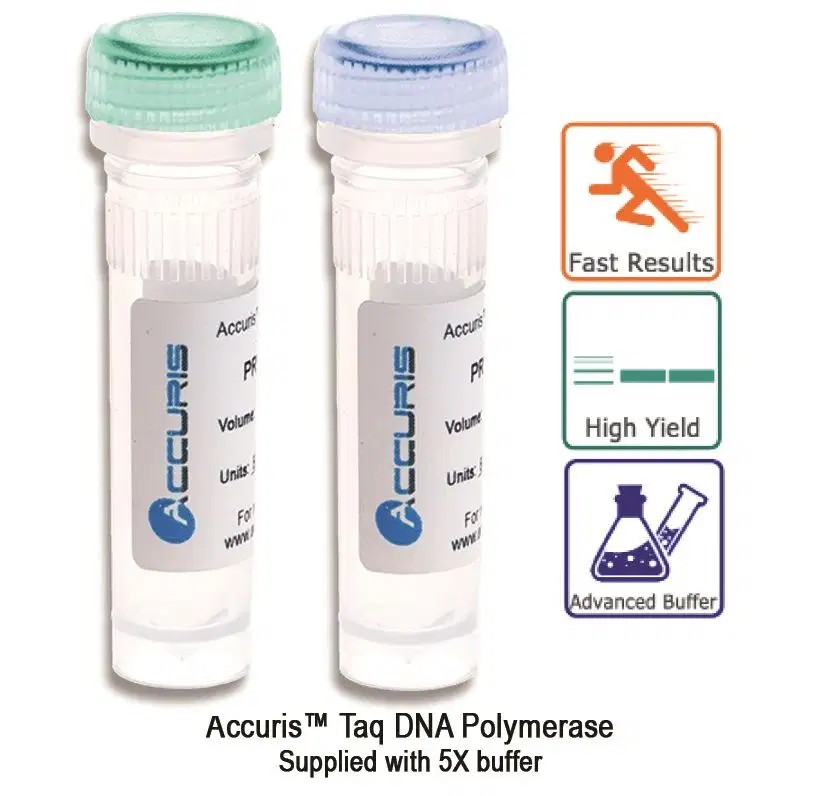
You order two tubes of Taq for your PCR labs. What is the function of Taq Polyermase?
a)
creates double-stranded DNA from the single stranded DNA.
b)
causes the DNA strand to separate into two single-stranded DNAs
c)
connects the two single-stranded DNAs into a double-stranded DNA
d)
None of these are used
58.
What is the function of a primer?
a)
it attaches to the single-stranded DNA, making a short double-stranded section so the polymerase can work
b)
it splits the double-stranded DNA into two single strands
c)
PCR does not use primer, it's only a type of paint.
d)
it adds individual nucleotides to the single-stranded DNA, making it double-stranded.
59.
What are the three steps of a PCR cycle?
a)
denaturation, annealing, extension
b)
initiation, copying, purifiction
c)
binding, replication, separation
d)
initiation, copying, replication
60.
You want to copy a gene for Hemoglobin protein. There is a binding site at each end for the primers, and you are ready to copy it! What do you call the piece of DNA you want to copy?
a)
target sequence
b)
replication region
c)
primer
61.
What is a typical temperature cycle for PCR?
a)
heat to 95C, cool to 45C, warm to 68C, then repeat.
b)
heat to 72C, keep there for 5 minutes, then heat to 80C, cool to 72, and repeat.
c)
cool to 32C, warm to 88C, cool to 45C, and repeat 5 times.
62.
In the lab, where did you get your DNA? We did not do the lab, but this is in the protocol and video.
a)
A drop of blood from a fingertip
b)
Cheek cells in your mouth
c)
The end of a piece of hair
d)
None of these; your DNA would not be used in the lab
63.
In this lab, you needed to digest (cut) the pieces of DNA. What is used to cut the DNA?
a)
Restriction Enzymes
b)
Taq Polymerase
c)
Centrifuge
d)
None of these are used
64.
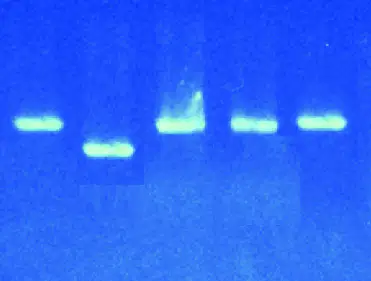
In this image, how many different lengths of DNA are shown?
a)
only one; they are all the same color and size
b)
two; one is shorter, the other four are longer and the same length
c)
two; four are shorter and the same length, the other one is longer
65.
This lab studied the ability of people to taste what chemical? They could only taste it if they had the genes for it. (Think the paper strips you tasted.)
a)
PTC
b)
DNA
c)
gels
d)
restriction enzymes
66.
How is a mother tested for gestational diabetes?
a)
Blood screen, then drink glucose, then test blood glucose over the course of three hours.
b)
Urine test after 24 hours of fasting
c)
Amniocentesis; the placental extract indicates elevated insulin
d)
This is not a test given to a pregnant woman.
67.
What is a vector?
a)
Used to move DNA into cells
b)
single-stranded DNA
c)
double-stranded DNA
68.
This means of moving DNA can only infect dividing cells and has a max size of 8000 bp. What is it?
a)
Retrovirus
b)
Naked DNA
c)
Herpes Simplex Virus
d)
Liposome
69.
What is a big advantage of CRISPR?
a)
All of these are true
b)
It can be done in living cells
c)
The new gene goes into the person's DNA
d)
It can be used to replace or destroy a gene that causes problems
70.
___________ is the type of gene therapy when a functional gene is given to a patient, providing their body with the means to make a functional protein.
a)
Insertion
b)
Disable
c)
Repair
71.
Changing a person's genes to prevent or fix a problem
a)
metastasis
b)
gene therapy
c)
genetic disruption
d)
all of these
72.
Your assistant only got a small DNA sample. If you are doing a genetic test and your small DNA sample has been obtained, what is your next step?
a)
a. PCR to purify DNA
b)
b. PCR to make copies of DNA
c)
c. Electrophoresis to analyze DNA
d)
d. ELISA to quantify DNA
e)
Both c and d are correct
73.
A group of MI students did a lab to detect the PTC gene with PCR and gel Electrophoresis, which is good at predicting diseases caused by an SNP. We found the appropriate restriction enzyme for the sequence which allowed us to distinguish between those who had the gene, and those who did not.
Which type of genetic disorder can be detected with the methods described above?
a)
single gene disorder
b)
multifactorial
c)
mitochondrial
d)
chromosomal
74.
___________ is the type of gene therapy when a dysfunctional gene is fixed so that it is able to produce a functional protein.
a)
Insertion
b)
Disable
c)
Repair
75.
A group of MI students did a lab to detect the PTC gene with PCR and gel Electrophoresis, which is good at predicting diseases caused by an SNP. We found the appropriate restriction enzyme for the sequence which allowed us to distinguish between those who had the gene, and those who did not.
Which of these diseases can be detected with the methods described above?
a)
a. Tay-Sach's
b)
b. Sickle Cell Anemia
c)
c. Down Syndrome
d)
Both a and b
e)
76.
Combining a sperm and egg to fertilize the egg, but in a petri dish or test tube
a)
egg-errific!
b)
external fertilization
c)
in vivo
d)
in vitro
77.
A couple has several embryos that they are ready to transfer to the uterus. However, both parents carry some genetic diseases. Their doctor recommends checking the embryos for genetic problems before implanting them. They agree. What procedure is most likely to tell them if an embryo is genetically healthy?
a)
PGD
b)
Reproductive Cloning
c)
IVF
d)
Somatic Cell Nuclear Transfer
78.
What is true of PGT
a)
it is done before pregnancy
b)
it checks an embryo for problems before implantation
c)
it is very expensive
d)
all of these
79.
This means of moving DNA needs a helper virus. It integrates into a single region of chromosome 19 about 95% of the time.
a)
Adeno-associated virus
b)
Adenovirus
c)
Naked DNA
d)
Liposome
80.
This means of moving DNA uses double-stranded DNA. It can contain up to 20,000 bp of information and does not enter the hosts genome.
a)
Herpes Simplex Virus
b)
Adenovirus
c)
Retrovirus
d)
Liposome
100 %

