
 Worksheets
Honors Chemistry Midterm 2025
Total questions: 80
Worksheet time: 2hrs 45mins
Who concluded that electrons orbit the nucleus in specific shells?
John Dalton
Rutherford
Thompson
Bohr
According to Democritus' atomic theory, atoms are _________.
indivisible and indestructible
composed of protons, neutrons, and electrons
arranged in a plum pudding structure
located in the nucleus

This model was the first to show a nucleus, consisting of protons and neutron. Electrons surround the nucleus but are not shown in distinct energy levels.
Democritus's model of the atom
The "Rutherford Model" of the atom
The "Plum Pudding Model" of the atom
The "Quantum Mechanical Modell" of the atom
The "Golf ball Model" of the atom
John Dalton was the first person recorded as thinking that matter was ultimately composed of atoms.
True
False
You can continually divide matter into smaller and smaller pieces without ever coming to an end.
True
False
In all atoms, the number of protons is the same as the:
mass number
atomic number
number of neutrons
Any two atoms that have the same number of protons:
have the same overall charge
belong to the same element
belong to the same isotope
have the same mass number

How many electrons does an Iodine atom have?
53
126
73
179
What is the average mass of this element?
An element has three isotopes. Given the abundances and relative masses, calculate the average atomic mass and determine (from the periodic table) which element it is.
Abundances | Relative masses
0.005% | 234.04 amu
0.720% | 235.04 amu
99.275% | 238.05 amu
Uranium (#92, Atomic Mass: 238.03 amu)
Fluorine (#9, Atomic Mass: 19.00 amu)
Mercury (#89, Atomic Mass: 200.59 amu)
Polonium (#84 209 amu)
1s22s22p63s2
1s22s22p63s23p64s23d10
[Xe] 6s25d9

This orbital diagram represents
Sodium
Magnesium
Aluminum
Iron
Elements in group 1 of the periodic table are commonly referred to as what?
Halogens
Noble Gases
Alkali Metals
Alkaline Earth Metals.
Elements in group 2 of the periodic table are commonly referred to as what?
Halogens
Noble Gases
Alkali Metals
Alkaline Earth Metals.
Elements in group 17 of the periodic table are commonly referred to as what?
Halogens
Noble Gases
Alkali Metals
Alkaline Earth Metals.
Elements in this group classification tend to be poor electrical and thermal conductors.
Metalloids
Transition metals
Nonmetals
Rare earth metals
Elements in this group classification tend to have properties that are partially like metals and partially like non-metals such as the quality of semi-conductivity.
Metalloids
Transition metals
Nonmetals
Rare earth metals
Which of the following is not a property of metals?
brittle (can break apart easily)
malleable (can bend, be formed into shapes)
lustrous (shiny!)
conduct heat and electricity
Which two elements have the most similar chemical properties?
K and Na
K and Ca
K and Cl
K and S
The elements that display the greatest nonmetallic character are located toward which corner of the periodic table?
Dead center
Lower left
Lower right
Upper left
Upper right
The elements K, Ca, Se+, Kr, and Ga− all appear in Period 4 of the Periodic Table. Which arrangement, from left to right, orders them with respect to their atomic size, from largest to smallest?
K; Ca; Se+; Kr; Ga
Ca; Ga; K, Kr; Se
K; Kr; Se; Ca; Ga
K; Ca; Ga; Se; Kr
Which list arranges the elements Na, Li, K, Rb, and Cs in order of increasing ionization energy (from left to right)?
Cs; Rb; K; Na; Li
Cs; Li; Na; K; Rb
Na; Li; K; Rb; Cs
Li; Na; K; Rb; Cs

Which element in period 4 has the highest electronegativity?
potassium
calcium
copper
bromine

Which of the following halogens has the greatest electronegativity?
Chlorine (Cl)
Bromine (Br)
Iodine (I)
Astatine (At)
Definition of ionization energy is
The energy required to remove an electron
The energy required to add an electron
The ability to attract an electron
The distance from the nucleus to the outermost electron
Consider the group 1A element sodium (atomic number 11), the group 3A element aluminum (atomic number 13), and the group 7A element chlorine (atomic number 17). These elements are in period 3. How are the first ionization energies of these elements related? (least to greatest)
sodium > aluminum > chlorine
sodium < aluminum < chlorine
sodium < chlorine < aluminum
sodium > chlorine > aluminum
What is the chemical formula for a compound formed between Sodium and Fluorine?
NaF2
Na2F2
NaF
Na2F
What is the name for AlN?
Aluminum Nitride
Aluminum Nitrate
Aluminum Nitrite
Aluminum Oxide
What is the charge on iron in FeO?
+2
+3
+4
+1
What type of elements form anions?
Metals
Nonmetals
Transition Elements
Isotopes
What is the chemical formula for a compound that forms between magnesium and sulfur?
MgS
Mg2S2
Mg2S
MgS2
What is the chemical formula for barium iodide?
Ba2I
BaI
BaI2
BI
if METALS are more likely to LOSE electrons, they will form ...
anions
neutral atoms
cations
Ionic compounds conduct electricity when dissolved in water. Which statement below best explains the property?
Ions are free to move.
Electrons are free to move.
Bonds are strong.
There are weak intermolecular forces of attraction.

The following properties are all characteristics of ionic compounds EXCEPT
high melting and boiling points
soft
crystal lattice structure
conduct electricity when dissolved in water
S2O4
sulfur oxide
disulfur pentaoxide
disulfur tetraoxide
disulfide tetraoxide
nitrogen tribromide
NBr
N3Br
NBr3
N3Br
Each contains polar bonds but only one is a polar molecule
CO2
NH3
CCl4
CH4
The shape of a molecule with 4 pairs of bonding electrons
linear
tetrahedral
trigonal planar
trigonal pyramidal
Which molecule has only single bonds?
CO2
Cl2
CO
N2
A bond formed between two bromine atoms is likely to be
Ionic
Coordinate covalent
Polar
Nonpolar
Which of the following is a property of covalent compounds?
Composed of a metal and nonmetal
Low melting points
Can conduct electricity when dissolved in water
Typically solid at room temperature
What is happening with the electrons in a nonpolar covalent bond?
Electrons are being transferred from one atom to another
Electrons are being shared unequally
Electrons are being shared equally
Nothing is happening to the electrons

Which image could be a representation of NH3?
A
B
C
3. Which is a correct Lewis structure for hydrogen cyanide, HCN?


Is the following molecule polar or nonpolar?
polar
nonpolar
What is the name of the ion with the formula C2H3O2-?
Bromide
Acetate
Carbonate
Cyanide
Which ion has the formula H2PO4-?
Phosphate
Dihydrogen phosphate
Oxalate
Permanganate

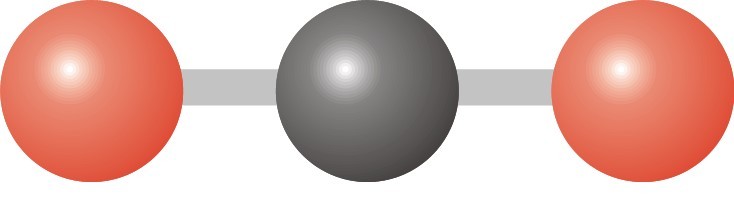
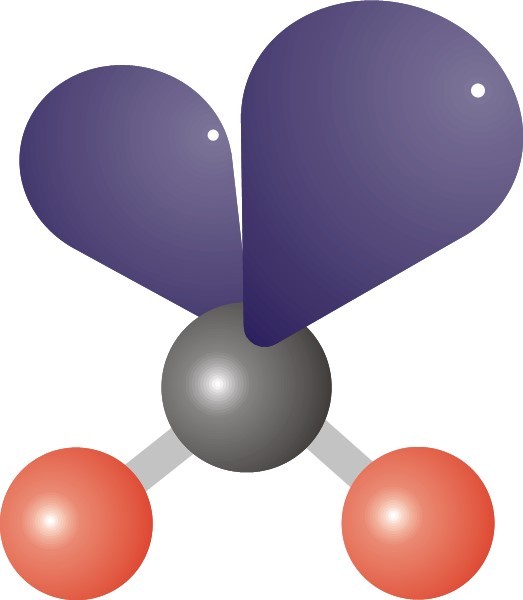
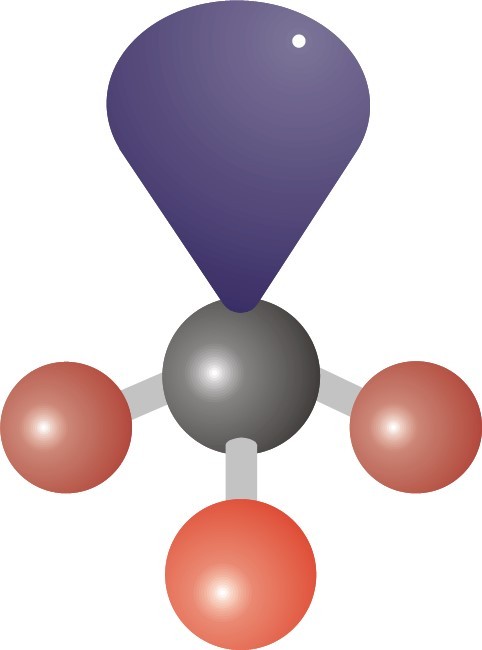

Which one of the following is the correct bond angle between atoms adopting a trigonal planar geometry?
180°
109.5°
90°
120°
Ammonia, NH3, adopts a tetrahedral geometry. However, the non-bonding pair on the central nitrogen atom distorts the bond angle away from the expected 109.5°. Which of the following statements correctly describes how the bond angle is distorted?
The actual bond angle is reduced: it is less than 109.5°
The actual bond angle is increased: it is more than 109.5°
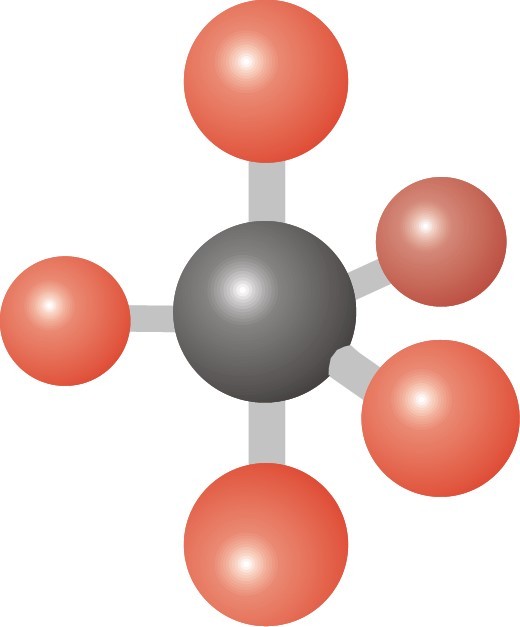
What shape is shown here?
Octahedral
Tetrahedral
Trigonal bipyramidal
Seesaw
water H2O would have what kind of electron geometry
linear
trigonal planar
tetrahedral
bent
The key step in the formation of ionic compounds is ...
electron transfer from nonmetal to metal atoms to form oppositely charged ions which are attracted to each other
electron transfer from metal to nonmetal atoms to form oppositely charged ions which repel each other
electron transfer from nonmetal to metal atoms to form oppositely charged ions which repel each other
electron transfer from metal to nonmetal atoms to form oppositely charged ions which attract each other

