
 Worksheets
MIDDLE AGES & CRUSADES REVIEW
Total questions: 45
Worksheet time: 23mins
Name
Class
Date
1.
Which major historical EVENT STARTS the Middle Ages?
a)
The 1st King of England is crowned.
b)
The Christians capture Jerusalem from the Muslims.
c)
The fall of the Western Roman Empire.
d)
The fall of the Eastern Roman Empire (Byzantine Empire).
2.
What is divine right?
a)
The code of honor that a knight lives by.
b)
The agricultural estate of a noble; that was self sufficient.
c)
A land grant a hereditary title given to vallas for their service.
d)
Kings and Queens have a God given right to rule.
3.
Which battle decided who became the 1st King of England?
a)
Battle of Bosworth Field 1485 A.D.
b)
Battle of Tours 732 A.D.
c)
Battle of Hastings 1066 A.D.
d)
D-Day 1944 A.D.
4.
Who is the Pope?
a)
Spiritual leader of the Roman catholic Church.
b)
Skilled armored warriors from noble birth.
c)
Wealthy landowners who have their own manor.
d)
Church officials who perform mass and other spiritual duties.
5.
What is a parcel?
a)
The agricultural estate of a noble; that was self sufficient.
b)
Small piece of land that serfs were allowed to live on.
c)
Isolated communities where monks lived and dedicated their lives to God.
d)
The code of honor that a knight lives by.
6.
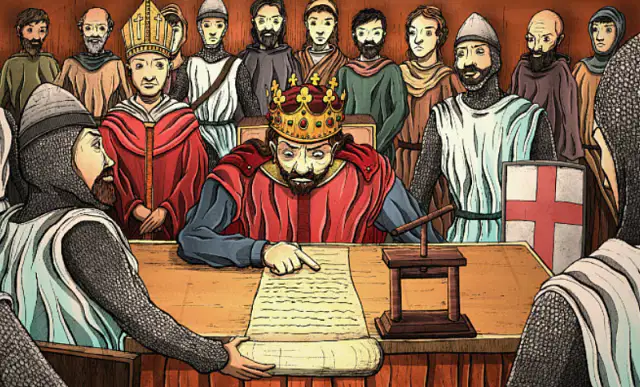
Which King of England was forced to sign the Magna Carta by the Barons and the Clergy in 1215 A.D.? He was the least popular king in England's history.
a)
King John
b)
King Richard the Lionheart
c)
William the Conqueror
d)
Charlemagne
7.
What is Parliament?
a)
All people, even the king are accountable to the law.
b)
Court order to bring an arrested person before the judge and jury.
c)
Assembly of representative who give the king advice and make the laws.
d)
A group of workers who have the same job and join together to protect their interests.
8.
What is the Rule of Law?
a)
All people even the king are accountable to the law.
b)
Court order to bring an arrested person before the judge and jury.
c)
Assembly of representative who give the king advice and make the laws.
d)
A group of workers who have the same job and join together to protect their interests.
9.
What is Habeas Corpus (Due Process)?
a)
All people even the king are accountable to the law.
b)
Court order to bring an arrested person before the judge and jury.
c)
Assembly of representative who give the king advice and make the laws.
d)
A group of workers who have the same job and join together to protect their interests.
10.
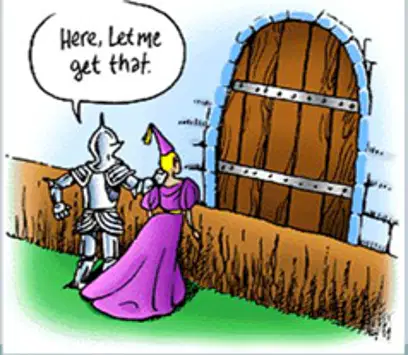
What is chivalry?
a)
The code of honor that a samurai lives by.
b)
The code of honor that a knight lives by.
c)
The agricultural estate of a noble; that was self sufficient.
d)
Kings and Queens have a God given right to rule.
11.
What is the Vatican?
a)
Name Medieval Christians called anyone who was polytheistic.
b)
Branch of Christianity led by the Emperor of the Eastern Roman Empire.
c)
Home to the Pope and the center of the Roman Catholic Church.
d)
isolated communities where monks dedicated their lives to God.
12.
What is an allegiance?
a)
A promise that must be kept.
b)
To pledge your loyalty to someone.
c)
System that governed life in the Middle Ages.
d)
Time era between 500 A.D. to 1500 A.D.
13.
What in an obligation?
a)
A promise that must be kept.
b)
To pledge your loyalty to someone.
c)
System that governed life in the Middle Ages.
d)
Time era between 500 A.D. to 1500 A.D.
14.
What is a manor?
a)
The agricultural estate of a noble; that was self sufficient.
b)
The code of honor that a knight lives by.
c)
Home to the Pope and the center of the Roman Catholic Church.
d)
Kings and Queens have a God given right to rule.
15.
What is a monastery?
a)
Name Medieval Christians called anyone who was polytheistic.
b)
The agricultural estate of a noble; that was self sufficient.
c)
Home to the Pope and the center of the Roman Catholic Church.
d)
isolated communities where monks dedicated their lives to God.
16.
Who was the 1st King of England?
a)
William the Conqueror
b)
John
c)
Richard the Lionheart
d)
Charlemagne
17.
What is the clergy?
a)
Spiritual leader of the Roman Catholic Church.
b)
Skilled armored warriors from noble birth.
c)
Church officials who perform mass and other spiritual duties.
d)
Wealthy landowners who own their own manor.
18.
What were the Crusades?
a)
Series of Holy Wars fought between Christians and Muslims.
b)
Territory in the Middle East that is sacred to Jews, Christians, and Muslims.
c)
City in the Middle East that is sacred to Jews, Christians, and Muslims.
d)
Movement by the Spanish to drive the Muslims from their lands.
19.
What is a noble?
a)
Spiritual leader of the Roman Catholic Church.
b)
Skilled armored warriors from noble birth.
c)
Wealthy landowners who own their own manor.
d)
Church officials who perform mass and other spiritual duties.
20.
What was the Black Death?
a)
Pandemic that killed 2/3 of the population in Europe; caused by infected fleas.
b)
Series of holy wars fought between Christians and Muslims.
c)
Epic battle that decided who would become the 1st King of England.
d)
Movement by the Spanish to drive the Muslims from their lands.
21.
What was the feudal system (feudalism)?
a)
A promise that must be kept.
b)
To pledge your loyalty to someone.
c)
System that governed life in the Middle Ages.
d)
Time era between 500 A.D. to 1500 A.D.
22.
Which job did 90% of the people do in Western Europe during the Middle Ages?
a)
knights
b)
monks
c)
farmers
d)
artists
e)
nobles
23.
What is a fief?
a)
The agricultural estate of a noble; that was self sufficient.
b)
The code of honor that knights live by.
c)
A land grant and hereditary title given to vassals for their service.
d)
Kings and Queens have a God given right to rule.
24.
Which major historical EVENT ENDS the Middle Ages?
a)
The 1st King of England is crowned.
b)
Christians capture Jerusalem from the Muslims.
c)
The fall of Western Roman Empire.
d)
The fall of the Eastern Roman Empire (Byzantine Empire).
25.
What is a pagan?
a)
Name that Medieval Christians called anyone who was polytheisic.
b)
Isolated communities where monks lived and dedicated their lives to God.
c)
Home to the Pope and center of the Roman Catholic Church.
d)
Branch of Christianity led by the Emperor of the Eastern Roman Empire.
26.
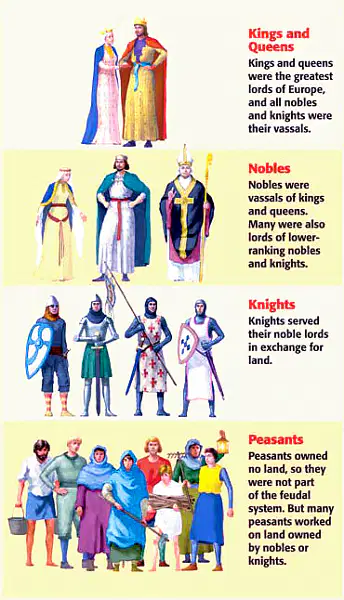
Which direction did wealth flow in the feudal system?
a)
Wealth flowed from the bottom to the top.
b)
Wealth flowed from the top to the bottom.
c)
Wealth did not change hands in the feudal system.
d)
Wealth only belonged to serfs who signed a feudal contract.
27.

Which city in the Middle East is spiritually important for Jews, Christians, and Muslims?
a)
Jerusalem
b)
Rome
c)
Paris
d)
London
28.
TRUE OR FALSE
The Roman Catholic Church gave people a common bond after the fall of Rome?
a)
TRUE
b)
FALSE
29.
Who was Charlemagne?
a)
1st King of England.
b)
King of the Franks (barbarians) who protected Christianity and Education.
c)
King forced to sign the Magna Carta.
d)
King of England who fought in the Crusades.
30.
What is a monk?
a)
Wealthy landowners who have their own manor.
b)
Skilled armored warriors from noble birth.
c)
A man who dedicated his life to God and vows to live a simple life.
d)
Kings and Queens have a God given right to rule.
31.
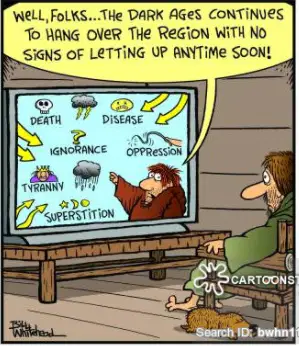
TRUE OR FALSE
Life became easier for people in Western Europe after the fall of Rome?
a)
TRUE
b)
FALSE
32.
What does it mean when we say the Magna Carta and U.S. Constitution are living documents?
a)
That the pieces of paper literally come to life.
b)
That the pieces of paper can last a lifetime then will fall apart.
c)
That the document has a shelf like and will expire on a certain day.
d)
That the document can be changed as the times and society changes by its people.
33.
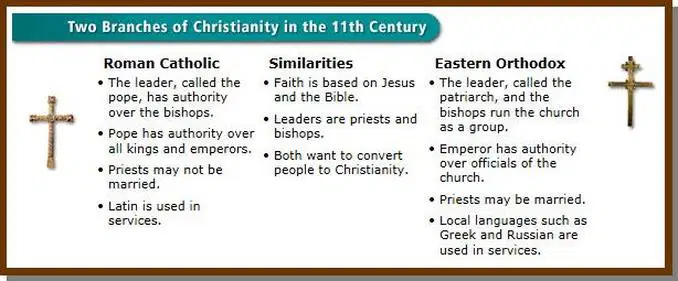
Use the chart below:
How many branches of Christianity were there in the 11th century?
a)
There was only ONE branch: Roman Catholic.
b)
There were TWO branches: Roman Catholic and Eastern Orthodox.
c)
There were TEN branches: To many types to list.
d)
There were ZERO branches: It went extinct.
34.
What is a guild?
a)
A group of workers who have the same job and join together to protect their interests.
b)
Church officials who perform mass and other spiritual duties.
c)
Assembly of representative who give the king advice and make the laws.
d)
The code of honor that knights live by.
35.
What was the major battle that stopped the Muslim incursions into Western Europe?
a)
Battle of Hastings in England 1066 A.D.
b)
Battle of Tours In France 732 A.D.
c)
D-Day In Normandy 1944 A.D.
d)
Battle of Jerusalem1485 A.D.
36.
Use the quote below:
"Serfs were tied to the land."
What is the meaning of the quote?
a)
Serfs were literally tied to the land they worked on with rope or chains.
b)
Serfs were not allowed to leave without the noble's permission and could be sold with the land.
c)
Serfs were responsible for training with the knights and dressing like nobles.
37.

Who benefitted the most from the signing of the Magna Carta in 1215 A.D. at Runnymede?
a)
The King of England gained more unlimited power by signing it.
b)
The nobles and the clergy gained rights and protection under the law.
c)
The peasants and serfs gained rights and protection under the law.
d)
Nobody benefitted from the signing of the Magna Carta.
38.
What was Pope Urban II's goal for calling the Crusades?
a)
For the Christians to recapture the Holy Land and Jerusalem.
b)
For the Muslims to defend the Holy land and Jerusalem.
c)
To convert all Muslims in the Middle East to Christianity.
d)
To make friends with the Muslims in the Middle East to trade.
39.
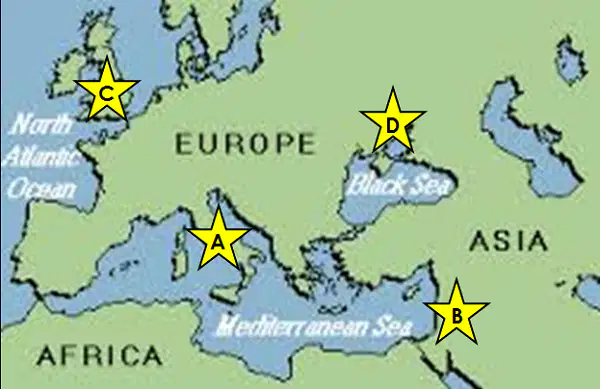
Which letter represents the Holy Land on the map?
a)
A
b)
B
c)
C
d)
D
40.
What was the result of the 1st Crusade?
a)
The Christian army conquered the Holy Land and the city of Jerusalem.
b)
The Muslim army recaptured Christian territory in the Holy Land and the city of Jerusalem.
c)
The Christians in Spain recaptured their country from the Moors (Muslims from North Africa).
d)
The Roman Catholic Church and Eastern Orthodox Church split into two.
41.
What was the result of the 2nd Crusade?
a)
The Christian army conquered the Holy Land and the city of Jerusalem.
b)
The Muslim army recaptured Christian territory in the Holy Land and the city of Jerusalem.
c)
The Christians in Spain recaptured their country from the Moors (Muslims from North Africa).
d)
The Roman Catholic Church and Eastern Orthodox Church split into two.
42.
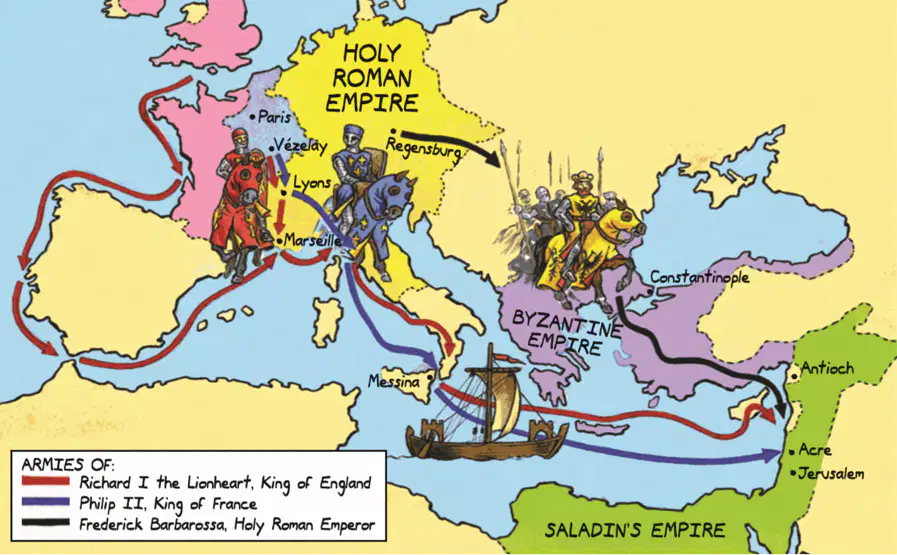
Which Crusade is represented by the image below and was known as the "Kings Crusade"? Analyze the map carefully.
a)
1st Crusade
b)
2nd Crusade
c)
3rd Crusade
d)
4th Crusade
43.
How did the Crusades impact the economy of Europe?
a)
They caused a demand for trading for goods from the Middle East and Asia.
b)
They caused people to not travel and to stay on their manor or village.
c)
They caused serfs to have to double to amount of farming they did.
d)
They caused Lords and Nobles to get more powerful in Europe.
44.
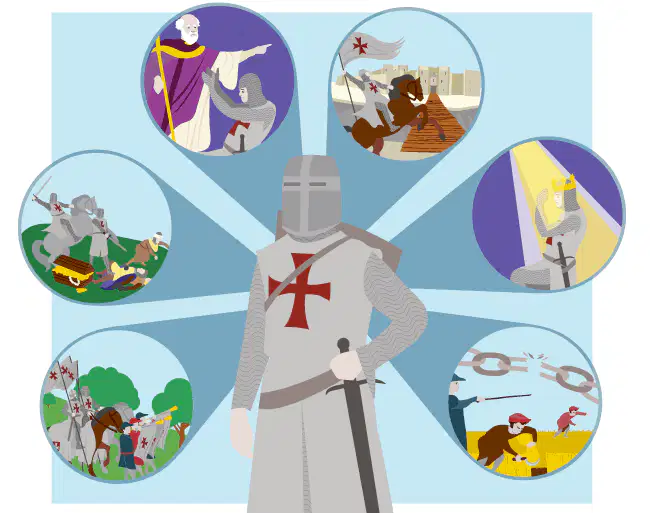
Use the image below: Which would be the BEST title for this image?
a)
"Personal Motivations to Join the Crusades"
b)
"Consequences of King John Signing the Magna Carta"
c)
"Members of the Roman Catholic Church Clergy"
d)
"Symptoms of the Black Death or Plague"
45.
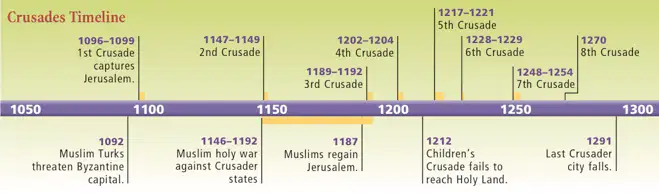
According to the timeline, how many Crusades were fought in totoal?
a)
2 Crusades
b)
4 Crusades
c)
8 Crusades
d)
10 Crusades
100 %

