
NEW
Font size
 Worksheets
Adipose Tissue
Total questions: 20
Worksheet time: 10mins
Ten days after birth, a full-term newborn boy develops firm, erythematous nodules, and plaques over his trunk, arms, buttocks, thighs, and cheeks. His mother’s pregnancy was complicated by placenta previa, and his airway was cleared of aspirated meconium immediately after birth. A biopsy of subcutaneous tissue shows necrosis within the brown adipose tissue. What metabolic activity is liable to be affected in this patient?
Export of fatty acids from fat
Thermal insulation
Oxidation of fatty acids for thermogenesis
Activation of the adenylate cyclase system
Initiation of shivering
Applied to adipocytes, the term “multilocular” refers to which of the following?
The large number of small cytoplasmic lipid droplets
The proliferation of the cells in an obese individual
The large number of mitochondria in the cells
The high density of nerves supplying the tissue
The type of mesenchymal cells also present
Why is the term “unilocular” often used to designate the characteristic cells of white adipose tissue?
Such cells are found primarily in one location in the body
The nucleus and most cytoplasm are located mostly within one location in these cells.
Triglycerides are concentrated within one large droplet or inclusion in these cells.
These cells have only one main function: storage of nutrients for energy production.
Each of these cells is normally very large and appears as a single “empty” white area by light microscopy.
The hormone-sensitive lipase in the cells of adipose tissue acts primarily on what substrate?
Glucose
Free fatty acids
Glycerol
Triglycerides
Very low-density lipoproteins
In terms of the various connective tissue types, which most commonly contains variable numbers of adipocytes?
Mucoid tissue
Areolar tissue
Pseudostratified connective tissue
Dense regular connective tissue
Reticular tissue
What substance, released from the adrenal gland and some autonomic neurons, increases lipolytic activity in white adipocytes?
Leptin
Insulin
Norepinephrine
Glycogen
Triglyceride
What is the significance of the term “uncoupling protein” as applied to a transmembrane membrane protein in brown adipocytes?
a. These cells have “uncoupled” growth from fatty acid uptake.
These cells have “uncoupled” the electron transport system from ATP formation.
This protein causes the “uncoupling” of brown adipocyte production from preadipocyte differentiation
This protein causes storage of lipids into multiple small cytoplasmic droplets rather than a single large droplet.
These cells have “uncoupled” fatty acid uptake from triglyceride formation.
The primary functional difference between white and brown adipocytes is due to what feature of these cells?
Different macromolecules used for storage in droplets of their major nutrient
Differing amounts of lipofuscin in their cytoplasm
Differing types and distributions of organelles in these two cells
Staining differences due to different amounts of rough ER in these cells
Differences in the number and enzymatic activity of mitochondria in these cells
What is one important polypeptide hormone released from white adipose tissue that has a role in regulating food intake?
Leptin
Hormone-sensitive lipase
Adiponectin
Insulin
Norepinephrine
What is the most important form of lipid storage in both white and brown adipocytes?
Free fatty acids
Cholesterol
Chylomicrons
Glycerol
Triglycerides
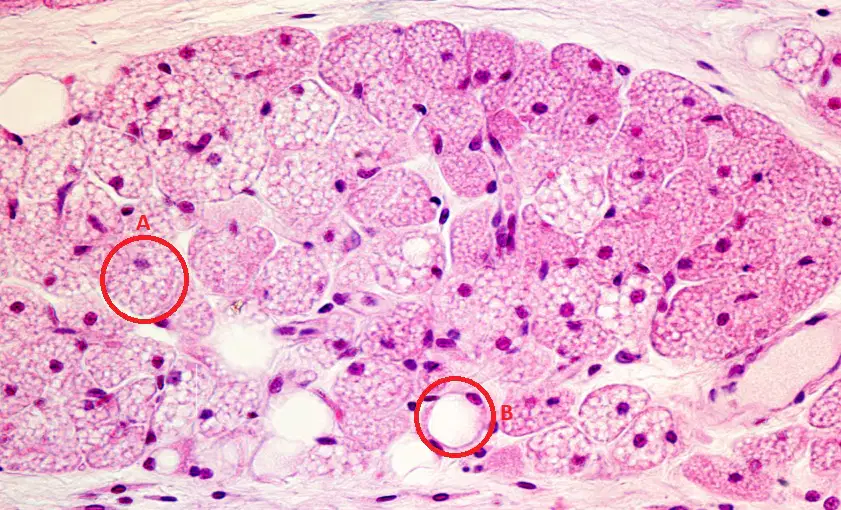
Based on the image, which of the following statements is correct?
B is more vascularized than A because it takes in both dietary and endogenous lipids via the circulation
A has a central droplet, B is known to have a signet ring appearance
A is for heat insulation, B is for heat production
A has a nucleus pushed to the periphery, B has a slightly eccentric nucleus
A has more of the energy-producing organelle than B, B contains more energy than A
In a healthy adult, adipose tissue normally represents how much of the body weight?
3%
6%
10%
20%
40%
Adipocytes develop from mesenchymal stem cells. Which of the following correctly pairs the embryonic origin of white adipocytes with the typical mechanism of adult-onset obesity?
Lateral mesoderm; Hypertrophy (increase in cell size)
Paraxial mesoderm; Hyperplasia (increase in cell number)
Ectoderm; Hypertrophy (increase in cell size)
Endoderm; Hyperplasia (increase in cell number)
Mesothelial lining; Accumulation of carotenoids
Important target cells of leptin are found in which organ?
Small intestine
White adipose tissue
Large intestine
Hypothalamus
Brown adipose tissue
What are the relatively large particles formed in the intestinal epithelial cells and rich in ingested lipids?
Fatty acids
Chylomicrons
Glycerols
Very low-density lipoproteins
Adipocytes
In a medical context the term “white fat” is best used to describe which of the following?
A macromolecule insoluble in water
A target tissue for leptin
A macromolecule synthesized in the liver and transported in very low-density lipoproteins
A specialized type of connective tissue
A tissue with cells rich in smooth ER that is abundant in the wall of the digestive system
Which of the following helps explain the selection of triglycerides as the body’s preferred form of nutrient storage?
Triglycerides are rapidly produced in the smooth ER of most cells.
As a major component of ground substance, triglycerides are readily available from the extracellular matrix of most cells.
The presence of triglycerides distinguishes white from brown adipose tissue.
A much greater number of calories can be generated from triglycerides than from an equal mass of carbohydrates or proteins.
Triglycerides are readily transferred around the body through the blood.
White adipocytes are derived developmentally from what precursor cells?
Monocytes
Fibroblasts
Mesenchymal cells
Brown adipocytes
Mast cells
Adaptation in adults to cold temperatures is best known to normally involve which of the following?
Differentiation of a small population of cells in white adipose tissue from “beige adipocytes” to “brown adipocytes”
Reorganization of the cytoplasmic lipid droplet content in white adipocytes into that of brown adipocytes
Apoptosis of white adipocytes and their replacement by brown adipocytes
Proliferation and formation of many more beige adipocytes
Increased production of free fatty acids in both white and brown adipocytes
The deep skin layer normally rich in white adipose tissue undergoes major changes if an individual must undergo a long period of starvation. These changes prominently include which of the following?
Loss of adipocytes and an increase in the population of macrophages
Conversion of white adipocytes to brown adipocytes
Decreased numbers of white adipocytes with increased numbers of cells resembling preadipocytes
Proliferation of mesenchymal cells
An increase in the number of mast cells

