
 Worksheets
Chapter 13: Borrowing and Debentures
Total questions: 57
Worksheet time: 29mins
Which statement best defines loan capital for a company?
Equity raised from ordinary shareholders
Government grants for research activities
All longer-term borrowing undertaken by a company
Short-term cash held for daily operations
A company borrows beyond directors’ delegated powers, but members later ratify the contract. Which outcome is most accurate?
The company’s assets are automatically released
The lender must convert debt into equity
The loan is void even if later approved
The lender can enforce the loan after ratification
Which option correctly distinguishes types of debentures regarding registration requirements?
Registration depends solely on interest rate; type is irrelevant
Only unsecured debentures require registration; secured never do
All debentures must be registered with the state; none are exempt
Single debentures generally need no state registration; series or debenture stock usually must be registered
In a winding up, who must be paid before shareholders and what is the main reason?
Ordinary lenders, because loans are unsecured
Debentureholders, because they are company creditors
Directors, because they authorized the debenture issue
Preference shareholders, because dividends are cumulative
Which statement best distinguishes a fixed charge from a floating charge?
Fixed is unregistrable by law; floating must never register
Fixed attaches to specific assets; floating hovers over classes
Fixed hovers over classes; floating attaches to specific assets
Fixed applies only to goodwill; floating applies only to land
Which of the following is commonly a registrable charge?
A charge over receivables or book debts
A charge for rent over land only
A charge over paid-up share capital
A charge over employees’ monthly salaries
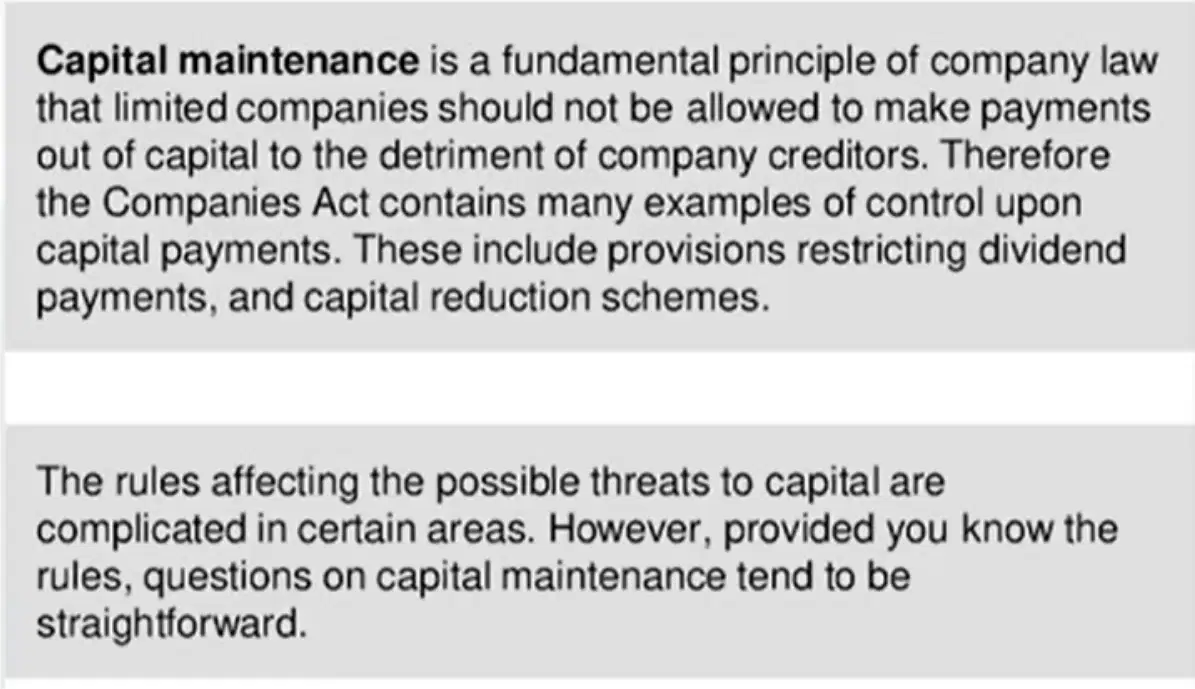
Which statement best describes the capital maintenance principle in company law?
Limited companies should not make capital payments harming creditors
Creditors must approve all dividend payments in general
Companies may freely return capital to shareholders anytime
Directors must maximize dividends every financial period
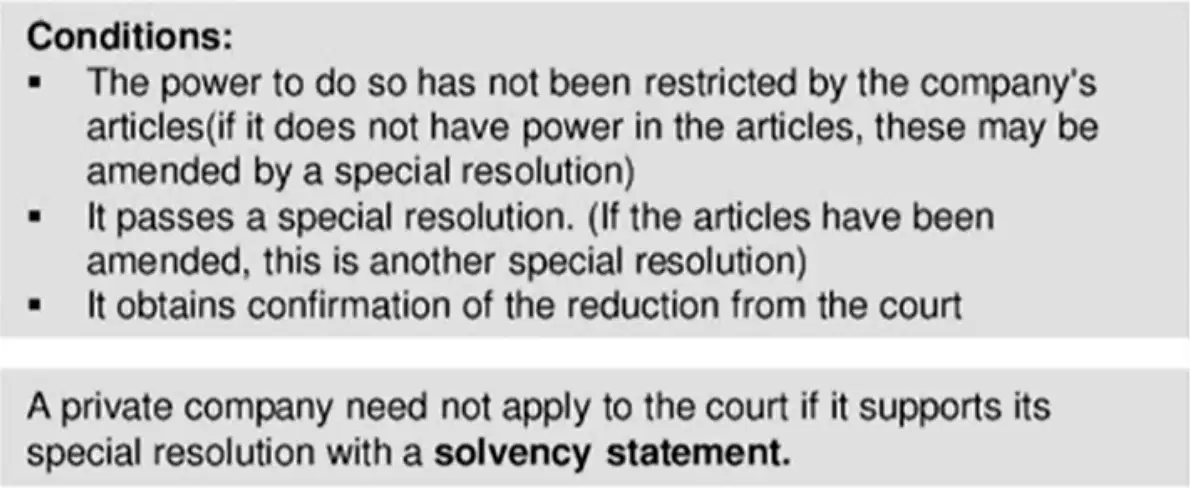
A private company seeks to reduce share capital without going to court. Which combination of conditions allows this?
Ordinary resolution and director guarantee to creditors
Shareholder waiver and confirmation from the registrar
Board resolution and auditor’s report on losses
Special resolution supported by a solvency statement
Which description best fits a de jure director?
Expressly appointed by the company
Influences the board without obligations
Attends as alternate when permitted
Acts as director without valid appointment
A person routinely instructs the board, and the board follows those directions without the person holding office. What type of director is this?
Managing director for daily operations
Shadow director with practical influence
De jure director with formal authority
Non‑executive director in governance
Which statement about directors’ expenses is accurate?
Expenses are paid only at contract expiry
Only managing directors can claim expenses
All expenses require a special resolution vote
Reasonable expenses are reimbursable during duties
A company wants to pay a director an ex‑gratia amount for leaving office. What approval is required for such unconvenanted payments?
Approval of members in general meeting
Approval from the registrar of companies
Approval by the chief executive officer
Approval by external remuneration consultant

A group of shareholders wants to remove a director. Which threshold most accurately reflects a quorum requirement that can trigger such action?
Two directors voting together
A simple majority of attendees
25% of issued share capital
10% of paid-up share capital
Which circumstance is most likely to reduce the period of a director’s disqualification?
Evidence of lack of dishonesty in conduct
Personal gain from insider arrangements
Receipt of excessive personal remuneration
High likelihood of repeated misconduct
Which statement best describes the CEO’s apparent authority when contracting with outsiders?
It binds the company only after shareholder ratification
It binds the company within perceived authority scope
It exists only with written board resolutions
It applies solely to internal operational matters
Which is a statutory duty owed by directors?
Accept modest gifts from suppliers
Delegate independent judgement routinely
Maximise short-term profits always
Act within their powers at all times
Which statement best describes a statutory duty of a company secretary in a public company?
Approving directors' remuneration and bonus schemes
Designing the company's long-term strategic plan
Maintaining the company's statutory registers accurately
Negotiating supplier pricing and volume discounts
A private company with a sole director wants to streamline roles. Which arrangement complies with appointment rules for the company secretary?
Rotating the role informally among administrators
Leaving the post empty for five financial years
Having the sole director act as secretary as well
Appointing an external qualified professional as secretary

Who typically fixes the auditors’ remuneration when auditors are appointed by the general meeting, and what disclosure is required?
Shareholders set it; disclose in chair’s report only
Auditors set it; disclose in engagement letter only
Regulator sets it; disclose in annual return statement
Directors set it; disclose in a note to accounts
A company proposes an agreement that fully indemnifies its auditor for negligence for three years. What is the compliant approach?
Limit only for fraud; unlimited for negligence
Allow full indemnity; disclose in the audit report
Accept indemnity; renew it every three years only
Void indemnity; use fair, reasonable annual liability limit
Members requisition a general meeting. Which combination meets the requirements?
A petition after the AGM has concluded
At least 5% voting share capital and written requisition
Directors’ informal agreement without notice
Any single shareholder request by phone call
What minimum approval is generally needed to pass an ordinary resolution at a general meeting?
A simple majority of votes cast
A three‑quarters majority of votes cast
A two‑thirds majority of votes cast
A unanimous vote of members present
Which combination correctly matches notice timing with the situation?
Special notice of certain resolutions — at least 28 days
General meeting short notice for private company — 80% shares agree
Public company AGM short notice — majority of directors agree
Creditors’ voluntary winding‑up meeting — at least 14 days

Which statement best distinguishes ordinary and special resolutions regarding notice text and filing?
Special resolution text must appear in the notice; filing required for all
Ordinary resolution text must appear in the notice; filing always required
Neither resolution’s text must appear; filing only for public companies
Both resolutions’ texts must appear; filing never required
Which criterion qualifies members to requisition a resolution at an AGM?
Owning at least one fully paid share
Having consent from the chairperson
Being any ten shareholders present
Holding 5% of voting rights collectively
Which statement best defines liquidation in a company context?
Merging operations with a solvent competitor
Refinancing debts to continue as a going concern
Temporarily suspending trading to reduce losses
Dissolving the company and winding up its affairs
In a members’ voluntary liquidation, which condition and action pair is correct?
Company is solvent; liquidation committee of five creditors
Company is insolvent; court orders compulsory liquidation
Company is insolvent; creditors appoint the liquidator
Company is solvent; directors make a declaration of solvency
A liquidator’s primary role after appointment is to do which of the following?
Issue new shares to raise working capital
Reinstate directors’ management powers fully
Negotiate new loans to expand operations
Realise assets and distribute proceeds to creditors
Which of the following is a statutory ground for compulsory liquidation of a company?
Company unable to pay its debts
Directors disagree on marketing plan
Share price falls for six months
Auditors resign without a report
A petition for winding up is presented and later a creditor sues the company for an old debt. What is the immediate legal effect once the court makes a compulsory liquidation order?
The company may settle the claim privately
Legal proceedings are halted without court leave
The creditor’s lawsuit continues automatically
Only new lawsuits are stayed by the order
What is the primary purpose of a creditors' voluntary liquidation?
To convert company assets into cash for immediate distribution
To facilitate the orderly winding up of a company's affairs
To enable the company to continue trading while debts are settled
To allow shareholders to regain control of the company
Which of the following best describes the role of a company secretary in ensuring compliance?
Directing marketing strategies and business development
Maintaining corporate governance and statutory records
Managing day-to-day operations of the company
Overseeing financial audits and reporting
In the context of company law, what does the term 'insolvency' refer to?
The act of distributing profits to shareholders
The requirement to file annual financial statements
The process of merging with another company
The inability to pay debts as they fall due
What is the primary responsibility of directors in relation to the company’s financial statements?
To prepare and present accurate financial statements
To approve all marketing strategies
To oversee employee performance reviews
To manage daily operational tasks
Which of the following best describes the process for a company to issue new shares?
Requires a special resolution and regulatory approval
Can be done without any formal resolution
Must be approved by the board of directors only
Requires a simple majority vote from shareholders
What is the minimum percentage of shareholders required to call for an extraordinary general meeting?
5% of voting rights
10% of issued share capital
20% of total shareholders
25% of paid-up share capital
What is the minimum percentage of voting rights required for shareholders to call a general meeting?
15%
5%
1%
10%
Which document must be filed with the registrar when a company passes a special resolution?
Annual return
Resolution minutes
Financial statements
Notice of the resolution
In the context of company law, what does the term 'insolvency' primarily refer to?
Failure to file annual returns
Loss of majority shareholder control
Reduction in share capital
Inability to pay debts as they fall due
What is the minimum notice period required for a general meeting in a public company?
14 days
30 days
21 days
28 days
Which of the following best describes the role of a company secretary in a private company?
Setting the strategic direction of the company
Overseeing financial audits and compliance
Managing day-to-day operations of the company
Ensuring proper documentation and statutory compliance
In the event of a company liquidation, which group of stakeholders is typically paid first?
Shareholders
Employees
Secured creditors
Unsecured creditors
What is the primary role of the audit committee in a company?
To oversee the financial reporting process
To handle employee recruitment and training
To set the company's operational budget
To manage the company's marketing strategies
Which of the following is a requirement for a company to maintain its status as a going concern?
Regular audits by external auditors
Consistent profitability over the last three years
Ability to pay debts as they fall due
Approval of all financial statements by shareholders
What is the consequence of failing to file annual returns for a company?
Loss of all shareholder rights
Company may be struck off the register
Mandatory liquidation proceedings initiated
Increased tax liabilities for the company
What is the required majority for shareholders to approve a special resolution at a general meeting?
A simple majority of votes cast
A three‑quarters majority of votes cast
A two‑thirds majority of votes cast
A unanimous vote of all shareholders
Which document must be submitted to the registrar when a company alters its articles of association?
Annual return
Special resolution
Alteration minutes
Notice of alteration
What is the primary duty of directors regarding the interests of shareholders?
To maximize short-term profits
To prioritize employee welfare over profits
To ensure compliance with all regulations
To act in the best interests of the company as a whole
Which statement best describes the role of a company director in relation to fiduciary duties?
To ensure compliance with all government regulations only
To delegate all decision-making to the company secretary
To maximize personal financial gain from company operations
To act in the best interest of the company and its shareholders
What is the primary purpose of a company’s articles of association?
To list all shareholders and their respective shares
To provide a summary of the company’s market strategy
To define the rules governing the company’s internal management
To outline the company’s financial performance
Which of the following best describes a preference share?
A share that has no financial return but offers ownership
A share that carries voting rights in company decisions
A share that provides fixed dividends before ordinary shares
A share that can be converted into ordinary shares at any time
What is the minimum percentage of shareholders required to pass a special resolution in a company?
40% of total shareholders
60% of issued share capital
75% of voting rights
50% of voting rights
Which of the following best describes the fiduciary duty of directors towards the company?
To ensure compliance with all regulatory requirements only
To act in good faith and in the best interest of the company
To prioritize shareholder profits exclusively
To act in their own interest above all
In the context of corporate governance, what is the primary function of the remuneration committee?
To handle shareholder communications
To manage the company’s financial audits
To determine the pay and benefits of executives
To oversee the company’s marketing strategies
What is the primary responsibility of a company auditor during a financial audit?
To manage the company's financial operations
To provide an independent opinion on the financial statements
To ensure compliance with tax regulations
To prepare the financial statements
Which of the following is a key requirement for a company to be classified as a public limited company?
It must be registered with the local chamber of commerce
It must issue shares to the public
It must have a board of directors
It must have a minimum number of shareholders
In the context of corporate governance, what is the main purpose of an audit committee?
To handle shareholder communications
To manage employee relations
To ensure the integrity of financial reporting
To oversee the company's marketing strategies

