Worksheets
Reproductive System Unit Test
Total questions: 29
Worksheet time: 37mins
What is the name of the male reproductive gamete?
Ovum
Sperm
Testosterone
Zygote
What is the name of the female reproductive gamete?
Estrogen
Sperm
Egg (Ovum)
Chromosome
How long can sperm typically survive inside the female reproductive tract?
12–24 hours
24–48 hours
5 days
2 weeks
Once released from the ovary, how long does an egg remain viable for fertilization?
12–24 hours
3 days
5 days
7 days
In the reproductive process, which event comes first?
Sperm are made in the testicles
Sperm fertilize an egg
Sperm mix with semen
Sperm enter the uterus
Which type of Sexually Transmitted Infection (STI) can usually be cured with antibiotics when treated early enough?
Viral
Bacterial
Fungal
Chronic
Which type of STI can be managed with treatment but cannot be fully 'cured'?
Bacterial
Parasitic
Viral
Yeast infections
Why is the term 'STI' (Infection) currently preferred over 'STD' (Disease)?
'Infection' sounds less scary to patients.
'Disease' implies visible symptoms, whereas many infections have none.
The term 'Disease' only applies to bacterial infections.
There is no difference; the terms are used interchangeably for no reason.
The most common symptom of an STI is...
Burning
Unusual discharge
Infertility
Nothing
What determines the reproductive anatomy an individual is born with?
Hormones in the environment
Chromosomes
Nutrition during pregnancy
Random chance
Which chromosomal pairing typically results in male anatomy? Female anatomy?
Male: XX | Female: XY
Male: YY | Female: XX
Male: XY | Female: XX
Male: XY | Female: YY
On average, how long does the process of puberty last?
1 year
2 years
5 years
10 years
Which biological sex typically begins the stages of puberty first?
Biological Males
Biological Females
There is no difference
Which hormone drives the development of biological males during puberty?
Estrogen
Progesterone
Testosterone
Insulin
Which hormone drives the development of biological females during puberty?
Testosterone
Estrogen
Adrenaline
Human Growth Hormone
Which organ is responsible for secreting the hormone that drives the development of biological males during puberty?
Urethra
Prostate
Testicles
Seminal Vesicles
Which organ is responsible for secreting the hormone that drives the development of biological females during puberty?
Uterus
Fallopian Tube
Ovary
Cervix
What is the primary purpose of the scrotum?
To produce semen
To protect the bladder
To keep the sperm at an optimal temperature
To transport sperm to the urethra
What is the name of the muscular, hollow organ where a fertilized egg implants and develops?
Ovary
Fallopian Tube
Uterus
Cervix
While many physical changes happen during puberty, which of the following is the "groundbreaking" change that allows for reproduction?
The start of the production of gametes
The growth of facial or underarm hair
The deepening of the voice
The increase in muscle mass
Males and females have different reproductive anatomy, neither of which comes “online” until (a) . Females tend to reach this developmental milestone (b) males. The most obvious signs of reaching this milestone signify a person's ability to reproduce and include (c)
for females and (d) for males.
Reorder the following, with the first answer being the earliest phase of the reproductive process.
Sperm is made in the testicles
Fluid is added to sperm to create semen
Sperm enters vagina
Sperm fertilizes egg
Fertilized egg implants into the uterine wall
Reorder the following with the first answer being the earliest phase of a potential reproductive process.
First menstrual cycle begins
Ovary releases an egg
Egg enter fallopian tube
Egg is not fertilized by sperm
Second menstrual cycle begins
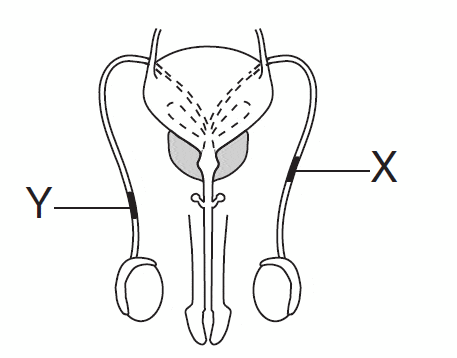
After production, male gametes are stored in a coiled tube known as the (a) . Here they reside until they are released from the body. Before male gametes are released from the body, they first travel into the (b) , which a long tube some males get cut if they want to greatly reduce their risk of causing a pregnancy. After, they would reach the (c) where other substances would be added to sperm to create (d) .
After production, a female gamete get swept into the (a) by the (b) , which are small finger-like projections. Eventually, it makes it's way to the (c) , which is a thick, muscular hollow organ. If fertilized, the egg may implant into the uterine wall and cause a (d) . Otherwise, the egg will dissolve and the uterus will shed its lining. This cycle occurs roughly every 28 days in a process known as (e) .
Label the internal parts of the female reproductive system.
Ovary
Fallopian Tube
Uterus
Cervix
Vagina