
 Worksheets
Emergency Preparedness & Business Continuity
Total questions: 75
Worksheet time: 38mins
Which of the following statements correctly describes the role of evaluation in the Emergency Preparedness & Business Continuity Model? Evaluation:
should be conducted by an objective third party.
is conducted in an ongoing manner and at regular intervals.
occurs primarily as soon as possible after an actual incident.
focuses primarily on the ability of staff and occupants to execute the plans.
In the Emergency Preparedness & Business Continuity Model, the first task is to:
identify, analyze and manage risks.
identify critical assets and processes.
form crossfunctional alliances.
develop an emergency management plan.
Which of the following best describes FM’s role in emergency preparedness and business continuity programs? FM:
implements risk management programs, but is not involved in planning and implementing emergency preparedness and business continuity programs.
is responsible only for safeguarding facility processes, equipment and personnel.
is the incident management team leader and the organization’s spokesperson.
works to protect the facility’s assets and supports continuation of essential processes.
FM’s risk management plan has focused on protecting the organization’s property and equipment. Senior management is distressed, however, when FM’s emergency response tactics interfere with the resumption of certain business operations. What challenge does this scenario illustrate?
Creating functional risk management plans and emergency preparedness programs
Aligning functional emergency preparedness plans with the organization’s strategy and goals
Achieving balance in the protection of hard and soft assets
Inevitable conflicts and competition among functions for their own interests
An organization has created an office of risk management and placed its director at the head of crossfunctional teams to develop risk management, emergency response and business continuity plans. What is the most likely role for FM in this type of organization? FM:
Participates fully in developing and supporting plans and ensures planning is completed and tested for FM.
is responsible for ensuring appropriate risk management tactics are implemented throughout the facility.
completes plans for FM, submits them to a senior management team for approval and then implements them at a functional level.
must argue for budget and staff to ensure continuance of FM processes during and after an emergency.
An organization informs residential and commercial neighbors when it plans to conduct an evacuation drill. This is an example of:
an emergency preparedness tactic.
alignment with strategic goals.
sustainable facility operations.
concern for stakeholder needs.
An organization conducts a risk assessment before its next strategic planning and budgeting cycle. What is the most likely effect of this action on the organization’s insurance costs?
Effect on insurance rates will be insignificant.
Insurers will be less likely to bid for covering the organization.
Rates will be lower if mitigation is undertaken.
Rates will increase because more risks have been identified.
FM has been requesting budget designated for emergency preparedness programs, but senior management has been refusing the request and directing budget towards media campaigns to improve its public image. The organization is trying to recover from legal and regulatory missteps. How could FM best win support for an emergency preparedness program?
Conduct an assessment now and wait to implement the program itself for a couple years.
Focus on ensuring minimal compliance with local laws and regulations.
Argue that an emergency preparedness program could also repair the organization's public image.
Independently implement a few actions and show their effectiveness to management.
During crisis management:
senior management plans its communication strategy.
senior management focuses on the organization's long-term survival.
the incident management team activates its emergency response plan.
potential risks to the organization's long-term survival are identified.
An organization knows very little about the concept of business continuity and does not allocate budget for emergency preparedness (EP) or business continuity (BC) planning. In this organization how will FM most likely focus its efforts?
Ensuring compliance to local laws and building codes.
Planning EP on the facility level and BC for FM processes.
Participating in a crossfunctional planning team.
Trying to persuade management to adopt EP and BC strategies.
Which of the following statements about how organizations respond to unfolding emergencies is correct?
Planning can shorten the duration and intensity of the emergency's impact.
Emergency response usually takes the longest amount of time in the return to normal.
The first thing an organization must do is manage the scope and impact of the emergency.
The organization is most extensively involved during restoration and recovery.
A management team, including FM, is studying a map showing a proposed location of a new entertainment complex that would host more than 50,000 daily visitors. There would be multiple tenants. Few employees will have cars. The complex would be open from noon to early morning hours, 365 days a year. Planners foresee heavy utility use and need for connectivity, since many systems will be linked to offsite headquarters or control sites. The proposed site is located in an area transitioning from heavy industrial to commercial use. One of the existing businesses manufactures solvents, which are shipped on tanker railcars on a spur from the adjacent freight line. The area is served by mass transit. The site is equidistant to two highway access points. Utilities have been upgraded to prepare for the transition. There is a fire station within a few minutes, but police are further away, and hospitals are at least thirty minutes away and more during peak commuting times. What are the two primary risks that this map shows?
Distance from hospitals and risk of spills/releases from neighbor
Inadequate infrastructure and risk of spills/releases from neighbor
Failure of mass transit system and highway accidents
Limited evacuation routes and noise from freight rail line
To manage risk in outsourcing essential facility services, FM must:
ensure contractors have their own business continuity plans.
implement contracts only after they have been reviewed by Legal.
use only well-known contractors.
secure recommendations from FM in comparable facilities.
What is the role of the business process analysis (BPA) in business continuity planning? The BPA:
identifies all the vulnerabilities in a workflow process.
helps establish what the organization risks losing in various risk scenarios.
describes all the requirements for an essential process.
assigns roles in contingency scenario if business continuity plans are invoked.
A team dissects a particular function to identify the inputs and outputs, requirements and interdependencies with other functions. They are working on a:
mission essential function.
business impact analysis.
workflow.
business process analysis.
The café in a multi-tenant building is located on the ground floor, looking out into the parking lot. Yesterday a visitor became confused and accidentally accelerated instead of braking, crashing through the café’s windows, injuring five occupants and doing significant property (but not structural) damage. FM must decide how to spend a limited risk management budget to respond to this type of risk. Which of the following is probably the best option?
Install concrete planters between the building and the lot.
Take no action since this type of event is not likely to happen again.
Move the parking lot further away from the building.
Relocate the café to the building’s interior.
FM is concerned about how to evacuate occupants from a building in a dense urban area. Who might be the best resource in this case?
Comparable facilities in other cities
A nationally known risk management expert
Local fire or police department
Facility’s insurer
A trucking firm operates eight regional depots, including two in regions known for a high incidence of tornadoes. The firm decides that business continuity planning is an unnecessary expense. This firm is exhibiting:
Inappropriate risk appetite
A reliance on organizational flexibility.
Risk avoidance.
Low risk tolerance.
In the course of creating business process analyses (BPA), an organization discovers that two separate functions have the resources to produce and bind printed material quickly and in large amounts—although for different types of projects. How could this affect business continuity planning?
One set of equipment should be disposed of and the two processes combined for greater overall efficiency.
Use of duplicate resources can be specified in the plan, instead of buying redundant equipment.
Since both functions use the equipment, this will have no effect on business continuity planning.
One of the functions should increase the capacity of its existing process to prepare for a possible interruption in the other function.
A facility has interior operations that produce a large amount of potentially flammable dust. What would be an example of an effective prevention strategy for this facility?
Relocation of process to different facility
Worker protective gear
Automated call out to local fire department
Exhaust ventilation system
Which risk in a risk matrix merits mitigation investment most? A risk assessed as:
High impact/high probability
Medium impact/low probability
High impact/low probability
Low impact/low probability
Which of the following is an example of a risk prevention tactic for managing facility technology risks?
Requiring user identification to access any system computer
Contracting with an off-site service to conduct daily data back ups
Installing a redundant cooling unit in a data center in case of failure of the first unit
Asking IT to assess and approve all new FM software
A business continuity planning team meets to identify essential functions in the organization. It decides to be as inclusive as possible and representatives from all departments attend. What is a likely outcome of this effort?
An efficient, inclusive emergency management strategy will be developed.
The team’s determination of essential functions will be made by department head count.
Too many functions will be identified as essential.
Business continuity costs if an interruption occurs will decrease.
FM has identified natural and man-made risks that could affect the facility. What type of risks has FM overlooked?
Technological
Labor-related
Weather-related
Accidental
Which of the following statements best describes FM’s role in managing facility technology risks? FM:
installs and operates physical security tactics.
is responsible for ensuring IT policies are followed by FM staff.
ensures that FM software, data and equipment are protected from identified risks.
works with IT to identify risks and supports tactics to manage risk.
Which of the following statements about supporting functions is correct? Supporting functions:
may be needed to maintain mission essential functions.
may be continued at the discretion of the responsible unit.
can be suspended until the recovery phase is well under way.
must be considered as essential in the event of a business disruption.
Which of the following statements best describe the purpose of risk management for FM?
Allocate resources to FM projects strategically
Avoidance of risks that threaten property damage and destruction
Identifying facility vulnerabilities to senior management
Minimizing the impact of identified risks on organizational assets
A business impact analysis (BIA):
outlines how an essential process is performed and lists its requirements.
develops tactics to avoid the disruption of mission essential functions.
establishes the costs of business continuity contingency plans.
explores how a process will be affected by a specific risk event.
An accounting firm that is very risk averse has asked FM to participate in proposing possible sites for a new satellite office. FM believes the committee should focus on multi-tenant office buildings. Why would this be an effective solution?
Fewer risks to business continuity
Less responsibility for FM for emergency response planning
Less exposure to risks from other tenants
Ability to transfer risk to, or share risk with, the landlord
A risk assessment tool asks respondents to rate a possible risk event in terms of probability and:
impact.
potential to cause significant property damage.
potential to cause fatalities.
significance.
Which of the following is an example of designing a facility for better emergency preparedness?
Implementing an aggressive preventive maintenance program
Ensuring ample space for shelter in place
Replacing on-site data centers with contracts for software and storage over the Internet
Locating work areas away from windows
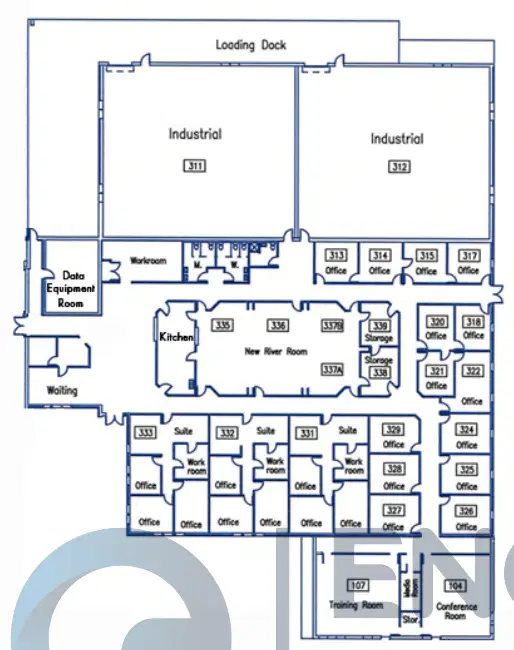
Which of the following statements is a reasonable assessment of the light industrial facility whose layout is depicted below?
Offices are too close to industrial areas.
Industrial areas are adjacent to each other.
Training and conference rooms are located on exterior, windowed walls.
Data equipment room is located near an entrance and the loading zone.
In an interview with Accounting, a business continuity planning team has established that, of the various tasks it performs, its most important processes are related to governance (ensuring continuous and accurate financial records, filing necessary legal reports within required timeframes), avoiding penalties and contract issues by continuing payments to suppliers and contractors (including insurers), and issuing payroll checks. It has provided business process analyses (BPA) for these processes. Accounting does not believe another function can perform these processes. It has named the employees involved in these priority tasks and provided a list of required reports/services for internal and external stakeholders and regular payments. What additional important information would be helpful in this business impact analysis (BIA)?
List and location of all accounting files
Interdependencies with other functions
Recovery time objectives for various processes
What facilities are needed to resume a normal level of operation
A facility is concerned about the risk of employee theft. In the past several years, equipment has disappeared and FM suspects pilfering of supplies. The losses are more embarrassing than expensive, and management would prefer not to spend much for any solution. In a brainstorming meeting, managers come up with possible risk management tactics aimed at this problem. Which seems most plausible for this organization?
Install closed circuit video surveillance in equipment and supplies areas
Secure equipment and supplies in a locked area that only a manager can access
Implement bar code or manual check out of equipment and supplies
Circulate a memo reminding employees about penalties for stealing
Who, in an organization, is in the best position to designate the organization’s mission essential functions?
Line unit managers
Investors
Senior management
FM
Asked to develop a function risk management plan, FM has conducted a risk assessment and identified the organization’s critical processes. A list of possible responses to major risks has been compiled and costs identified. What step has FM missed?
Gaining senior management commitment
Involving staff in identifying possible risks
Identifying impacts of events on critical processes in other functions
Determining benefit to cost ratio for recommendations
When is tolerance a reasonable risk management strategy?
An event is unlikely to occur and would have little effect
The occurrence of an event is highly unlikely
The event would have only moderate impact on the facility
Costs of managing the risk would be higher than management will accept
The purpose of a drive-away kit is to:
support the re-establishment of an organizational chain of command and coordinate emergency response after an incident.
equip leaders of the incident management and business continuity teams with adequate communication and documentation in the event of an emergency.
ensure that each individual in the organization is prepared to report to a contingent workplace if the business continuity plan is invoked.
ensure those assigned to an essential function have all the tools and supplies required to continue work if the facility is unavailable.
An organization includes participation in business continuity planning in position descriptions for all managerial positions. What is the probable effect of this action?
Quality of business continuity planning will increase.
Managers will resent additional responsibilities and continuity planning will suffer.
Quality of business continuity planning will decrease.
Importance accorded to business continuity in the organization will increase.
FM is responsible for a number of sites, all located in leased properties. One of the properties is a multi-tenant single-floor building in an industrial park zoned for light manufacturing. One of the building’s tenants is engaged in manufacturing electronic components. FM has established that the property managers have no emergency response plans. What should FM do?
Ensure the organization’s employees onsite are drilled in evacuation procedures.
Coordinate with other tenants to develop a concept of operations for responding to identified risks.
Report the property to local governments who may enforce emergency planning requirements.
Use an existing emergency response plan for another site, assigning responsibilities to this site’s personnel.
The business continuity plan:
does not address the issue of reconstitution and return to the facility.
analyzes contingency tactics in terms of continuity objectives.
defines conditions that will cause the plan to be invoked.
presents a cost/benefit analysis for selection of processes to be continued.
Which of the following statements about emergency response plans is correct? Emergency response plans:
do not require explicit approval by senior management, but they must be approved by local first responders.
should impart a general understanding of the organization's philosophy of emergency response, rather than specific details.
reflect thorough planning into necessary authority, roles, resources and processes in the emergency response.
can be virtual—not a formal plan but an understanding of authority and responsibilities in certain events.
What is the proper goal of contingency planning?
Enable essential function to recover to an acceptable level of performance within a required timeframe
Return essential function to its normal level in the shortest time possible
Achieve the greatest level of functionality with the least use of recovery resources
Allow an essential function to continue without any visible sign of interruption or discontinuity
After a facility is damaged in a flood, FM oversees reconstitution, declares the facility once again functional and tells business unit leaders that their employees can return to work. The largest business unit refuses, saying that the conditions are not minimally acceptable. How could this conflict have been avoided?
Senior management should have issued the order to return to the facility.
Policy should clarify that FM can order return to the facility at the appropriate time.
The business continuity plan should have specified criteria for return to normal operations that have been agreed with by senior management and business unit leaders.
FM should have involved all the business unit leaders in the reconstitution program and its progress, leading a final facility tour before issuing its announcement to return.
Which of the following statements about the incident management team is correct?
It is an interdisciplinary group in charge of planning, response and recovery.
It is typically led by the designated spokesperson.
It should be led by the highest ranking individual in the organization.
Effective teams are composed of FM, Security and IT.
The functions of an emergency response team include command, operations, planning, logistics and: _________
media communication.
human resources.
finance/administration.
IT.
FM is working with leaders of areas performing essential functions to compile a list of continuity requirements, such as space and environment, furnishings, systems and services. One leader says that the function requires space for all its employees, including meeting rooms, in a building that does not require additional travel. How should FM respond?
Disregard the functions and allocate resources according to budget.
Accept the facility requirements but negotiate for more flexibility in locating the temporary site.
Do not question the requirements, but focus on finding a way to meet them
Negotiate for an appropriate level of performance during this period and scale requirements accordingly
Which of the following statements about an incident command post is correct?
In a global organization there may be multiple incident command posts.
Resources for the response are stored at and assigned from the command center.
The command post does not require technology, only an incident commander.
The incident command post may change location in the course of an event.
Which of the following statements about facility managers and facility data/documents continuity is correct?
Data and document continuity is assured by the organization’s business continuity planning team, not FM.
Backing up too many documents can be problematic. FM should focus on building drawings and service histories.
Facility managers are responsible for identifying and backing up critical facility documents.
Backup of all documents and data records should be both hard copy and electronic copies.
During a business impact analysis, it became clear that a process essential to the organization's survival did not require highly skilled and experienced workers or highly specialized equipment. The profit margin on the product produced would not merit a large budget for continuity, however. How could the organization best plan for an incident, such as a tornado, in which the facility is unavailable for at least a month and employees’ lives and homes are severely disrupted?
Lease a warm site large enough to accommodate the process.
Plan to outsource production to a contractor.
Work with an employment firm that can quickly assemble the necessary contingent workforce.
Commit to suspending the process but resuming it as soon as possible.
Which of the following would be the best candidate for spokesperson during and after an emergency at a large university?
Well-respected and well-known professor at the institution
University president
University information officer trained in public speaking
Head of the university’s FM function
An emergency response plan describes the reporting structure during an emergency and the decisions that may be made by different members of the emergency response team, from incident command to floor captain. What emergency management principle does this illustrate?
Span of control
Planning function
Delegation of authority
Chain of command
What is probably the most valuable information FM can share with first responders before an event to ensure the facility’s preparedness?
Contractors who have agreed to support recovery operations
List of all employees at the facility
Specific skills of FM staff
Detailed layout of facility and lists and locations of hazardous materials
An FM organization conducts a risk assessment of its vital documents and creates an inventory of all data and documents that should be backed up on hard drives, compact discs and remote servers off site. FM ensures access to vital documents, including email, within twelve hours. Documents include records related to emergency and business continuity, operations and compliance. Is there any way in which the organization could have improved in this area?
It could have made data/document continuity a business process, institutionalized in a standard operating procedure.
No, the approach described complies with all the recommendations of the U.S. Federal Emergency Management Agency (FEMA) for vital records programs.
This process should be under the direction of the organization’s IT function.
The program should provide immediate access to documents and email.
Which of the following statements about emergency management terminology is correct?
The goal is to communicate effectively with local first responders.
Terminology was developed by the insurance industry.
Incident Command System (ICS) terminology is universally used.
Terminology is designed to support communication within the emergency team itself.
Which of the following would be considered a hot site in contingency planning?
An agreement to relocate college classes at a nearby hotel
Duplicate production line with identical equipment in a separate building or area
A generic office area with desks, voice/data service and utilities
An empty warehouse area that could be converted into a temporary fleet maintenance area
An organization’s concept of operations:
describes how its functions will respond in a coordinated manner to an emergency, from beginning to end.
is an agreement with neighboring organization to share or lend resources during an emergency.
provides a strategy for testing the effectiveness of the organization’s emergency response plan.
describes the chain of command during an emergency response and the types of decisions that can be made at each level.
An effective communication plan:
is focused on communicating with public authorities and the media.
includes tactics for communicating with the hearing and sight impaired.
uses non-technology dependent phone trees to notify occupants about emergencies.
is based on mobile cellular communication technology.
A manufacturer contracts with a government to supply computer systems and 24-hour support to one of its agencies. How will this organization’s strategy affect its business continuity program? It should consider:
leasing empty space in nearby facilities to accommodate support personnel and equipment.
creating multiple support centers located in different facilities.
contingency plans that ensure return of support capability at a limited level within one hour.
outsourcing the support operation until the facility has recovered.
The Chief Operating Officer (COO) of an organization has been designated its incident commander/incident management team leader during emergencies. When a fire occurs, the COO goes to the command center and leads the response. Within a short time, the local fire department arrives. What will probably happen to the chain of command?
The fire chief becomes the incident commander.
The COO and fire chief will share incident command until the immediate danger is passed.
The chain of command ends when local first responders arrive.
The COO will remain incident commander and represent the organization’s interests.
A factory needs to be certain that, if an emergency requires evacuation and automated systems fail, certain pipes carrying fuel and water can be closed manually immediately. FM assigns technicians to each shut off location, develops a protocol for the shut off process and trains all staff in the processes (to ensure back up personnel will always be available) without actually shutting down systems. How could FM’s training plan have been improved? It should have:
included a full-scale exercise in which systems were actually shut down.
Have training prepared by equipment manufacturers.
included plans for training new hires and for retraining.
assessed staff’s competencies in the assigned tasks before training.
During an evacuation drill at a convalescent home, the incident management team realized that, while they were well prepared to evacuate staff and physically disabled residents, confused family members who were visiting had trouble exiting the building and in some cases interfered with staff trying to evacuate residents. What could FM do to help?
Include a message on the public address system, directing all visitors to one exit and assembly area.
Assign FM staff to escorting visitors out of the building.
Install highly visible, understandable signage in each room and area, directing visitors to exits.
Require first-time visitors to complete an orientation video and quiz including evacuation procedures.
An organization’s operations are significantly disrupted as the result of a typhoon. Contingency plans are invoked, and extensive repairs are required to return the facility to pre-incident condition. A month after the functions have returned to the facility and are operating at normal levels, the incident management team schedules a debriefing workshop for all department heads. What will be the likely result of this action?
Debriefing reports will be less detailed.
The organization’s commitment to emergency preparedness and business continuity will be questioned by functions.
Department heads will have had enough time to process their experiences and report their assessments.
It is still too soon. Function leaders will be too engaged in resuming normal operations.
A facility has to be completely evacuated because of a gas leak. Although an emergency response plan is in place, the response is confused. Some occupants congregate in surrounding parking areas, interfering with access by first responders. The incident command post cannot communicate with some of the assembly areas and is not sure where these occupants are exactly. What is the most likely cause of this confusion?
Poor training and inadequate testing of the plan
Poorly equipped incident command post
Occupant panic
Poor coordination with first responders
A facility is located in an extremely hot climate with little shade outside the buildings. Senior management has directed that evacuation drills be conducted once a quarter, but during the last drill medical attention had to be summoned to treat several occupants who became faint in the heat. What should the incident management team do?
Have all occupants work late one night and schedule the drill then.
Continue as planned and have necessary supplies and first aid on hand.
Schedule multiple drills in the next quarter.
Ask permission to practice a shelter-in drill during hot weather.
6. Which if the following types of training will provide the highest level of competency in participating team members?
Tabletop exercises
Games
Seminars
Functional exercises
An earthquake heavily damages a facility. The insurer has agreed to replace a large part of the heating and cooling systems. Later, while debriefing the damage assessment team, the facility manager proposes removing the damaged equipment and selling it as metal scrap. What should the facility manager do first?
Perform a cost/benefit analysis of the task of removing and selling the scrap.
Check that the insurer allows this.
Seek senior management approval for this plan.
Check the scrap metal market to see if this would be a wise economic move.
During an emergency, FM’s primary responsibility is to coordinate with the incident commander, monitor the situation for possible escalation and:
communicate with the media.
support communication between assembly areas and the incident command post.
activate the damage assessment team, if relevant.
transfer authority to first responders and debrief them fully.
Due to an earthquake, a building collapses. It houses both administrative offices and a dormitory for single workers, including FM staff. In line with the organization’s business continuity plan, the offices and workers are quickly moved into space in a nearby college. Soon office personnel realize that they do not have the required data connectivity. The workers are also unhappy about the meals provided through the college. Who is in charge of addressing these issues?
Facility manager
Their unit leaders
Incident management team leader
Human Resources and IT
An earthquake heavily damages a facility. The aftershocks have stopped, and FM is eager to get damage assessment crews into the facility. What should FM do first, however?
Bring in the facility’s insurance adjustors.
Reinforce weakened structures.
Bring in equipment needed for debris removal.
Check if local government agencies need to approve entering the structure.
Fire has damaged a wing of a facility. Which of the following is an example of FM exercising its responsibility as a steward of the environment in the aftermath of this incident?
Proposing passive solar design features for new construction.
Ensuring proper disposal of potentially hazardous facility debris
Restore the facility to its original performance levels.
Restricting the amount of materials used in reconstitution of the facility.
. An individual from outside the organization studies its business continuity program, comparing the contingencies described in the plan against the plan’s objectives, industry practices and probable costs. The individual interviews managers to determine their understanding of their roles in the event of an incident, and checks data and document protection, including how whether and how recently data and documents have been backed up. What process is being conducted here?
Evaluation
Audit
Cost-effectiveness study
Benchmark study
The major difference between an evaluation of emergency preparedness and business continuity programs and an audit of these programs is that:
an evaluation examines whether a program is meeting its objectives, while an audit focuses on compliance only.
an evaluation may take the place of an audit but an audit cannot replace an evaluation.
an audit may occur at any time, while an evaluation occurs on a regular, often annual schedule.
an audit is conducted by someone not directly involved in the programs.
An organization has entered into a strategic partnership with another organization to win some lucrative government contracts. Does the organization’s business continuity plan need to be reviewed and revised?
Yes, it may be able to transfer some risk to the partner.
No, this change will not be sufficient to affect business continuity planning.
No, plans should be reviewed only as the result of internal changes in structure, policies or procedures.
Yes, the partnership may have changed essential processes and contingency strategies.
The incident management team is discussing the annual review of its emergency response plan. The organization’s strategy has not changed. FM notes that little has changed physically in the facility in the previous year. HR confirms that head counts are the same. Business units’ needs, including IT, have also remained the same. What should the team do?
Indicate the status quo and assign a new version number and date to the plan.
Conduct an evacuation drill and have local first responders sign off on the plan’s effectiveness.
Conduct the annual review.
Conduct a full scale exercise to test the plan’s effectiveness in meeting objectives.

