
 Worksheets
Quiz on Aminoglycosides and Nephrotoxicity
Total questions: 85
Worksheet time: 43mins
Which of the following drugs is a classic cause of acute tubular necrosis (ATN) in hospitalized and ICU patients?
Neomycin
Penicillin
Acetaminophen
Ibuprofen
What is the primary site of preferential accumulation for aminoglycosides in the kidney?
Glomerulus
Proximal Tubule Cells
Collecting Duct
Loop of Henle
Which process is inhibited by aminoglycosides, leading to phospholipidosis and enlargement of lysosomes?
Protein synthesis
Phospholipases
DNA replication
Sodium reabsorption
What is the consequence of lysosomal overload and destabilization in proximal tubule cells due to aminoglycoside toxicity?
Increased urine output
Cellular necrosis
Enhanced glucose reabsorption
Decreased blood pressure
Which of the following enzymes is released due to lysosomal degradation in aminoglycoside-induced nephrotoxicity?
Amylase
Nucleases
Lactase
Pepsin
Loss of brush border and reabsorptive capacity in aminoglycoside toxicity contributes to the pathogenesis of acute tubular necrosis by:
It increases the filtration rate.
It impairs the ability of tubule cells to reabsorb essential substances, leading to cell injury and necrosis.
It enhances the secretion of waste products.
It improves the function of lysosomes.
Which class of antibiotics is associated with acute tubular necrosis as a clinical pattern of nephrotoxicity?
A. Aminoglycosides
B. Penicillins
C. Cephalosporins
D. Macrolides
What is one cellular effect of gentamicin accumulation in the kidney proximal tubule membrane that contributes to nephrotoxicity?
A. ER stress
B. Increased glucose uptake
C. Enhanced protein synthesis
D. Decreased cell division
Which organelle is directly affected by aminoglycosides, leading to phospholipidosis in nephrotoxicity?
A. Lysosomes/Endosomes
B. Golgi apparatus
C. Ribosomes
D. Peroxisomes
Mitochondrial injury contributes to nephrotoxicity in the context of aminoglycoside exposure by:
It disrupts cellular energy production, leading to cell damage and nephrotoxicity.
It increases protein synthesis, protecting the kidney cells.
It enhances glucose metabolism, preventing nephrotoxicity.
It stimulates cell division, reducing nephrotoxicity.
Which of the following is NOT a mechanism of injury caused by Cisplatin in acute tubular necrosis?
Oxidative stress
Inflammation & vascular injury
Apoptosis & DNA damage
Protein synthesis enhancement
Which platinum compounds are considered less nephrotoxic compared to Cisplatin?
Carboplatin & oxaliplatin
Cisplatin & amifostine
Methotrexate & doxorubicin
Vincristine & paclitaxel
What is the role of Amifostine in minimizing toxicity during chemotherapy?
It enhances DNA damage
It acts as a cytoprotective agent
It increases oxidative stress
It promotes mitochondrial dysfunction
How does Amifostine act as a ROS scavenger?
By binding and neutralizing free radicals and reducing lipid peroxidation
By increasing apoptosis and DNA damage
By promoting inflammation and vascular injury
By causing mitochondrial dysfunction
Explain how Amifostine protects healthy cells during chemotherapy and radiation, and discuss its mechanism as a ROS scavenger.
Amifostine protects healthy cells by acting as a cytoprotective agent, binding and neutralizing free radicals, and reducing lipid peroxidation to stabilize cellular membranes.
Amifostine increases oxidative stress and promotes apoptosis in healthy cells.
Amifostine causes mitochondrial dysfunction and inflammation in healthy cells.
Amifostine enhances DNA damage in healthy cells.
Which drug is associated with acute tubular necrosis as a clinical pattern of nephrotoxicity?
Cisplatin
Ibuprofen
Amoxicillin
Metformin
What is the initial cellular event after cisplatin uptake that leads to nephrotoxicity?
Renal microvasculature vasoconstriction
Cisplatin accumulation
ER stress
Necrosis
Which of the following is a consequence of oxidative stress in cisplatin-induced nephrotoxicity?
Renal tubular injury
Increased glomerular filtration rate
Decreased inflammation
Enhanced antioxidant enzyme activity
Which cytokine is involved in the inflammation process during cisplatin-induced nephrotoxicity?
IL-1
TNF-β
IL-10
IFN-γ
What is the final clinical outcome of the pathway initiated by cisplatin in the kidney?
Acute Kidney Injury
Chronic Liver Disease
Pulmonary Edema
Cardiac Arrhythmia
Which markers are used to indicate necrosis in cisplatin-induced renal injury?
KIM-1, sCr, BUN, NGAL
ALT, AST, ALP, GGT
CRP, ESR, WBC, RBC
TSH, T3, T4, FT4
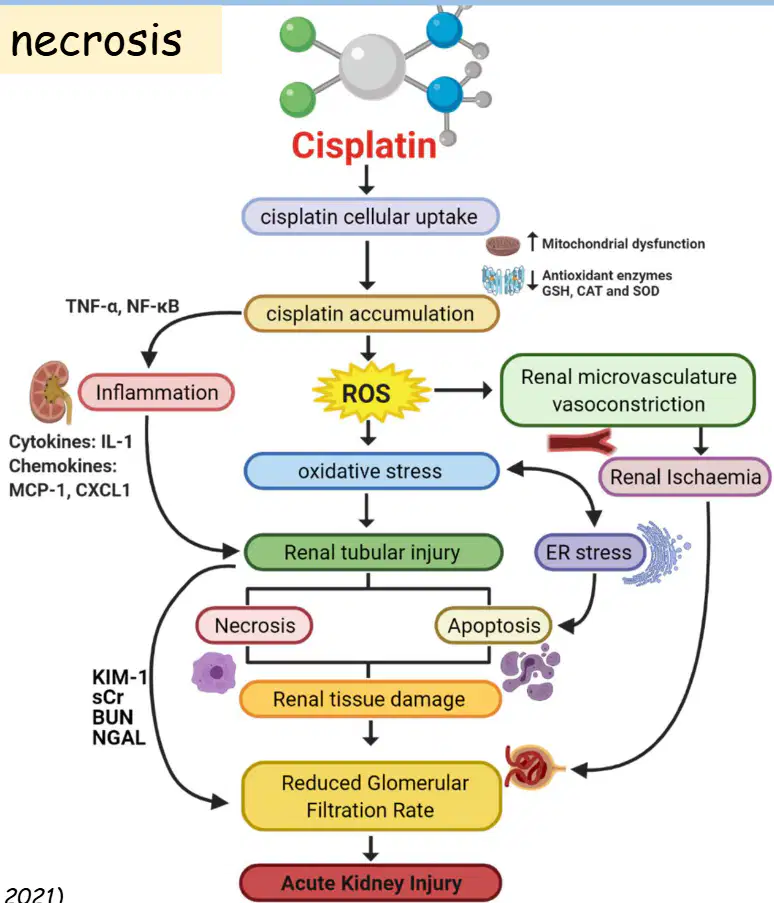
Explain how reactive oxygen species (ROS) contribute to the development of acute kidney injury in the context of cisplatin nephrotoxicity.
ROS promote oxidative stress, leading to renal tubular injury and subsequent tissue damage, which reduces glomerular filtration rate and results in acute kidney injury.
ROS increase glomerular filtration rate, preventing acute kidney injury.
ROS inhibit inflammation, protecting the kidney from injury.
ROS stimulate antioxidant enzymes, reversing tissue damage.
Which of the following is a clinical pattern of nephrotoxicity mentioned in the material?
Acute tubular necrosis
Glomerulonephritis
Interstitial nephritis
Renal artery stenosis
What is the primary purpose of radiocontrast agents in medical imaging?
To enhance the visibility of internal structures
To treat kidney diseases
To reduce inflammation
To prevent infections
Which type of radiocontrast agent is used to visualize vascular and soft tissues?
Iodinated compounds
Barium sulfate
Gadolinium-based agents
Calcium carbonate
Barium sulfate is primarily used to visualize which part of the body in medical imaging?
Gastrointestinal tract (GIT)
Vascular tissues
Soft tissues
Brain
Gadolinium-based agents are magnetic substances used in which type of scan?
MRI scans
CT scans
X-ray scans
Ultrasound scans
Different types of radiocontrast agents are used for different imaging purposes because:
Each agent has unique properties that make it suitable for visualizing specific tissues or organs.
All agents are equally effective for all tissues.
Some agents are less expensive.
Some agents are easier to administer.
A patient needs to have their gastrointestinal tract visualized. Which radiocontrast agent should be used and why?
Iodinated compounds, because they visualize vascular tissues
Barium sulfate, because it is specifically used to visualize the GIT
Calcium carbonate, because it is used for bone imaging
Gadolinium-based agents, because they are used in MRI scans
Which of the following is a mechanism of injury caused by radiocontrast media in acute tubular necrosis?
Direct cytotoxicity to tubular cells
Increased protein synthesis
Enhanced glucose uptake
Decreased lipid peroxidation
What does a dramatic increase in ROS in tubular cells lead to?
Lipid peroxidation and DNA fragmentation
Increased cell proliferation
Enhanced mitochondrial function
Protein synthesis
Inhibition of which cellular function leads to ATP depletion in tubular cells affected by radiocontrast media?
Mitochondrial function
Ribosomal function
Lysosomal function
Golgi apparatus function
Which of the following is NOT a consequence of necrosis and apoptosis induced by radiocontrast media in tubular cells?
Cell swelling
Loss of brush border
Cell death
Increased cell division
Radiocontrast media can lead to cell death in tubular cells by which of the following mechanisms involving ROS and mitochondrial function?
By increasing ROS, causing lipid peroxidation and DNA fragmentation, and inhibiting mitochondrial function leading to ATP depletion, which together induce necrosis and apoptosis resulting in cell swelling, loss of brush border, and cell death.
By decreasing ROS, enhancing mitochondrial function, and promoting cell survival.
By increasing protein synthesis and cell proliferation.
By stimulating immune cell recruitment and tissue regeneration.
Which property of radiocontrast agents contributes to slower passage of tubular fluid in acute tubular necrosis?
Low viscosity
High viscosity
High acidity
Low density
What is a consequence of intratubular stasis caused by radiocontrast agents?
Increased urine output
Mechanical stress and cast formation
Enhanced filtration rate
Decreased tubular pressure
Radiocontrast agents can cause medullary ischemia primarily by which mechanism?
Increasing nitric oxide
Decreasing endothelin
Inducing vasoconstriction
Promoting vasodilation
Which of the following is NOT a result of radiocontrast-induced medullary ischemia?
Hypoperfusion of medulla
Hypoxia
Ischemia
Hyperperfusion of medulla
Explain how increased viscosity of tubular fluid due to radiocontrast agents leads to tubular obstruction and back leakage of filtrate. Use evidence from the mechanism described.
Increased viscosity speeds up fluid passage, preventing obstruction.
Increased viscosity slows fluid passage, causing intratubular stasis, mechanical stress, cast formation, and ultimately obstruction and back leakage.
Increased viscosity has no effect on tubular fluid movement.
Increased viscosity dilutes the filtrate, reducing obstruction risk.
Which of the following radiocontrast agents is classified as high osmolar?
Diatrizoate
Iopamidol
Iodixanol
Iohexol
What is the main mechanism by which highly osmotic radiocontrast agents cause nephrotoxicity?
They decrease cell metabolism
They draw more water into tubular cells, causing swelling and disruption of membranes
They increase protein synthesis in tubular cells
They reduce blood flow to the kidneys
Which type of radiocontrast agent has the lowest rate of nephrotoxicity?
High osmolar agents
Low-osmolar agents
Iso-osmotic agents
Both B and C
Why do iso-osmotic and low-osmolar contrast media have a lower rate of nephrotoxicity compared to high osmotic agents?
They are less likely to cause osmotic injury to tubular cells
They increase cell swelling
They disrupt cell membranes more frequently
They draw more water into tubular cells
Which of the following is classified as an iso-osmolar radiocontrast agent?
Diatrizoate
Iopamidol
Iodixanol
Iohexol
Which clinical pattern of nephrotoxicity is associated with radiocontrast media administration?
Acute tubular necrosis
Glomerulonephritis
Interstitial nephritis
Pyelonephritis
What are the two main effects of radiocontrast media that contribute to nephrotoxicity?
Cytotoxic effect and viscosity effect
Immunologic effect and osmotic effect
Allergic effect and metabolic effect
Hemolytic effect and oxidative effect
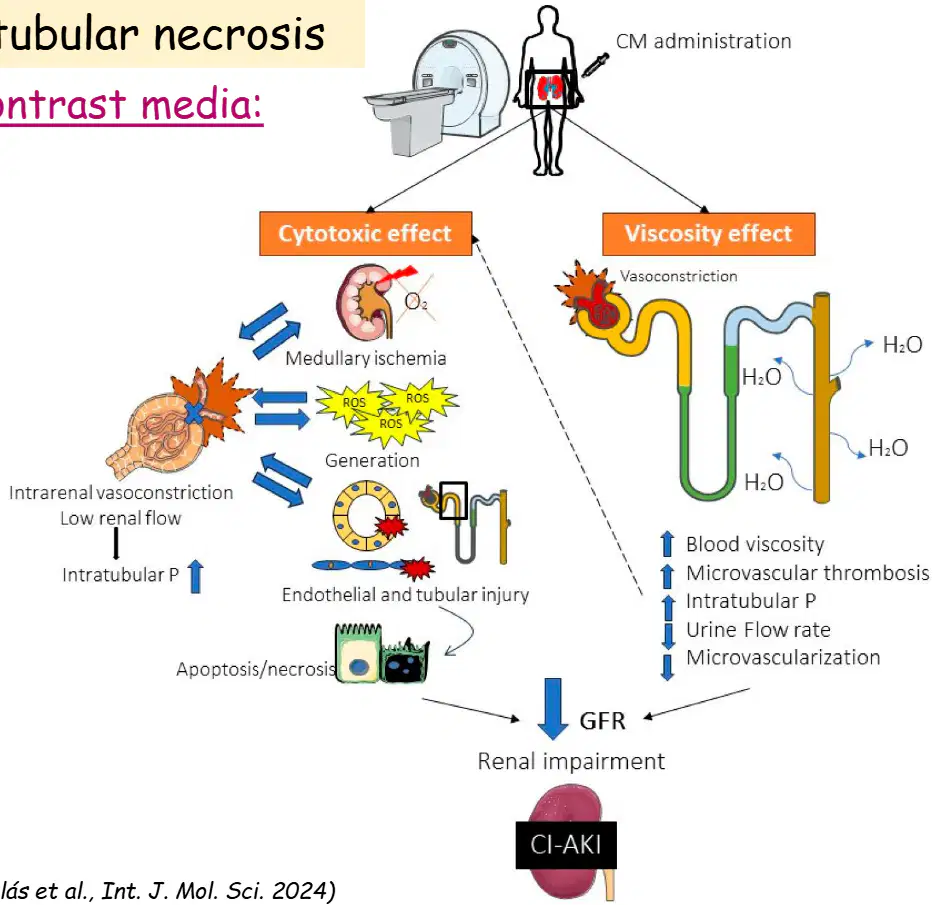
Which of the following is a consequence of increased blood viscosity due to radiocontrast media?
Microvascular thrombosis
Increased urine flow rate
Enhanced glomerular filtration rate (GFR)
Decreased intratubular pressure
Which process is directly linked to the cytotoxic effect of radiocontrast media in the kidney?
Medullary ischemia
Glomerular hyperfiltration
Tubular regeneration
Increased urine osmolality
How does radiocontrast media-induced nephrotoxicity ultimately affect renal function?
It decreases glomerular filtration rate (GFR), leading to renal impairment.
It increases GFR, improving renal function.
It causes hyperfiltration, preventing renal impairment.
It has no effect on renal function.
Which of the following is NOT a mechanism by which radiocontrast media can cause nephrotoxicity?
Generation of reactive oxygen species (ROS)
Endothelial and tubular injury
Increased blood viscosity
Enhanced tubular regeneration
Which of the following is a clinical pattern of nephrotoxicity associated with urinary tract obstruction?
Hematuria, renal colic, and anuria
Proteinuria, polyuria, and edema
Glycosuria, oliguria, and hypertension
Pyuria, nocturia, and hypotension
What is the most common drug cause of post-renal acute kidney injury (AKI)?
Chemotherapy
Antibiotics
Antihypertensives
Diuretics
Which process leads to the blockage of renal tubules during chemotherapy?
Overproduction of uric acid from tumor cell breakdown
Increased protein synthesis in the kidneys
Decreased blood flow to the kidneys
Excessive calcium excretion
Which of the following is recommended to minimize nephrotoxicity during chemotherapy?
Adequate hydration
High protein diet
Increased sodium intake
Reduced fluid intake
Which drug inhibits uric acid production and is used to minimize nephrotoxicity in chemotherapy?
Allopurinol
Probenecid
Furosemide
Amoxicillin
Which agent is used to increase uric acid excretion in the urine during chemotherapy?
Probenecid
Allopurinol
Acetaminophen
Metformin
Which of the following is a method to minimize the risk of renal tubule blockage during chemotherapy?
Alkalinization of the urine
Acidification of the urine
Restriction of water intake
Increased protein intake
Explain how the breakdown of tumor cells during chemotherapy can lead to acute kidney injury and describe two strategies to minimize this risk.
Tumor cell breakdown increases uric acid, which blocks renal tubules; strategies include using allopurinol and ensuring adequate hydration.
Tumor cell breakdown decreases uric acid, which dilates renal tubules; strategies include using antibiotics and reducing fluid intake.
Tumor cell breakdown increases calcium, which blocks renal tubules; strategies include using diuretics and increasing sodium intake.
Tumor cell breakdown decreases potassium, which blocks renal tubules; strategies include using antihypertensives and restricting protein.
Which drug is known to precipitate in the tubules at high concentrations, potentially leading to nephrotoxicity?
Methotrexate
Acyclovir
Sulfadiazine
Sulfamethoxazole
Crystals of which drug may precipitate in the renal collecting tubules due to its low solubility?
Acyclovir
Methotrexate
Sulfapyridine
Sulfamethoxazole
Older sulfonamide agents such as sulfadiazine and sulfapyridine are more likely to cause which renal complication compared to newer agents?
Crystalluria & obstructive nephropathy
Acute tubular necrosis
Glomerulonephritis
Renal artery stenosis
Why are newer and more soluble sulfonamides like sulfamethoxazole less likely to cause obstructive nephropathy?
They have higher solubility
They are less potent
They are not excreted by the kidneys
They do not interact with renal tubules
Given a patient with post-renal AKI after drug administration, which evidence would best support a diagnosis of nephrotoxicity due to precipitation of drugs?
Presence of crystals in renal collecting tubules
Elevated liver enzymes
Low blood pressure
Increased urine output
Which of the following is recommended to prevent Acute Kidney Injury (AKI) during therapy?
Maintain adequate hydration
Increase protein intake
Avoid all medications
Reduce physical activity
What is an example of an alternative drug to NSAIDs for patients at risk of nephrotoxicity?
Acetaminophen
Ibuprofen
Aspirin
Naproxen
Which solution should be used to wash high risk radiocontrast agents to prevent nephrotoxicity?
Isotonic saline
Hypertonic glucose
Distilled water
Hypotonic saline
Why is it important to monitor renal function tests and serum creatinine regularly in patients at risk of nephrotoxicity?
To detect early signs of kidney injury
To measure blood pressure
To check for liver function
To monitor glucose levels
At what point should a drug be stopped to prevent further kidney injury in patients at risk of nephrotoxicity?
At the first sign of kidney injury
After one week of therapy
When symptoms of dehydration appear
When blood pressure increases
Which strategy is recommended when using high risk drugs to minimize nephrotoxicity?
Use the lowest dose for the shortest duration
Use the highest dose for the longest duration
Avoid monitoring renal function
Combine with multiple other drugs
Which laboratory test is used to assess reduced glomerular filtration rate (GFR) in the diagnosis of AKI?
Blood urea nitrogen (BUN)
Urine glucose
Serum potassium
Blood pressure
What does the presence of anuria indicate in a patient suspected of having AKI?
Emergency case
Mild dehydration
Chronic kidney disease
Normal urine output
Why is proteinuria significant in the diagnosis of AKI?
It indicates glomerulonephritis
It confirms diabetes mellitus
It suggests liver failure
It shows urinary tract infection
What is the main purpose of performing an ultrasound in the diagnosis of AKI?
To exclude obstruction
To measure blood pressure
To detect proteinuria
To analyze urine crystals
Which finding in urine analysis is important for diagnosing AKI?
Presence of casts and crystals
High glucose levels
Low sodium concentration
Increased urine volume
How does a biopsy contribute to the diagnosis of AKI?
By histological examination of renal tissue
By measuring serum creatinine
By detecting urinary tract infection
By assessing blood pressure
A patient presents with polyuria and reduced GFR. Which two diagnostic findings are most relevant for AKI?
Oliguria and BUN
Polyuria and serum creatinine
Anuria and blood pressure
Proteinuria and glucose
If proteins are detected in urine, what underlying renal condition should be considered?
Glomerulonephritis
Hypertension
Diabetes insipidus
Liver cirrhosis
Which of the following is the first step in the management of Acute Kidney Injury (AKI)?
Correct fluid & electrolyte abnormalities.
Stop suspected drug.
Avoid nephrotoxic combinations.
Dose adjustments for renally cleared drugs.
Which drug combination should be avoided to prevent nephrotoxic effects in AKI management?
NSAID + ACEI + Diuretics
Antibiotics + Antivirals
Statins + Beta-blockers
Calcium channel blockers + Diuretics
What is the specific treatment for Cisplatin-induced AKI?
Isotonic fluids
Glucarpidase
Amifostine
Furosemide
Glucarpidase is used in AKI management to:
Increase plasma concentrations of methotrexate
Rapidly hydrolyze methotrexate into its nontoxic metabolites
Prevent contrast injury
Adjust dose of renally cleared drugs
In patients with impaired renal function, what is the purpose of using glucarpidase?
To increase the toxicity of methotrexate
To reduce plasma concentrations of methotrexate
To enhance the effect of NSAIDs
To correct electrolyte abnormalities
Which of the following is recommended for contrast injury in AKI management?
Amifostine
Glucarpidase
Isotonic fluids
NSAIDs
A patient with severe AKI is not responding to initial management steps. What should be considered next?
Increase dose of nephrotoxic drugs
Renal replacement therapy
Administer NSAIDs
Reduce fluid intake
Why is dose adjustment necessary for renally cleared drugs in AKI management?
To increase drug toxicity
To prevent drug accumulation and toxicity
To enhance drug absorption
To reduce plasma protein binding

