
 Worksheets
Midterm Review 2025
Total questions: 52
Worksheet time: 34mins
Name
Class
Date
1.
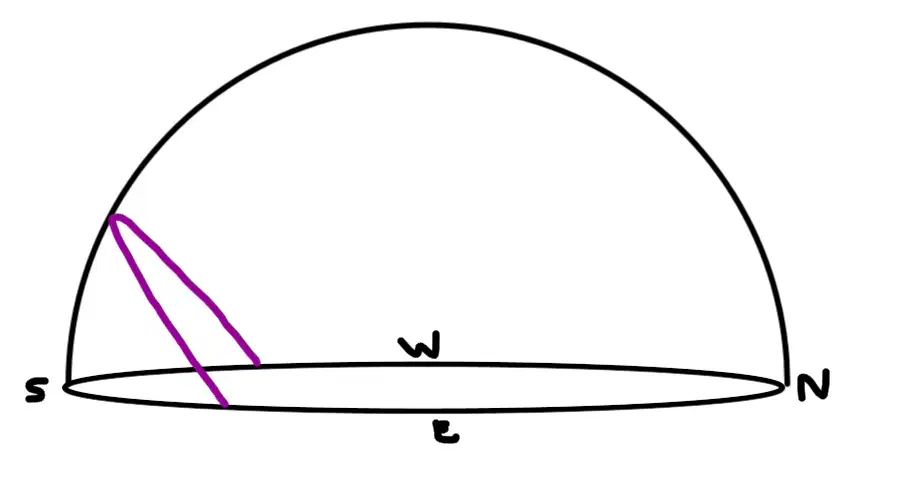
What Date of the year could be represented by this diagram?
a)
December 21
b)
September 23
c)
March 20
d)
June 21
2.

If Earth's Axis tilt was tilted further, from 23.5 deg to 65 deg, what would happen to Seasons on Earth?
a)
Winters would get hotter, and summers would get colder
b)
Winters would get colder and summers would get hotter
c)
The northern Hemisphere would not experience seaons
d)
The southern Hemisphere would not experience seasons
3.
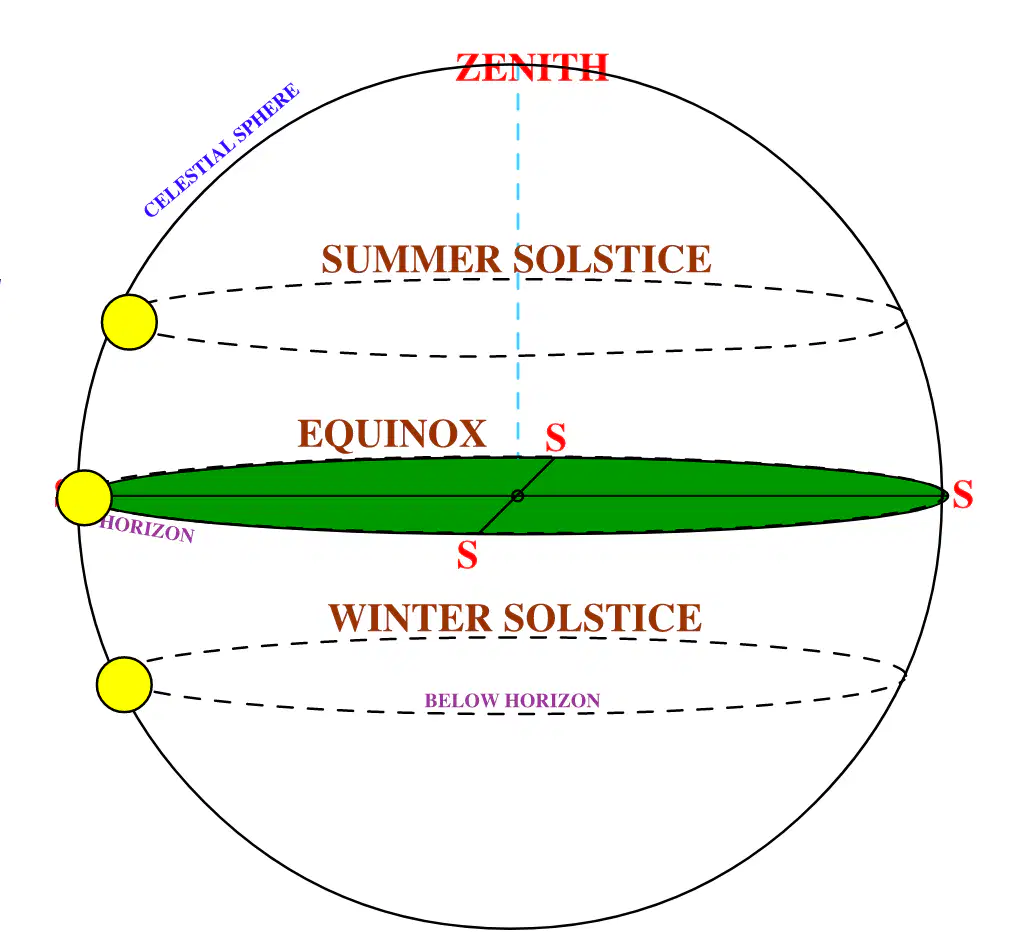
What latitude can be represented by the image below?
a)
0 Deg
b)
90 North
c)
90 South
d)
45 North
4.
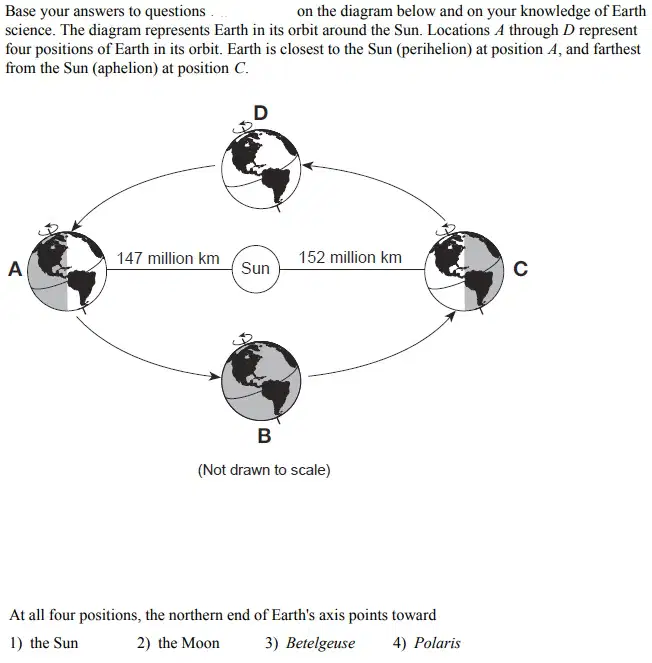
a)
Option 1
b)
Option 2
c)
Option 3
d)
Option 4
5.
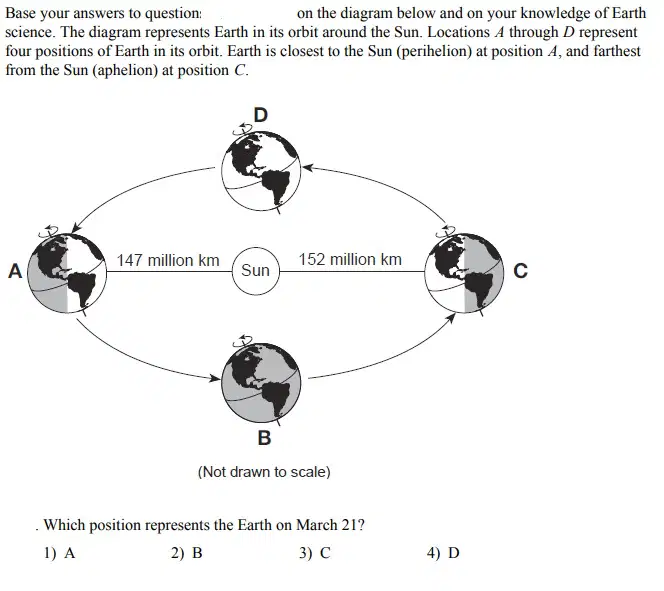
a)
Option 1
b)
Option 2
c)
Option 3
d)
Option 4
6.
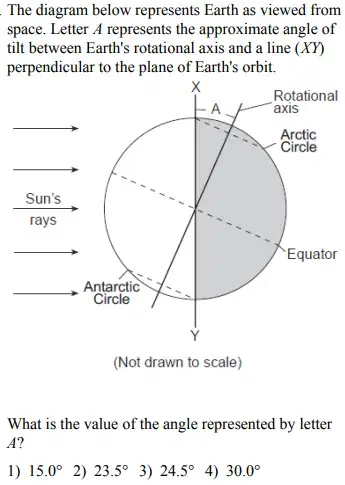
a)
Option 1
b)
Option 2
c)
Option 3
d)
Option 4
7.
Which is true about the Summer Solstice in the Northern Hemisphere?
a)
Longest day of the year, and the longest night of the year
b)
Longest day of the year and shortest night of the year
c)
Shortest day of the year and longest night of the year
d)
Shortest day of the year and shortest night of the year
8.
What motion causes the apparent rising and setting of the sun each day?
a)
Earth's Revolution
b)
Earth's Rotation
c)
Sun's Rotation
d)
Sun's Revolution
9.
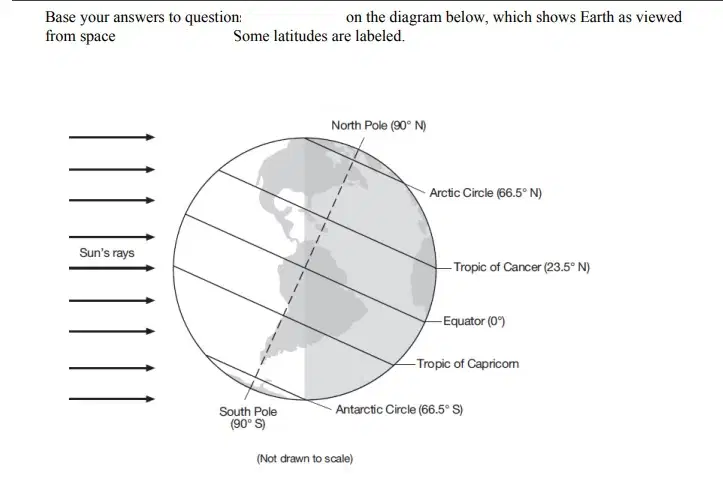
What celestial date and longest night in the Northern Hemisphere is represented by the diagram below?
a)
June 21
b)
December 21
10.
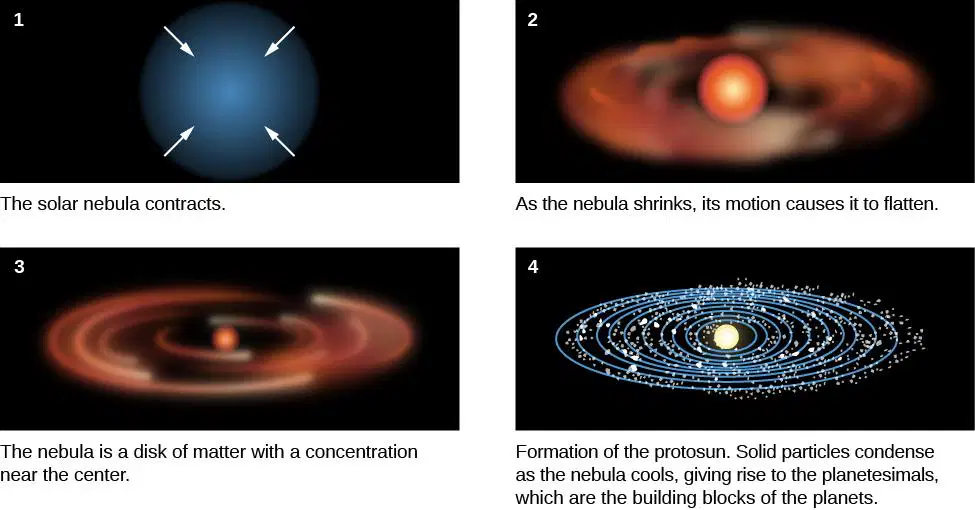
Planetesimals grew through the process of accretion. When they grew large enough, what force caused more and more material to crash into them?
a)
Electromagnetic force
b)
Gravitational Force
c)
Nuclear force
d)
Centripetal force
11.
Which event is oldest in time?
a)
Taconian Orogeny
b)
Mammoth Walked the Earth
c)
Cyanobacteria first change CO2 to Oxygen in the oceans
d)
Pangea Broke up
12.
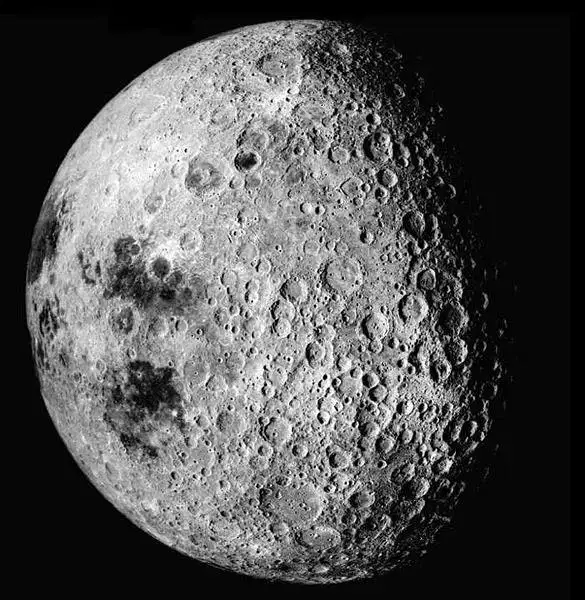
The stark, heavily-cratered surface of the Moon is a geological time capsule, preserving a record of the earliest, most violent eras of solar system history. The visual evidence presented in this image directly ties into two fundamental concepts in planetary science: the process of accretion, as described by the Nebular Hypothesis, and the catastrophic events of the Late Heavy Bombardment (LHB). How does this image of lunar craters serve as physical evidence for both the systematic birth of the solar system and a hypothesized period of intense cosmic violence?
a)
The deep, circular craters formed by explosions are a result of the Moon's volcanic history, which occurred immediately after the solar nebula condensed into a disk.
b)
The craters are evidence of impact events that would be expected during both the final stages of accretion (Nebular Hypothesis) and the subsequent cataclysmic era known as the Late Heavy Bombardment (LHB).
c)
The uniform distribution of craters proves that the impact rate has been constant throughout solar system history, which contradicts the main predictions of the Nebular Hypothesis.
d)
Craters are only found on the Moon's near side, which shows that the impactors during the LHB were gravitationally captured by the Earth and funneled toward one side of the Moon.
13.

The image shows two prominent impact craters on the Moon's surface. Crater A is a large, well-defined crater with a central peak. Crater B is a smaller, sharper crater located on the upper right rim of crater A, with bright ejecta rays extending outwards.
What can we say about the relative age of impact B vs impact A?
a)
Impact A is younger because it is much larger, and the largest impacts occurred later in the Moon's history.
b)
Impact B is older because it is smaller, and the rate of impacts has been steadily decreasing since the Moon formed
c)
Impact B is younger than Impact A because it crosscuts the rim of Crater A.
d)
Impacts A and B are the same age because they both occur on the lunar surface, meaning they were formed during the same catastrophic event.
14.
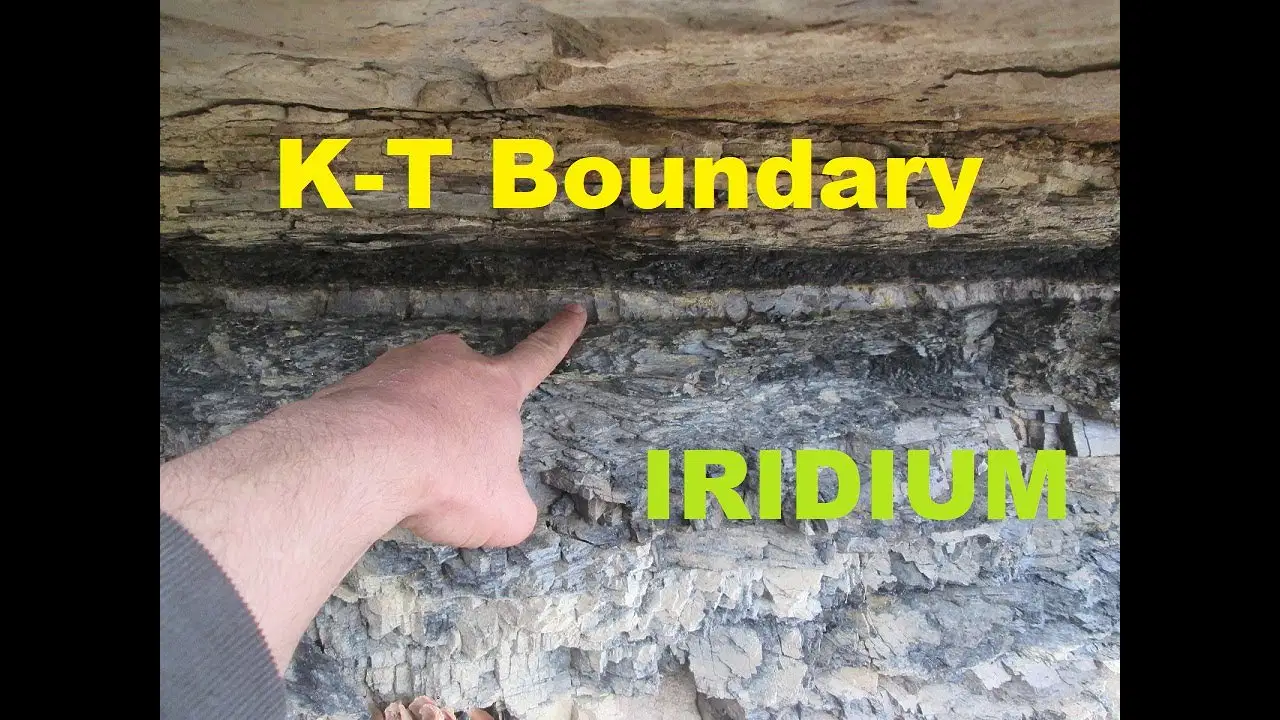
A mass extinction event wiped out the non-avian dinosaurs. Scientists have identified a thin layer of sediment enriched in iridium, a metal rare in Earth's crust but common in asteroids, worldwide at the K–T boundary. Fossil evidence shows a sudden disappearance of dinosaur species after this layer. Geologists use this layer as a marker horizon to correlate sedimentary rocks in different locations.
Based on the information above and the image below, in what rock layers would we expect to see dinosaur fossils?
a)
We would expect to see dinosaur fossils only exactly on the K-T boundary because that is where every dinosaur died
b)
We would expect to see dinosaur fossils below and up to the K-T boundary because older rocks are found at the bottom
c)
We would expect to see dinosaur fossils above the K-T boundary because older rocks are found on top
d)
We would expect to see dinosaur fossils below the K-T boundary because they sunk to the bottom over time
15.

Base your answer on the data table and information below and on your knowledge of Earth science. The data table shows the radioactive decay of carbon-14 and the age of fossil remains, in years (y). Part of the table has been left blank.
The carbon-14 in the fossil remains of a mastodont has undergone five half-lives of radioactive decay. Calculate the age of these fossil remains.
a)
3,125 y
b)
28,500 y
c)
70,000 y
d)
17,100 y
16.
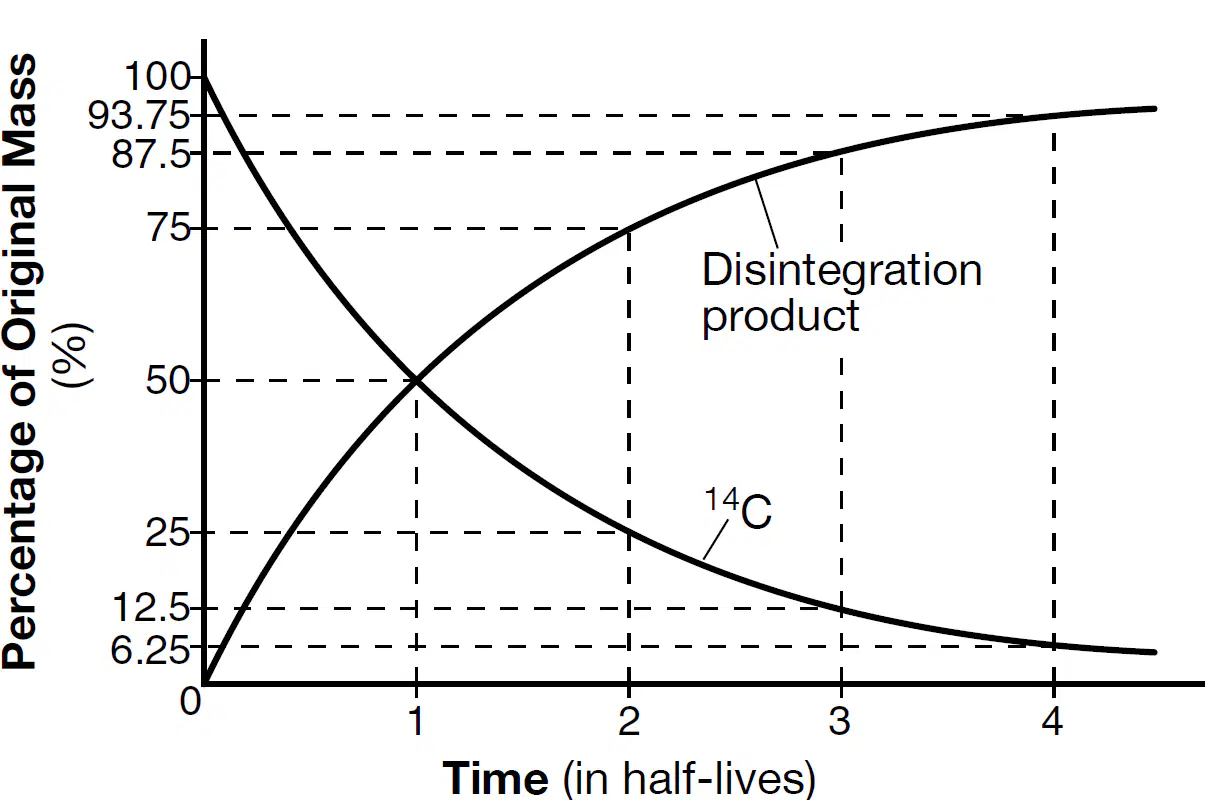
8. Base your answer on the graph below and on your knowledge of Earth science.
The graph shows the percentages of the radioactive isotope carbon-14 and its disintegration product, Nitrogen-14 produced during four half-lives of radioactive decay.
How many half lives have passed when there is 25% of the original C-14 remaining?
a)
1 half-life
b)
2 half-lives
c)
3 half-lives
d)
4 half-lives
17.
Which radioactive element would be most useful in dating a relatively young (between 100-70,000 year old) fossil?
a)
Samarium-147
b)
Uranium-238
c)
Potassium-40
d)
Carbon-14
18.

The passage of the moon into Earth's shadow causes a
a)
Solar eclipse
b)
Lunar eclipse
c)
New moon
d)
Full moon
19.
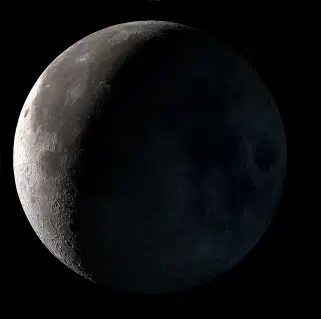
What Phase is this?
a)
Waxing Gibbous
b)
Waning Gibbous
c)
Waxing Crescent
d)
Waning Crescent
20.
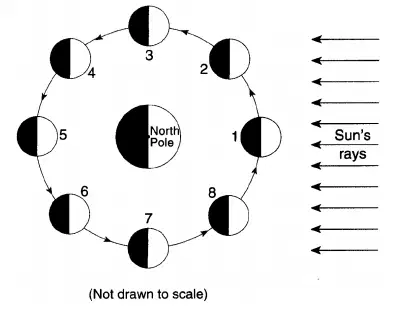
Identify the numbered location that a lunar eclipse could be viewed from Earth.
a)
1
b)
5
21.
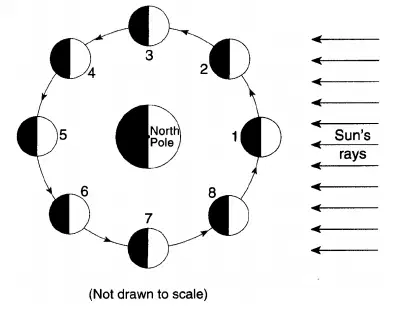
At which numbered position would the moon causes high tides that are higher than normal (Spring Tide)?
a)
1 or 5
b)
3 or 7
c)
2 or 8
d)
4 or 6
22.

a)
1
b)
2
c)
3
d)
4
23.
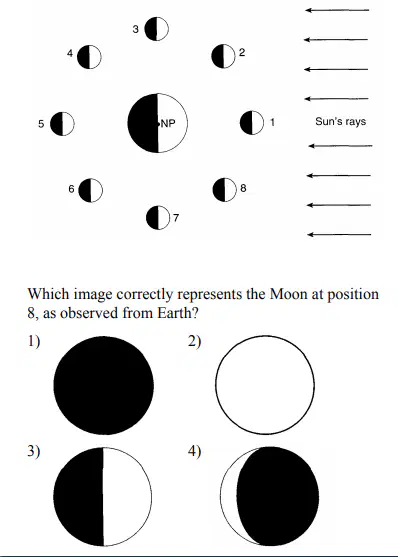
a)
1
b)
2
c)
3
d)
4
24.

What is this person observing?
a)
Solar Eclipse
b)
Lunar Eclipse
c)
Full Moon
d)
Neap Tide
25.
If an observer experienced a full moon on February 1, what date of the year would that observer experience the next full moon?
a)
Feb 30
b)
March 2
26.
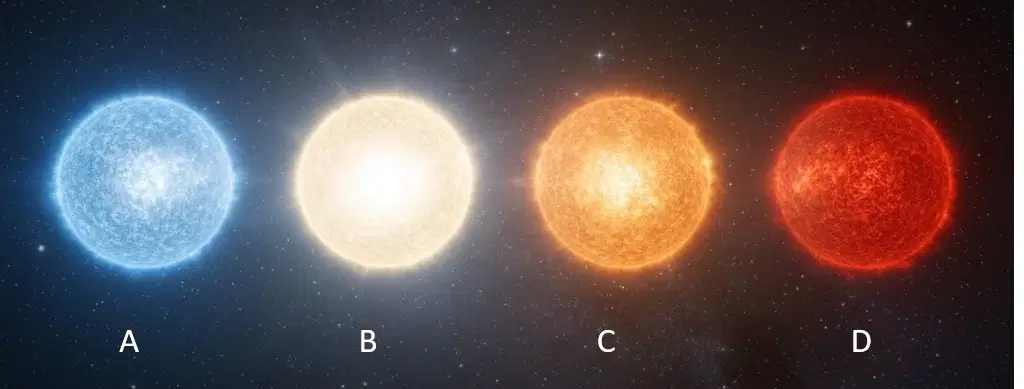
Which of the following stars would be measured the coldest in degrees Kelvin?
a)
A
b)
B
c)
C
d)
D
27.
Analyze the H-R Diagram. Based on its current Surface Temperature and Luminosity, which of the following best describes the Sun's present position in relation to its future Red Giant phase?
a)
(1) The Sun currently has a lower luminosity and a higher temperature than the Red Giant phase.
b)
(2) The Sun currently has a higher luminosity and a lower temperature than the Red Giant phase.
c)
(3) The Sun currently has a similar temperature but a significantly higher luminosity than the Red Giant phase.
d)
(4) The Sun currently has a similar luminosity but a significantly lower temperature than the Red Giant phase.
28.
The Sun is currently powered by the fusion of hydrogen into helium. Explain the process that will power the Sun's expansion into a Red Giant phase, according to the Life Cycles of Stars Model
a)
(1) The core begins to fuse carbon and oxygen, increasing the star's overall mass.
b)
(2) Helium fusion stops completely, causing the Sun to rapidly contract into a White Dwarf.
c)
(3) Hydrogen fusion ceases in the core and begins in a shell around the core as it begins to run out, heating and pushing the outer layers outward into its first stage of death..
d)
(4) Gravitational forces entirely overcome the outward pressure, causing the star to cool and end up on the Main Sequence.
29.
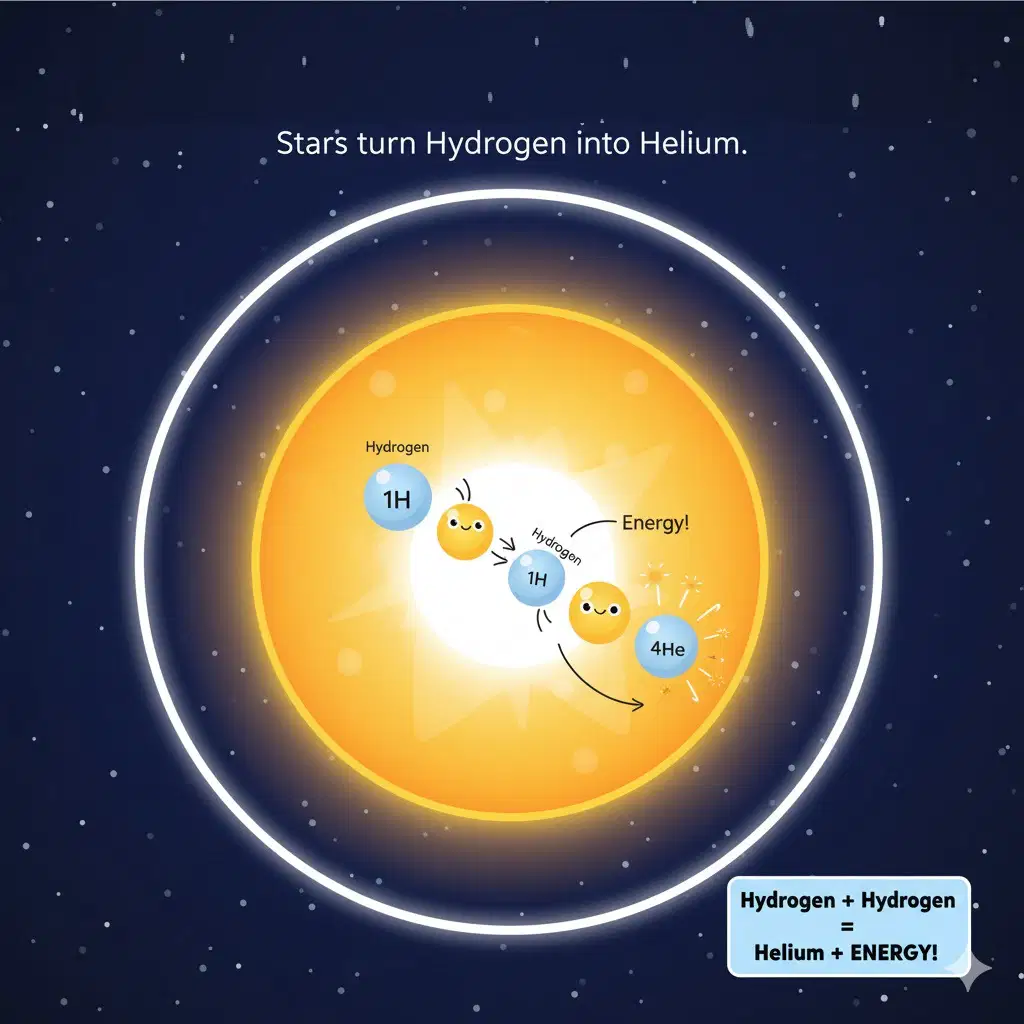
What process is modeled in the picture below?
a)
Nuclear Fusion
b)
Convection
c)
Supernovae atom splitting
d)
Hydrolisis
30.

In what layer of the Sun does nuclear Fusion Occur
a)
Magnetosphere
b)
Radiative Zone
c)
Convective Zone
d)
Core
31.
Which of the following processes is not a way in which atoms and elements are created:
a)
Big Bang Nucleosynthesis of Hydrogen
b)
Supernova explosions of massive stars
c)
Nuclear Fusion of elements in a star's core
d)
Electromagnetic Diffusion of Stellar nebulae
32.

What is the person most likely modeling in the photo
a)
the elliptical orbit of a planet
b)
the speed of rotation from a comet
c)
the path of destruction of an earthquake
d)
the laws of planetary interaction
33.
Which planet's orbit around the sun is most nearly circular?
a)
Neptune
b)
Venus
c)
Mercury
d)
Mars
34.
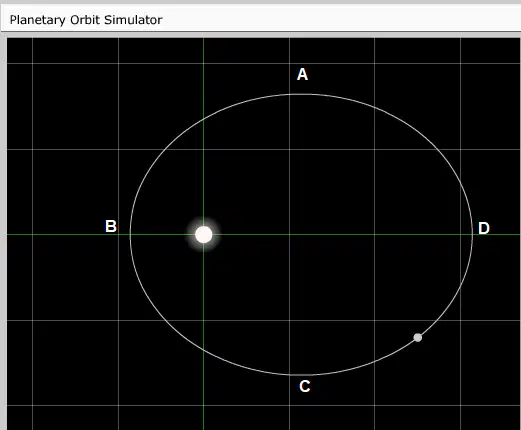
Which letter would the planet hit next on its orbit?
a)
A
b)
B
c)
C
d)
D
35.
Kepler’s laws describe how planets move around the Sun. According to his first law, what shape is a planet’s orbit?
A. A perfect circle
B. An oval, or ellipse
C. A straight line
D. A spiral
a)
A
b)
B
c)
C
d)
D
36.
Why does Earth move faster in its orbit when it is closer to the Sun?
A. The Sun’s gravity pulls on Earth more strongly
B. The Sun’s heat pushes Earth forward
C. Earth’s atmosphere makes it speed up
D. The Moon’s gravity pulls it faster
a)
A
b)
B
c)
C
d)
D
37.
Which statement best explains why the outer planets take longer to orbit the Sun than the inner planets?
A. The law of accretion states that they are smaller than inner planets
B. The inverse square law states that because they are farther from the Sun they move more slowly
C. The Law of equal areas states that they spin slower on their axes
D. The law of conservation of matter states that they have more moons
a)
A
b)
B
c)
C
d)
D
38.
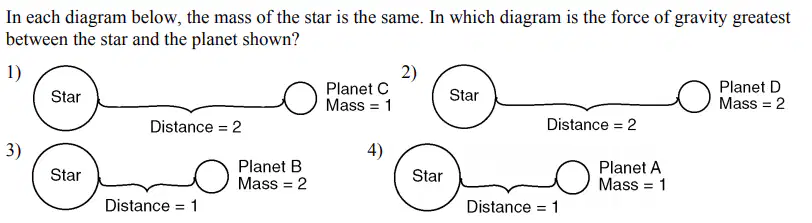
?
a)
Option 1
b)
Option 2
c)
Option 3
d)
Option 4
39.
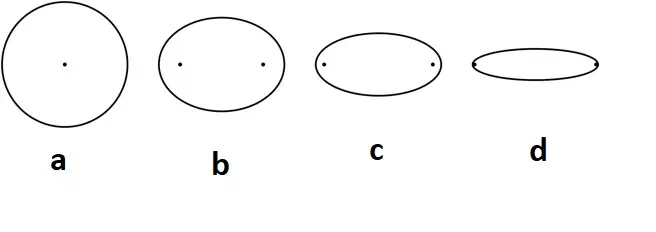
Which ellipse is considered the most eccentric?
a)
A
b)
B
c)
C
d)
D
40.
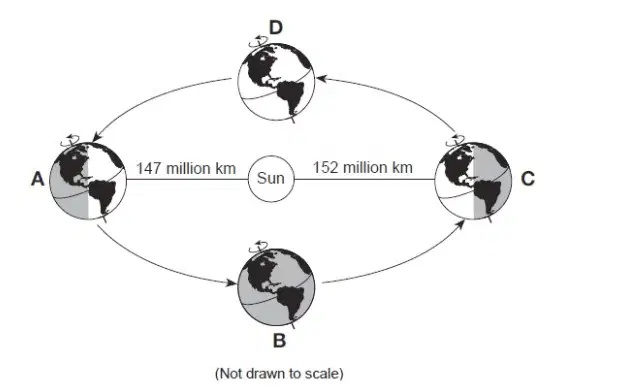
If Earth in the diagram at location C is June 21, which lettered location would be December 21?
a)
A
b)
B
c)
C
d)
D
41.
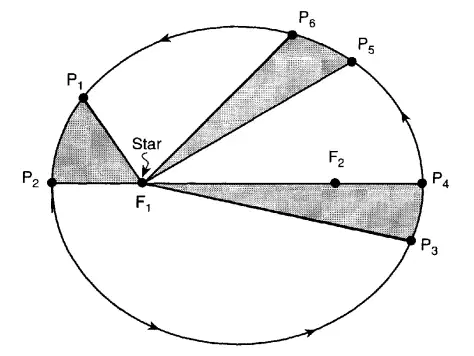
If each shaded region is equal in area, then the time it took the planet to go from P1 to P2 is the same time as the planet moves from P3 to
a)
P4
b)
P5
c)
P6
d)
P2
42.
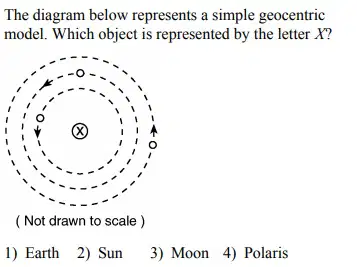
a)
Option 1
b)
Option 2
c)
Option 3
d)
Option 4
43.

The chart below shows the plotting of distant galaxies discovered by Edwin Hubble in 1929 compared to more recent galaxies discovered. Which of the following claims can be made based on the chart below?
a)
Megaparsecs are smaller in value than light years.
b)
A recessional velocity has no bearing on distance away from the observer.
c)
As distance in space increases, the speed at which galaxies move increases.
d)
As galaxies move further away from our solar system, they get larger in size.
44.
What is the relationship between time and distances between galaxy since the big bang?
a)
As time goes on, the distances between galaxies decrease.
b)
As time goes on, the distances between galaxies stay the same.
c)
As time goes on, the distances between galaxies expand and contract.
d)
As time goes on, the distances between galaxies increase.
45.
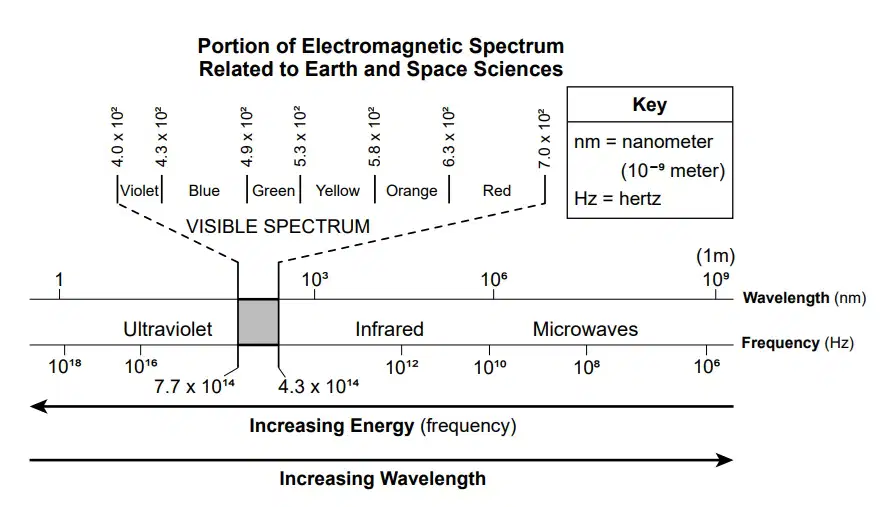
A student claims that the frequency of infrared light is approximately 10^5. Based on the image below, which evidence either supports or refutes this claim?
a)
Support: Frequency decreases as wavelength decreases. So the exponents in this image would support this.
b)
Refute: Infrared radiation is not visible to the naked eye and this number would not fit in the visible spectrum.
c)
Refute: Gamma rays are missing from the image.
d)
Refute: Although the wavelength of light in the infrared spectrum is close to this value, the frequency is much higher.
46.
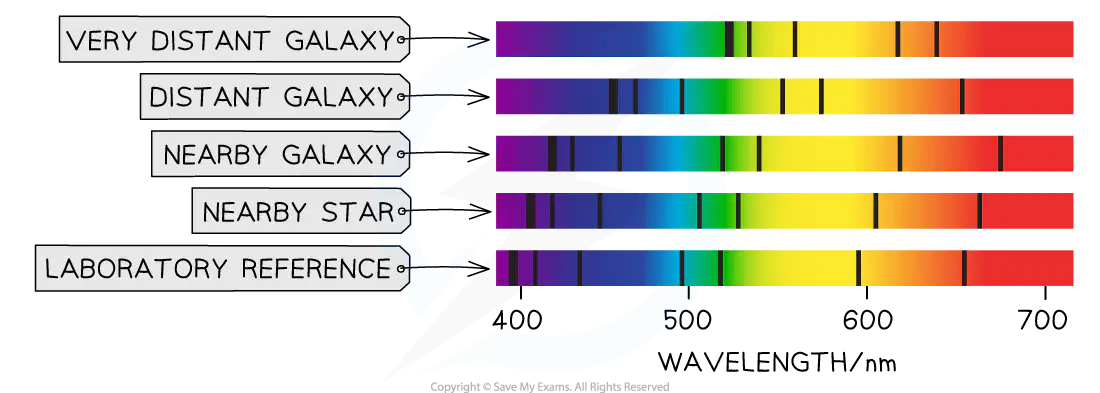
When the spectra lines in the image below are very far to the right, like in the "very distant galaxy," this means that galaxy is moving
a)
the fastest and toward us
b)
the slowest and toward us
c)
the fastest and away from us
d)
the slowest but away from us
47.

a)
Option 1
b)
Option 2
c)
Option 3
d)
Option 4
48.
Refer to Figure A. Based on the information in the table, A student claims that the constellation Hydra is moving away the fastest because it is furthest away. What information, from the Red Shift Column, supports this claim?
a)
It is the most red shifted.
b)
Its light is being absorbed by calcium.
c)
It is the most violet/blue shifted.
d)
It is less than one light year away from Earth.
49.

a)
1
b)
2
c)
3
d)
4
50.

a)
Option 1
b)
Option 2
c)
Option 3
d)
Option 4
51.

a)
Option 1
b)
Option 2
c)
Option 3
d)
Option 4
52.

a)
Option 1
b)
Option 2
c)
Option 3
d)
Option 4
100 %

