
 Worksheets
Morphology and Modification of Stems
Total questions: 150
Worksheet time: 1hrs 15mins
Which statement best defines a stem in seed plants?
Flattened leaf-like organ doing photosynthesis
Underground root-like organ absorbing water
Descending axis from radicle storing food
Ascending axis from plumule bearing organs
Identify the part of the stem where leaves arise.
Axillary roots
Petiole of leaves
Internodes between nodes
Nodes along the axis
Which function is primarily performed by stems?
Production of pollen in anthers
Absorption of minerals from soil
Nitrogen fixation in soil
Conduction of water and solutes
Young stems are typically green; with age they become what?
Spongy and light yellow
Fibrous and bright red
Woody and dark brown
Fleshy and pale white
Which option correctly pairs a stem modification with its role?
Corm for nitrogen uptake
Bulbil for photosynthetic roots
Tendril for seed dormancy
Tuber for food storage
Which is an underground stem modification?
Rhizome of ginger
Thorn of citrus
Tendril of grapevine
Stolon of jasmine
Which plant shows a bulb as a stem modification?
Pistia in aquatic offset
Mint in creeping runner
Passiflora in aerial tendrils
Onion in storage leaves
What distinguishes internodes from nodes on a stem?
Points of thorn development
Regions where leaves form
Sites of axillary buds
Portions between two nodes
Which statement about thorns is accurate?
Woody pointed structures from axillary buds
Soft epidermal outgrowths called prickles
Modified leaves used for storage
Elongated runners aiding vegetative spread
Phylloclade is best described as which structure?
Green flattened or fleshy cylindrical stem
Flattened leaf blade with many stomata
Underground corm with storage parenchyma
Aerial runner with long internodes
Which example fits a phylloclade?
Opuntia flattened stem
Gladiolus underground corm
Passiflora leaf tendril
Duranta axillary thorn
Which sub-aerial modification forms a rosette of leaves and tuft of roots at nodes in aquatics?
Runner in Oxalis
Sucker in Banana
Offset in Pistia
Stolon in Jasmine
Stolon is characterized by which growth pattern?
Slender branch arches downward to ground
Horizontal underground storage organ
Erect woody shoot with spines
Short internodes forming leaf rosettes
Bulbil is most closely associated with which phenomenon?
Creeping stem rooting at nodes
Flattened photosynthetic stem segment
Woody spine protecting from herbivory
Aerial propagule replacing inflorescences
Which pairing of plant and modification is correct?
Grapevine—tendril
Euphorbia—corm
Crocus—runner
Water hyacinth—stolon
Which feature best distinguishes a tap root system from a fibrous root system?
Roots mainly confined to superficial soil layers
Numerous equal-sized roots replace primary
Primary root persists and branches laterally
Roots arise from stem nodes and internodes
In monocots, which root system typically develops after the short-lived primary root?
Tap root system with tertiary roots
Fibrous root system from stem base
True adventitious roots from leaves
Prop roots originating from lower nodes
Which region of the root tip is immediately above the root cap and contains rapidly dividing cells?
Stele with xylem and phloem tissues
Region of meristematic activity
Region of maturation with root hairs
Region of elongation with enlarging cells
What is the primary function of the root cap?
Absorb water and mineral ions
Anchor the plant to the soil
Store reserve food materials
Protect the tender root apex
Which statement correctly describes the region of elongation in roots?
Cells differentiate and form root hairs
Cells undergo rapid length increase
Cells develop secondary xylem and phloem
Cells divide repeatedly and are thin-walled
Root hairs are most abundant in which region of a root tip?
Region of meristematic activity near apex
Region of elongation above meristem
Region of maturation proximal to elongation
Root cap covering the apex tip

Which modification consists of aerial roots that grow upward to obtain oxygen in swampy soils?
Prop roots supporting heavy branches
Pneumatophores for respiratory exchange
Stilt roots arising from stem nodes
Buttress roots widening basal trunk
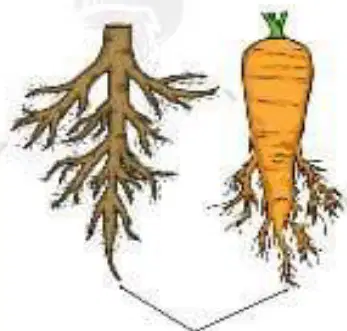
Identify the main root type shown with a single dominant central root and lateral branches.
Foliar roots emerging from leaves
Tap with primary root and laterals
Adventitious from non-radicle parts
Fibrous with many similar roots
Which root system provides strong vertical penetration for anchorage and deep water access in dicots?
Pneumatophore system for aeration
Adventitious network from stems and nodes
Tap system with elongated primary root
Fibrous shallow network near surface
During early seedling development, which sequence of regions is encountered when moving from the apex upward?
Cap, meristem, elongation
Meristem, maturation, elongation
Maturation, meristem, elongation
Cap, elongation, maturation
Which statement best explains why fibrous root systems efficiently prevent soil erosion?
They develop deep taproots penetrating subsoil
They form dense, branching surface networks
They produce thick storage roots with starch
They grow aerial roots specialized for gas exchange
Which is a correct pairing of modification and function?
Corm roots—nitrogen fixation in nodules
Pneumatophores—anchorage by lateral branches
Stilt roots—support from lower stem nodes
Prop roots—food storage in swollen taproots
Adventitious roots are defined by which origin pattern?
Form exclusively from underground stems
Emerge from the radicle of the embryo
Develop only from secondary root tips
Arise from parts other than the radicle

Which feature best distinguishes a taproot system from an adventitious root system in the diagrams?
Short roots emerging only near shoot apex
Roots spreading evenly from leaf bases
Clustered roots arising from stem nodes
Main central root with lateral branches

In the chart of root modifications, which storage organ is explicitly shown as a taproot example?
Sweet potato with tuberous roots
Carrot with swollen primary root
Potato with underground stem
Ginger with rhizome segments
Which statement matches the definition of adventitious roots given in the diagram?
Roots develop only in seedling taproot tips
Roots always arise from the radicle only
Roots originate from stems, leaves, or nodes
Roots form exclusively below the root zone

Which modification provides respiratory function in mangrove habitats according to the images?
Pneumatophores projecting above mud
Prop roots hanging from branches
Stilt roots from lower stem bases
Buttress roots forming flared plates

Which pair correctly matches mechanical support type with the plant shown?
Prop roots — banyan tree aerial supports
Stilt roots — epiphyte orchid anchors
Buttress roots — floating aquatic leaves
Contractile roots — mangrove pneumatophores
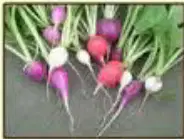
Which category groups root modifications by enhancing growth and survival rather than structural support in the poster?
Reproductive functions only without storage
Physiological functions like storage
Mechanical functions like buttressing
Defensive functions like thorns

Which example is listed under adventitious root storage rather than taproot storage?
Radish with swollen taproot
Sweet potato with tuberous roots
Beetroot primary root thickening
Carrot taproot enlargement
Which root type is associated with epiphytes like orchids in the diagram set?
Aerial adventitious roots with velamen
Nodulated taproots with rhizobia
Pneumatophores in salt marsh plants
Contractile roots in bulbs
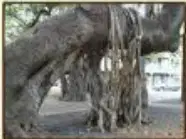
Which function is specifically categorized under mechanical functions in the third image?
Assimilatory photosynthetic root surfaces
Parasitic haustoria extracting nutrients
Climbing support using adventitious roots
Respiratory gas exchange via pneumatophores
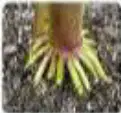
Which description best fits stilt roots as shown?
Oblique brace roots from lower stem
Vertical air roots with lenticels
Thread-like roots from leaf margins
Plate-like flares at trunk base
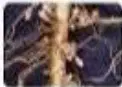
Which root modification is directly linked to symbiosis in legumes according to the chart?
Epiphytic aerial roots
Nodulated roots housing rhizobia
Contractile roots beneath bulbs
Parasitic haustorial roots

Which option correctly contrasts prop roots and buttress roots in support strategy?
Prop roots descend from branches; buttresses are trunk flanges
Prop roots are underground swellings; buttresses are aerial pads
Prop roots are leaf-derived; buttresses are radicle-derived
Prop roots photosynthesize; buttresses perform respiration
Which modification is shown for parasitic plants like Cuscuta in the adventitious column?
Haustorial roots penetrating hosts
Pneumatophores for oxygen uptake
Nodules fixing atmospheric nitrogen
Velamen-covered aerial absorptive roots
Which classification includes root-thorns and contractile roots together?
Reproductive function exclusive category
Mechanical function modifications group
Respiratory adaptation category
Physiological function modifications group

Which statement best identifies true adventitious roots in the first diagram set?
Roots originate away from the root zone
Roots arise from primary taproot only
Roots form exclusively from leaf veins
Roots emerge solely from underground stems

In the diagram of embryonic eudicots, which root type emerges from the radicle and forms the main axis early in development?
Seminal root from coleoptile
Hypocotyl root from stem
Lateral root from pericycle
Primary root from radicle axis
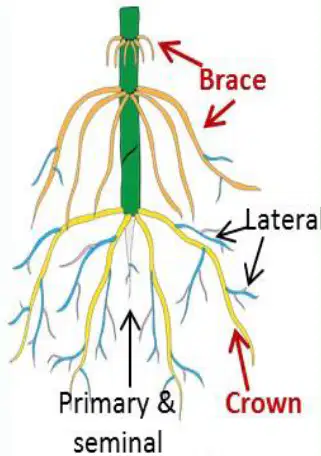
In post-embryonic monocots shown, brace roots originate from which region to support the shoot mechanically?
Radicle tip region
Coleorhiza sheath apex
Above-ground stem nodes
Leaf petiole bases
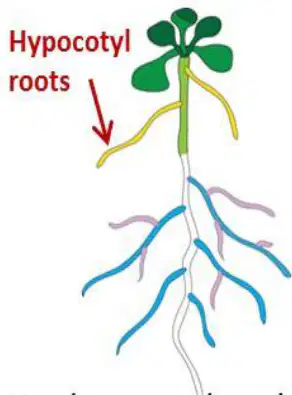
Which label in the intact plant panel refers specifically to roots emerging from the hypocotyl under etiolation conditions?
Hypocotyl roots under etiolation
Junction roots at cotyledon
Crown roots during maturity
Seminal roots near seed
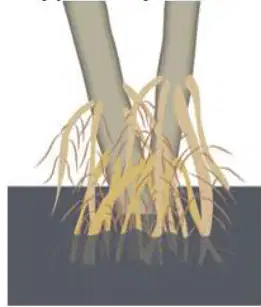
Flood-induced stem roots, as depicted, most directly enhance which function during waterlogging?
Oxygen uptake near waterline
Phloem loading efficiency
Coleoptile elongation rate
Nutrient storage in taproot
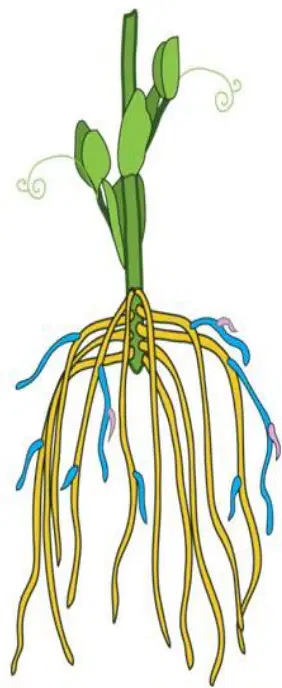
The wounding panel illustrates roots arising after cutting or herbivory. These are best classified as which adventitious type?
Seminal primary roots
Wound-induced stem roots
Pericycle lateral roots
Haustorial feeding roots
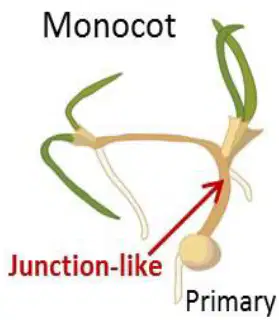
In monocots, junction-like roots shown near the seed are associated with which protective structure around the radicle?
Crown node lignification
Hypocotyl cortex thickening
Coleoptile leaf emergence
Coleorhiza sheath protection
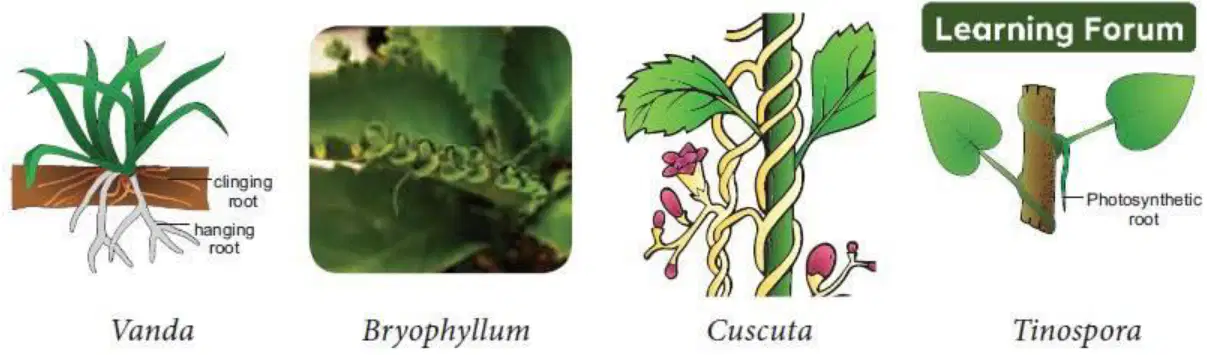
Which option correctly pairs the aerial orchid Vanda roots with their dual roles shown?
Hanging roots for gas exchange, clinging roots for transpiration
Clinging roots for anchorage, hanging roots for absorption
Hanging roots for support, clinging roots for storage
Clinging roots for photosynthesis, hanging roots for pollination
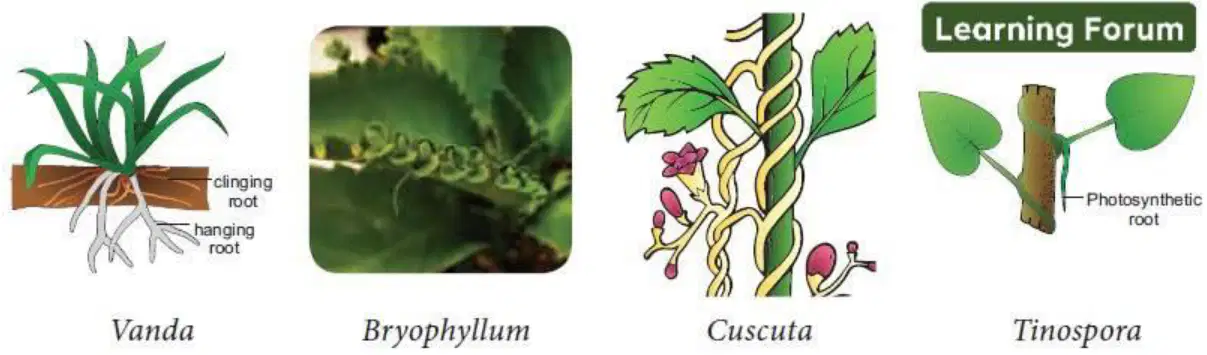
Bryophyllum exhibits small rootlets on leaf margins. These structures primarily enable which capability?
Vegetative propagation via plantlets
Parasitic haustorial penetration
Hygroscopic water absorption
Photosynthetic carbohydrate storage

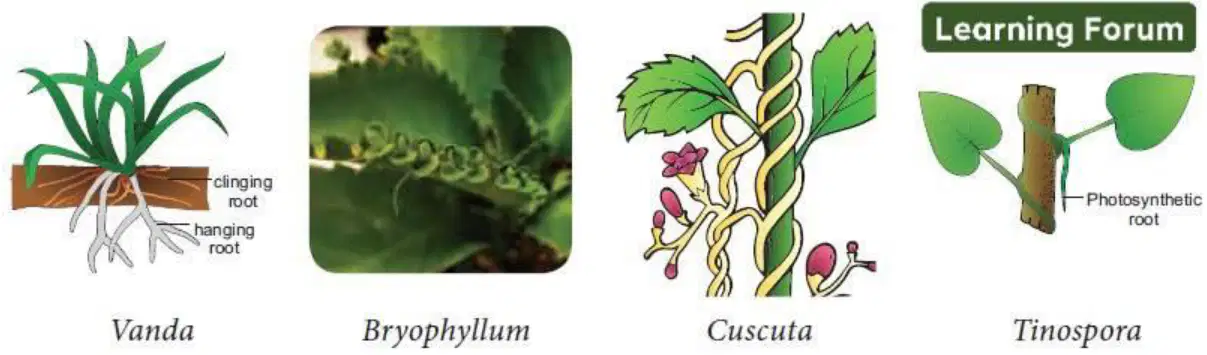
In Cuscuta, the specialized roots that penetrate host tissues are called what?
Haustoria for host penetration
Brace roots for support
Hypocotyl roots for storage
Seminal roots for germination
Tinospora is shown with green roots. What distinctive function do these adventitious roots perform?
Mycorrhizal symbiosis formation
Salt exclusion from xylem
Nitrogen fixation in cortex
Photosynthesis in exposed roots
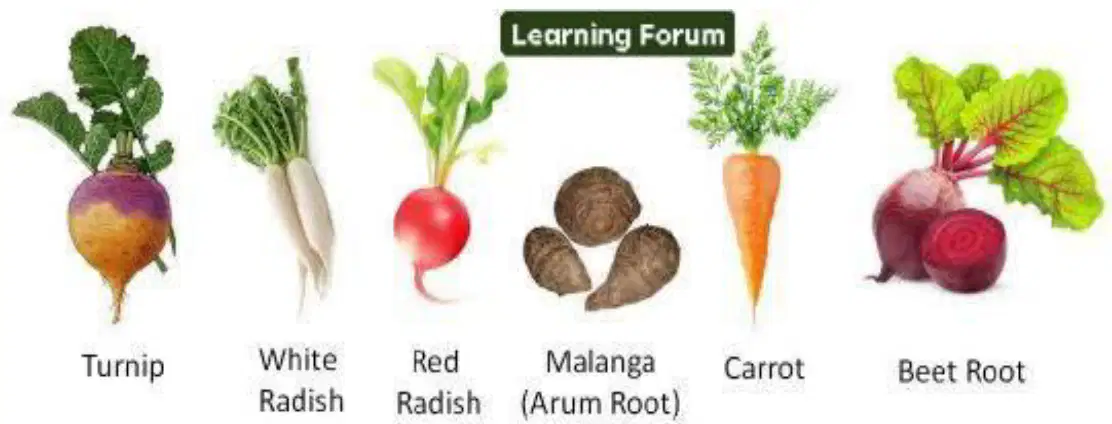
Among the edible roots depicted, which example is a classic taproot with substantial storage parenchyma typical of eudicots?
Carrot storage taproot
Malanga corm root
White radish fibrous root
Turnip stem tuber

Beet roots often show concentric rings of pigmentation. Which physiological role accompanies this morphology?
Haustorial feeding on hosts
Aerating aerenchyma development
Mechanical anchorage bracing
Sucrose-rich storage tissues
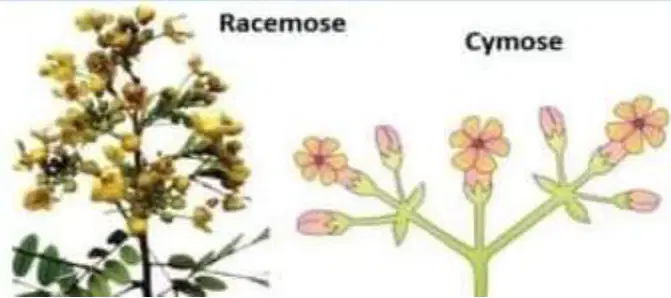
Which statement best defines an inflorescence in flowering plants?
A group of leaves around a bud
A single flower with multiple ovaries
A cluster of flowers on a floral axis
A solitary flower at a shoot tip
In a cymose inflorescence, what happens to the main axis?
It forms a raceme with equal pedicels
It produces only lateral leaves
It terminates in a flower and stops
It grows indefinitely without flowers
Which term refers to the swollen end of the stalk (pedicel) that bears floral whorls?
Receptacle
Calyx
Thalamus
Bract
What are bracts in the context of flower morphology?
Reduced leaves at the base of pedicel
Petals that protect the bud
Stamens modified into sterile parts
Sepals fused into a tube
Which set correctly lists the four typical floral whorls?
Sepals, petals, stamens, ovules
Bracts, receptacle, sepals, petals
Calyx, corolla, androecium, gynoecium
Pedicel, thalamus, stamens, pistil
Actinomorphic flowers are characterized by which feature?
Two equal radial halves in any plane
Two equal halves only in one plane
No equal halves in any plane
Multiple planes but unequal halves
Zygomorphic symmetry allows division into two similar halves in which manner?
Any radial plane through the center
No plane through the center
Only a particular vertical plane
Multiple horizontal planes
Which classification is based on the number of floral appendages?
Hypogynous, perigynous, epigynous
Racemose, cymose, solitary
Trimerous, tetramerous, pentamerous
Actinomorphic, zygomorphic, asymmetric
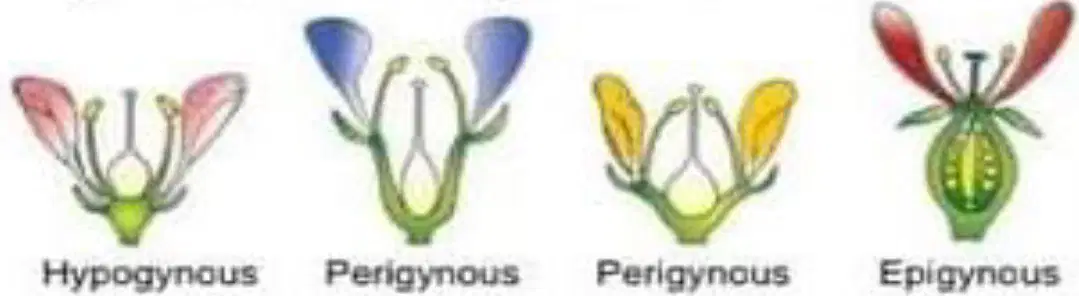
In hypogynous flowers, the position of the ovary is described as what?
Enclosed within the thalamus
Half inferior at same level
Superior above other parts
Inferior under the receptacle
Which statement correctly describes perigynous flowers?
Parts on rim of thalamus, same level
Thalamus encloses ovary completely
Other parts arise above the ovary
Gynoecium at highest position
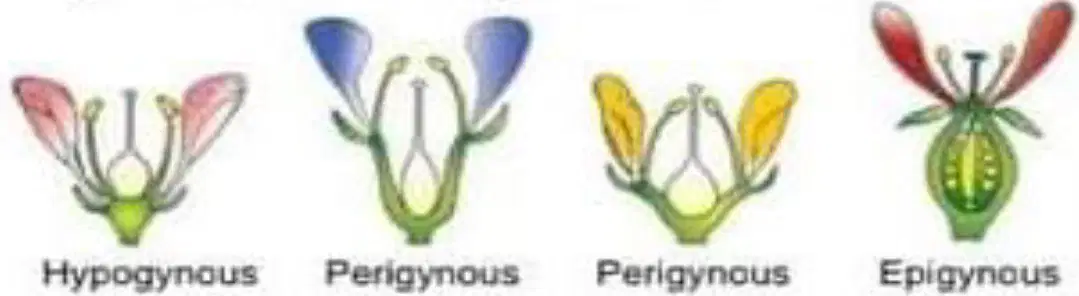
Epigynous flowers are best characterized by which feature?
Ovary superior, parts above
Ovary superior, parts below
Ovary inferior, thalamus fused
Ovary half inferior, rim level
Which pairing of inflorescence types contrasts main-axis growth patterns?
Both unlimited with lateral flowers
Both limited main-axis growth
Racemose limited vs. cymose unlimited
Racemose unlimited vs. cymose limited
Which term describes sepals or petals that touch at the margins without overlapping in a floral bud?
Twisted aestivation with overlapping margins
Valvate aestivation without overlapping
Imbricate aestivation with random overlap
Vexillary aestivation with five petals
In vexillary (papilionaceous) aestivation, which arrangement is characteristic?
All petals touch but do not overlap
Two smallest petals overlap the standard
Margins overlap in no specific order
Largest petal overlaps two lateral petals
Epipetalous stamens are best described as stamens that are
Free from all floral parts
Joined into one common bundle
Attached to petals directly
Attached to sepals directly
Which part of the stamen produces pollen grains?
Receptacle beneath the ovary
Staminode without fertile tissue
Filament supporting the anther
Anther with bilobed pollen-sacs
When stamens are united into two bundles, the condition is
Synandrous fusion with perianth
Monadelphous bundling of stamens
Diadelphous bundling of stamens
Polyadelphous bundling of stamens
Which statement correctly distinguishes syncarpous from apocarpous pistils?
Syncarpous has free carpels
Apocarpous forms a single ovary
Apocarpous has fused carpels
Syncarpous has fused carpels
Marginal placentation is characterized by ovules borne
Along ventral suture forming two rows
At base of ovary with single ovule
On inner wall forming false septum
On central axis without septa
Axile placentation occurs when
Ovules borne on central axis only
Placenta forms ridge along suture
Ovules develop on inner ovary wall
Placenta is axial in multilocular ovary
Parietal placentation typically results from
Basal attachment of a single ovule
Multilocular ovary with axial placenta
Ovules on inner wall with false septum
Central axis bearing ovules without septa
Which floral whorl lies inner to the calyx and is composed of petals?
Gynoecium forming carpels
Receptacle supporting whorls
Androecium forming stamens
Corolla with coloured petals
What term describes sepals that are united into a single structure?
Gamosepalous with united sepals
Polysepalous with free sepals
Gamopetalous with united petals
Polypetalous with free petals
Which feature best identifies imbricate aestivation?
Margins overlap without specific order
Largest petal covers the smaller keels
Petals touch edges without overlap
Margins overlap in fixed order
A sterile stamen in the androecium is called a
Filament supporting anther
Staminode lacking pollen-sacs
Nectary attracting insects
Anther with two pollen sacs
Which condition describes stamens united into more than two bundles?
Monadelphous with one bundle
Diadelphous with two bundles
Polyadelphous with many bundles
Synandrous fused to perianth
Which component of the carpel is the receptive surface for pollen grains?
Stigma at the tip of style
Ovary with attached ovules
Placenta bearing the ovules
Style connecting to ovary
Free central placentation is defined by ovules borne
On inner wall forming false septum
Along ventral suture in two rows
At base of ovary as single ovule
On central axis with absent septa
Which pair correctly matches corolla types mentioned?
Axile and parietal forms
Tubular and wheel-shaped forms
Marginal and basal forms
Monadelphous and diadelphous
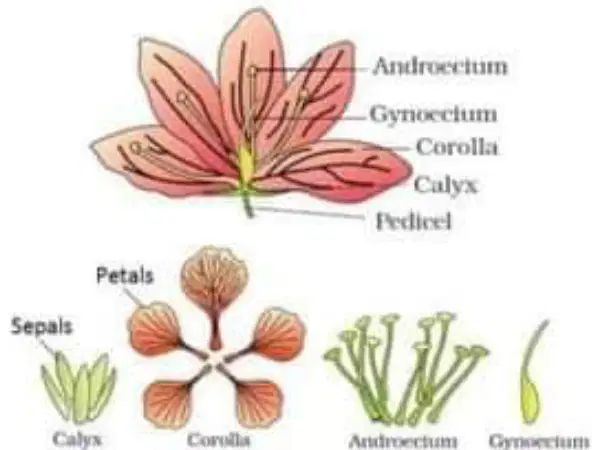
Identify the labeled structure that links the stigma to the ovary, allowing pollen tubes to grow through it (refer to the diagram).
Style as elongated tube
Receptacle at flower base
Filament supporting anther
Stigma as sticky surface
Which statement best defines parthenocarpic fruit?
Fruit developed from inferior multicarpellary ovary
Fruit developed without fertilisation of ovary
Fruit formed when endosperm persists in seed
Fruit formed after double fertilisation
In mango, which pericarp layer is fleshy and edible?
Seed coat protective layer
Endocarp stony inner layer
Epicarp thin outer layer
Mesocarp fleshy middle layer
A drupe typically has which combination of features?
Many seeds and fibrous endocarp
Single seed and stony endocarp
Multiple seeds and edible endocarp
No seed and papery endocarp
Which set correctly lists the pericarp layers from outside to inside?
Epicarp, mesocarp, endocarp
Mesocarp, epicarp, endocarp
Endocarp, mesocarp, epicarp
Epicarp, endocarp, mesocarp
Which component is NOT part of the pericarp?
Tegmen inner seed coat
Epicarp outer fruit wall
Mesocarp middle fruit wall
Endocarp inner fruit wall
Which feature distinguishes endospermic seeds?
Two cotyledons store proteins
Endosperm present in mature seed
Embryo absent in mature seed
Seed coat lacks testa layer
Castor seeds are best described as
Non-endospermic mature seeds
Apomictic seeds without embryo
Drupe seeds with stony endocarp
Endospermic due to double fertilisation
Which part of a dicot seed forms the shoot system during germination?
Micropyle water entry
Radicle primary root
Cotyledons seed leaves
Plumule embryonic shoot
Testa and tegmen together constitute the
Seed coat protective cover
Pericarp fruit wall
Embryo embryonal axis
Endosperm storage tissue
In monocots like maize, how many cotyledons are present?
Two cotyledons present
One cotyledon only
None in mature seed
Three cotyledons formed
Which function is correctly matched to endosperm?
Anchors seedling in soil
Stores reserve food materials
Forms protective outer coat
Transports water to embryo
During germination, which structure becomes the primary root?
Plumule first leaves
Coleorhiza seed coat
Radicle embryonic root
Coleoptile shoot sheath
Which sheath surrounds the radicle in monocot seeds?
Coleoptile sheath
Coleorhiza sheath
Epidermal sheath
Endocarp sheath
Which statement differentiates non-endospermic seeds like bean?
Endosperm persists in maturity
Endosperm absorbed by cotyledons
Seed lacks cotyledons entirely
Embryo absent at maturity
Which pair correctly identifies hilum and micropyle in a dicot seed diagram?
Hilum seed scar, micropyle pore
Hilum pore, micropyle scar
Hilum embryo tip, micropyle root
Hilum food store, micropyle leaf
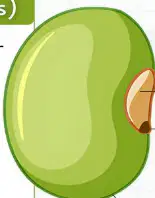
In the dicot seed diagram, which part is the small opening that permits water and air entry during germination?
Micropyle near the hilum
Hilum scar on seed coat
Aleurone membrane layer
Tegmen inner seed coat
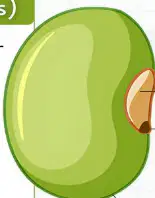
Which statement best identifies the function of cotyledons in dicot seeds as shown?
Attach the seed to the fruit
Protect seed from pathogens
Allow gas exchange during germination
Store food for the embryo
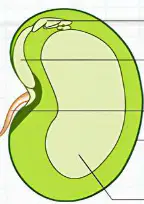
According to the embryo parts diagram, which segment develops into the primary root?
Plumule shoot apex
Hypocotyl stem base
Radicle embryonic root
Epicotyl upper axis
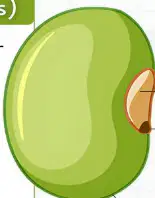
In dicot seeds, which layer is described as a tough outer covering often brown or black?
Scutellum shield cotyledon
Endosperm storage tissue
Coleorhiza root sheath
Testa outer seed coat
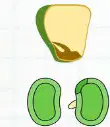
Which feature distinguishes dicot seeds from monocot seeds as noted in the diagram?
Two cotyledons present
Presence of coleoptile
Single scutellum only
Aleurone layer dominant

In the monocot seed structure, what is the shield-shaped cotyledon called?
Coleorhiza root cover
Scutellum of embryo
Aleurone protein layer
Coleoptile sheath
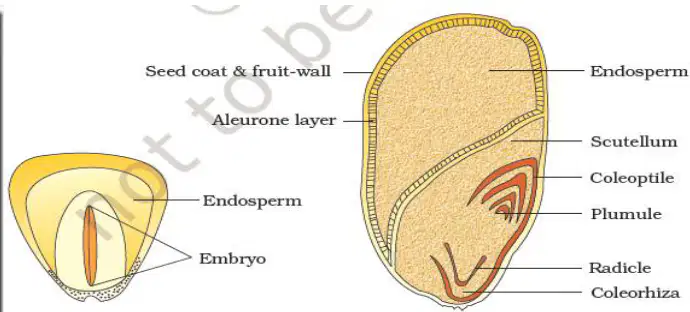
Which sheath protects the plumule in monocot seeds?
Testa around seed
Coleoptile around shoot
Coleorhiza around root
Pericarp around fruit
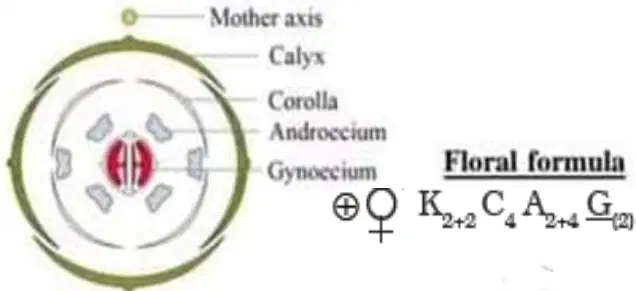
In floral formula notation, which symbol denotes the androecium?
G for gynoecium
A for androecium
K for calyx
C for corolla
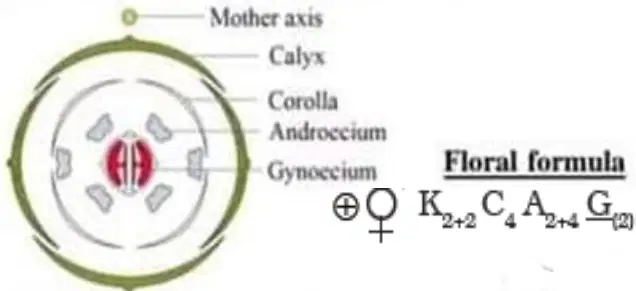
Which floral diagram feature indicates the mother axis position?
Percent symbol for zygomorphy
Central ovary cross-section
Arc marking outside whorls
Bracketed cohesion numbers
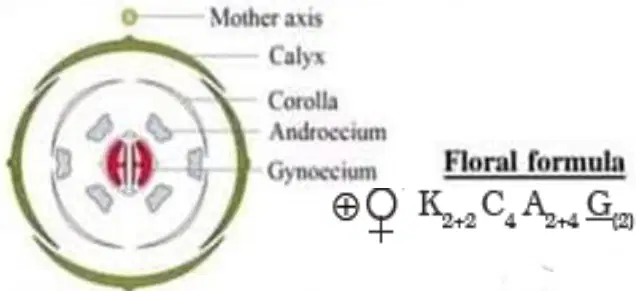
In floral formulas, which symbol represents actinomorphic symmetry?
Male symbol
Percent sign
Bracketed digits
Plus-in-circle sign
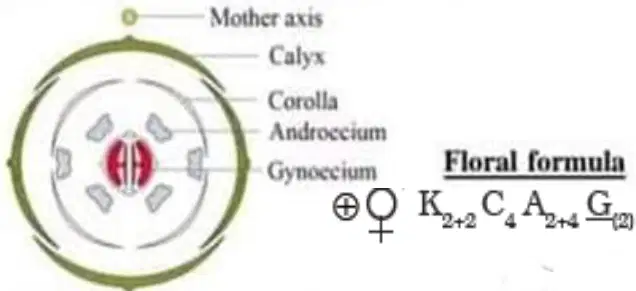
When fusion of floral parts is shown, how is cohesion indicated in the formula?
Numbers enclosed in brackets
Asterisk after whorl symbol
Colon separating organ counts
A line drawn above symbols
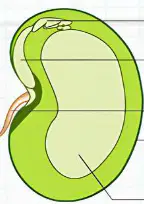
Which sequence correctly matches embryo regions to future structures in dicots?
Hypocotyl to leaf, radicle to flower
Radicle to root, plumule to shoot
Plumule to root, epicotyl to seed coat
Epicotyl to root, cotyledon to stem
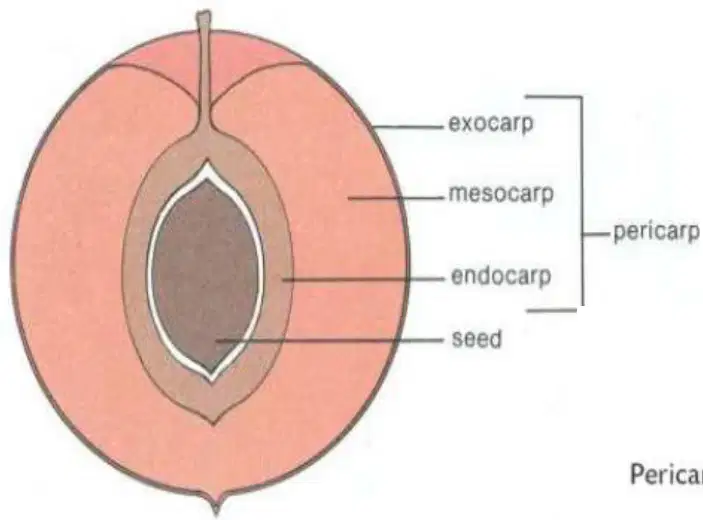
In the labeled fruit cross-section, which layer directly surrounds the seed inside the pericarp?
Exocarp layer of pericarp
Endocarp inner pericarp
Mesocarp fleshy middle
Edible fused flower parts

Which statement best distinguishes a true fruit like grape from a false fruit like apple in the diagrams?
False fruit lacks any edible tissues
True fruit contains no ovary tissues
False fruit forms only from pericarp
True fruit develops from swollen ovary
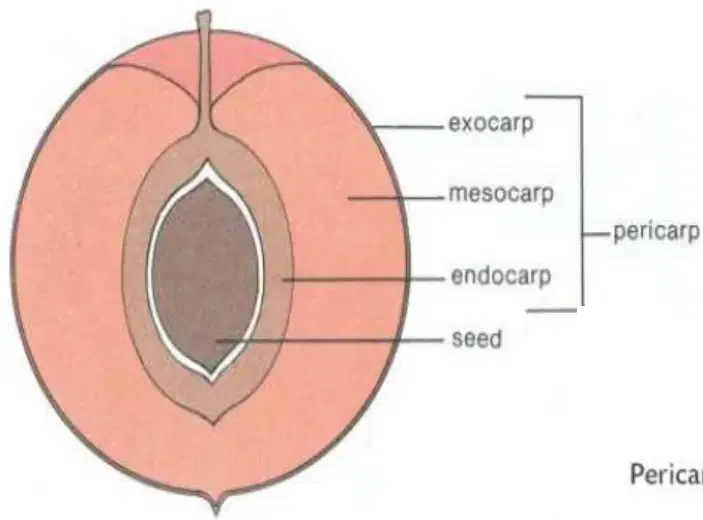
Which component collectively refers to exocarp, mesocarp, and endocarp?
Placenta of ovule
Pericarp of fruit wall
Seed protective coat
Core derived ovary
Autochory in the seed dispersal infographic refers to seeds spread by which mechanism?
Agents like wind or animals
Plant’s own gravity or force
Floating on surface water
Human-mediated transport

Under allochory, which subtype specifically denotes wind dispersal?
Hydrochory movement in water
Zoochory spread by animals
Anemochory transport by wind
Barochory fall by gravity

Which pairing correctly matches dispersal type with an example shown: dandelion and maple?
Explosive expulsion examples
Water dispersal examples
Animal ingestion examples
Wind dispersal examples

Which fruit structure adaptation most likely enhances anemochory?
Fleshy edible mesocarp
Winged samaras or plumes
Hooks on the pericarp
Buoyant fibrous husk

Ballochory is best illustrated by which plant examples in the figure?
Milkweed and jewelweed pods
Coconut floating drupes
Blackberry and tomato fruits
Burdock clingy burrs

Which example displays zoochory via external attachment rather than ingestion?
Oak acorns buried by animals
Tomato seeds eaten and defecated
Burdock burrs hooked to fur
Cattail seeds floating downstream

Hydrochory is represented in the diagram by which plant?
Cattail with waterborne seeds
Maple winged samaras
Blackberry fleshy drupelets
Lupins explosive legumes

Which process differentiates barochory from ballochory within autochory?
Use of animals to move seeds
Gravity drop versus explosive ejection
Wind lift versus winged gliding
Floating on waves versus sinking

A plant producing fleshy edible fruit primarily benefits which dispersal pathway depicted?
Anemochory wind carriage
Zoochory ingestion by animals
Hydrochory tidal transport
Ballochory explosive release
Which adaptive feature primarily enables seeds to be carried long distances by wind?
Heavy seeds with dense endosperm
Seeds with pappus or floss structures
Seeds with thick woody pericarps
Seeds with sticky mucilage layers
A coconut remains afloat for weeks at sea. Which structural feature most directly explains this buoyancy?
Presence of pappus-like hairs
Hard stony endocarp layer
Fibrous mesocarp trapping air
Thin membranous testa
Seeds that adhere to animal fur are most likely equipped with which feature?
Hooked appendages or hairs
Explosive dehiscence sutures
Waterproof epicarp coating
Air-filled parenchyma cells
Which agent of dispersal is depicted when a dry fruit suddenly splits and throws seeds outward?
Water floating drupes downstream
Wind currents carrying achenes
Bird ingestion and later defecation
Explosive mechanism in dehiscent pods
Choose the best match between agent and enabling feature:
Wind – fibrous mesocarp with air
Water – hooks and barbs on seed
Explosive – pappus on light seeds
Animals – edible fruits with hard seeds
Which statement correctly contrasts wind versus animal dispersal?
Wind depends on hooks and barbs; animals depend on air chambers
Wind uses pappus and low mass; animals use adhesion or ingestion
Wind relies on edible fleshy fruits; animals rely on light seeds
Wind requires waterproof pericarps; animals require buoyant tissues
A researcher finds seeds with waterproof epicarp and low density. Which dispersal agent is most probable?
Wind dispersal across open fields
Water dispersal across streams
Animal dispersal via fur attachment
Explosive dispersal from pods
Which feature most directly enables explosive dispersal in species like okra and flamboyant?
Thick fibrous mesocarp tissues
Lines of fission creating weak zones
Presence of pappus on the seed
Sticky arils attracting birds
In Fabaceae, what is the typical condition of stamens in the androecium?
Ten, diadelphous, anthers dithecous
Five, free, anthers dithecous
Ten, monadelphous, anthers monothecous
Six, epipetalous, anthers monothecous
Which term best describes the gynoecium in Fabaceae flowers?
Ovary superior, monocarpellary, unilocular
Ovary inferior, tricarpellary, trilocular
Ovary inferior, bicarpellary, bilocular
Ovary superior, syncarpous, trilocular
The corolla of Fabaceae is often described as papilionaceous. Which arrangement matches this?
Six tepals in two whorls, valvate aestivation
Five fused petals forming a bell, gamopetalous
Three equal petals forming a tube, actinomorphic
Posterior standard, two lateral wings, anterior keel
What type of fruit is most characteristic of Fabaceae?
Drupe with single stony seed
Capsule with axile placentation
Legume with one to many seeds
Berry with many endospermous seeds
Which economic product is correctly matched to Fabaceae?
Colchicine source from Colchicum
Pulses such as gram and soybean
Spices like chilli and pepper
Stimulants like tobacco leaves
In Solanaceae, what is the typical symmetry of the flower?
Zygomorphic and monoecious
Zygomorphic and unisexual
Actinomorphic and bisexual
Actinomorphic and dioecious
Which statement about Solanaceae gynoecium is accurate?
Monocarpellary, apocarpous, ovary inferior
Bicarpellary, syncarpous, ovary superior
Tricarpellary, apocarpous, ovary inferior
Bicarpellary, apocarpous, ovary superior
What is common vegetative character of Solanaceae stems?
Aerenchymatous, floating, hollow
Herbaceous, aerial, often branched
Woody, underground, unbranched
Succulent, climbing, leafless
Which edible examples belong to Solanaceae based on economic importance?
Asparagus, onion, garlic
Tomato, brinjal, potato
Soybean, gram, groundnut
Tulip, Gloriosa, lily
In Liliaceae, what is the perianth arrangement described as?
Tepals four forming a cruciform
Sepals five, united and persistent
Petals five with vexillary aestivation
Tepals six in two whorls (3+3)
The androecium of Liliaceae typically shows which feature?
Ten stamens, diadelphous
Stamens six, arranged as 3+3
Numerous stamens, polyandrous
Stamens five, epipetalous
Which fruit type most commonly occurs in Liliaceae?
Legume, dehiscent pod
Samara, winged fruit
Capsule, occasionally berry
Drupe, fleshy stone fruit
Parallel venation is typical of which family’s leaves?
Brassicaceae with lyrate leaves
Solanaceae with reticulate simple leaves
Fabaceae with pinnate compound leaves
Liliaceae with basal linear leaves
Which economic use is correctly matched to Liliaceae?
Ornamentals like tulip and Gloriosa
Pulses including arhar and moong
Fibres such as sun hemp
Dyes such as indigofera extracts
Identify the floral formula that best matches Fabaceae as shown.
% ⚥ P(6) A6 G(3)
⚥ K5 C5 A5 G(2)
% ⚥ K(5) C1+2+(2) A(9)+1 G1
⚥ K(5) C(5) A(10) G(2)
Which family commonly shows umbellate clusters in inflorescence variations?
Poaceae with panicles and spikes
Liliaceae with solitary or cymose umbels
Fabaceae with racemose spikes only
Solanaceae with strictly axillary pairs
Even though Ginger is seen under the soil, it is not a root, but a stem. a. Give reason. b. Write its functions.
It has nodes and internodes; storage and perennation
It shows primary growth; conduction and support
It has adventitious buds; reproduction and photosynthesis
It bears root hairs; absorption and anchorage
While examining a flower, Geetha noticed in its corolla a large outer standard petal, two small wing-like petals and two innermost petals united to a keel. The aestivation was of vexillary type. a. Identify the family of the plant which produced the above flower. b. Write the floral formula of the family.
Brassicaceae; Actinomorphic, bisexual, A2+4, G2 superior
Solanaceae; Actinomorphic, bisexual, A5 epipetalous, G2 superior
Malvaceae; Actinomorphic, bisexual, A∞ monadelphous, G5 superior
Fabaceae; Bracteate, zygomorphic, bisexual, A(9)+1, G1 superior

