
 Worksheets
ANALYTICS FOR FINANCE & ACCOUNTING Quiz
Total questions: 20
Worksheet time: 10mins
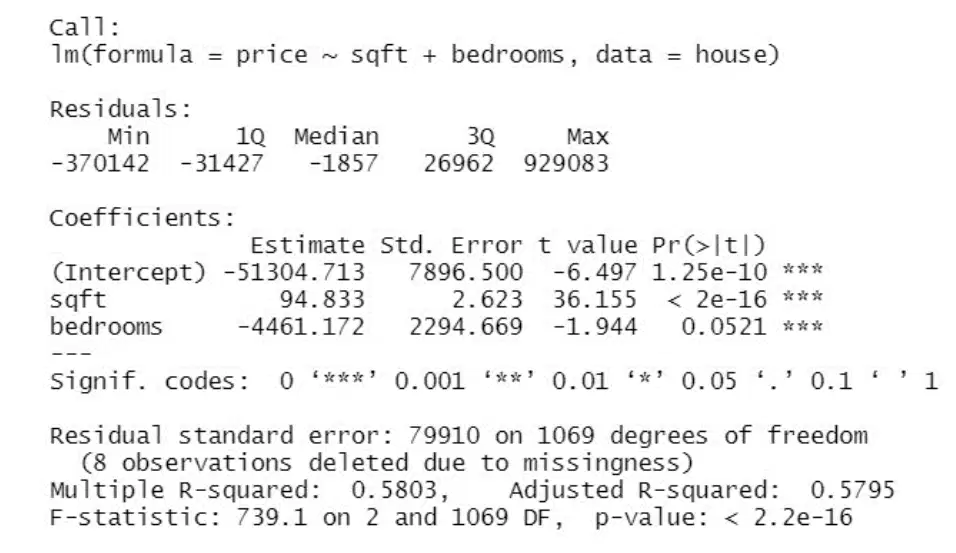
Based on the R-output, what is the estimated intercept (β₀) for the house price model?
94.833
-4,461.172
-51,304.713
79,910
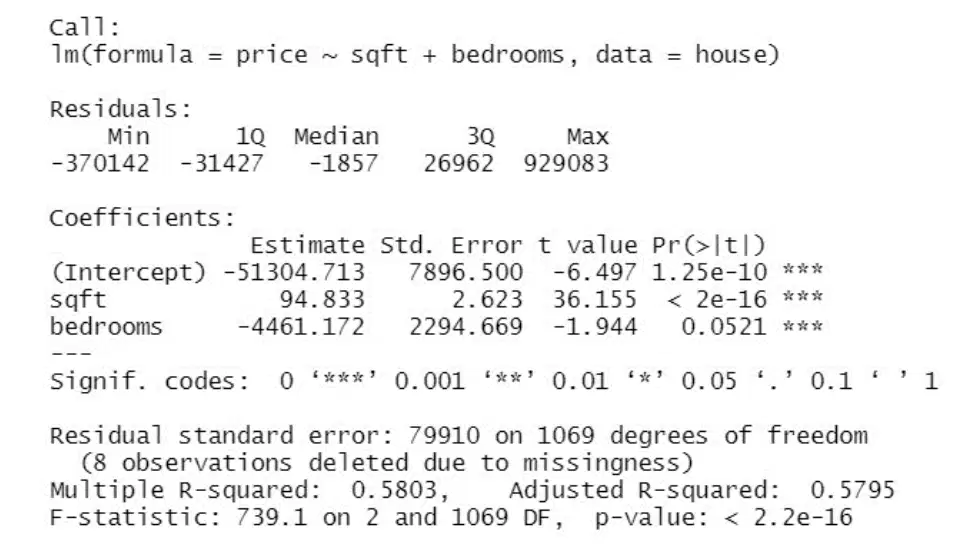
In the regression equation Ŷ = β₀ + β₁(sqft) + β₂(bedrooms), what is the value of β₁?
-51,304.713
94.833
2.623
0.5803
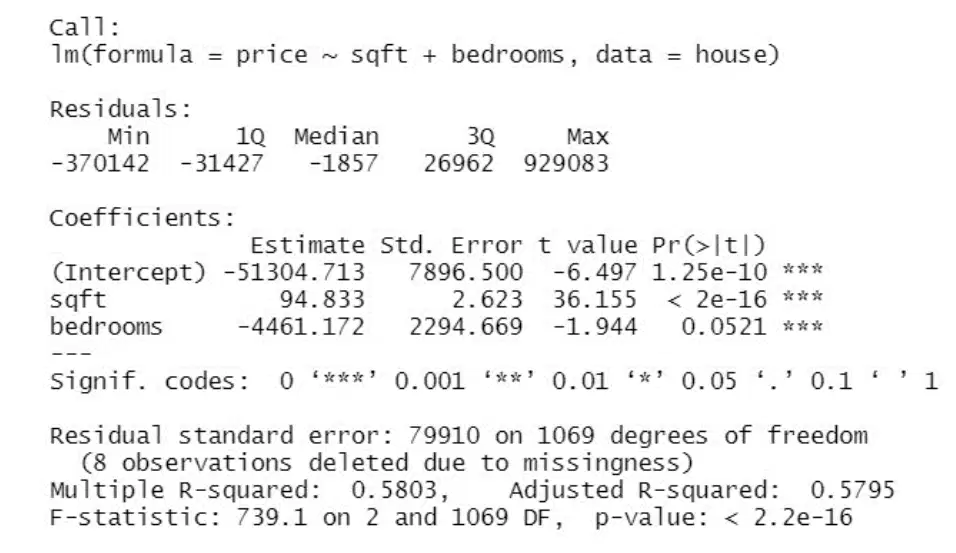
What does the coefficient for 'sqft' (94.833) represent?
The total price of a house.
The price decrease per bedroom.
The estimated increase in price for every additional square foot, holding bedrooms constant.
The average size of a house in the dataset.

According to the model, what happens to the price when the number of bedrooms increases by one, holding sqft constant?
It increases by £94.83.
It decreases by £4,461.17.
It stays the same.
It increases by £7,896.50.
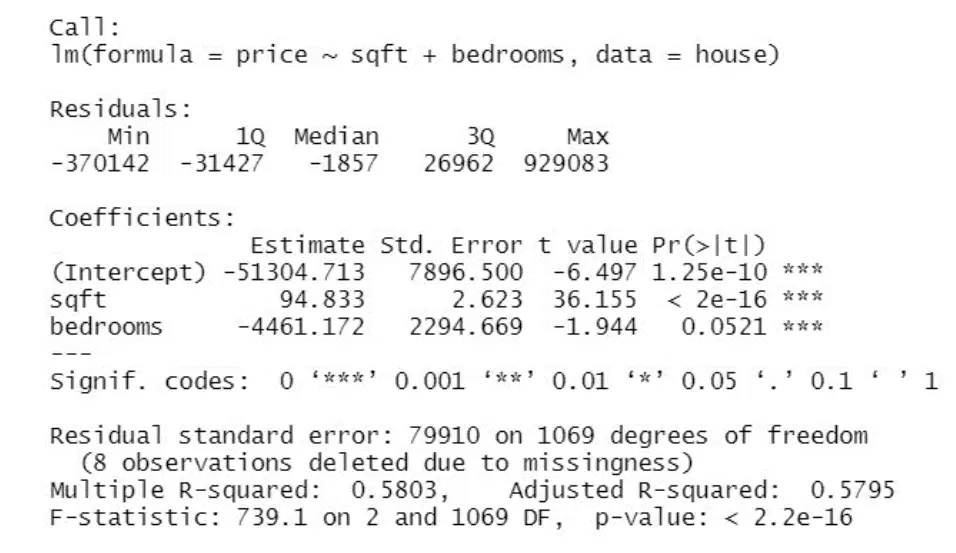
What is the Multiple R-squared value for this regression?
0.5795
739.1
0.5803
2.2e-16
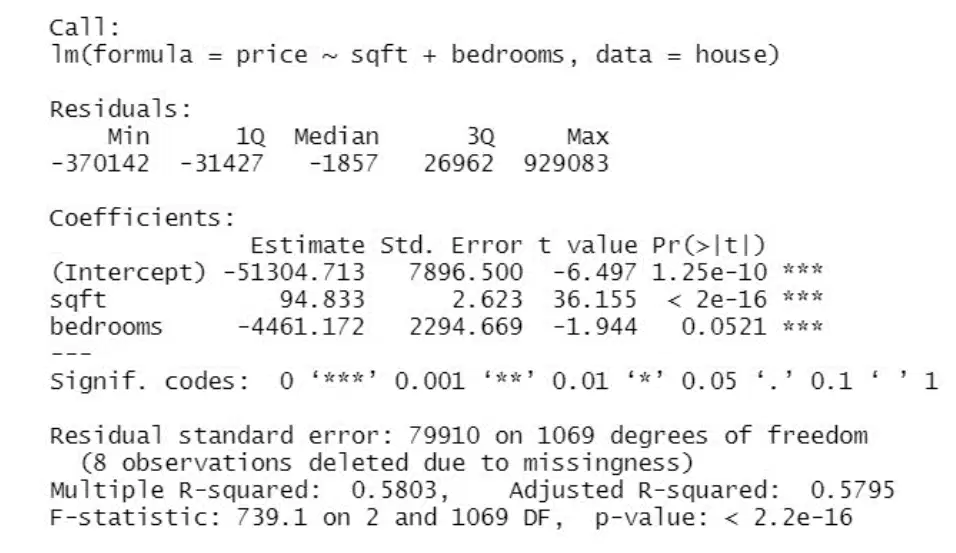
How is the R-squared value of 0.5803 interpreted?
58.03% of house prices are incorrect.
58.03% of the variation in house prices is explained by sqft and bedrooms.
The model is 58.03% accurate at predicting the exact price.
58.03% of the data was deleted due to missingness.
How many observations were deleted from the analysis due to missingness?
1069
2
8
0
Which of the following is a suggested way to improve the regression model?
Remove all explanatory variables.
Include additional variables like location or property age.
Ignore missing data.
Only use one observation.
Which data metric ensures that the data correctly represents real-world values?
Timeliness
Consistency
Accuracy
Completeness
What is the definition of 'Completeness' in data analysis?
Data is available in real-time.
There are no missing values in the dataset.
Data is the same across all systems.
Data is formatted correctly.
Which method is considered 'unsupervised' learning because it groups unlabeled data?
Classification
Regression
Clustering
Profiling
What is the primary difference between classification and clustering?
Classification uses predefined categories; clustering finds patterns in unlabeled data.
Clustering is used for fraud; classification is used for marketing.
Classification is unsupervised; clustering is supervised.
There is no difference.
In credit card fraud detection, classification is used to:
Group customers by their age.
Assign a transaction to 'Legitimate' or 'Fraudulent' categories.
Calculate the total interest rate.
Predict the next year's stock price.
What is 'profiling' in the context of financial operations?
Deleting old data.
Characterizing 'normal' behavior to identify anomalies or efficiencies.
Designing a new logo for the company.
Hiring new employees.
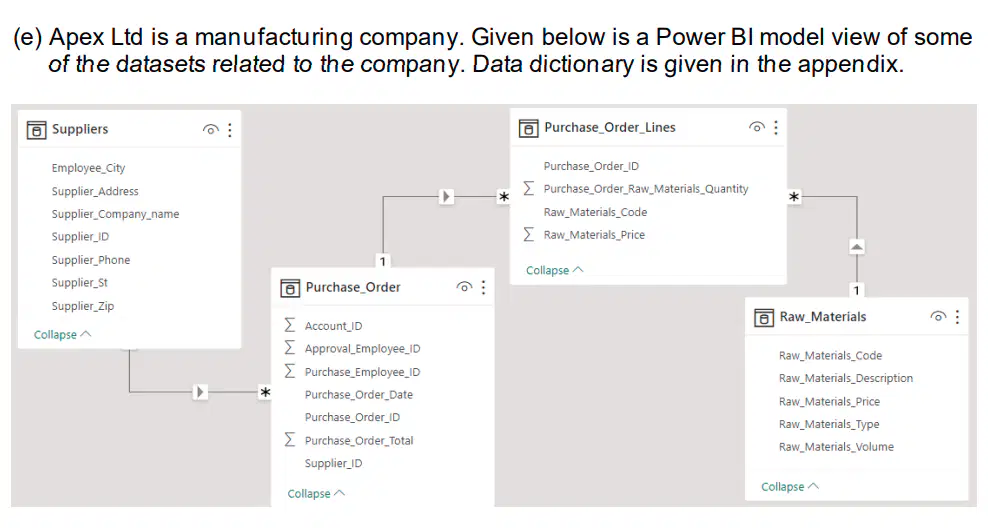
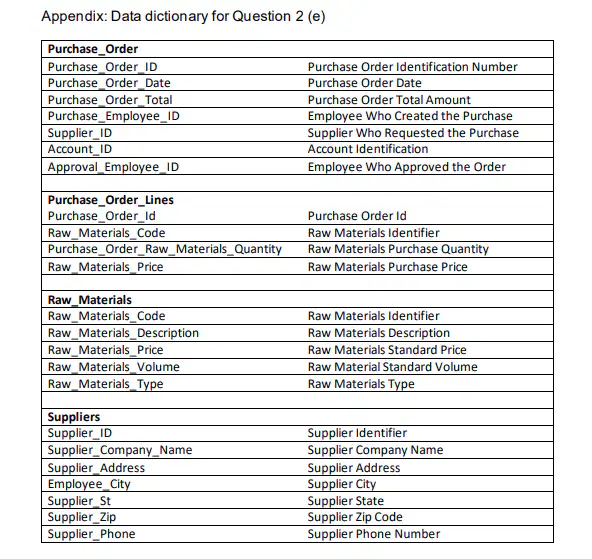
To create a report showing 'total raw material cost per supplier,' which table contains the Supplier_Company_Name?
Purchase_Order
Raw_Materials
Suppliers
Purchase_Order_Lines
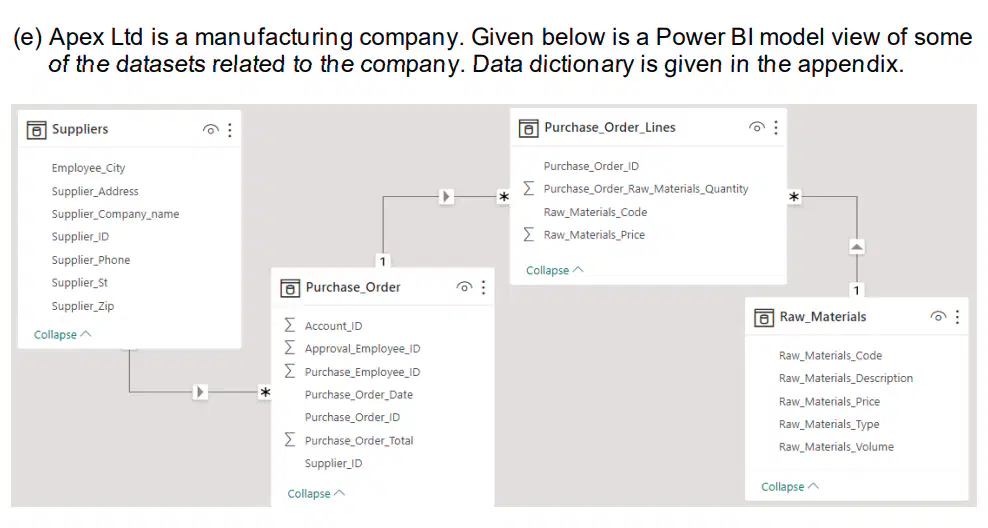
Which two fields are required to calculate the total cost of a specific raw material line item?
Supplier_ID and Account_ID.
Purchase_Order_Raw_Materials_Quantity and Raw_Materials_Price.
Employee_City and Supplier_Zip.
Purchase_Order_Date and Purchase_Order_ID.
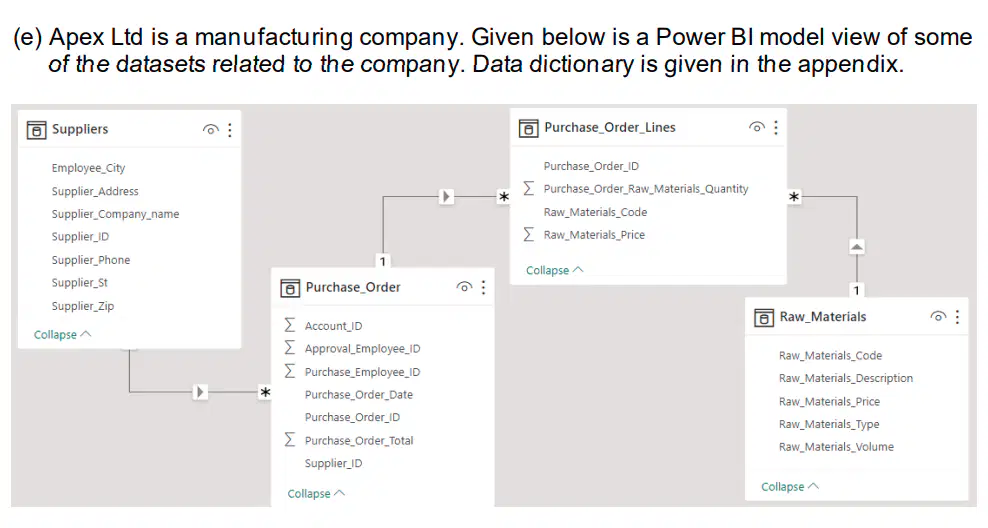
To detect if an employee is diverting funds to themselves, which field from the 'Suppliers' table might be cross-referenced with employee records?
Supplier_ID
Employee_City
Supplier_Phone
Raw_Materials_Code

Which table acts as the 'bridge' connecting Suppliers to Purchase Order Lines?
Raw_Materials
Purchase_Order
Data Dictionary
Appendix
When purchasing third-party data, what is a key part of ethical due diligence?
Buying the cheapest data available.
Ensuring the data was collected with explicit user consent.
Ignoring privacy laws to save time.
Sharing the data with as many people as possible.
Which regulation is a common legal framework used to mitigate privacy risks in data analytics?
OLS Regression
GDPR (General Data Protection Regulation)
Power BI Model View
F-statistic

