
 Worksheets
Abstract
Total questions: 95
Worksheet time: 48mins
Which challenge in the food industry does the study aim to address?
Color instability during storage
Starch retrogradation in freezing
Protein denaturation in heating
Lipid oxidation reducing quality
What role do phosphatidylserine (PS) and phosphatidylethanolamine (PE) play with tocopherols?
Convert tocopherols to quinones
Increase tocopherol solubility
Hydrolyze tocopherol esters
Regenerate oxidized tocopherols
In oil-in-water emulsions, which phospholipid previously showed better antioxidant performance with tocopherols?
Phosphatidylcholine performed best
Phosphatidylserine performed best
No phospholipid showed benefit
Phosphatidylethanolamine performed best
Why was high PS lecithin chosen over pure phospholipids?
Greater chemical stability overall
Lower cost and accessibility
Higher antioxidant capacity alone
Better compatibility with Tween20
Which concentration of mixed tocopherols was most effective at pH 3?
5.0 μmol/kg emulsion
1.0 μmol/kg emulsion
0.5 μmol/kg emulsion
3.0 μmol/kg emulsion
How did pH influence the lag phase provided by tocopherols?
Lag phase increased at higher pH
Lag phase decreased at higher pH
Lag phase eliminated at neutral pH
Lag phase unaffected by pH
When testing PS lecithin with mixed tocopherols, what was observed regarding salt at pH 7?
Salt enhanced synergy strongly
Salt reduced antioxidant action
Salt reversed the lag phase
Salt had no measurable effect
What overall conclusion was drawn about high PS lecithin with mixed tocopherols?
Requires synthetic stabilizers to work
Best performance only in bulk oils
Synergy extends lag phase at lower pH
No synergy in emulsions studied
Which statement best describes the primary consequence of lipid oxidation in foods?
Decreases shelf life and alters texture
Improves flavor and increases nutrition
Stabilizes emulsions and lowers rancidity
Reduces caloric content and water activity
Which health concern is linked to toxic lipid oxidation products?
Reduced inflammatory signaling
Atherosclerosis development risk
Enhanced immune resilience
Improved metabolic efficiency
Which pair lists commonly used synthetic antioxidants in commercial foods?
Curcumin and catechin
Ascorbate and quercetin
Glutathione and resveratrol
BHA and TBHQ
Which food system is an example of an oil-in-water emulsion relevant to this study?
Butter and margarine
Mayonnaise and salad dressing
Cheese and yogurt
Olive oil and lard
What consumer trend motivates research into naturally occurring antioxidants?
Interest in saturated fat sources
Shift toward alkaline diets
Preference for higher viscosity
Demand for cleaner labels
Which statement about phosphatidylserine (PS) and tocopherols is accurate?
PS shows synergism with mixed tocopherols
PS reduces tocopherol solubility in water
PS inhibits all tocopherol homologues
PS is ineffective in bulk oils only
Why were mixed tocopherols preferred over specific homologues in combination with PS?
Commercial availability and synergy
Higher molecular weight advantage
Lower polarity and better taste
Greater volatility and rapid action
At lower pH around 3, what observation was made about mixed tocopherol concentrations in emulsions?
Extended lag phase observed
Rapid depletion rate noted
Immediate pro-oxidant effect
No change in oxidation lag
Which mechanistic explanation supports the reduced activity of α-tocopherol at low pH?
Chelation with sodium chloride ions
Oxidation of carboxylate head group
Protonation of phenolic hydrogen group
Phase inversion of the emulsion
What was concluded when comparing authentic PS with high PS lecithin at pH 7?
Authentic PS was unstable in salt
High PS lecithin was strongly pro-oxidant
Authentic PS showed no antioxidant effect
High PS lecithin is an inexpensive alternative
How did the PS–mixed tocopherol combination respond to lower pH of 3?
Phase separation induced
Extended shelf life achieved
Immediate rancidity onset
Synergy completely lost
What effect did varying salt concentrations have on antioxidant ability at pH 7?
Complete inhibition occurred
No observable effect reported
Gradual decline with more salt
Strong enhancement detected
Which radical is first formed when unsaturated lipids react with an initiator in emulsions?
Alkyl radical from lipid hydrogen abstraction
Alkoxyl radical from hydroperoxide split
Peroxyl radical from oxygen combination
Hydroxyl radical from water cleavage
Peroxyl radicals are primarily generated when alkyl radicals undergo which process?
Isomerize to more stable forms
Reduce metal ions at interface
React with molecular oxygen rapidly
Dimerize to terminate chains
Degradation of lipid hydroperoxides commonly yields which sensory-active products in foods?
Volatile aldehydes like hexanal and propanal
Short peptides with bitter notes
Organic acids lowering pH sharply
Ethanol increasing sweetness perception
Which statement best describes the role of transition metals such as iron in emulsions?
They act as major pro-oxidants catalyzing radical formation
They neutralize radicals by chelation inherently
They partition only in oil and stop oxidation
They form inert complexes that precipitate
Which factor list most directly influences the rate of lipid oxidation in emulsions?
Starch retrogradation and viscosity
Protein folding and gel elasticity
Headspace humidity and sugar content
Antioxidant location and interfacial properties
What is a key function of emulsifiers at the droplet interface regarding oxidation?
Form molecular barriers reducing pro-oxidant interactions
Hydrolyze triglycerides to free radicals
Provide oxygen to accelerate propagation
Convert metals into volatile compounds
Studies comparing Brij 76 and Brij 700 showed what outcome for salmon oil emulsions?
Both had identical oxidation regardless of type
Brij 700 produced more peroxides consistently
Brij 76 systems exhibited higher oxidation rates
Neither affected interfacial reactions measurably
How does droplet surface area generally affect lipid oxidation rate in oil-in-water emulsions?
Intermediate surface area maximizes termination
Smaller surface always halts radical initiation
Larger surface always accelerates oxidation strongly
Surface area alone does not significantly change rate
Droplet charge can influence interactions with cationic metal ions. Which condition increases attraction of Fe3+ to droplets?
Strong cationic surfactant coverage
Neutral zeta potential at all pH
Zero ionic strength in the phase
Anionic interfacial charge at given pH
Small surfactants like Tweens impact oxidation mainly after what event in the aqueous phase?
Full depletion of dissolved oxygen
Reaching the critical micelle concentration
Formation of stable foam lamellae
Complete ester hydrolysis of lipids
Adding Tween 20 was observed to increase α- and δ-tocopherol antioxidant activity in which system?
Bulk oils by reducing interfacial area
Water-in-oil emulsions by salting out
Oil-in-water emulsions by enhancing solubilization
Dry powders by limiting oxygen diffusion
Which sequence correctly outlines the general stages of lipid oxidation?
Propagation, initiation, recombination
Initiation, propagation, termination
Termination, initiation, acceleration
Reduction, oxidation, polymerization
Which reaction depicts the initiation stage of lipid autoxidation in unsaturated fatty acids?
ROO· + RH → ROOH + R·
ROO· + R· → ROOR at end
R· + O2 → ROO· in air
RH → R· + H· under heat
During propagation, what is the immediate product when an alkyl radical reacts with molecular oxygen?
Alkoxyl radical RO· species
Peroxyl radical ROO· formed
Dimer RR termination product
Hydroperoxide ROOH species
Which step explains how the chain reaction continues by abstracting hydrogen from another lipid molecule?
Initiation via homolytic cleavage
Propagation via ROO· + RH reaction
Termination via radical recombination
Metal-catalyzed β-scission pathway
Primary oxidation products in lipid autoxidation are unstable. Which class is identified as primary products in the diagram text?
Short-chain aldehydes and ketones
Hydroperoxides formed initially
Alkoxyl radicals from metals
Dimerized RR termination products
Which statement best links antioxidant strategy to the stage kinetics in emulsions? Choose the most accurate.
Increasing β-scission prevents volatile formation
Shorter propagation favors peroxide buildup
Reducing initiation lowers radical formation
Enhancing termination decreases oxygen solubility
Which mechanism directly donates a hydrogen atom to stabilize a lipid radical during oxidation control?
Nitrogen flushing of headspace
Free radical scavenging by phenolics
Metal chelation by EDTA complexes
Quenching of triplet oxygen states
The Polar Paradox suggests which pairing of antioxidant type and environment shows higher efficacy in emulsions?
Non-polar antioxidants at oil–water interface
Polar antioxidants dissolved in lipid core
Polar antioxidants embedded in oil droplet center
Non-polar antioxidants in aqueous continuous phase
Which statement best describes why location matters for antioxidants in emulsions?
Oxygen cannot dissolve in dispersed oil droplets
Reactions initiate near interfaces where radicals form
Aqueous phases always stop chain initiation completely
Lipid cores exclude all transition metals entirely
Among the listed compounds, which is primarily used as a metal chelator in food systems to limit lipid oxidation?
Tert-butylhydroquinone additive
Ascorbic acid vitamin C
Alpha-tocopherol vitamin E
Ethylenediaminetetraacetic acid
What effect can metal chelators have on lipid oxidation catalyzed by iron or copper?
Increase radical propagation at interfaces
Generate additional hydroperoxides quickly
Convert triplet oxygen into singlet oxygen
Bind metals and reduce catalytic activity
Which description correctly contrasts singlet and triplet oxygen in lipid systems?
Triplet cannot form peroxyl radicals; singlet always reduces metals
Singlet is ground-state and reactive; triplet is excited and harmless
Singlet dominates air; triplet only exists in vacuum chambers
Triplet is common and chain-reactive; singlet is rarer and quenched
Why might an esterified antioxidant with an 8–12 carbon chain show higher scavenging in emulsions?
Greater aqueous solubility drives bulk phase action
Short chains prevent access to any radicals
Optimal interfacial solubility balances oil and water
Long chains force antioxidants deep into droplets
Which common synthetic free radical scavengers are being reconsidered due to health concerns?
Phosphatidylserine, phosphatidylcholine
EDTA, citric acid, and tartaric
TBHQ, BHT, and propyl gallate
Ascorbic acid, Trolox, carnosic
In an emulsion, why are polar antioxidants often less effective than non-polar ones at inhibiting lipid oxidation?
They remain in water and miss lipid radicals
They polymerize to inactive dimers rapidly
They over-quench triplet oxygen in the core
They chelate metals too strongly at interfaces
Which mechanism best explains how chelators restrain redox cycling during oxidation?
Forming micelles that trap hydroperoxides
Reacting with oxygen to lower its partial pressure
Providing electrons to peroxyl radicals to terminate
Occupying metal coordination sites to stop catalysis
Where is the most efficient position for a non-polar antioxidant to inhibit lipid oxidation in emulsions?
Aqueous continuous phase center
Deep interior of aqueous micelles
Interfacial region around oil droplets
Headspace above the emulsion
Which event initiates propagation in the free radical chain of lipid oxidation?
Triplet oxygen reduces to singlet state
Hydroperoxide decomposes to stable alcohol
Chelator complexes precipitate as solids
Peroxyl radical abstracts a lipid hydrogen
Phospholipids like PS, PC, and PE may show which dual behavior regarding oxidation?
Radical generation suppression and starch retrogradation
Hydroperoxide decomposition and polymer inhibition
Strong oxygen quenching and nitrogen release
Metal chelation antioxidant and possible pro-oxidant
Which practical strategy aligns with the Polar Paradox to enhance antioxidant performance in emulsions?
Use moderately lipophilic esters to target interfaces
Exclude all surfactants to avoid phase mixing
Increase water-soluble antioxidants in bulk water
Place highly polar acids inside oil droplets
Which structural feature defines tocopherols across alpha, beta, gamma, and delta homologues?
Indole ring with 12‑carbon side chain
Pyran ring with 18‑carbon side chain
Carboxyl ring with 14‑carbon side chain
Chromanol ring with 16‑carbon side chain
What primarily differentiates alpha, beta, gamma, and delta tocopherol homologues?
Number and position of methyl groups
Length of the isoprenoid side chain
Presence of additional hydroxyl groups
Degree of unsaturation in the tail
In food systems, why are tocopherols considered effective against lipid oxidation?
They scavenge singlet oxygen exclusively
They polymerize lipids into inert micelles
They donate phenolic hydrogen to peroxyl radicals
They chelate ferrous ions in aqueous phase
Which statement best describes the fate of the tocopheroxyl radical after hydrogen donation?
It rapidly initiates lipid autoxidation chain reactions
It reduces back to tocopherol without interaction
It decomposes into volatile aldehydes and ketones
It reacts with another peroxyl radical to form stable product
Under which condition can alpha‑tocopherol behave as a prooxidant in oils?
Only when chelators are present at trace levels
In the presence of saturated triglycerides only
At extremely low temperatures below freezing
At higher concentrations generating tocopheroxyl radicals
What optimum concentration range was reported for alpha‑tocopherol in 10% corn oil‑in‑water emulsions?
25–50 ppm for rapid peroxide decline
250–500 ppm for inhibition of hydroperoxides
5–10 ppm for minimal prooxidant effects
750–1000 ppm for maximal stabilization
Which tocopherol showed antioxidant activity with an optimum range of 250–500 ppm in corn oil systems?
Beta‑tocopherol in soybean aqueous extracts
Gamma‑tocopherol in emulsions and distilled oil
Alpha‑tocopherol exclusively above 500 ppm
Delta‑tocopherol only in saturated fats
Which trend was observed for alpha‑tocopherol antioxidant activity in Tween20‑stabilized corn oil‑in‑water emulsions with pH?
Unchanged between pH 3 and pH 7
Only active near neutral pH values
Higher at pH 3 than at pH 7
Higher at pH 7 than at pH 3
In vacuum distilled corn oil, which concentration worked best for alpha‑tocopherol?
10 ppm for early initiation prevention
500 ppm for eliminating peroxide completely
250 ppm for balanced oxidation control
100 ppm for minimizing lipid hydroperoxides
Which set of tocopherols showed antioxidant properties at 100, 250, and 500 ppm but prooxidant effects above these levels?
Alpha, beta, gamma, and delta in purified soybean oil
Delta alone in vacuum distilled vegetable oils
Only gamma and delta in fish oil emulsions
Alpha and beta exclusively in saturated oils
What mechanistic reason is suggested for alpha‑tocopherol’s prooxidant behavior at high levels?
Catalysis of singlet oxygen without photosensitizer
Formation of tocopherol dimers blocking radicals
Complete depletion of phenolic hydrogen donors
Higher concentrations of tocopheroxyl radicals initiating chains
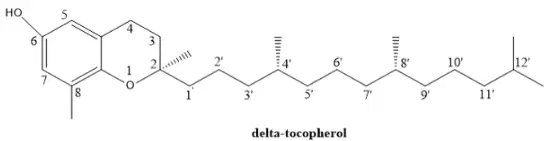
From the structural diagrams, which homolog would have the fewest methyl substituents on the chromanol ring?
Beta‑tocopherol among the four shown
Alpha‑tocopherol among the four shown
Gamma‑tocopherol among the four shown
Delta‑tocopherol among the four shown
Which component forms the backbone of phospholipids in biological membranes?
Propane skeleton with carboxyl groups
Glycerol backbone with phosphate group
Sucrose chain with hydroxyl groups
Sterol ring with amine substitution
Phosphatidylcholine (PC) is named based on which head group attachment to the phosphate?
Serine head group attached at sn-1
Ethanolamine head group at sn-3
Choline head group attached to phosphate
Inositol head group replacing glycerol
Phospholipids with the fatty acid removed from the sn-2 position are categorized as what?
Lysophospholipids by structure
Plasmalogens with ether linkages
Triacylglycerols in storage
Diacylglycerols in membranes
Which statement best distinguishes PC from PS regarding head group identity?
PC has choline, PS has serine
PC has serine, PS has choline
PC has ethanolamine, PS has choline
PC has inositol, PS has ethanolamine
Among common solvents, which correctly matches a solubility property: PC dissolves in ethanol whereas PI and PA cannot?
PC dissolves in hexane; PI and PA precipitate
PC insoluble in ethanol; PI and PA soluble
PC dissolves in ethanol; PI and PA insoluble
PC dissolves in water; PI and PA dissolve
Which food source contributes a high proportion of phospholipids with PC and PE as major classes?
Fermented dairy cultures
Refined sugars from cane
Leafy greens with carotenoids
Egg yolks rich in phospholipids
Raw meats typically contain approximately what percentage range of phospholipids due to biological membranes?
15–20 percent by weight
0.05–0.1 percent by weight
5–10 percent by weight
0.5–1.0 percent by weight
Which list includes plant sources noted as rich in phospholipids?
Rice bran, wheat bran, rye
Spinach, kale, lettuce
Banana, apple, grape
Soybean, sunflower, corn
Lecithin is best described as which type of mixture?
Pure phosphatidylcholine single compound
Crude phospholipid mixture with other compounds
Refined triglyceride fraction only
Aqueous solution of sterols and sugars
Which processing approach can modify lecithin composition beyond solvent extraction?
Physical milling without heat
Chemical and enzyme modification processes
Freeze-drying without solvents
Ultraviolet irradiation only
Different phospholipids show varying prooxidative or antioxidative behavior primarily due to which structural factors?
Total molecular mass and density
Number of double bonds in sterols
Presence of triglycerides and glycolipids
Degree of unsaturation and polar head group
Phospholipids are present in all living species because they are integral components of what?
Energy storage granules
Biological membranes
Ribosomal subunits
Nuclear pores
Which phospholipid property most directly enables iron chelation in emulsions?
Hydrophobic fatty acyl tails
High degree of unsaturation
Neutral zwitterionic headgroup
Negative phosphate charge on headgroup
At pH 3, why did phosphatidylcholine (PC) lose apparent antioxidant activity in emulsions?
Phosphate group lost charge
Iron became fully reduced
PC oxidized rapidly
Micelles collapsed entirely
Which statement best explains why increased PS or PA ratio in liposomes could raise lipid oxidation?
Greater surface area dilutes tocopherol
Stronger hydrogen bonding stops chelation
Higher bilayer fluidity traps radicals
More negative charge binds more copper
Which phospholipid headgroup can form antioxidative Maillard products with carbonyls from lipid oxidation?
Carboxyl of PA
Phosphate of PI
Tertiary amine of PC
Primary amine of PE
Which combination was reported to inhibit iron-induced oxidation in sardine oil-in-water emulsions?
PA and PS liposomes
PC alone at neutral pH
PE with tertiary amines
PI with copper ions
Why might phospholipids’ iron-binding not always reduce oxidation?
Increased iron solubility can enhance reactions
Chelation releases reactive oxygen species
Headgroups convert iron to ferryl state
Binding blocks tocopherol partitioning
Which experimental observation supports amine-dependent Maillard antioxidation?
PI prevents carbonyl generation
PC enhances aldehyde formation
PE reacts with 4,5-epoxy-2-heptenal
PA accelerates hydroperoxide cleavage
What role does α-tocopherol quinone play in synergism with phospholipids?
Initiator of Maillard crosslinking
Surfactant improving emulsion stability
Chelator that binds ferrous iron
Intermediate for α-tocopherol regeneration
In studies where phospholipids act alone, what is commonly observed regarding lipid oxidation?
Limited inhibition compared to with tocopherols
No change in metal catalysis
Complete suppression of oxidation
Acceleration of hydroperoxide formation
Addition of soybean lecithin to virgin oil most directly affected which parameter in Rancimat analysis?
Tocopherol concentration increased
Peroxide value decreased
pH of oil decreased
Density of oil increased
How can phospholipids enhance tocopherol effectiveness beyond regeneration chemistry?
Raising oil boiling point
Altering tocopherol physical location
Blocking lipoxygenase enzymes
Reducing fatty acid chain length
Which statement aligns with distribution-dependent antioxidant activity?
Partitioning is unaffected by emulsions
All antioxidants distribute identically
Trolox and α-tocopherol partition differently
Surface activity has no influence
Which phospholipid showed stronger synergism with α-tocopherol homologues in bulk oil?
PI stronger than PS
PE stronger than PS
PS stronger than PE
PC stronger than PE
In soybean oil-in-water emulsions, which pairing was effective synergistically?
PC alone without tocopherol
PI with copper and PE
PS and PE with tocopherol
PA with tertiary amine and PC
Which mechanism best explains the need for α-tocopherol presence during amine-mediated Maillard antioxidation?
Maillard products require α-tocopherol-derived carbonyls
PS supplies phosphate for protonation
Tocopherol lowers emulsifier HLB
PC donates tertiary amine radicals
Which statement best describes why unsaturated fatty acids in food emulsions are prone to quality loss?
Triglycerides crystallize and trap reactive oxygen species
Double bonds increase susceptibility to oxidative reactions
Proteins encapsulate lipids preventing radical initiation
Saturated chains catalyze hydrolysis producing off-flavors
In soybean oil-in-water emulsions, what is the primary product formed when oxygen reacts with unsaturated fatty acids?
Polymeric peroxides causing gelation
Short-chain acids from direct decomposition
Volatile aldehydes as immediate end products
Lipid hydroperoxides as initial oxidation products
Which pair reflects the study’s focus on antioxidant synergy in emulsions?
Butylated hydroxyanisole with sodium chloride
EDTA combined with tert-butylhydroquinone (TBHQ)
Casein micelles with citric acid buffers
Phosphatidylserine lecithin combined with mixed tocopherol
Why has interest grown in natural antioxidants for cleaner labels in food systems?
Reports of deleterious health effects of synthetic antioxidants
Natural compounds show universally stronger antioxidant potency
Synthetic antioxidants are banned in all jurisdictions globally
Natural antioxidants never influence flavor profiles negatively
Which statement aligns with how secondary oxidation products affect food quality in emulsions?
They reduce volatility of aldehydes in headspace
They improve nutritional value by adding vitamins
They immediately halt primary oxidation reactions
They cause rancid odors and off-flavor development

