
 Worksheets
ChemistryUnit 3 Review 2025-26
Total questions: 42
Worksheet time: 27mins
The equation shows a redox reaction. Use the equation to answer the question that follows.
Zn(s)+CuSO4(aq)→ZnSO4(aq)+Cu(s)
Zinc loses one electron and copper gains one electron.
Zinc loses two electrons and copper gains two electrons.
Copper loses two electrons and zinc gains two electrons.
Sulfate loses two electrons and zinc gains two electrons.
Michael is conducting an experiment to see how fast a chemical reaction occurs. He tries changing different factors to see their effects. Which of the following factors does NOT affect the rate of reaction?
container size
reactant phases
reactant amounts
container temperature
Maggy is planning an investigation of a chemical reaction in her laboratory that produces a precipitate. Which of the following conditions MUST be true?
Both products are soluble in water.
One of the reactants must be insoluble in water.
At least one product is insoluble in water.
Spectator ions are included in the solution as reactants.
Maria conducts an experiment in which she adds magnesium metal to hydrochloric acid. She writes the following equation to model her experiment:
Mg(s)+2HCl(aq)→MgCl2(aq)+H2(g)
Which evidence from the model suggests that a chemical reaction took place?
The solution became warmer.
A precipitate formed.
The color changed.
A gas was produced.
A gas-phase reaction reaches equilibrium as shown below:
N2(g)+3H2(g)⇌2NH3(g). (exothermic)
Which change would cause the equilibrium to shift toward the products?
Increase the temperature at which an experimenter performs the reaction. Adding heat to an endothermic reaction causes the equilibrium to shift toward the products.
Increase the concentration of hydrogen iodide in the system. Adding more product would cause the reactants to bond at a faster rate than the products can dissociate.
Decrease the temperature of the reactants. Endothermic reactions absorb heat from their environment, so removing heat would discourage the products from dissociating.
Increase the pressure placed upon the system. Pressure causes the reactants to bond more quickly and would prevent the product from dissociating back into hydrogen and iodine.
Olivia is conducting an experiment in her chemistry class. She needs to identify which chemical equation is correctly balanced before proceeding. Which one should she choose?
2Mg(s)+O2(g)→MgO(s)
Ca(s)+Cl2(g)→CaCl(s)
2Al(s)+3Cl2(g)→2AlCl3(s)
Na(s)+H2O(l)→NaOH(aq)+H2(g)
Fe+CuCl2→FeCl2+Cu
When you balance the equation using the smallest whole-number coefficients, what is the coefficient of Fe?
1
2
3
4
Oliver is conducting an experiment where he increases the concentration of reactants in a chemical reaction. What happens to the reaction?
The reaction rate is faster.
The reaction rate is generally slower.
The reaction rate is not affected.
The activated complex does not form.
The following equation is incomplete.
2H2O2(g)→?
Which set of products completes and balances the incomplete equation?
2H2(g)+2O2(g)
2H2O(g)+O2(g)
4 H(g)+2 O(g)
H2(g)+O2(g)
Rohan is mixing two chemicals in a beaker. In which of the following situations will the rate of the reaction increase?
When the frequency of effective particle collisions increases
When particles move more slowly
When the temperature of the system decreases
When the reactants are in the solid state
A class is investigating chemical reactions. The students mix substance A and substance B in a container, producing substance C.
How could the students determine if the reaction is exothermic?
Measure how quickly the reaction occurs using a stopwatch
Measure the temperature increase of the mixture with a thermometer
Measure the volume of substance C using a graduated cylinder
Measure the change in mass of substances A and B using a balance
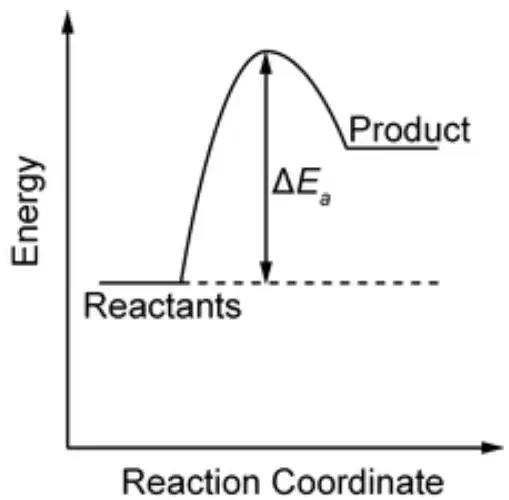
The reaction coordinate diagram of a decomposition reaction is shown below.
What kind of energy is represented by the activation energy, ΔEa?
Kinetic energy required to break the bonds of the reactants
Thermal energy in the product after the reaction
Chemical energy stored in the products’ bonds
Chemical energy released when new bonds form
A beaker contains a solution of water and sodium chloride. When more sodium chloride is added, some dissolves, but the rest remains undissolved at the bottom.
What does this indicate about the system?
The solution is at equilibrium between dissolved and undissolved salt
The solution is unsaturated and can dissolve more salt
The solution is supersaturated and unstable
The solution is being diluted
Scarlett is conducting experiments to observe equilibrium in different systems. Select all of the systems she observes that are in equilibrium.
A reversible reaction where reactants form products at the same rate as products revert to reactants
A gas in a closed container where the rate of condensation equals the rate of evaporation
solution becomes saturatedA solid in an open container melting continuously until it disappears
A solution in a closed container where the rate of dissolution equals the rate of crystallization
A solution that can still dissolve more solute
Elijah is working in a fertilizer factory where they are trying to produce ammonia by combining nitrogen from the air with hydrogen. The factory uses a graph to track the energy changes during the reaction, with points labeled 1, 2, 3, and 4. Elijah learns that adding an iron catalyst can change the reaction's progress. What effect will adding the catalyst have on the shape of the reaction graph?
1 will begin lower on the energy axis.
2 will be closer to the time axis.
3 will shift to the right on the time axis.
4 will rise on the energy axis.
A student performs a reaction by mixing two clear solutions. They observe that the reaction happens faster when the temperature is higher or when the solutions are more concentrated.
Which statement best explains these observations?
Increasing the temperature or increasing the concentration increases the reaction rate.
Decreasing the temperature or decreasing the concentration increases the reaction rate.
Increasing the temperature or decreasing the concentration increases the reaction rate.
Decreasing the temperature or increasing the concentration increases the reaction rate.
Olivia is conducting experiments to observe chemical changes. Which observation would most likely indicate a chemical change?
Solid carbon dioxide changes directly into carbon dioxide gas.
Rock is slowly worn away by the action of wind and sand.
A mineral is crushed into fine dust and mixed with water.
A light green powder forms on the outside of a penny.
Elijah was working in a laboratory and observed bubbling and fizzing after adding an acid solution to a white powdery substance in a beaker. Which of the following can be inferred?
The acid boiled when poured into the beaker.
The acid and powder formed a new product.
A physical reaction produced a gas mixture.
A reaction occurred that produced heat.
Kai is working in a laboratory where the following reaction is at equilibrium: COBr2(g)⇌CO(g)+Br2(g) . According to Le Chatelier’s principle, what would happen if Kai adds more carbon monoxide to the system?
Br2 would react with CO to produce COBr2 to minimize the increase in CO.
Br2 would react with CO to produce COBr2 to increase the production of CO.
COBr2 would decompose to produce CO and Br2 to minimize the decrease in CO.
COBr2 would decompose to produce CO and Br2 to increase the production of CO.
In a factory, a reversible chemical reaction is taking place at equilibrium: A+B ↔ C+D . Sophia is trying to increase the production of C and D. Which of these actions will shift the equilibrium to the right?
remove A
add A
remove B
add D
During a laboratory demonstration, a teacher heats a strip of magnesium ribbon. The ribbon burns with a bright white light and turns into a white powder.
This demonstration is an example of what kind of change?
chemical
physical
magnetic
electric
A student mixes calcium chloride with water in a sealed plastic bag and observes a temperature change. The student claims the reaction is exothermic.
Which observation best supports the student’s claim?
The bag becomes cooler to the touch.
The bag becomes warmer to the touch.
A solid forms at the bottom of the bag.
The solution changes color.
Savannah is a city located in the Coastal Plains region of Georgia. Much of this region contains limestone, which is primarily composed of calcium carbonate.
Which formula best represents the formation of calcium carbonate from its constituent ions,
Ca+2 and CO3-2 ?
Ca2CO3
Ca(CO)3
Ca(CO3)2
CaCO3
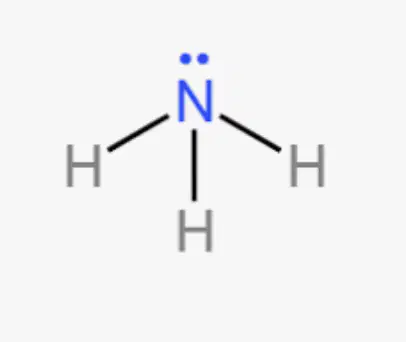
The molecular model below represents a covalent compound. What is the correct name and formula for the compound represented in the model?
Nitrogen trihydride: NH₃
Nitrogen hydride: NH
Ammonium: NH₄
Nitrogen dihydride: NH₂
Ava is studying how atoms bond by examining their Lewis dot diagrams. She has sodium (Na) atoms and oxygen (O) atoms. Based on the number of valence electrons shown in the dot diagrams, what is the correct chemical formula for a compound made only of sodium and oxygen?
NaO
Na₂O
NaO₂
Na₂O₂
Noah is investigating how different metals react with halogens in his chemistry class. He has samples of sodium (Na), an alkali metal, and calcium (Ca), an alkaline earth metal. He allows each metal to react with chlorine (Cl), a halogen. What compound will each element (Na and Ca) most likely form with chlorine?
NaCl and CaCl
NaCl and CaCl₂
Na₂Cl and CaCl₂
Na₂Cl and Ca₂Cl
Maria is conducting an investigation in which she dissolves potassium nitrate in water. She observes that the temperature of the solution decreases. Which THREE statements BEST describe this process? Select all that apply.
The process is exothermic.
The process is endothermic.
The enthalpy change (ΔH) is positive.
Energy is absorbed from the surroundings
Sophia is conducting an experiment in her kitchen. Which observation most clearly indicates that a chemical reaction has occurred?
A powder dissolves in water without any change in temperature.
A substance melts when heated.
A solid forms when two clear solutions are mixed.
A liquid evaporates when left in an open container.
Abigail is experimenting in the lab. She adds a strip of Aluminum to a glass containing hydrochloric acid. She notices bubbles forming and the temperature of the solution rising. What type of reaction is this?
Exothermic chemical reaction
Endothermic physical change
Magnetic reaction
Physical change with no energy transfer
Mia is experimenting to see how quickly two solutions react with each other. Which of the following actions will increase the rate of the chemical reaction?
Reducing the concentration of reactants
Adding a catalyst
Decreasing the temperature
Using larger containers
Chemical changes can be identified by specific observations. Which observation most likely indicates a chemical change?
Ice melts into liquid water when left at room temperature.
A piece of metal is bent into a new shape.
Sugar dissolves completely in water.
A reddish-brown coating forms on an iron nail left outside.
A+BC → AC+B This is the general format for a -------- type of reaction
single displacement
double displacement
combustian
combination
N2+O2--> _NO
Explain the concept of activation energy in relation to collision theory.
Activation energy is the maximum amount of energy required for a chemical reaction to occur.
Activation energy is the energy released during a chemical reaction.
Activation energy is the minimum amount of energy required for a chemical reaction to occur.
Activation energy has no relation to collision theory.
How does an increase in pressure affect a system at equilibrium according to Le Chatelier's principle?
The system will not shift at all.
The system will shift towards the side with fewer moles of gas.
The system will completely stop all reactions.
The system will shift towards the side with more moles of gas.

Compare the two pathway diagrams for the same reaction. Which pathway shows the reaction that has taken place with the help of a catalyst?
Pathway 1
Pathway 2
You cannot tell from these graphs.
Both reactions involved an enzyme.
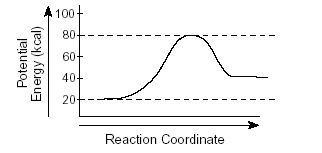
What is the ΔH of this reaction?
40 kJ
20 kJ
80 kJ
-60 kJ
2SO2(g)+O2(g) ⇌ 2SO3(g) + Heat
Adding SO2(g) will
shift equilibrium right
shift equilibrium left
increase rate of reaction
have no change

Which two statements are correct about the figure shown?
It is a covalent bond.
Hydrogen atoms loss electrons and Carbon gains the atoms.
It happens on metal and on another non-metal.
The valence electrons are shared by both atoms.
2NH3(g) + 22 kJ ↔ N2(g) + 3H2(g),
which of the following changes would result in the formation of more N2 and H2 at equilibrium?
What is the correct Lewis Dot Structure for ammonia NH3



