
Font size
 Worksheets
Introduction and Basic Terms
Total questions: 70
Worksheet time: 35mins

In an agency relationship, who gives authority to another to act on their behalf?
Principal
Third party
Agent of necessity
Del credere agent
Which statement best captures Section 182’s definition of an agent?
A person who merely introduces contracting parties
A person who guarantees third-party payment
A person employed to represent another with third persons
A person who supervises employees in a firm
Who is the person for whom the act is done or who is represented, under Section 182?
Broker
Factor
Principal
Agent

Match each role with its primary function in the agency triad.
Principal authorizes the contract, agent pays consideration
Third party grants authority to the agent
Principal executes acts on behalf of the agent
Agent uses authority, contracts with third party
Which pair correctly identifies who delegates power and who receives it?
Principal receives; third party delegates
Principal delegates; agent receives
Agent delegates; principal receives
Third party delegates; agent receives
According to the basic terms, what is the relationship created when authority is delegated?
Estoppel
Bailment
Agency
Partnership
Which statement about obligations in the agency cycle is most accurate?
The principal has no duty once authority is delegated
The third party supervises the agent’s internal authority
The principal is obligated to perform the contract made by the agent
The agent must perform the principal’s contract personally

Which of the following best distinguishes the third party in an agency arrangement?
Receives representation from the agent’s principal
Grants authority to the agent to act
Controls the agent’s internal directions
Enters the contract with the agent on the principal’s behalf
Which statement best describes consideration in creating an agency under Section 185?
Consideration is required for principal’s liability
Consideration is required only for written agency
No consideration is necessary to create agency
Consideration is always required for valid agency
Who must have contractual capacity in a contract of agency?
Both principal and agent must be minors
Neither party needs contractual capacity
The principal must be competent to contract
Only the agent must be competent to contract
Which situation correctly states the agent’s capacity and effect on the principal?
An unsound mind agent never binds the principal
Only a major agent binds the principal to contracts
A minor cannot act as agent in any circumstance
A minor may act as agent and bind the principal
Select all statements that are true about principal’s liability and agency capacity.
Only a competent principal can appoint an agent
Principal is answerable to third parties for agent acts
Only paid agents can bind the principal legally
A person of unsound mind can be an agent
Which option best explains the distinction between capacity of principal and agent?
Principal must be competent; agent may lack capacity
Both must be competent to contract equally
Agent must be competent; principal may lack capacity
Neither needs capacity if consideration exists
Which statement best distinguishes a special agent from a general agent?
General agent performs one isolated transaction only
Special agent manages all acts of a business
Special agent handles one specific transaction only
General agent acts with power of attorney for all acts
A universal agent is characterized by which scope of authority?
Authorized to do all acts the principal can legally do
Authorized to perform one transaction in real estate
Authorized to manage a single branch office only
Authorized to sell goods at public auction events
Identify the correct pairing of agent type and example of appointment.
General agent – branch manager for company activities
Special agent – manager for ongoing store operations
Universal agent – hired to sell one vehicle only
General agent – person with general power of attorney
Which feature most clearly differentiates a factor from a broker?
Factor usually has possession of goods entrusted
Broker normally remits sale proceeds to principal
Broker typically sells goods in own legal name
Factor mainly connects buyers and sellers only
Which statements are true about an auctioneer?
Authorized to sell by public auction
Sells privately without competitive bidding
Usually has possession and lien for charges
Always acts in the principal’s name when suing
Which roles are listed under the types of mercantile agents in the structure diagram?
Universal agent and special agent
Factor and broker
Commission agent and del credere agent
Auctioneer and banker
A broker primarily performs which function in commerce?
Manages all activities of a business branch
Conducts public sales and sues buyers personally
Holds goods and sells in own name with lien
Brings buyers and sellers together and negotiates
Which scenario best exemplifies a special agent?
Granted power to do everything the principal can
Engaged to run daily operations of a factory
Given authority to manage all branch activities
Appointed only to sell one house for the owner
Which statement about a factor’s authority is accurate?
Cannot extend credit or collect sale proceeds
Never has possession or lien over the goods
Can sell in own name and give valid discharge
Must act only in the principal’s legal name
Which combination correctly contrasts factor and broker regarding possession and name of acting?
Factor has possession of goods
Broker usually lacks possession of goods
Broker typically acts in principal’s name
Factor acts in own name in sales

Which statement best distinguishes a commission agent from a broker in the agent structure diagram?
Commission agent never possesses any goods
Commission agent earns brokerage not commission
Commission agent only brings parties together
Commission agent buys or sells for principal
A del credere agent most precisely adds which obligation beyond a standard commission agent?
Arranges meetings between parties without risk
Conducts sales strictly by public auction only
Holds goods in possession for all transactions
Guarantees buyer performance for extra remuneration
In which scenario is a banker acting as an agent?
Holding customer valuables in a safe locker
Issuing new shares for a corporation
Lending long-term capital for expansion
Collecting a cheque and crediting a customer

Which pair correctly matches agent type with possession of goods as indicated in the structure diagram?
All three have possession; each stores goods
Auctioneer has possession; factor has no possession
Factor has possession; broker has no possession
Broker has possession; auctioneer has possession
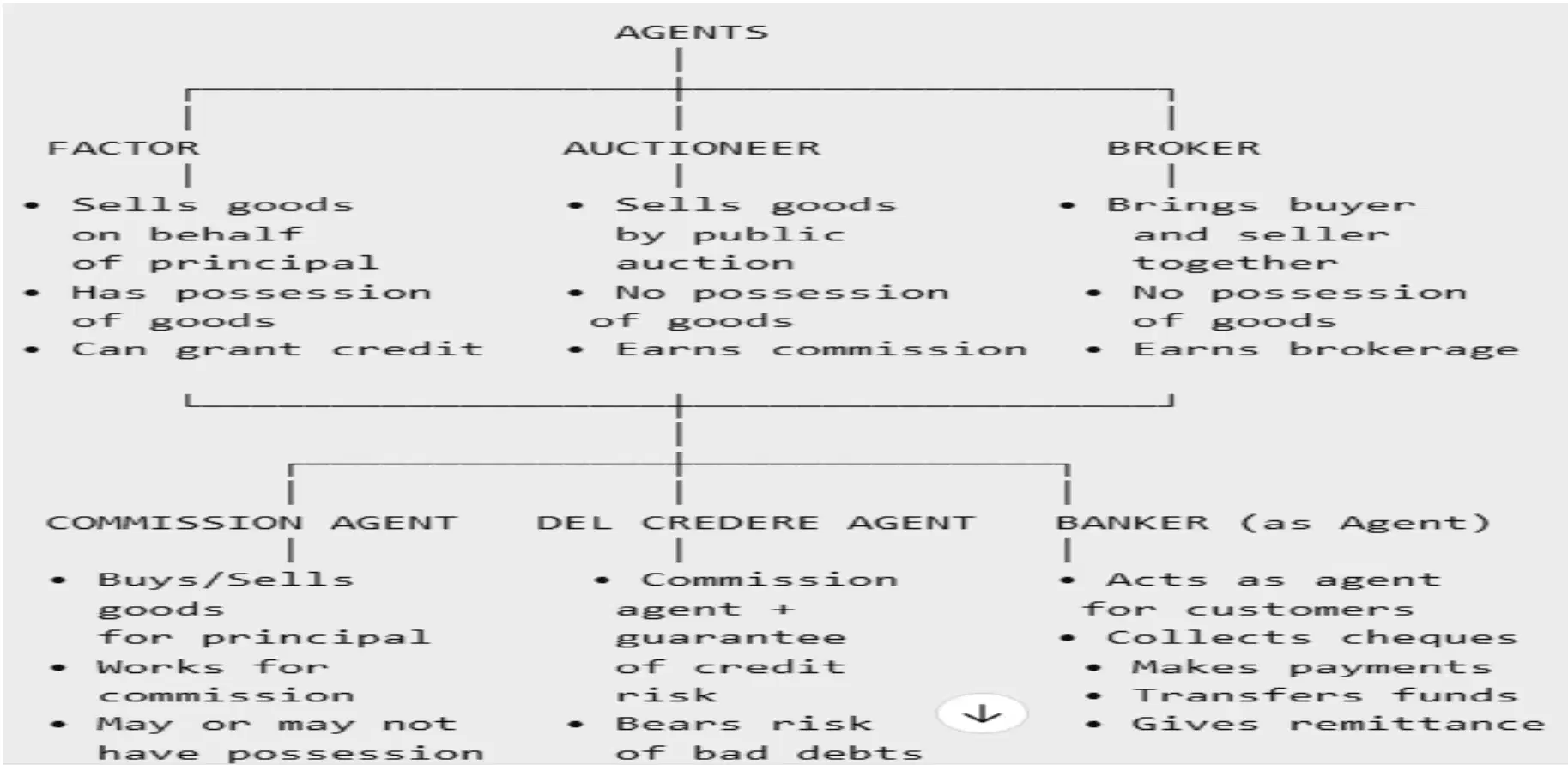
Select all functions listed for a banker acting as agent in the diagram.
Conducts public auctions of goods
Grants credit on goods as security
Transfers funds and remittances
Makes payments on instructions
Collects cheques for customers
Which example best illustrates a commission agent’s role as described?
Grain agent sells farmers’ wheat for a percentage
Bank manager approves a mortgage loan for term
Auctioneer sells assets to highest bidder publicly
Retail broker only introduces buyer and seller
Which method creates an agency through clear spoken or written words appointing an agent and conferring authority?
Express agreement with explicit words
Agency by necessity in emergencies
Implied agreement from conduct
Agency by estoppel through conduct
A shop owner regularly lets a supervisor order stock and deal with suppliers without formal appointment. Which creation of agency best fits this scenario?
Express agreement with clear terms
Implied agreement from conduct
Ratification after unauthorized act
Necessity during urgent risk
Agency by estoppel arises when a person, by words or conduct, causes a third party to reasonably believe another is his agent, and later cannot deny it. Which statement best captures this?
Authority created after later approval
Authority prevented from denial by representation
Authority inferred from repeated dealings
Authority granted in a power of attorney
A friend stands behind the counter and completes a sale while the owner watches and does not intervene. Later, the owner cannot deny the friend’s authority against the customer. Which doctrine applies?
Implied agreement due to custom
Estoppel based on representation
Holding out through long practice
Ratification after the transaction
Agency by holding out is best described as which situation?
Principal later approves unauthorized act
Principal expressly appoints an agent
Principal’s ongoing conduct presents a person as agent
Emergency compels action to prevent loss
A allows his servant, over a long time, to buy goods on credit from a nearby shop in A’s name and regularly pays. The shop may treat the servant as A’s agent for future similar purchases. This illustrates:
Implied agreement from isolated event
Agency by holding out through course of conduct
Agency by necessity due to perishable goods
Express agreement with clear authorization
Which element most distinguishes agency by necessity from other types?
Existence of emergency requiring action
Prior express appointment by principal
Payment of commission to the agent
Public notice of agency relationship
A carrier transporting perishable goods cannot reach the owner due to disruption and sells the goods quickly to minimize loss. What type of agency is most applicable?
Implied agreement from course
Agency by ratification after approval
Agency by necessity to prevent loss
Agency by estoppel through conduct
Agency by ratification requires which key feature?
Unauthorized act later approved by principal
Authority existed at the time of act
Public representation to a third party
Emergency preventing contact with owner
A, without B’s authority, contracts with C on behalf of B. B later, knowing all material facts, accepts the contract. Which statement is accurate?
An implied agency existed from outset
Agency by necessity validates the contract
Estoppel prevents B from denying authority
Ratification creates binding authority retrospectively
Which of the following are ways an agency relationship may be created?
Agency by estoppel or by holding out
Agency by necessity or ratification
Implied agreement from conduct
Express agreement by clear words
Which scenarios would NOT typically create agency by estoppel?
Principal’s repeated conduct presenting an agent
Principal’s silence while a friend makes a sale
Principal clearly denies authority to a third party
Principal issues a registered power of attorney
Which agency type is formed through spoken or written words between the parties?
Implied agency formed by conduct
Estoppel agency arising by representation
Operation of law agency automatically
Express agency formed by explicit words
Necessity agency during emergencies
An agency that arises because the principal cannot later deny an apparent agency once a representation was made is called what?
Express agency using clear words
Estoppel agency due to representation
Implied agency based on circumstances
Operation of law agency automatic
Ratification after unauthorized act
Select all agency types that are created without explicit words between principal and agent.
Implied agency created by conduct
Necessity agency in emergencies
Estoppel agency after representation
Express agency by spoken words
Operation of law agency automatic
Cohabitation in agency law most commonly refers to which relationship for necessities?
Husband acts as agent for wife
Wife acts as agent for husband
Friend acts as agent for friend
Parent acts as agent for child
Sibling acts as agent for sibling
For ratification to be valid, the act must have been done how?
By an agent for an identifiable principal
By any person acting in their own name
By promoters forming a future company
By law without any human decision
By an agent for an unknown future party
Why did the court in Keighley, Maxsted & Co. v. Durant hold that ratification was not possible when X bought wheat in his own name?
X lacked capacity to enter any contract
X did not profess to act as Y’s agent
Y refused to pay the higher market price
Z disclosed Y’s identity to the market
The wheat quality failed inspection standards
Which scenario fails the second essential for valid ratification regarding the principal’s existence?
Promoters contract for a company to be formed later
A spouse buys essentials while cohabiting
A manager purchases supplies for current employer
An agent buys goods for a disclosed principal
An agent signs on behalf of an existing principal
Which statement best explains contractual capacity in ratification?
Principal must be competent at ratification only
Agent must be competent at act and ratification
Principal must be competent at act hazard only
Principal must be competent at act and ratification
A minor becomes a major and tries to ratify a contract made for him during minority. What is the correct legal outcome?
Ratification binds if consideration was adequate
Ratification binds if the agent had good faith
Ratification binds because he is now major
Ratification fails because contract was during minority
Ratification based on ignorance of an excessive price paid by the agent is generally
Valid because price is commercial risk
Invalid because material facts were unknown
Valid if the market later increases
Valid if the agent intended no fraud
Which scenario demonstrates full knowledge of material facts?
Principal ratifies after learning all essential terms
Principal approves without reading terms fully
Principal approves because agent is trustworthy
Principal ratifies only after market improves
The whole transaction rule requires the principal to
Adopt the entire act with both sides
Adopt only cash terms if favorable
Adopt burdens but reject benefits
Adopt benefits but reject burdens
An agent sells goods on credit at a low price without authority. The principal wants only the low price term. Under the whole transaction rule, the principal
May ratify price but refuse credit
Must ratify both price and credit
Must refuse both price and credit
May renegotiate and then ratify
Reasonable time for ratification primarily depends on
Agent’s convenience and schedule
Length of the written contract
Nature of transaction and market conditions
Court calendar and filing dates
If the principal delays ratification for many months and prices change drastically, the ratification is most likely
Ineffective because time was unreasonable
Effective because delay shows caution
Effective because market shifts are normal
Effective if agent confirms again
Which act cannot be made valid by ratification?
Void or illegal agreement by law
Ultra vires but lawful contract
Unauthorized but beneficial sale
Excessively priced purchase
An agent without authority enters an illegal contract for the principal. The principal later approves in writing. The legal effect is
Ratification makes contract enforceable
Ratification keeps contract still void
Ratification binds the agent personally
Ratification validates only lawful parts
To complete ratification, the principal must
Keep approval private for records
Communicate adoption to agent or third party
Record approval with a notary public
Wait for agent to inform counterpart
Which communication most clearly completes ratification?
Internal memo noting tentative approval
Silence implying acceptance after delivery
Verbal praise to the legal department
Email to third party adopting the contract
Which duty requires an agent to follow instructions or, if none are given, to act according to prevailing customs?
Avoid conflicts with the principal’s interests
Act according to the principal’s directions
Return all documents and property promptly
Reasonable care and skill in performance
An agent deciding to take an undisclosed margin on a purchase made for the principal violates which duty?
Duty not to delegate authority
Duty to communicate during emergencies
Duty not to make secret profits
Duty to render proper accounts
Which actions together best demonstrate the duty of reasonable care and skill?
Checking market rates before contracting
Relying solely on intuition for pricing
Following practices a prudent person would use
Ignoring known risks to expedite closing
When must an agent seek instructions from the principal under the communication duty?
During ordinary routine transactions
Whenever a better commission is possible
In case of difficulty or emergency
When accounts are already reconciled
Maintaining and submitting accurate records of all transactions primarily fulfills which duty?
Avoid conflict of interest
Act with reasonable skill
Protect the principal’s interests
Render proper accounts
Which scenario most clearly illustrates a conflict of interest?
Agent documenting each expense accurately
Agent buying stock for principal’s portfolio
Agent declining to act beyond instructions
Agent steering business to a company they own
Under what circumstances may an agent delegate authority without breaching their duty?
When the task is minor and routine
Only when contract or necessity permits
Whenever delegation increases efficiency
If the principal does not object later
Which behaviors fulfill the duty to protect and preserve the principal’s interests?
Acting honestly and in good faith
Safeguarding property from foreseeable loss
Withholding material information from the principal
Speculating with funds for higher returns
After agency termination, what is the correct handling of the principal’s materials?
Return all documents, money, and goods
Keep funds until final audit occurs
Dispose of duplicates after notice
Retain originals for future reference
Which pair of duties most directly prevents self-dealing by an agent?
Reasonable care and protect interests
Render accounts and communicate promptly
Follow directions and avoid delegation
Avoid conflicts and no secret profits

