
 Worksheets
Introduction to Mechanical Properties
Total questions: 49
Worksheet time: 25mins
Which statement best distinguishes physical properties from mechanical properties of materials?
Physical change with loading cycles; mechanical remain constant
Physical include strength; mechanical include color and density
Physical describe performance; mechanical are measurable quantities
Physical are measurable; mechanical describe performance under forces
Which set lists examples correctly classified as mechanical properties?
Strength, ductility, wear resistance
Mass, melting point, refractive index
Color, density, thermal expansion
Luster, electrical resistivity, hardness
A component is subjected to repeated loading and unloading below its tensile strength. What failure mechanism becomes critical to consider?
Creep deformation over long times
Fatigue leading to fracture
Buckling under compression
Brittle rupture at low temperature
What does fatigue strength quantify for a material under cyclic loading?
Average strain measured during one loading cycle
Maximum stress endured for a given number of cycles
Minimum stress causing immediate yielding
Tensile strength under monotonic loading
When designing parts for repetitive load conditions, which design priority is most appropriate?
Minimize elastic modulus to avoid stiffness
Maximize thermal conductivity for heat dissipation
Minimize density to reduce self-weight
Maximize fatigue strength at expected cycle count
Which scenario best illustrates mechanical property behavior rather than a physical property?
Ice melting at 0 degrees Celsius
Copper exhibiting high electrical conductivity
A polymer having a density of 1.2 g/cm³
A steel rod resisting wear in sliding contact
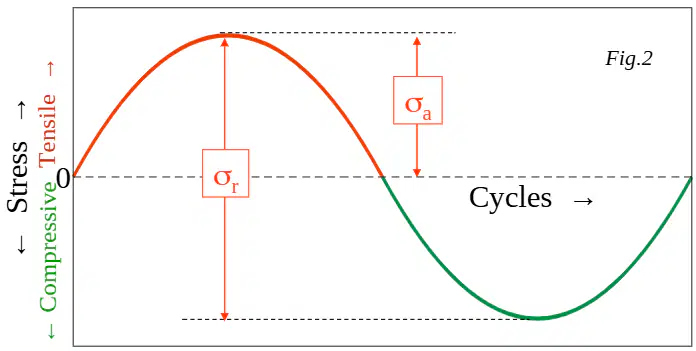
In a completely reversed cycle of stress, which statement best describes the mean stress over one full cycle?
Mean stress equals zero magnitude
Mean stress equals peak tensile value
Mean stress equals peak compressive value
Mean stress equals stress amplitude only
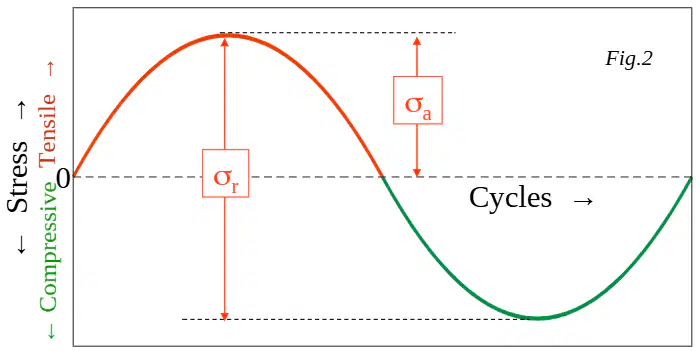
Which parameter labeled on the stress cycle diagram represents half the range between maximum and minimum stress?
Cyclic frequency f value
Residual stress σr meaning
Stress amplitude σa definition
Mean stress σm magnitude
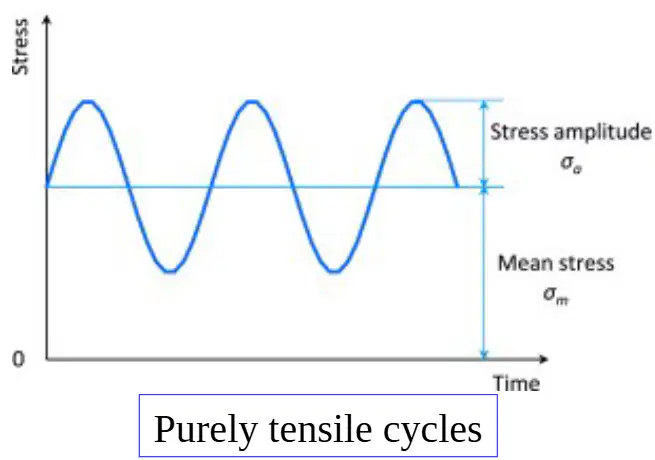
Purely tensile cycles, as illustrated, have what defining characteristic compared to reversed cycles?
Stress switches to compressive peaks
Stress never drops below zero line
Stress alternates equally around zero
Stress remains constant in time
Shear strength of a material is best described as its ability to resist which action?
Temperature-driven expansion
Axial compression without buckling
Uniform elastic stretching only
Sliding of adjacent material layers
At the granular level, shear occurs primarily because directional forces cause what internal response?
Crystals to rotate without slip
Grains to expand volumetrically
Particles to slide against each other
Atoms to bond more strongly

Which loading pair in the force diagrams correctly matches the arrows to tensile force?
No arrows, uniform field
One arrow up, one arrow down
Opposing arrows pushing together
Opposing arrows pulling apart
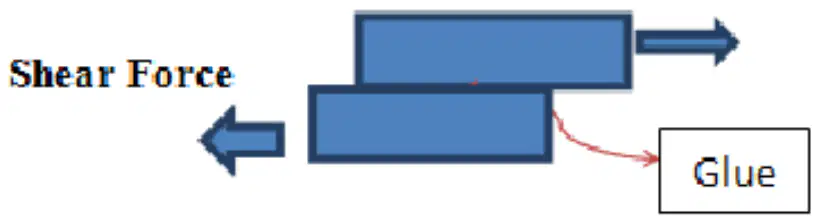
A glued lap joint under shear, as shown, primarily fails along which plane?
A plane through compressive axis
A plane perpendicular to tension
The interface between bonded layers
Random planes unaffected by load
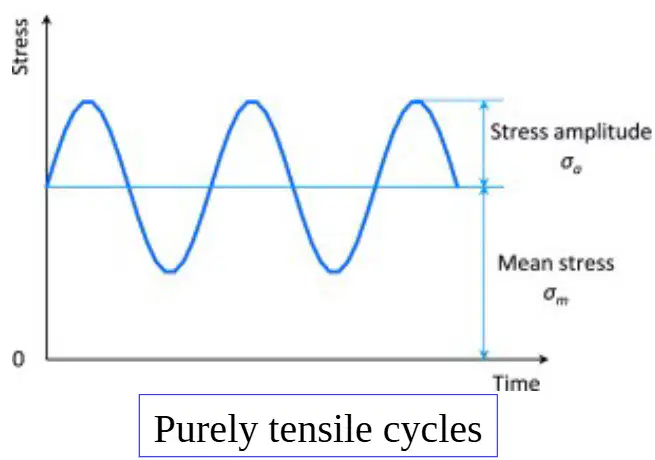
An engineer increases mean stress while keeping stress amplitude constant in a tensile-only cycle. What change is seen on the diagram?
Waveform shifts upward from zero line
Waveform remains centered on zero
Waveform shifts downward equally
Waveform becomes double frequency
Which statement best defines yield strength for a loaded material?
Stress where permanent deformation begins
Stress where elastic strain reaches its peak
Maximum stress before sudden fracture occurs
Load where stiffness increases significantly
During deformation, what change occurs at the yield point?
Elastic behavior transitions to plastic behavior
Plastic behavior transitions back to elastic
Material stiffness increases rapidly and linearly
No change in deformation mode is observed
Which unit is commonly used to report yield strength in engineering data sheets?
Meters per second, m/s
Kilowatt-hours, kWh
Degrees Celsius, °C
Megapascals, MPa
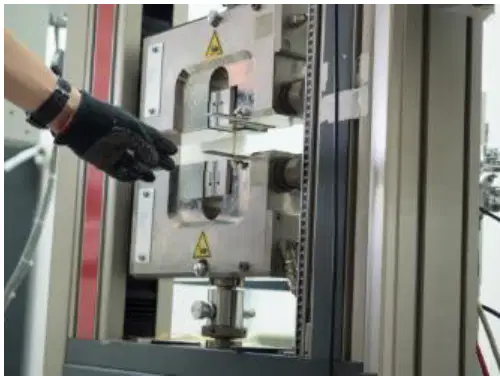
Tensile strength refers to the amount of load a material can withstand until which event occurs?
Increase in cross-sectional area
Fracture of the material
Onset of plastic deformation
Complete elastic recovery
Which option correctly distinguishes yield strength from tensile (ultimate) strength?
Yield: maximum elastic load; Ultimate: start of plasticity
Yield: fracture load; Ultimate: start of elasticity
Yield: start of permanent set; Ultimate: fracture load
Yield: stiffness limit; Ultimate: temperature limit
In a paperclip bending demonstration, what behavior is observed with gentle bending?
It springs back to shape
It immediately fractures
It hardens and thickens
It retains a permanent bend
Design calculations use yield strength primarily to ensure what?
Maximum temperature tolerance
Dimensional integrity under load
Electrical conductivity performance
Corrosion resistance in service
Which statement best defines ductility for engineering materials?
Ability to return perfectly after small strain
Ability to resist surface scratching and wear
Ability to absorb impact energy without damage
Ability to deform plastically without fracturing
During a tensile test, which measurement is commonly used to quantify ductility?
Percentage of elongation before failure
Hardness number under indentation
Fatigue life under cyclic loading
Ultimate shear strength at yield
Young’s modulus determined from a tensile test primarily indicates which property?
Thermal softening above transition
Plastic flow resistance at necking
Elastic stiffness under linear strain
Surface hardening during cold work
A material that snaps suddenly without noticeable deformation is best described as:
Tough with large energy absorption
Ductile with high elongation
Brittle under tensile loading
Elastic with low hysteresis
Which observation most supports that a sample is ductile when tested by bending or stretching?
It fractures at very low energy input
It returns fully after small deformation
It scratches easily under light wear
It bends permanently before breaking
A Grade 12 lab compares two metals. Metal A has higher percentage elongation but similar Young’s modulus to Metal B. What is the most valid conclusion?
Metal A is less ductile and less stiff
Metal A is more ductile yet equally stiff
Metal B is tougher and more elastic
Both metals have identical brittleness
Which property describes a material’s ability to absorb impact energy without fracturing at a given temperature?
Hardness of surface indentation resistance
Toughness as impact energy absorption
Elasticity as reversible deformation
Ductility as plastic strain capacity
Which test is commonly used to measure a material’s toughness?
Brinell hardness indentation test
Rockwell hardness scale assessment
Charpy impact pendulum test
Vickers microhardness diamond test
What does hardness primarily evaluate in materials?
Resistance to permanent bending under load
Resistance to surface indentation or scratching
Ability to absorb impact energy at temperature
Capacity for elastic recovery after stretching
At low temperatures, what change commonly occurs in many materials regarding impact behavior?
Impact resistance increases substantially
Hardness decreases dramatically
Materials become more ductile overall
Materials may become more brittle
Which statement best contrasts toughness and brittleness?
Toughness is elastic strain, brittleness is plastic strain
Toughness measures indentation depth, brittleness resists wear
Toughness resists impact fracture, brittleness fails easily
Toughness is low energy absorption, brittleness is high
A designer selects a steel for offshore platforms exposed to very low sea temperatures. Which property and test data should be prioritized?
Toughness values from Charpy testing
Hardness values from Vickers testing
Elastic modulus from tensile testing
Ductility percentage from bend testing
Which hardness test uses a ball indenter and measures indentation diameter?
Vickers diamond pyramid method
Rockwell C scale method
Brinell hardness test method
Charpy pendulum impact method
During a classroom activity, a rubber band snaps back after stretching while a small ball deforms Blu Tack on impact. Which observation indicates toughness?
Ball’s absorption of impact without fracture
Ball’s ability to indent the Blu Tack
Rubber band’s elastic recovery behavior
Rubber band’s resistance to surface wear
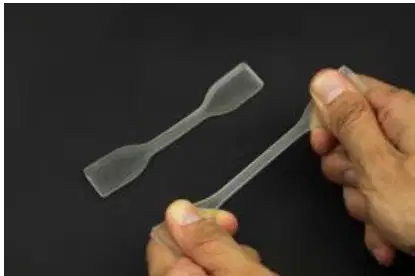
Which statement best describes elasticity in materials?
Capacity to hold a new shape after forming forces
Ease of being formed into thin sheets under pressure
Ability to resist permanent indentation under load
Tendency to return to original shape after stress
Plasticity in a solid material primarily refers to:
Resistance to scratching, abrasion, or cutting
Immediate recovery to original size after force removal
Permanent shape change when forming forces are applied
Ability to withstand compressive stress without buckling
At what point do materials transition from elastic to plastic behavior?
Yield point in the stress–strain response
Ultimate tensile strength of the specimen
Fracture point under tensile loading
Proportional limit for small strains
Which property is most associated with being rolled or hammered into thin sheets?
Malleability under compressive stress
Elasticity under tensile stress
Hardness against indentation
Stiffness measured by Young’s modulus
Which test method is commonly used to quantify hardness?
Brinell, Rockwell, or Vickers indentation tests
Charpy or Izod impact pendulum tests
Creep rupture time at elevated temperatures
Four-point probe electrical resistivity tests
Stiffness is often quantified by Young’s modulus, which compares:
Compressive strength to density
Load to cross-sectional area
Applied stress to resulting strain
Force to displacement over time
Which expression correctly defines density in engineering materials?
Volume divided by mass
Mass divided by volume
Mass minus volume
Mass multiplied by volume
A block has mass 2.5 kg and volume 0.00032 m³. What is its density?
7,812.5 kg/m³
800.0 kg/m³
1.28 kg/m³
0.00013 kg/m³
Which pair lists typical units used to express density?
W/m·K and S/m
mm and inches
kg/m³ and g/cm³
N/m and Pa
Using the density triangle, which rearrangement gives mass from density and volume?
m = ρ + V
m = ρ × V
m = ρ ÷ V
m = V ÷ ρ
Engineers choose lower-density materials for aerospace because they primarily reduce which factor?
Melting temperature
Electrical resistance
Material stiffness
Component weight
Two materials have equal strength, but Material A has half the density of Material B. Which statement best describes the strength-to-weight ratio?
Both have identical strength-to-weight ratios
Material B has a better strength-to-weight ratio
Material A has a better strength-to-weight ratio
Strength-to-weight ratio does not involve density
A steel bracket is selected over aluminum because it can be made thinner for the same load. Which reasoning supports this choice?
Conductivity determines structural thickness
Lower density steel reduces mass significantly
Higher density steel provides higher strength
Aluminum has higher melting point than steel
Which statement about physical properties is accurate for material selection?
They cannot be quantified numerically
They are only mechanical behaviors under load
They include marketing features and price
They are measurable characteristics like density

