
Font size
 Worksheets
IGAC 2-Heat Topic
Total questions: 200
Worksheet time: 2hrs 53mins
Heat is often measured in units called _____.
temperature
degrees
pounds
calories
In this state of matter the molecules vibrate in place, but they do not change positions relative to each other.
liquid
solid
plasma
gas
In this state of matter the molecules are in constant contact with one another, but they can move around freely.
liquid
solid
plasma
gas
In this state of matter the molecules are spaced very far apart from each other and move freely through space.
liquid
solid
plasma
gas
Materials that hinder the flow of heat
insulators
conductors
radiation
radiation
A method of heat transfer that does not rely upon any contact between a source of heat and the heated object
insulators
conductors
radiation
convection
It occurs when warmer areas of a liquid or gas rise to cooler areas
conduction
convection
conductors
insulators
Forces that are equal in magnitude but opposite in direction.
motion
balanced forces
speed
unbalanced forces
The capacity to do work
Energy
Speed
Pitch
Conduct
Energy that transfers between substances because of a temperature difference between the substances; the transfer of energy is always from the warmer substance to the cooler substance
Conductor
Circuit
Heat Energy
Sound Energy
A material used to reduce or prevent the transfer of heat
Electrical Energy
Insulator
Speed
Conductor
The energy that is possessed by an object due to its motion or position
Electricity
Motion
Unbalanced Forces
Mechanical Energy
The only visible form of energy; produced or given off directly from the Sun causing the growth of plants and the existence of most life forms
Electricity
Light Energy
Sound Energy
Reflect
The relative frequency, high or low, of a sound as perceived by a listener.
Sound Energy
Attraction
Pitch
Insulator
The act or process of changing position and/or direction
Energy
Motion
Mechanical Energy
Speed
To bounce light, sound, or heat off of a surface.
Reflect
Circuit
Attraction
Light Energy
Energy produced by sound vibrations
Mechanical Energy
Conductor
Sound Energy
Pitch
To force away or apart.
Reflect
Attraction
Repel
Heat Energy
Amount of distance traveled divided by time taken
Motion
Speed
Energy
Conduct
Forces that are unequal in magnitude and may or may not be opposite in direction; also see force and balanced forces
Sound Energy
Motion
Pitch
Unbalanced Forces
To transmit heat, sound, or electricity through a medium.
Light Energy
Circuit
Heat Energy
Conduct
The physical phenomena arising from the behavior of electrons and protons that is caused by the attraction of particles with opposite charges and the repulsion of particles with the same charge
Repel
Motion
Electricity
Energy
A material that readily allows electric charges to pass through it and therefore carries electricity well
Conductor
Unbalanced Force
Insulator
Reflect
Energy made available by the flow of electric charge through a conductor
Heat Energy
Motion
Speed
Electrical Energy
An interconnection of electrical elements forming a complete path for the flow of electric current
Conductor
Insulator
Circuit
Reflect
The electric force exerted by oppositely charged particles, tending to draw or hold the particles together
Conductor
Attraction
Electricity
Pitch
Energy that is stored in matter and can be released by a chemical reaction
Chemical Energy
Conduct
Energy
Insulator
If two objects have different temperatures, heat will flow from the warmer object to the cooler one UNTIL ____________
one reaches a temperature of zero
they both have an equal temperature
one runs out of energy
On a hot day the lake water warms and the temperature increases. How does the movement of the particles change?
move slower and farther apart
move slower and closer together
move faster and farther apart
move faster and closer together
At room temperature water is a liquid. How could the water be changed to a solid?
add heat
remove heat
decrease density
increase density
Which description defines heat?
total thermal energy of an object or substance
change in the temperature of a substance in degrees Celsius
energy transferred between objects at different temperatures
average kinetic energy of the particles that make up a substance

How does the thermal energy of the liquid in the larger beaker compare to the thermal energy of the liquid in the smaller beaker?
The liquid in the larger beaker has less thermal energy than the liquid in the smaller beaker.
The liquid in the larger beaker has more thermal energy than the liquid in the smaller beaker.
The liquid in the larger beaker has the same amount of thermal energy as the liquid in the smaller beaker.
The exact volume of the liquid in each beaker must be known to compare the thermal energy of the liquids.
How does heat transfer when you hold an ice cube in your hand?
from the cold ice cube to your warm hand
the cold ice cube makes your hand cold
from your warm hand to the cold ice cube
very carefully
Jeriah places two metal cubes in contact with each other. Energy transfers as heat flows from Cube A to Cube B. What conclusion can you draw regarding Cube A?
It is larger than Cube B.
It is cooler than Cube B.
It is smaller than Cube B.
It is warmer than Cube B.

Joe places two solid objects in contact with each other. Which property determines the direction of the flow of heat between the two objects?
material of the objects
volume of objects
density of objects
temperature of objects
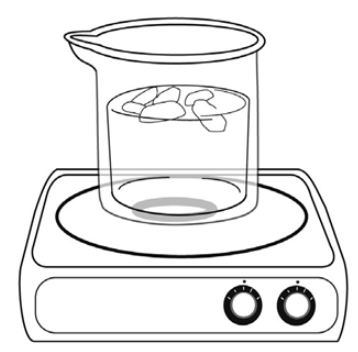
Emerson places a beaker of water on a hotplate and turns the hotplate on. The temperature in the room is 25 ºC. After the water heats to 75 ºC, she adds pieces of ice to the beaker.
Which of the following describes a transfer of heat energy that occurs during this experiment?
from the air to the water
from the ice to the beaker
from the water to the ice
from the water to the hotplate
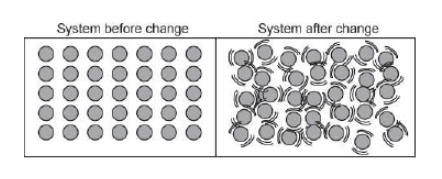
The picture below shows a closed system before and after undergoing a change.
What was changed in the system?
Particles were added to the system.
Water was added to the system.
Heat was added to the system.
Air was added to the system.

The water in Mario’s swimming pool absorbs energy as heat during the day. Which of the following would the water in the pool be most likely to do?
condense
evaporate
freeze
melt
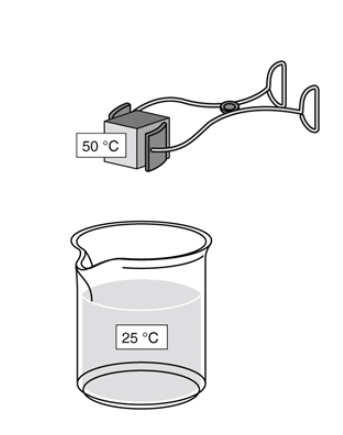
As part of a lab experiment, Tasha drops a metal cube into a beaker of water, as shown in the figure below.
After energy in the form of heat transfers between the substances, what is the final temperature of the water?
The final temperature is 25 °C because there is more water than metal.
The final temperature is 50 °C because the metal warms the water to the temperature of the metal.
The final temperature is between 25 °C and 50 °C because energy is transferred from the metal to the water.
The final temperature is between 25 °C and 50 °C because most of the thermal energy is lost to the air around the substances.
The natural direction of heat flow between two bodies depends on __________.
their volume
their temperature
their heat capacity
whether they are in a liquid, a solid or gaseous state
The boiling point of water is 100oC. What is this in kelvin?
173
212
373
512
Contraction of a solid indicates that _______.
the number of particles decreases
the space between particles increases
the average velocity of particles increases
there is a decrease in the average kinetic energy of particles
During warm days, you cool yourself by damping your skin with a wet towel. Which of the following takes place?
Your skin absorbs the coldness of the water.
Your skin releases energy when water from your skin evaporates.
The temperature of the water on your skin decreases as it
evaporates.
The temperature of your skin increases as water evaporates from your skin.
What happens to the surface of the water when the rate of evaporation is
greater?
It becomes cooler.
It absorbs less energy.
It becomes more massive.
It absorbs greater energy.
Which of the following happens when ice changes into a liquid at 0oC?
The molecules move slower than before.
The temperature of the substance increases.
The potential energy of the molecules increases.
The average movement of the molecules increases.
The normal body temperature is 37oC. What is this in Fahrenheit?
32 oF
99 oF
212 oF
373 oF
The decrease in temperature of a substance indicates that _______.
the number of particles in it decreases
the average velocity of its particles increases
the average potential energy of particles decreases
the average kinetic energy of its particles decreases
Which of the following is NOT a unit of temperature?
Calorie
Celsius
Fahrenheit
Kelvin
All substances will expand equally with the same change in temperature.
True
False
Neither
Either Yes or No
When a substance undergoes thermal expansion, its _________.
mass increases
volume decreases
particles get colder
particles spread out
Does the temperature of a substance depend on how much of the substance
is present?
No
Yes
Maybe
None of the above
Do all particles of the substance at a certain temperature move at the same
speed and in the same direction?
No
Yes
Maybe
None of the above
What happens to the temperature of an object when the particles are moving
faster?
reduces
increases
remains constant
increases then reduces
What average energy of particles does temperature measure?
kinetic
potential
chemical
mechanical
Which of the following affects thermal energy transfer. (Select all that apply)
Color
Mass
Table
Cells
Temperature
Which of the following has the least amount of kinetic energy?
gas
solid
liquid
Which of the following has the greatest kinetic energy?
gas
solid
liquid
What is the relationship between the variables mass and temperature?
The greater the mass, the greater the temperature.
Mass and temperature do not have a relationship.
The lower the temperature, the lower the mass.
As mass increases, the temperature decreases.
The movement of substances from an area of higher concentration to an area of lower concentration is the definition for which of the following vocabulary terms?
Diffusion
Confusion
Dissolution
Solution
Which of the following is a change in volume due to an increase in heat?
Thermal Contraction
Radiation
Thermal Expansion
Toaster Coils
This is the energy an object has when it's moving
Temperature
Collision
Stability
Kinetic energy
Which of the following is a measure of the average kinetic energy of all the particles in an object?
Heat
Convection
Temperature
Radiation
Energy cannot be created or destroyed, it can only be transformed

When an object expands upon heating, its volume increases.
TRUE
FALSE
Substances with high heat capacities heat up more slowly because they can absorb more heat before their temperature rises.
TRUE
FALSE
Heat depends only on how fast molecules vibrate.
TRUE
FALSE
A decrease in temperature of a substance indicates that the_______
volume of the substance reduces
volume of the substance increases
particles of the substance get closer with each other
particles of the substance move farther from each other
Which of the following happens when ice changes into liquid at 0ºC?
The molecules are not moving.
The molecules move slower when ice changes into liquid.
The temperature of the liquid is higher than the temperature of the ice.
The temperature of the liquid is the same as the temperature of the ice.
Why does liquid in the thermometer rise when put in hot water?
The liquid is boiling.
The liquid is evaporating.
The liquid gains heat from the hot water causing it to expand.
The liquid loses heat from the hot water causing it to contract.
During warm days, you cool yourself by damping your skin with a wet towel. Which of the following takes place?
Wet towel has no effect on your body
Wet towel releases heat energy to your body
Wet towel absorbs heat energy from your body.
Wet towel has the same temperature as your body.
Temperature of a body measures the molecular_______.
average kinetic energy
average potential energy
differences in kinetic energy
differences in potential energy
It is dependent of the average
KINETIC ENERGY
(a)
It is the total KINETIC ENERGY of all particles
In a substance and it is measured in
JOULES.
(a)
Inflated balloon will shrink when kept inside a freezer.
TRUE
FALSE
A glass of water with ice floating on it cools faster than a glass of water with ice pushed to the bottom of the glass.
TRUE
FALSE
MAYBE
NOT SURE
The air blown from a wide, open mouth is warm, while the air blown from tight, closed lips cold.
TRUE
FALSE
MAYBE
NOT SURE
When storing water inside a freezer at night, closing the metal cover of the glass container tightly would make it difficult to open the following day.
TRUE
FALSE
Boiling water causes more damage to the skin than steam at 100ºC.
TRUE
FALSE


ALL the energy of all the particles in a substance is a measure of its
temperature
insulator
specific heat
thermal energy
The amount of energy needed to change 1 kg of a substance by 1 degree celsius is its
thermal energy
specific heat
temperature
Thermal expansion is
a measure of the kinetic energy
all the energy of all the particles
the increase in volume of a substance due to an increase in temperature
Which is NOT a good insulator?
metal
plastic
wood
cloth
If two substances have the same AVERAGE kinetic energy, then
they have equal thermal energy
they have the same temperature
they have the same specific heat
Compared to the Pacific Ocean, a cup of hot tea has
more thermal energy and a higher temperature
less thermal energy and a higher temperature
more thermal energy and a lower temperature
When a stethoscope touches your skin, what happens?
heat travels from the stethoscope to your skin
no energy is transferred
the stethoscope warms up due to humidity
heat travels from your warm body to the stethoscope
Mr. Salyer has a two-story house. In the winter, he uses his downstairs heating unit because the arm air
contracts, rises, and heats the house through conduction
expands, sinks, and heats the house through convection
expands, rises, and heats the house through convection
The rising and falling of air due to uneven heating of the Earth's surface is called
convection
radiation
conduction
does not happen
When a gas or liquid heat up, what happens?
molecules are closer together, become less dense, and rise
molecules are spread out, become less dense, and rise
molecules are closer together, become denser, and rise
Warming a marshmallow OVER a campfire is an example of
radiation
convection
conduction
global warming
Roller coasters have gaps in the tracks so they can expand in hot weather due to
thermal expansion
specific heat
mood swings
thermal conductivity
Aluminum changes temperature at a slower pace than lead. Aluminum has a higher
temperature
conduction rate
thermal energy
specific heat
A fireplace is heating an entire house through
radiation
conduction
convection
Which is NOT a heat transfer by radiation?
A bottle sitting in the sun that gets warm
Sitting beside of a campfire and feeling the heat
A pot of water heating over a hot stove
A person sunbathing
Total amount of thermal energy in an object depends on
temperature and number of particles
temperature
the object's specific heat
the number of particles
The temperature of a substance increases as___.
a. the substance expands
b. the average kinetic energy of its particles increases
c. the substance's volume increases
d. the substance's mass increases
When you touch something that feels cold,
a. heat from your hand moves into the cold substance.
b. coldness moves from the cold substance into your hand.
c. it melts.
d. it freezes.
How does the speed of the particle in a substance relate to the temperature of the substance?
a. helps to determine the amount of average kinetic energy, which helps to determine temperature
b. there is no relationship between the two
c. helps to determine if a relationship even exists between the two
d. helps to determine the amount of heat, which helps to determine the temperature
The energy transferred between object's at different temperatures
a. heat
b. thermal energy
c. radiation
d. convection
The total kinetic energy of a substance's particles
a. heat
b. convection
c. thermal energy
d. conduction
Heat is thermal energy that flows between objects that differ in___.
a. radiation
b. temperature
c. thermal energy
d. specific heat
Scientists use either the ____ scale or the ____ scale.
a. celsius, farenheit
b. farenheit, kelvin
c. kelvin
d. celsius, kelvin
Water freezes at 32⁰F, which as the same as___ K.
a. 273
b. 0
c. 373
d. 100
Water boils at 100⁰ C, which is the same as___⁰F.
a. 273
b. 32
c. 212
d. 0
If the particles in an object have more kinetic energy, what must be true?
a. The object's temperature is lower
b. The object's temperature is higher
c. The object moves faster
d. The object is heavier
In which state do particles move fastest and with little effect on each other?
a. ice
b. gas
c. liquid
d. solid
What does the average kinetic energy of an object's particles tell you?
a. the temperature of the object
b. how hot the object is
c. how cold the object is
d. how fast the particles are moving
If the particles of two substances have the same average kinetic energy, then___.
a. the specific heats of the substances are identical
b. the particles will not react chemically
c. the substances have equal thermal energies
d. the substances have equal temperatures
The boiling of water on the Farenheit, Celsius, and Kelvin scales is respectively,____.
a. 98.6⁰F, 37⁰C, 310K
b. 212⁰F, 100⁰C, 273K
c. 68⁰F, 20⁰C, 293K
d. 32⁰F, 0⁰C, 273K
Water boils at 212⁰F, which is equivalent to__.
a. 273 K
b. 37⁰C
c. 0⁰ C
d. 100⁰C
Electric energy: computer, freezer
Heat energy: ?
Energy of motion: roller coaster, swing set
Which of these best completes the students’ chart?
Which types of energy does the bulb give off?

Juanita tells to his mother that she wants to go some day to iceland to see beautiful landscape, but his mother says that the temperatures there are around 280 K on may, Juanita convert to Celsius and get:
44.33 ºC
280 ºC
7 ºC
89 ºC

Mariana is at the beach with her parents so she see on a clock that the temperature is 104 ºF, she asks his father what is the temperature in celsius. He father says:
279,5 ºC
40 ºC
55,5 ºC
104 ºC


A temperature scale that is used mostly in United States.
According to it, water freezes at 32 degrees and boils at 212 degrees.
Celsius
Fahrenheit
Kelvin
All of them

A device that measures temperature.
Heat loss causes matter to ________. Heat gain causes matter to ________.
contract ; expand
expand ; contract
stay ; change
change ; stay

Rahma got an ice cream from her mom. The ice cream melts under the sun because the ice cream ___________.
gains heat from the sun
loses heat to the sun
cannot withstand the heat from the sun
produce too much heat

The pan is made of iron. The handle is NOT too hot to touch. What might the pan's handle be made of?
copper
aluminum
wood
iron
Which description defines heat?
total thermal energy of an object or substance
change in the temperature of a substance in degrees Celsius
energy transferred between objects at different temperatures
average kinetic energy of the particles that make up a substance
How does the thermal energy of the liquid in the larger beaker compare to the thermal energy of the liquid in the smaller beaker?
The liquid in the larger beaker has less thermal energy than the liquid in the smaller beaker.
The liquid in the larger beaker has more thermal energy than the liquid in the smaller beaker.
The liquid in the larger beaker has the same amount of thermal energy as the liquid in the smaller beaker.
The exact volume of the liquid in each beaker must be known to compare the thermal energy of the liquids.
Emerson places a beaker of water on a hotplate and turns the hotplate on. The temperature in the room is 25 ºC. After the water heats to 75 ºC, she adds pieces of ice to the beaker.
Which of the following describes a transfer of heat energy that occurs during this experiment?
from the air to the water
from the ice to the beaker
from the water to the ice
from the water to the hotplate
The water in Mario’s swimming pool absorbs energy as heat during the day. Which of the following would the water in the pool be most likely to do?
condense
evaporate
freeze
melt
As part of a lab experiment, Tasha drops a metal cube into a beaker of water, as shown in the figure below.
After energy in the form of heat transfers between the substances, what is the final temperature of the water?
The final temperature is 25 °C because there is more water than metal.
The final temperature is 50 °C because the metal warms the water to the temperature of the metal.
The final temperature is between 25 °C and 50 °C because energy is transferred from the metal to the water.
The final temperature is between 25 °C and 50 °C because most of the thermal energy is lost to the air around the substances.
The faster the molecules move, the ________ the object is.
warmer
cooler
Heat flows from a warmer place to a cooler one.
True
False
It is the transfer of heat that does not rely upon any contact between the heat source and the heated object.
Conduction
Convection
Radiation
It is the transfer of heat from one place to another by the movement of molecules.
Conduction
Convection
Radiation
It is the transfer of heat between substances that are in direct contact with each other.
Conduction
Convection
Radiation

Identify the mode of heat transfer in the given picture.
Conduction
Convection
Radiation

Identify the mode of heat transfer in the given picture.
Conduction
Convection
Radiation

Identify the mode of heat transfer in the given picture.
(movement of water molecules)
Conduction
Convection
Radiation

Identify the mode of heat transfer in the given picture.
Conduction
Convection
Radiation

Identify the mode of heat transfer in the given picture.
Conduction
Convection
Radiation

Identify the mode of heat transfer in the given situation.
Sunbathing at the beach
Conduction
Convection
Radiation

Identify the mode of heat transfer in the given situation.
Frying a hotdog
Conduction
Convection
Radiation

Identify the mode of heat transfer in the given situation.
Ironing a handkerchief
Conduction
Convection
Radiation

Identify the mode of heat transfer in the given situation.
Drying clothes under the sun
Conduction
Convection
Radiation

Identify the mode of heat transfer in the given situation.
Floating hot air balloon
Conduction
Convection
Radiation

Identify the mode of heat transfer in the given situation.
Cooking steamed siomai
Conduction
Convection
Radiation



