
 Worksheets
FDHRC PREP TEST 3
Total questions: 74
Worksheet time: 37mins
What term refers to maintaining the terminal third of the instrument blade against the tooth as it moves around the tooth’s circumference?
Adaptation
Insertion
Rotation
Angulation
What is the definition of a “focal trough”?
A device that places the client's teeth in an edge-to-edge position for exposure
The area in which the dental anatomy is reproduced most distinctly on a panoramic radiograph
An anatomical landmark used to position the client’s head during panoramic radiography
A term used in rotational radiography that describes the manufacturer’s specifications
During periodontal debridement, the tip of the ultrasonic scaler cuts the client’s tongue resulting in a minor laceration and minimal bleeding. What should the dental hygienist do next?
Call the liability insurance company to report the incident
Document the treatment provided
Call the professional regulatory authority for advice
Explain to the client what happened
How can a dental hygienist determine the success of previous dental hygiene intervention?
Measurable criteria were used
Client satisfaction was documented
All hygiene services were provided
Continuing care appointments were kept
What is the purpose of subgingival lavage during non-surgical periodontal therapy with ultrasonic instrumentation?
Saturation of the area
Disruption of the dental biofilm
Reduction of the periodontal probing depths
Stimulation of the circulation within the area
What is the general appearance of an overexposed intraoral radiographic film?
Light
Clear
Dark
Yellow
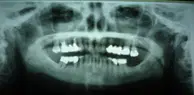
Which of the following is the correct way to position a client for a dental panoramic radiograph?
Have the client position his Curve of Spee perpendicular to the floor
Position the client so that his Frankfort plane is parallel to the floor
Adjust the head of the client so that the mid-sagittal plane is parallel to the floor
Secure the head of the client in a chin-up position
Mr. Leduc, 65 years old, presents with dull, intermittent pain on the maxillary right side of his mouth. He reports sensitivity to hot beverages and to applied pressure. Radiographs reveal a radiolucency at the apex of tooth 17. Which one of the following pathologies is associated with these manifestations?
Periapical abscess on tooth 17
Hypercementosis
Gingival abscess
Periodontal abscess on tooth 17
What is the ideal length of time for the periodontal dressing to remain in place following a free gingival graft surgery?
4 days
7 days
14 days
21 days
Mr. Wyett, 66 years old, presents for his 6 month continuing care appointment. He began taking isoniazid (Laniazid) for the treatment of tuberculosis last week. He also reports a weight loss of 5 kg, night sweats, and a productive cough for the last 2 months. What should the dental hygienist do next?
Provide Mr. Wyett with a preprocedural mouthrinse
Refer Mr. Wyett for a medical evaluation
Postpone Mr. Wyett’s continuing care appointment
Ensure Mr. Wyett has taken his antibiotic premedication
What is the primary objective for developing a periodic chart audit program in the dental office?
Quality assurance
Calibration of auditors
To identify missing signatures
To develop audit plans and goals
The dental hygienist is debriding quadrant 1 on a client with generalized Stage III Grade B periodontitis. The tissue is inflamed around the mesial surface of tooth 14. What anatomical feature should the dental hygienist consider when debriding this area?
Mesial marginal ridge
Mesial developmental depression
Mesial tubercle
Mesio-buccal developmental groove
Mrs. Martin, 35 years old, visits the dental hygienist for the first time in 5 years. Her gingiva is pink, firm, and resilient, and there is an absence of bleeding on probing. The only remarkable observation is that the facial and lingual aspects of interdental papillae, especially in the posterior region, have straight-line cuts that extend from the gingival margin toward the mucogingival junction. Which one of the following reasons is the most likely primary etiological factor for this observation?
The client previously wore fixed orthodontic bands
The client previously had unsuccessful periodontal surgery
The client is not curving the floss around the teeth
The client is forcing the rubber tip into the gingival sulcus
Ms. Rioux, 68 years old, presents with root erosion and sensitivity on the facial surfaces of teeth 25, 26, and 27. She habitually “sucks hard candies” to relieve a dry mouth caused by her prescribed medication. The dental hygienist advises use of sugar-free candies and nightly application of topical fluoride to the sensitive areas. At the continuing care appointment, which one of the following assessment methods should the dental hygienist use to evaluate the success of these recommendations?
Ms. Rioux’s report of her adherence to the recommendations
Clinical observation and the subjective reports of Ms. Rioux
Radiographic assessment of the affected area
Tests for dental caries and periodontal disease activity
What is the benefit of daily oral self care around a dental implant?
Reduces the incidence of gingival recession
Avoids the development of a bacteremia
Prevents inflammation around the site
Accelerates the osseointegration
Which one of the following recommendations should the dental hygienist provide to a client as she is applying a professional topical fluoride?
Avoid swallowing the fluoride
Avoid smoking for a minimum of 60 minutes
Avoid eating and drinking for 2 hours
Avoid brushing and flossing for 6 hours
Mr. Halabisky, 69 years old, received an inferior alveolar nerve block injection prior to periodontal debridement. The chair is returned to the upright position while Mr. Halabisky waits for the anesthetic to take effect. He reports dizziness and a feeling of nausea. The dental hygienist notes that Mr. Halabisky’s face is pale and cold, and he has begun to sweat. What is this client most likely experiencing?
Insulin shock
Angina pectoris
Anaphylactic shock
Early syncope
Mrs. Green, 43 years old, arrives for her initial dental hygiene appointment. The dental hygienist reviews her health history but is having difficulty understanding some of her responses because she uses an electronic speech device for communicating. What should the dental hygienist do to ensure that all relevant information has been obtained?
Repeat the client's responses
Ask the client to write out all of her responses
Contact the client’s physician to validate the history
Observe the client’s non-verbal behavior
Naseep, 17 years old, has developed 4 new carious lesions since his previous 6 month continuing care appointment. What should the dental hygienist include in the care plan for Naseep?
Recommend having the water supply tested for fluoride content
Conduct a dietary analysis
Consult Naseep’s mother about his oral self care
Recommend a daily essential oil mouthrinse
Kara, a recently graduated dental hygienist, is uncertain about how to maintain the slow speed handpiece, which is at least 6 years old, in her new practice. How should Kara proceed?
Refer to the manufacturer’s specifications
Take a continuing education course of equipment maintenance
Use the same procedure she used at school
Consult the office procedural manual
A supervisor of a local shelter for homeless men has requested assistance in promoting oral health care. The dental hygienist determines that a team of volunteer nurses works at the shelter for a total of 6 hours per week and that a fund of $100 is available for this project. Which one of the following actions by the dental hygienist would best address the supervisor’s request?
Purchase oral hygiene supplies for distribution to the clients
Teach the nurses to provide oral hygiene education to the clients
Distribute information on oral self care and lists of offices providing lower-cost dental services
Teach the nurses to provide oral hygiene education and to distribute supplies to the clients
Mr. Pelletier, 85 years old, has mild hypertension and reports dental sensitivity in sextant 1, requiring the use of local anesthesia. What should the dental hygienist do prior to periodontal debridement?
Take Mr. Pelletier’s blood pressure
Ensure antibiotic premedication
Obtain medical clearance
Place Mr. Pelletier in a semi-supine position
Kelly, 14 years old, presents with congenitally missing maxillary lateral incisors. What type of dental anomaly does Kelly exhibit?
Mesiodens
Microdontia
Hypodontia
Anodontia
In a rural school, the dental hygienist has set up portable dental equipment in a basement classroom to provide dental hygiene care for all students. James, 13 years old, has spina bifida and uses a wheelchair with a back brace. There is no wheelchair access to the basement. What should the dental hygienist do to ensure James receives dental hygiene care?
Inform James' parents that because of the lack of wheelchair access to the equipment, he will be referred for dental hygiene care
Arrange with the school administration to move the portable equipment upstairs and treat James while he is seated in his wheelchair
Enlist the help of the teachers to carry James downstairs in his wheelchair, and treat him in his wheelchair
Arrange with the school administration to move the portable equipment upstairs and treat him in the dental chair
Dawn, 15 years old, inquires about pit and fissure sealants. Which one of the following factors should the dental hygienist identify as the most important criterion for determining the need for sealants?
The client’s age
The amount of dental biofilm
History of carious lesions
Current exposure to fluoride

When assessing the radiograph, what conclusion can be drawn?
Bone loss
Fractured implant
Apical radiolucency
Over-contoured crown margin
Mrs. Ng, 67 years old, has been diagnosed with osteoporosis. She smokes, drinks coffee and alcohol, and wears a partial mandibular denture. What should the dental hygienist expect to find upon examining Mrs. Ng?
Bleeding on probing
Residual ridge resorption
Dentinal hypersensitivity
Enlarged masseter muscles
Mr. Carney, 66 years old, is visually impaired and has a guide dog. What should the dental hygienist do regarding the guide dog during Mr. Carney's continuing care appointment?
Ask Mr. Carney where the dog should stay
Ask the receptionist to hold the dog
Leave the dog outside the clinic
Place the dog in a separate room
Mr. Mendon, 21 years old, presents with gingival hyperplasia and minimal dental biofilm. He has end-stage renal disease and received a kidney transplant in the last year. What information should the dental hygienist consider with respect to Mr. Mendon’s drug therapy?
Phenytoin (Dilantin) causes generalized overgrowth of gingiva
Acetylsalicylic Acid (Aspirin) causes inflammation and tissue bleeding
Warfarin (Coumadin) causes generalized fibrosis and tissue overgrowth
Cyclosporine (Neoral) stimulates diffuse, firm, fibrous overgrowth of gingiva
Mr. Watson, 66 years old, presents with an upper respiratory infection and a history of emphysema. Which of the following actions should the dental hygienist take?
Consult with the dentist regarding Mr. Watson’s use of premedication
Refrain from treating Mr. Watson and reschedule his appointment
Use an ultrasonic scaler to shorten Mr. Watson’s appointment
Recommend the use of nitrous oxide to reduce Mr. Watson’s stress
Ms. Jones, 44 years old, contacted the dental office the day after she received an inferior alveolar nerve block for periodontal debridement in quadrant 4. She reports jaw pain and cannot open her mouth without discomfort. What instructions are best to provide to Ms. Jones?
Have the client come in for an assessment and refrain from providing any management recommendations over the phone
Advise the client to apply cold compresses several times a day and to take muscle relaxants for 3 days
Have the client come in for an assessment, recommend heat therapy every hour, and suggest that she take analgesics and muscle relaxants
Advise the client to apply hot and cold compresses intermittently every 1-2 hours and to take analgesics every 4 hours
The dental hygienist suggests to 5 years old Yin and his mother that his teeth be brushed twice daily. The dental hygienist provides them with a colorful calendar to record Yin’s tooth brushing frequency. What learning principle is the dental hygienist using to help Yim learn a new oral self care technique?
Physiological readiness is required for learning
Motivation is essential for behavior modification
What is learned depends on what is understood
An individual learns what is actually used
Sasha, 16 years old, presents for her initial dental hygiene appointment. Radiographs reveal crestal bone between teeth 26 and 27 is 4 mm apical to the cementoenamel junction (CEJ). The crestal bone between teeth 11 and 21 is 4 mm apical to the CEJ and 2 mm between teeth 46 and 47. What should Sasha’s periodontal status?
Molar/Incisor pattern periodontitis, Stage II Grade C
Generalized plaque-induced gingivitis
Generalized Stage III Grade B periodontitis
Generalized puberty-associated gingivitis
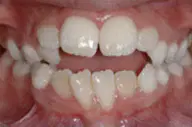
Which one of the following parafunctional habits should be documented in this child's chart?
Bruxism
Tongue thrusting
Clenching
Pencil chewing
In keeping with infection prevention protocols, how should the dental hygienist deal with the dental unit light handles?
Wipe clean twice with an alcohol soaked gauze square
Scrub with a glutaraldehyde solution
Treat with an approved chemical disinfectant
Clean the entire surface with a sanitizer
A client reports that he has avoided dental hygiene care for the past 10 years because he felt the previous dental hygienist was critical on his oral self care practices. The dental hygienist has completed the assessment phase of dental hygiene care. What is the best indicator that the client is satisfied with his care?
He compliments the dental hygienist
He admits his oral health is inadequate
He agrees to begin flossing his teeth
He returns for a second appointment
After locating the infraorbital foramen, what steps should the dental hygienist take to prepare for the insertion and deposition of local anesthetic for an infraorbital nerve block?
Position the syringe parallel to the long axis of the first premolar and deposit 0.9 - 1.2 mL for 30 - 45 seconds
Position the syringe parallel to the long axis of the first premolar and deposit 0.6 - 0.8 mL for 2 minutes
Position the syringe parallel to the long axis of the maxillary canine and deposit 0.9 - 1.2 mL for 30 - 45 seconds
Position the syringe parallel to the long axis of the maxillary canine and deposit 0.6 - 0.8 mL for 2 minutes
Ms. Raven, 20 years old, is a new client. She states her primary concern is, “after 3 years of wearing braces in my teens, my lower front teeth have moved and are now crowded again”. What is the most likely explanation for Ms. Raven’s current crowding?
Orthodontic treatment commonly creates post-treatment bruxism
Genetic tendencies often results in a relapse of the anterior sextant
Mandibular growth post-treatment can lead to altered tooth positioning
Post treatment retention therapy was not followed
Ms. Gardner, 40 years old, was recently involved in a motor vehicle collision which resulted in a severely fractured right arm, fractured ribs and paralysis on the left side of her body. Ms. Gardner is still very motivated to maintain good oral health, and requests the dental hygienist’s help in redesigning her oral self care regimen. What is the best course of action for the dental hygienist to take when developing Ms. Gardner’s oral self care plan?
Consult with other members of Ms. Gardner’s health care team to determine her range of motion and fine motor skills
Review the literature on these types of injuries to ensure that continued upper body movement will not exacerbate her injuries
Have Ms. Gardner demonstrate the modified Bass toothbrushing stroke to determine her ability to achieve optimum oral health
Assess Ms. Gardner’s willingness to have a caregiver assist with her oral self care regimen
Cara, 17 years old, has been late for five appointments. When Cara arrives, she says to the dental hygienist, “I don’t want any lectures about flossing!” The Bleeding Points Index indicates a total of 20 bleeding points. How should the dental hygienist record this information in the chart?
“Cara is confrontational and is non-receptive to oral hygiene education”
“Cara arrived late and has been non-adherent with oral hygiene instruction”
“Cara was late five times and has poor oral hygiene”
“Cara is uncooperative and her parents will be notified”
Diagnostic tests reveal that Mr. Lindsay, 73 years old, has a predominance of gram-negative bacteria in his periodontal pockets. What conclusion should the dental hygienist draw?
Mr. Lindsay likely has high levels of endotoxins in his periodontal pockets
The bacteria are likely to cause the destruction of exotoxins in Mr. Lindsay’s subgingival area
The bacteria are obtained within the subgingival area, and invasion into Mr. Lindsay’s connective tissue is unlikely
Mr. Lindsay’s fibroblasts will likely produce chemotactic factors to attract lymphocytes and macrophages
What instrumentation criterion needs to be followed when using a power driven scaler?
Maintain an intraoral fulcrum close to the working area
Use the highest power setting on heavy subgingival deposits
Use a tight modified pen grasp on the handpiece
Move the tip continuously over the root surfaces
When requiring local anesthesia for periodontal debridement of the maxillary right posterior sextant, which of the following nerves will need to be anesthetized?
Middle superior alveolar nerve, infraorbital nerve, and greater palatine nerve
Nasopalatine nerve, lesser palatine nerve, and middle superior alveolar nerve
Greater palatine nerve, posterior superior alveolar nerve, and middle superior alveolar nerve
Posterior superior alveolar nerve, infraorbital nerve, and lesser palatine nerve
At the previous 4 month continuing care appointment, the dental hygienist recommended the use of a powered toothbrush for 66 year old Mrs. Louks. Which one of the following measures should indicate the success of this intervention?
A reduction in the dental biofilm score
Reported increased frequency of toothbrushing
No increase in gingival recession
Client satisfaction with ease of use
Mrs. Stokich, 53 years old, presents for her 6 month continuing care appointment. She informed the dental hygienist that she resumed her smoking habit to “calm her nerves” following her husband’s recent dearth. Mrs. Stokich’s periodontal status has worsened. What is most important for the dental hygienist to discuss with Mrs. Stokich?
A periodontal referral
Smoking cessation
Shortening the continuing care interval
Complete periodontal debridement
The dental hygienist has taken a periapical radiograph of the maxillary canine on a client presenting with a large palatine torus. Upon viewing the film, the dental hygienist notes the teeth appear shortened with blunted roots. Still using the paralleling technique, how should the dental hygienist correct this error?
Position the film closer to the tooth and use a number 2 size film
Direct the horizontal angulation more anterior and use a number 2 size film
Decrease the vertical angulation and use a number 1 size film
Increase the vertical angulation and use a number 1 size film
Mrs. Isselhardt, 27 years old, is 4 months pregnant. The dental hygienist notes a soft, deep red, pedunculated, 4x4 mm mass with a shiny surface on the buccal gingiva between teeth 12 and 13. Which one of the following terms best describes this condition?
Pyogenic granuloma
Papillary hyperplasia
Localized pregnancy gingivitis
Central giant cell granuloma

What landmark is located inferior to the apices of teeth 31 and 41 and shows on the following periapical radiograph as a circular radiopacity?
Sclerotic bone
Genial tubercles
Lingual foramen
Mandibular symphysis
What is the most likely to lead to improved oral self care for the average 15 year old male client?
His parents’ oral self care behaviors
His knowledge of periodontal diseases
His desire for improved appearance
His ability to self-actualize
What part of the curet is the best indicator of appropriate blade adaptation and angulation for subgingival debridement?
The cutting edge
The handle
The toe
The terminal shank
Ms. Vernino, 52 years old, presents for her 6 months continuing care appointment. She states she has had a recurrence of breast cancer and is currently undergoing chemotherapy. Which one of the following reasons would be grounds for the dental hygienist to postpone periodontal debridement?
Alopecia
Immune system suppression
Gastrointestinal reactions
Osteoradionecrosis
Randy, 14 years old, participates in many sports. He has a sports mouthguard, but his mother reports that he seldom wears it. She asks the dental hygienist to convince Randy to use it. Which one of the following strategies would be most effective in this situation?
Suggest that Randy’s mother discuss the problem with her son’s sports coach
Inform Randy of the number of oral injuries that occur from athletic activities
Show random a video on the proper use of sports mouthguards
Provide Randy with examples of famous athletes and peers who wear sport mouthguards
What professionally applied topical fluoride is recommended for a client with porcelain crowns?
Acidulated phosphate fluoride
Stannous fluoride
Neutral sodium fluoride
Sodium monofluorophosphate
In order to obtain informed consent, what information is the most important to provide to the client prior to proceeding with treatment?
Details of the procedure codes planned for each appointments
Information about the proposed and alternative treatments
The costs and benefits of proceeding with the care as planned
The dental hygiene prognosis of the client's periodontal condition
What assessment finding could be indicative of a parafunctional habit?
Dental erosion
Narrowing of the periodontal ligament space
High dental caries index
Temporomandibular joint discomfort
Ms. Hertzel, 38 years old, reports recurring sensitivity following initial desensitizing therapy. What should the dental hygienist do next?
Refer her for root canal therapy
Reapply the desensitizing agent
Expose a bitewing radiograph
Refer her for cervical bonding
A dental hygienist documents a white lesion on the buccal mucosa next to tooth 46. The client states that this tooth has been very painful for the last 2 weeks. What is the most likely cause of the lesion?
Acetylsalicylic Acid (Aspirin) directly on the area
Heavy smoking on a daily basis
Spit tobacco in the left vestibule
Chronic cheek biting
Following administration of a posterior superior alveolar injection, the dental hygienist notices the formation of a hematoma at the injection site. What is the most likely cause of this complication?
Insertion of a long needle into the cavernous sinus
Single aspiration prior to deposition of a solution
Insertion of the needle into the parotid gland
Insertion of the needle into the pterygoid plexus
A client has recently been diagnosed with hepatitis C. Which one of the following systemic functions will be compromised for this client?
Vitamin A production
Detoxification of wastes
Production of red blood cells
Synthesis of steroid hormones
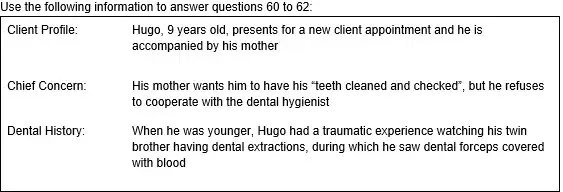
The mother discusses her son’s favorite treats with the dental hygienist. Which one of the following items poses the greatest risk for dental caries for Hugo?
125 mL of unsweetened apple juice
A piece of chewing gum
A honey sandwich
250 mL of chocolate milk

Which of the following is an appropriate strategy for encouraging a child to cooperate during a dental appointment?
Administer a mild sedative to relax him throughout the entire appointment
Tell him that he can pick a prize at the end of the appointment if he behaves
Allow him to play a video game while receiving dental hygiene care
Have him watch another child being treated, who is praised and rewarded for being cooperative
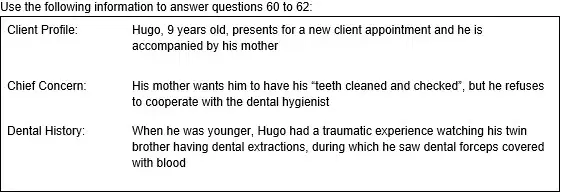
The dental hygienist determines that Hugo could benefit from improved dental biofilm control. What strategy should the dental hygienist use?
Observe his tooth brushing technique, making changes as necessary and provide positive reinforcement
Use a mirror to show him a sample of his dental biofilm and then demonstrate how to remove it using a model
Demonstrate the Fones toothbrushing technique using a model and explain the consequences of dental biofilm
Provide him with a children’s book on toothbrushing methods along with a toothbrush and disclosing tablets

What is the most likely cause of Brittany’s reported dental sensitivity?
Leaking amalgam restorations
Chemical irritation
Antidepressant drug therapy
Exposed root surfaces
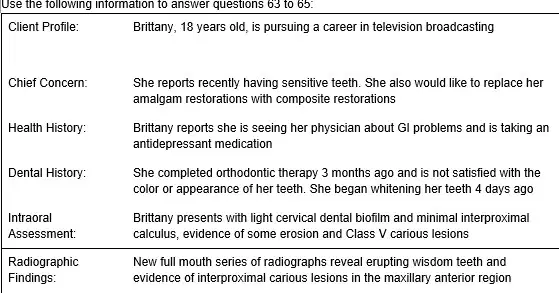
What question should the dental hygienist ask Brittany about her antidepressant drug therapy?
Do you experience bleeding gums?
Do you take your medication with food?
Do you experience dry mouth?
Do you experience sleep difficulties?
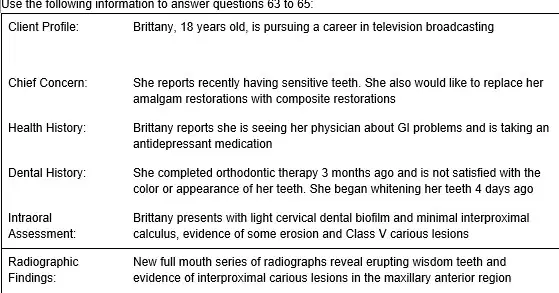
What is the most likely cause of Brittany’s intraoral assessment findings?
Antidepressant drug therapy
Bulimia
Gastroesophageal reflux disease
Anorexia nervosa
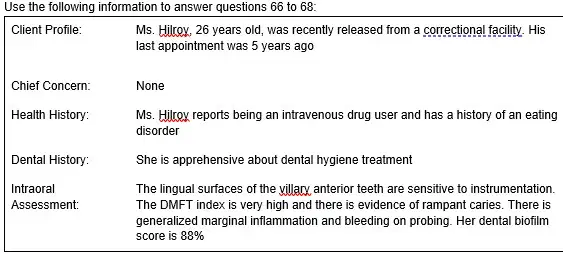
Based on the epidemiology statistics, Ms. Hilroy is at highest risk for what disease?
Influenza
Hepatitis B
Tuberculosis
Herpes zoster
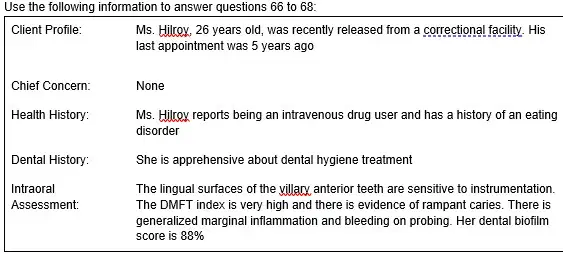
What dental material is the best choice to treat Ms. Hilroy’s Class V carious lesions?
Zinc oxide eugenol
Amalgam
Glass ionomer
Zinc phosphate
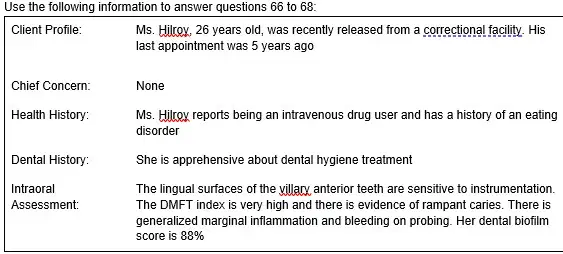
Twenty-four hours after the initial assessment and oral self care instruction, Ms. Hilroy presents with multiple painful oral lesions. What is the most likely cause of these oral manifestations?
Aggressive tooth brushing
Reactivation of herpes labialis
Oral candidiasis
Type III hypersensitivity
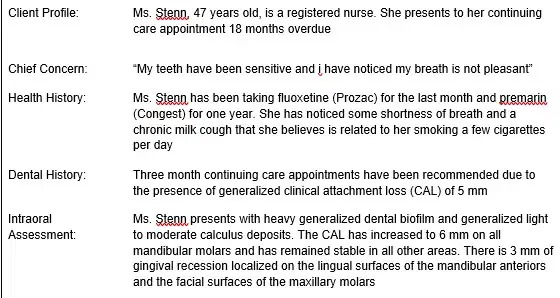
What is the clinical attachment level of the facial aspect of tooth 16?
3 mm
5 mm
8 mm
9 mm
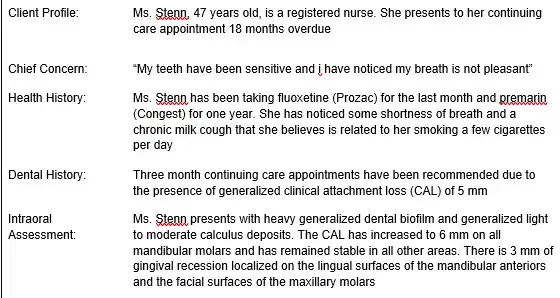
While debriding the areas of furcation involvement, what principle of positioning should take priority?
The dental hygienist maintains a neutral body position to reduce strain
The client’s chin is raised to provide easier access to the areas
The dental light is positioned close to the oral cavity for optimum illumination
The dental hygienist maintains the 12 o’clock position to provide the best visibility
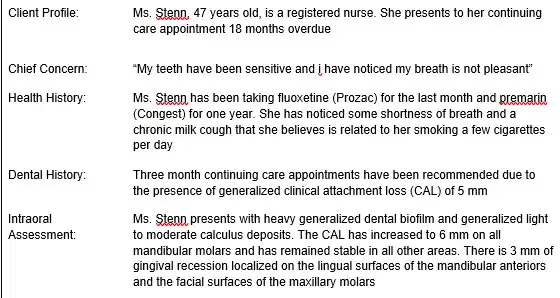
Ms. Stenn’s dental hygiene care plan included oral self care instruction, ultrasonic and hand debridement, selective coronal polish, and desensitizing treatment with fluoride varnish. She has been placed on a 3 month continuing care interval. What is missing from this dental hygiene care plan?
Professional subgingival irrigation
Topical tray fluoride application
Dietary supplements to address halitosis
Tobacco use cessation strategies
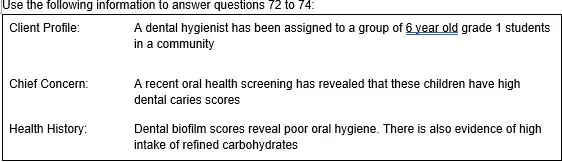
What is a prime example of promoting wellness through healthy public policy with this target population?
Refer clients to a local pedodontist
Lobby for healthy snack options in vending machines
Introduce a school flossing program
Provide dental sealants for all students
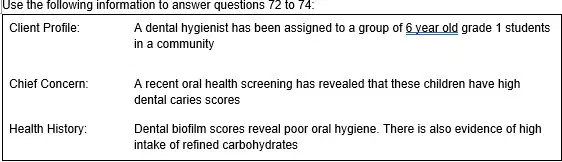
What is the major barrier when implementing a weekly fluoride mouthrinse program in school for this target group?
Running water
Time constraints
Funding availability
Parental supervision
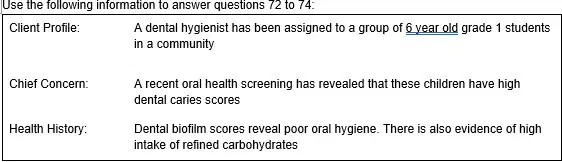
What must be considered when planning oral self care instruction for this target group?
Use correct dental terminology
Communicate mainly through verbal presentation
Use concrete demonstrations of key points
Emphasize correct tooth brushing technique

