
 Worksheets
Electronic Components and IC Definition
Total questions: 30
Worksheet time: 15mins

Which device is classified as an active component in electronics?
Bipolar junction transistor
Ferrite core inductor
Carbon film resistor
Ceramic disc capacitor
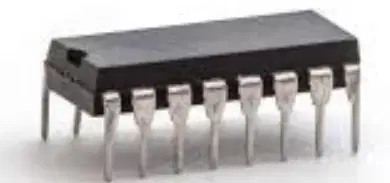
Choose all statements that accurately describe an integrated circuit.
It is a small electronic device
It combines many components on one chip
It is fabricated on semiconductor material
It is a standalone mechanical assembly
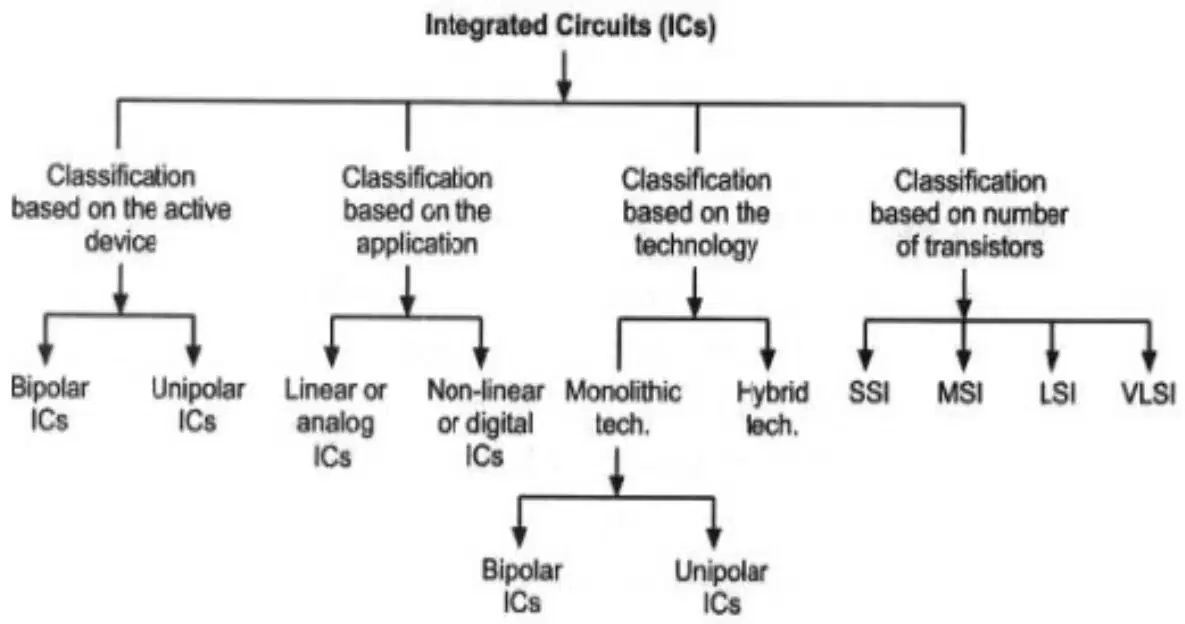
Arrange the transistor-count families from smallest to largest integration level.
MSI, SSI, LSI, VLSI
SSI, MSI, LSI, VLSI
VLSI, LSI, MSI, SSI
LSI, MSI, SSI, VLSI
Which statement best distinguishes digital ICs from linear ICs?
Digital ICs are only SSI; linear ICs are only VLSI
Digital ICs use two-state logic; linear ICs use continuous-range signals
Digital ICs rely on unipolar devices; linear ICs rely on bipolar devices
Digital ICs process continuous values; linear ICs process discrete states
Which statement best explains miniaturization achieved by integrated circuits?
Using larger discrete resistors shrinks overall board footprint
Replacing chips with mechanical relays makes products thinner
Packing many components onto one chip reduces device size
Adding external wiring allows components to be spread out compactly
Which combination directly contributes to the lower cost of integrated circuits?
Use of bulky discrete components across designs
Custom wiring harnesses for every device line
Mass production with standardized chip fabrication
Hand-soldered assembly with unique parts per board
Which factor primarily lowers power consumption in many modern ICs?
External heat sinks directly cut dynamic power
Longer interconnects dissipate less energy overall
High-voltage bipolar designs reduce leakage losses
CMOS and MOS technologies minimize switching power
What enables integrated circuits to operate at high speed?
Signals travel microscopic distances within the chip
Signals traverse long cables between modules
Large heat sinks increase electron drift velocity
Mechanical relays switch faster than transistors
Which practical maintenance benefit is associated with integrated circuits?
Easy replacement due to modular chip packages
Frequent re-soldering to fix loose connections
Routine rewiring of long signal paths
Regular mechanical relay upgrades for speed
Which statement best describes the influence of DC characteristics in an op-amp?
They improve common-mode rejection at AC
They control slew rate under transients
They determine steady-state output levels only
They set small-signal bandwidth and phase
In small-signal sinusoidal operation, which parameters primarily define an op-amp’s AC behavior?
Input bias current drift
Common-mode rejection ratio (CMRR)
Slew rate limiting
Frequency response of the amplifier
DC offset voltage
A designer increases the required signal frequency well beyond the op-amp’s specified limit. What outcome is most likely?
Reduced gain and phase distortion appear
Improved steady-state DC accuracy
Higher CMRR at all frequencies
Unlimited slew rate and perfect waveform
An ideal op-amp is described as having infinite bandwidth. What does this imply about its open-loop gain across frequencies?
Gain remains constant from DC to radio
Gain peaks at mid-audio frequencies only
Gain increases with higher radio frequencies
Gain drops rapidly beyond audio frequencies
In practical op-amps, what primarily causes gain to decrease at higher frequencies?
Inductance of power supply leads
Thermal noise in feedback resistors
Purely resistive loading effects
Internal and parasitic capacitances
Which statement best characterizes the high-frequency behavior of real op-amps?
They operate as a high-pass amplifier
They act as an ideal band-pass filter
They maintain flat gain at all frequencies
They behave like a low-pass filter
What term is used to describe the reduction in op-amp gain as frequency increases?
Gain peaking
Bandwidth expansion
Frequency roll-off
Phase flattening
At low frequencies, how does a practical op-amp’s gain compare to its gain at high frequencies?
Zero at low, finite at high frequencies
Much higher at low frequencies
Approximately the same everywhere
Lower at low than high frequencies
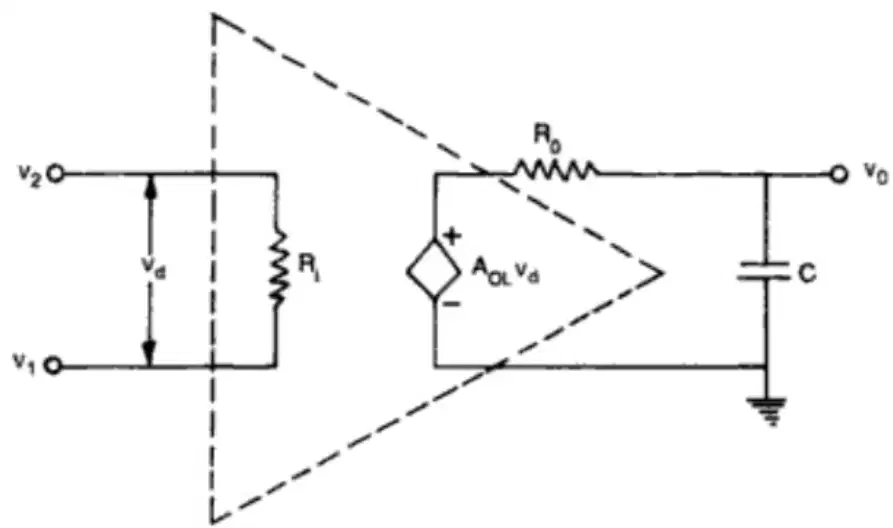
In the high-frequency op-amp model shown, what element primarily sets the dominant pole that limits open-loop bandwidth?
Dependent source A_OL alone
Shunt capacitance C to ground
Output resistance Ro alone
Input differential resistor R1
Given f1 = 1/(2π R_o C), which change increases the corner frequency?
Increase C value
Increase R_o value
Decrease C value
Add series resistor with C
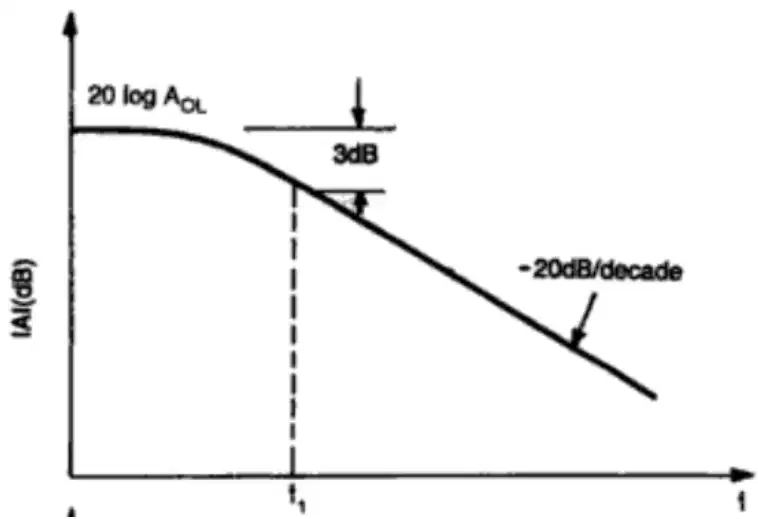
At frequencies much lower than f1, how does the Bode magnitude behave?
Falls at −20 dB/decade
Oscillates around 0 dB
Rises at +20 dB/decade
Constant near 20 log A_OL
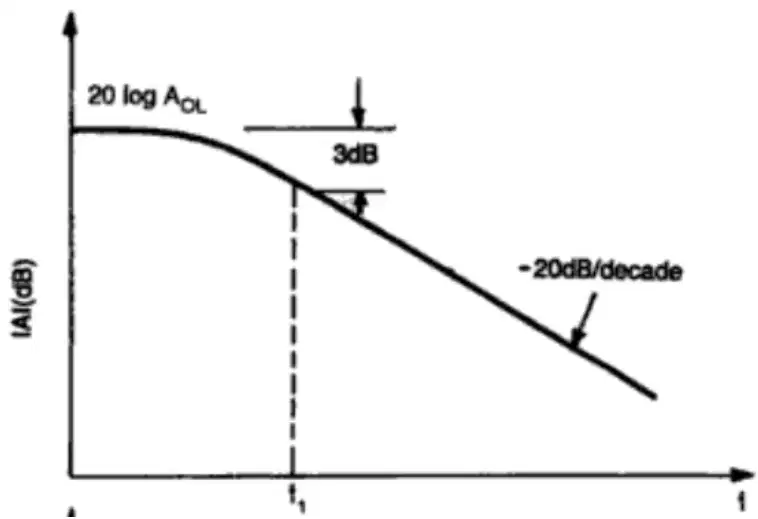
Past the corner frequency f1, the asymptotic slope of the magnitude plot becomes:
+20 dB/decade
0 dB/decade
−20 dB/decade
−40 dB/decade
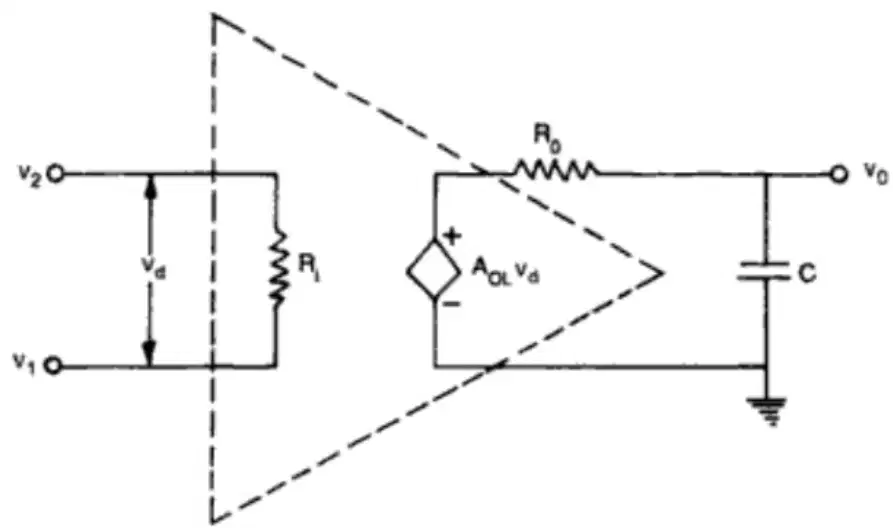
In the model diagram, v_d represents:
Differential input voltage v2−v1
Output voltage across Ro
Common-mode input voltage v2+v1
Voltage across capacitor C
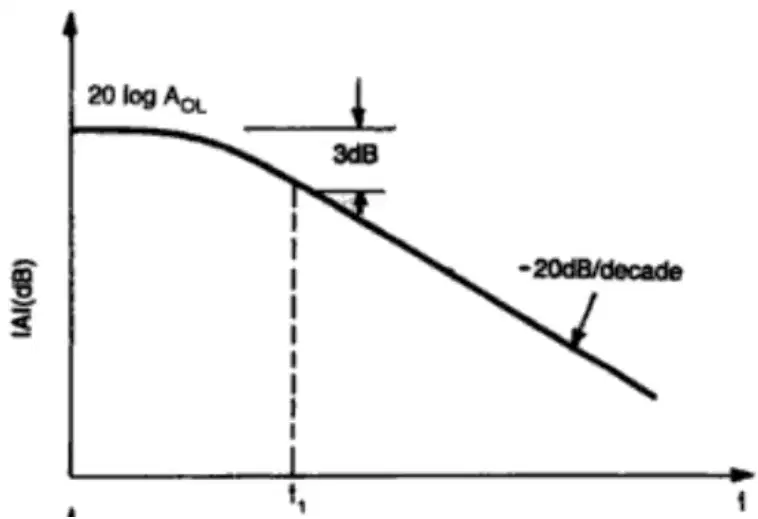
Which expression gives the −3 dB point for the single-pole op-amp open-loop response?
f = √2 f1
f = 2 f1
f = f1
f = f1/2
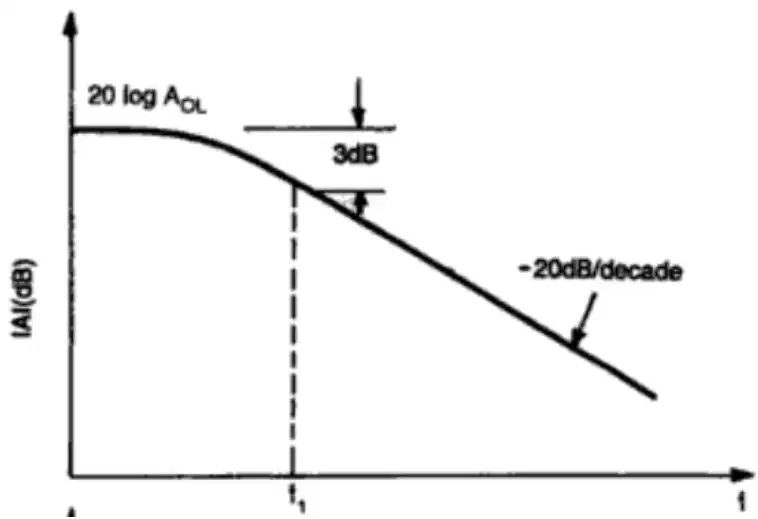
If A_OL is the low-frequency open-loop gain, what does 20 log A_OL denote on the Bode plot?
Noise floor level
Phase at DC
Magnitude in dB at DC
Bandwidth in kHz
For an op-amp with R_o = 2 kΩ and C = 10 nF, estimate f1.
About 8 Hz
About 8 kHz
About 80 Hz
About 80 kHz
Which statements are true for a single-pole open-loop model?
Corner frequency decreases when C increases
Magnitude drops −20 dB/decade beyond f1
Phase shift approaches −90° at high f
Gain equals A_OL at all frequencies
What does frequency limitation imply for an op-amp’s gain behavior across frequency?
Gain stays constant over all frequencies
Gain is zero beyond the cutoff frequency
Gain is constant within a limited band only
Gain increases indefinitely with frequency
Which physical factor directly causes the op-amp’s output to change no faster than a certain rate?
Thermal noise in resistors
Slew rate limitation of output
Internal capacitances in stages
Finite carrier transit time
Select all phenomena that contribute to finite bandwidth and gain roll-off in op-amps.
Internal capacitances within the amplifier
Finite transit time of charge carriers
Slew rate limitation under large signals
Ideal infinite open-loop gain of op-amps
When operating at high frequencies, why does an op-amp’s gain decrease rather than remain flat?
External wiring inductance dominates behavior
Internal capacitances and carrier transit limits
Perfect feedback cancels dynamic effects
Biasing networks boost high-frequency gain

