
 Worksheets
S1 Final Test
Total questions: 50
Worksheet time: 25mins
Who should you tell if an accident happens in the lab?
Your friend
The principal
Your parents
A teacher
Where should electrical equipment be kept away from?
Chemicals
Water
Heat
Fire
Who is responsible for cleaning their area when done?
The teacher
The lab assistant
The janitor
Everyone
In an experiment about how much water affects plant growth, what could be the independent variable?
The amount of water each plant gets
The temperature of the environment
The height of the plants
The type of soil used
What does the independent variable represent in an experiment?
The variable that is not measured
The constant factor in the experiment
The cause or reason for an outcome
The outcome of the experiment
What is the dependent variable in an experiment?
The variable that is being changed
The variable that is used as a control
The variable that is being measured or tested
The variable that is not affected by other variables
What is a controlled variable?
A variable that is not used in the experiment
A variable that is changed during the experiment
A variable that is kept the same during the experiment and is not part of the experiment
A variable that is measured during the experiment
When experimenting with the growth of a plant, a scientist uses three of the same type of plants, two different fertilizers, equal light, and equal water. What type of variable is the fertilizer?
Dependent
Control
Independent
Compound
What are viruses?
Large organisms that can live independently
Non-living particles that do not need a host
Tiny infectious agents that can only multiply inside a host
Bacteria that can multiply on their own
What are bacteria?
Multi-celled organisms that rely on a host
Single-celled organisms that do not rely on a host
Multi-celled organisms that do not rely on a host
Single-celled organisms that rely on a host
What type of organisms are yeasts and molds?
Viruses
Bacteria
Algae
Fungi
What is an example of a microorganism?
Tree
Elephant
Rock
Bacterium
Which of the following is sometimes classified as a microorganism, even though it is not considered a living organism?
Animal
Fungus
Plant
Virus
What is the incubation period?
The time when a person is contagious
The time between contact and onset of illness
The time after recovery from illness
The time when symptoms are most severe
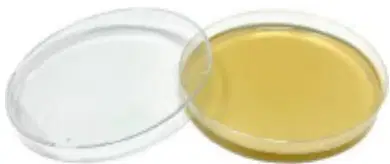
What is agar?
A type of bacteria
A gelatinous substance that provides the proper nutritional environment for microorganisms
A chemical used to kill microorganisms
A type of virus
What is the primary use of a Tryptic Soy Agar plate?
To grow bacteria
To store chemicals
To measure temperature
To grow plants
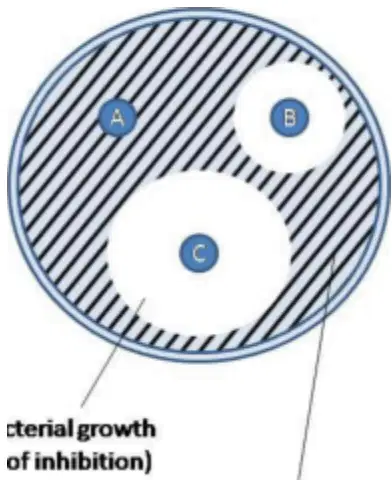
What does the shaded area around the antibiotic disks represent in the diagram?
Area of decreased temperature
Area of increased bacterial growth
Zone of nutrient concentration
Zone of inhibition
Bacteria, viruses, fungi, and protists have a bad reputation because of the diseases they cause, the food they rot, and the bad odors they create, even though most types cause no harm to living things. One type is an exception. It is non-living and can only reproduce by hurting its host. Which one of these groups is a non-living agent of disease?
Viruses
Protists
Bacteria
Fungi
Match the definition with the correct vocabulary word.
microorganisms
Microscopic living organisms such as bacteria and fungi
bacteria
Single-celled organisms that do not rely on a host
virus
Tiny infectious agents that can only multiply inside a host
A person is running a race. Which of the following will happen to their vital signs as they’re running?
Blood pressure will decrease, pulse will decrease, respiratory rate will decrease
Blood pressure will increase, pulse will decrease, respiratory rate will increase
Blood pressure will increase, pulse will increase, respiratory rate will increase
Blood pressure will decrease, pulse will increase, respiratory rate will increase

A group of students performed an experiment to test whether performing yoga breaths affects heart rate. They first measured their heart rates while resting and then again while performing yoga breaths. They recorded their measurements and repeated the experiment three times. Their results are shown in Table 1. What is the conclusion of this experiment?
The experiment was inconclusive.
Performing yoga breaths has no effect on heart rate.
Performing yoga breaths reduces heart rate.
Performing yoga breaths increases heart rate.
This microorganism causes the common cold, can only multiply when inside a human host, is too small to be seen with school microscopes, and has the ability to mutate or change. What type of disease agent is this microorganism?
Fungus
Virus
Bacteria
Which part of the nervous system includes nerves and is not part of the brain and spinal cord?
Central nervous system (CNS)
Peripheral nervous system (PNS)
Sensory neurons
Motor neurons
Which part of the nervous system includes the brain and spinal cord?
Sensory neurons
Central nervous system (CNS)
Neurons
Peripheral nervous system (PNS)
What is a bundle of neurons called?
Nerves
Dendrite
Synapse
Myelin
Which type of neurons are responsible for receiving external stimuli from the environment?
Dendrites
Motor neurons
Neurotransmitters
Sensory neurons
What is the function of motor neurons?
To cushion the brain and spinal cord
To receive signals from the environment
To pass signals from the brain or spinal cord to a muscle or gland
To increase the speed of signal travel
What is a neuron?
A clear liquid surrounding the brain
A gap between branches of neurons
A nerve cell that sends signals or transmits nerve impulses
A fatty substance surrounding the axon
A dendrite is which of the following? Choose from the below words: A branch extending from a neuron, A fatty substance surrounding the axon, A gap between neurons, A type of neurotransmitter.
A branch extending from a neuron
A fatty substance surrounding the axon
A gap between neurons
A type of neurotransmitter
What is a synapse?
A gap between neurons
A type of neurotransmitter
A nerve cell
A bundle of neurons
What is the role of neurotransmitters?
To increase the speed of signal travel
To cushion the brain and spinal cord
To receive signals from the environment
To assist in passing a signal through the synapse
What is Cerebrospinal Spinal Fluid (CSF)?
A gap between neurons
A fatty substance surrounding the axon
A type of neuron
A clear, colorless liquid surrounding the brain and spinal cord
Match the descriptions with their corresponding functions.
Corpus callosum
Connects the left and right brain hemispheres
Cerebellum
Coordinates muscular activity
CT scan
Scans the head from multiple angles
MRI
Uses magnetic fields to create images
What is the function of the cerebellum?
To connect the brain hemispheres
To interpret medical images
To coordinate and regulate muscular activity
To form the spinal cord
Which part of the brain is responsible for sensing touch and spatial processing?
Olfactory bulbs
Occipital lobes
Auditory cortex
Parietal lobes
What is the primary role of the occipital lobes?
Transmitting input signals from the retina
Processing smells
Initiating voluntary movement
Visual perception
What is the function of the hypothalamus in the brain?
It relays sensory information and acts as a center for pain perception.
It is responsible for voluntary muscle movements.
It coordinates the autonomic nervous system and controls body temperature, thirst, and hunger.
It serves as the primary gland for the body, producing several hormones.
Which part of the brain relays sensory information and acts as a center for pain perception?
Cerebellum
Hypothalamus
Thalamus
Pituitary gland
What is the primary function of the pituitary gland?
It relays sensory information.
It serves as the primary gland for the body, producing several hormones.
It controls voluntary muscle movements.
It coordinates sleep and emotional activity.
What are neurons primarily responsible for?
Producing hormones
Storing energy
Attaching muscles to bones
Communicating with each other at specialized junctions called synapses
What is the role of dendrites in a neuron?
To receive signals from other neurons
To produce energy for the neuron
To store genetic information
To transmit signals away from the cell body
____ neurons carry messages to the central nervous system.
Fun
Sensory
Motor
Inter
____ neurons carry messages away from the central nervous system.
Inter
Motor
Flower
Sensory
Which lobe controls the sense of hearing and memories?
Temporal
Occipital
Parietal
Frontal
The cerebellum controls…
Personality and feelings
Movement and balance
Heartbeat and breathing
Sight
What is a tumor?
An abnormal growth of tissue
A type of brain scan
A medical imaging professional
A part of the brain
Which lobe controls the sense of hearing and memories?
Temporal
Occipital
Parietal
Frontal
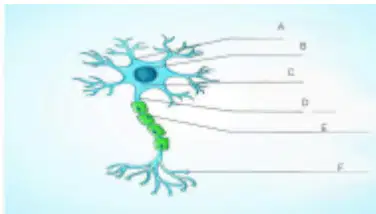
Correctly label the parts of the neuron shown in the diagram by matching each lettered label to its part name.
A
Myelin sheath
B
Axon
C
Dendrite
D
Cell body
E
Nucleus
What should you always follow when completing a lab, especially with chemicals?
your insticts
teacher directions
The internet
your friends advice
What should you do if you break glass in the lab?
Tell a teacher
Pick it up yourself
Leave it there
Sweep it up

