
Font size
 Worksheets
India’s Achievements, Challenges, and Development Aspirations
Total questions: 82
Worksheet time: 41mins
Which statement best captures India’s economic trajectory since independence?
Rapid growth with steady poverty increase
Rebuilt economy and sustained GDP growth
Stable GDP with minimal structural change
Declining GDP share and rising inequality only
What does the India@2047 Vision primarily aim for?
Becoming a Developed Nation status
Eliminating all external debt completely
Doubling services exports annually
Achieving net-zero agriculture emissions
Which initiative is linked to improving public infrastructure and inclusion?
GST rollout and corporate tax cuts
Make in India and FDI liberalization
Swachh Bharat Mission and Aadhaar
Startup India and Atal Innovation
Which concept measures overlapping deprivations beyond income, such as health, education, and living standards?
Multidimensional Poverty
Purchasing Power Parity
Human Development Index
Gini Coefficient
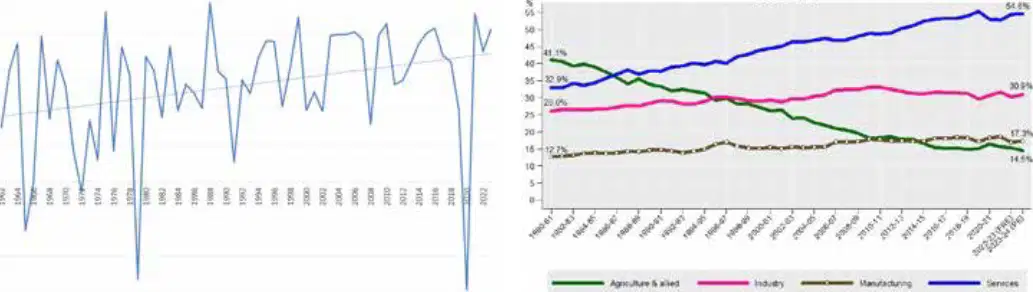
Identify the sector with the largest share in India’s GDP as depicted in the line chart.
Construction and real estate
Services and trade
Manufacturing and industry
Agriculture and allied activities
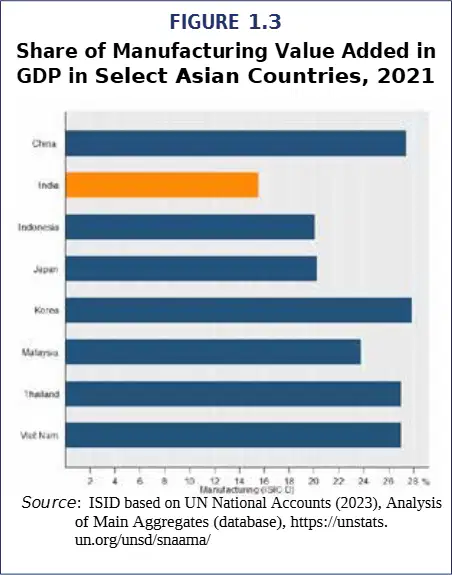
In 2021, India’s Manufacturing Value Added (MVA) share in GDP is closest to which range among Asian peers?
Above 40 percent of GDP
Below 10 percent of GDP
Around 30 percent of GDP
Around 17 percent of GDP
Which scenario best illustrates ‘jobless growth’ in India?
GDP rises while formal jobs stagnate
Agriculture jobs expand rapidly
GDP falls while wages increase
Employment rises faster than GDP
Why does neglecting manufacturing impose a significant cost on job creation?
Manufacturing generates the fewest indirect jobs
Manufacturing lacks forward market linkages
Manufacturing offers extensive indirect job linkages
Manufacturing only creates public sector jobs
Match each term to its best description.
Manufacturing Value Added
Manufacturing’s share in GDP output
Backward linkages
Inputs demanded from other sectors
Forward linkages
Outputs supplied to other sectors
Informal employment
Work without formal protections
Which statements are correct about poverty trends in India over the past decade?
Over 500 million exited extreme poverty
135 million moved out of multidimensional poverty
Rural multidimensional poverty is far lower than urban
Extreme poverty fell to zero nationwide
Which factors intensify inequality of opportunity across India’s regions and groups?
Disparities in electricity and sanitation
Limited banking services availability
Unequal access to education and health
Uniform secondary schooling completion
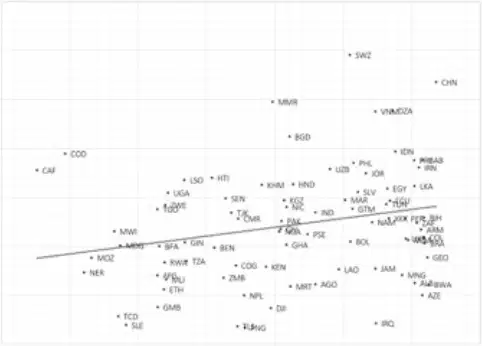
According to the scatter plot, higher manufacturing activity across countries correlates with which outcome?
Higher per capita income levels
Stable per capita income levels
Lower per capita income levels
Volatile per capita income levels
Which insight by economist Nicholas Kaldor is supported by observed links between manufacturing and prosperity?
Industrialization rarely precedes prosperity anywhere
Few countries attain prosperity without industrialization
Prosperity follows agriculture-led growth universally
Services expansion alone ensures broad-based prosperity

In Indian states, higher manufacturing activity is associated with which socio-economic pattern?
Higher poverty with rising informal work
Higher per capita incomes and lower poverty
Stable incomes unaffected by sector shares
Lower per capita incomes overall
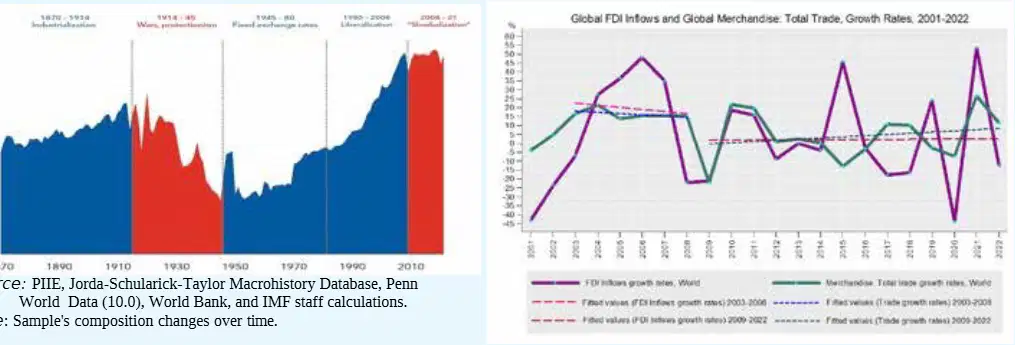
Which statement best captures the idea of Slowbalisation?
Regional trade blocs replacing all global institutions
Complete deglobalisation and collapse of global value chains
A shift from hyper-globalisation to slower global integration
A rapid surge in global trade and FDI since 2010
What is a core emphasis of the Productivism Paradigm in recent global policy debates?
Expanding global value chains at any cost
Prioritizing finance and consumption over production
Focusing on production, jobs, and localization
Eliminating state involvement in industry
Which Sustainable Development Goals are directly linked to manufacturing’s contributions listed in the material?
SDG 8 Decent Work and Economic Growth
SDG 12 Responsible Consumption and Production
SDG 1 No Poverty
SDG 14 Life Below Water
SDG 2 Zero Hunger
Which policy initiatives exemplify a revival of industrial policy in a major advanced economy?
Large-scale tax incentives for industry
CHIPS and Science Act
Universal basic income rollout
Inflation Reduction Act
Abolition of tariffs across sectors
Which factor from IR4.0 could alter traditional offshoring advantages for developing countries?
Higher commodity prices benefiting exporters
Stronger international labor unions
Advances in automation reducing low-cost labor importance
Rising logistics costs globally
Match each trend or term with its most accurate description.
Slowbalisation
Slower global trade and FDI growth
Friend-shoring
Redirecting supply chains to aligned countries
Productivism Paradigm
Policy focus on production and jobs
Make-in-India initiative
Program to boost domestic manufacturing
Which mechanism explains how manufacturing strengthens a country’s resilience to shocks?
It eliminates need for imports during crises
It fixes exchange rates permanently
It enhances diversification and absorptive capacity
It increases dependence on single export commodity
What risk has India faced due to the slowdown in global trade and investment during Slowbalisation?
Permanent decline in manufacturing employment
Complete decoupling from global markets
Possible loss of approximately one percentage point of growth
Loss of two percentage points of GDP growth
Which policy is part of the European Union’s Green Deal Industrial Plan to strengthen industrial competitiveness?
Schengen Agreement border coordination
European Stability Mechanism lending
Common Agricultural Policy price supports
Net-Zero Industry Act streamlining regulations
What is the primary purpose of the EU’s Carbon Border Adjustment Mechanism (CBAM)?
Subsidize domestic agriculture
Protect intellectual property rights
Account for carbon in imports
Reduce exchange rate volatility
Which sector collaboration aims to promote battery research and subsidised manufacturing across Europe?
Trans-European Transport network
Single Market Services pact
Horizon Europe social program
European Battery Alliance initiative
Made‑in‑China 2025 primarily seeks to achieve which strategic goal?
Eliminate all import tariffs
Increase competitiveness in high‑tech
Focus exclusively on low‑skill exports
Privatize state‑owned enterprises
Which combination of tools supported China’s rise as a manufacturing powerhouse?
Undervalued exchange rates
Direct industrial subsidies
Strict laissez‑faire policies
Enhanced IP protection for SMEs
Mobilisation of state‑owned enterprises
Match each EU initiative with its key objective.
Net‑Zero Industry Act
Simplify permits for clean tech
Critical Raw Materials Act
Secure stable supply of inputs
Electricity market reform
Mitigate gas price impacts
Which outcome is linked to China’s mercantilist approach?
Immediate full market liberalisation
Sustained increasing trade surpluses
Collapse of state involvement in industry
Reduction of global manufacturing share
Which statement best captures the infant industry protection argument?
Temporary tariffs to nurture new sectors
Subsidies only for mature exporters
Permanent bans on foreign competition
Price controls to fix consumer demand
According to the rationale for intervention, which market failure often hampers technologically dynamic sectors?
Abundant economies of scale always
Weak capital markets limiting investment
Excessive consumer information flow
Perfect coordination among firms
Which policy instrument pair is identified as fostering industrial upgrading in late‑industrialising countries?
Laissez‑faire antitrust stance
Government procurement incentives
Export subsidies mechanisms
Universal basic income payments
Which feature best characterizes Import-Substituting Industrialization (ISI) in India before 1991?
High tariffs and import controls
Low tariffs and open trade
Strong product patent enforcement
Unrestricted foreign investment
Under ISI, what role was expected of the public sector in India?
Minor support to private firms
Commanding heights of the economy
Export marketing partner only
Limited role in consumer goods
Which policy element under ISI contributed to domestic monopolies and higher prices?
Export obligation removal
Automatic FDI approvals
Industrial licensing restrictions
Floating exchange rate regime
What consequence did limited innovation under ISI have for Indian industry by the late 1980s?
Rapid global competitiveness
Decline in import dependence
Surge in high-quality exports
Technological obsolescence
After 1991, which change most directly increased foreign participation in Indian industries?
Strengthened industrial licensing rules
Liberalized FDI policy with facilitation
Reimposed quantitative import limits
Raised average tariff levels
Which statement correctly contrasts India’s ISI approach with East Asian strategies?
India pursued export-led competitiveness; East Asia did not
Both avoided working with multinational corporations
Both prioritized sectoral caps and licensing
India targeted closed domestic champions; East Asia targeted global markets
Which sectors saw foreign ownership limits rise to 100% in the years after reforms?
Multi-brand retail immediately
Defence equipment across the board
Civil aviation without any caps
Most manufacturing sectors over time
Which reform step was part of aligning India with global trade and IP regimes in the late 1990s?
Restricting portfolio foreign investment
Eliminating all sectoral FDI caps
Adopting TRIPS-consistent patent law
Rejecting WTO ITA participation
Match each policy phase with its dominant characteristic.
ISI era (mid-1960s–1991)
High tariffs, licensing controls
1991 reforms
Trade and FDI liberalization
Post-1997 global integration steps
TRIPS compliance and ITA participation
Which outcomes followed 1991 reforms for Indian industry? Select ALL that apply.
Strengthened sectoral export obligations
Reintroduction of quantitative import restrictions
Automatic clearance of FDI proposals
Greater competition exposing weak firms
What was a mixed result of ISI despite its limitations?
Instant global leadership across all sectors
A diversified base producing most consumer items
No notable industrial base emerged
Complete reliance on imports for capital goods
Which sector experienced decline amid liberalization and global competition?
Electronic hardware industry
Generic pharmaceuticals
Information technology services
Two-wheelers and compact cars
Which reform outcome is most associated with the term “hollowing out” of industry in India during the 2000s?
Raising tariffs on household consumer goods
Outsourcing final production to cheaper imports
Restricting MSME sectors from foreign exports
Increasing quantitative restrictions on imports
What was a key objective of the Make-in-India programme launched in 2014?
Reversing premature deindustrialization trends
Eliminating corporate tax benefits for new firms
Prioritizing services-led export expansion
Reducing insolvency and bankruptcy filings
Which policy change accompanied Make-in-India to improve procurement and local content?
Removal of tariff protection for six corridors
General Financial Rules mandating 50% local content
GST exemption for imported capital goods
Automatic FDI approval in all consumer sectors
Production-Linked Incentives (PLI) primarily aim to:
Reduce corporate tax rates for old companies
Subsidize public sector employment growth
Enhance domestic consumption of services
Boost local production and strategic exports
Which sectors are explicitly included under PLI according to the material?
Electronics and semiconductors
Advanced battery technologies
Household irons and toasters
Telecom and networking equipment
Solar PV cells and modules
Which initiative was established to attract investment and facilitate projects alongside tariff adjustments?
Green Hydrogen Mission for exports
National Plan for Multimodal Connectivity
Invest India investment promotion agency
Semiconductor Mission for chip displays
Match each initiative or reform with its main purpose.
GST (2017)
Unified national market for goods/services
Insolvency and Bankruptcy Code (2016)
Faster resolution of distressed companies
National Master Plan for Multimodal Connectivity (2021)
Improving logistics infrastructure
Corporate tax rate cuts (2019/20)
Lower statutory taxes for new firms
In the manufacturing versus services debate, which statement best captures the relationship described?
Manufacturing depends entirely on service exports
Services and manufacturing have no spillovers
Both sectors compete for identical demand
Services growth relies on manufacturing linkages
Which claim counters the view that India has comparative advantage only in services?
India’s reliance on imported semiconductors
Brazil’s initiatives to build aircraft
Europe’s efforts to break Boeing’s monopoly
India’s gains in compact cars and two-wheelers
What risk to strategic autonomy is highlighted in the material?
Dependence on imported manufactured goods
High tariffs on domestic consumer products
Excessive services offshoring by ICT firms
Overinvestment in agriculture-based exports
India’s recent transition in mobile handsets suggests what about industrial policy?
Industrial policy can catalyze domestic assembly
Service exports alone create enough jobs
Tariff hikes reduce foreign investment inflows
Subsidies inevitably cause market distortions
Which external trend creates opportunities for India in manufacturing supply chains?
Rising global trade growth rates since 2015
Expanding carbon space under UN commitments
Global firms de-risking away from single-source China
Automation increasing offshoring to low-cost nations
Which factor describes India’s demographic sweet spot for manufacturing growth?
Rapidly ageing population in metros
Peak working-age share near 68.9% by 2030
High dependency ratio in all states
Declining youth participation across sectors
What opportunity arises from India’s climate action commitments for industry?
Maintain coal-centric energy mix
Limit domestic manufacturing expansion
Leapfrog to sustainable industrialization
Delay renewable deployment to 2050
Which new green industries are highlighted as emerging in India’s energy transition?
Coal gasification plants
Green hydrogen production
Large-scale EVs and batteries
Wind turbines fabrication
Solar panels manufacturing
India’s ICT software and chip design strengths enable what positioning?
Follower in legacy hardware
Outsourcer of low-end assembly
Leader in digital industrialization
Exporter of raw commodities
India’s large and fast-growing market provides what advantage to manufacturers?
Opportunity to build scale economies
Elimination of import dependence
Guaranteed trade surpluses
Reduced need for innovation
Which strategy can expand India’s manufacturing base under “Making for India”?
Focus solely on export markets
Restrict competition in services
Reverse outsourcing of domestic production
Increase imports of consumer goods
Match each initiative or trend with its primary goal or effect.
PLI schemes
Incentivize local production capacity
Strategic import substitution
Reduce reliance on manufactured imports
Guarding against dumping
Protect fledgling industries from cheap inflows
Diversifying supply chains
Integrate with global value networks
Why is guarding against dumping from China emphasized for India?
To attract more foreign retailers
To comply with WTO quotas
To prevent destruction of nascent capacities
To access cheaper raw materials
Which action by governments and regions indicates rising caution about cheap imports?
Relaxation of anti-dumping rules
New measures by US, EU, Southeast Asia
Removal of tariffs on green products
Privatization of customs enforcement
Export-oriented manufacturing could benefit India primarily through what corporate strategy?
Consolidating all production in China
De-risking by China+1 diversification
Outsourcing only high-end components
Re-shoring to single-country bases
Which sectors are identified as promising for export growth beyond traditional areas?
Vaccines and generics pharmaceuticals
Automobiles and components
Processed foods and textiles
Machinery and electrical equipment
Software services exclusively
What does the India Semiconductor Mission aim to catalyze?
Reduction in software development
Shift to feature phone assembly
Manufacture of chips and displays
Import dependence on displays
Which companies have shown interest in India’s semiconductor and display initiatives?
Tata Group
Micron
Renesas
Foxconn only
Nokia exclusively
Electric mobility’s rise increases demand for which key technologies?
Li-Ion batteries and storage
Lead-acid batteries for buses
Diesel hybrid carburetors
Steam engines for two-wheelers
Translating opportunities, what scale of additional MVA by 2030 is projected from strategic initiatives?
Exactly US$3 trillion expansion
About US$200 billion increase
Nearly US$1.5 trillion potential
US$0.5 trillion growth
Which statement best describes export-orientation (EO) as used by East Asian countries?
Focus on building local productive capacities then export
Restricting domestic firms and relying solely on imports
Immediate liberalization without capacity building efforts
Prioritizing foreign market protection over competitiveness
In practice, East Asian development combined which two strategies in a dual approach?
Import substitution and export orientation
Mission goals and tariff liberalization
Financialization and demand management
Privatization and currency devaluation
Why is substituting imports not sufficient without building large-scale local capacities?
Foreign firms always block local market entry
Domestic demand eliminates the need for exports
Export markets require competitive scale production
Currency appreciation guarantees lower import costs
Which approach focuses on targeted government interventions to solve societal challenges like healthcare or clean energy?
Mission-oriented industrial strategy
Trade liberalization strategy
Export-orientation model
National champions approach
What is a key strength of mission-oriented industrial policy?
Relies solely on foreign direct investment
Eliminates need for any private sector input
Avoids using incentives for innovation entirely
Sets clear objectives and mobilizes stakeholders
Which Indian initiatives exemplify a mission-oriented approach?
National Solar Mission
Across-the-board tariff hikes
PLI for 14+ sectors
Green Hydrogen Mission
Why should generic and mission-oriented policies be seen as complementary?
Missions replace all regulatory frameworks entirely
Both eliminate competition and reduce firm entry
Generic policies make specific goals unnecessary
Generic creates conducive environment; missions drive innovation
A coordinated industrial policy should align which elements to avoid neutralizing effects?
Investment facilitation
Unrelated social media campaigns
Exchange rate management
Innovation policy
What institutional arrangement is recommended to ensure coordination across ministries and agencies?
Independent task forces limited to single-sector mandates
Ad hoc panels formed only during crises
Decentralized committees with rotating volunteer chairs
High-powered industrial policy secretariat under PM’s Office
How does India’s current policy differ from the early post-independence period?
Exclusive reliance on perpetual subsidies to state firms
Primary emphasis on import bans without competitiveness
Stronger focus on EO with transparent, time-bound incentives
Reduced attention to technology and scale economies

Match the industrial strategy model to its characteristic.
Export-orientation (EO)
Build local capacity to compete in exports
National champions
Anchor domestic firms to develop capabilities
Mission-oriented strategy
Target specific societal missions with interventions
FDI-led industrialization
Invite foreign MNCs to establish plants and bring tech

