
 Worksheets
Introduction to Complaints
Total questions: 69
Worksheet time: 35mins
Which statement best defines a complaint in a quality context?
A statement indicating something is not good enough
A formal praise of product excellence
An internal audit scheduling memo
A routine production status notification
Which example most clearly represents a customer complaint?
Request for a new product feature roadmap
Concern about defective packaging materials
Inquiry about upcoming promotional discounts
Feedback about excellent customer service
Why should companies systematically track complaints?
To increase advertising impressions
To improve product quality over time
To avoid documenting manufacturing steps
To reduce employee training requirements
Maintaining cGMP is a stated reason to address complaints. What does cGMP most directly relate to?
Centralized governance metrics portal
Customer growth management program
Certified global marketing policies
Current good manufacturing practices
Which outcome is most aligned with regulatory obligations around complaints?
Voluntary changes to pricing strategy
Seasonal adjustments to packaging colors
Optional updates to branding guidelines
Mandatory adherence to device regulations
A structured complaint process can help reduce costs and improve schedules primarily by:
Shortening legal compliance reports
Increasing social media engagement
Preventing recurring quality problems
Eliminating all recalls immediately
Which action shows strategic use of complaint data in a quality system?
Ignore minor issues to maintain speed
Identify faulty device design and processes
Limit investigations to marketing teams
Delay fixes until annual reviews
Which benefit best describes improving customer relations through complaint handling?
Prioritizing marketing over engineering
Increasing the number of complaint channels
Reducing frequency of problems and recalls
Outsourcing all product support tasks
Which scenario best fits a quality complaint for a healthcare product?
Clinician observes no symptom relief after therapy
Patient experiences hives after correct dosage use
Tablet crumbles due to poor packaging integrity
User faints from a severe anaphylactic episode
What primarily characterizes an adverse reaction complaint?
Issues with labeling or container condition
Reports of allergic or other untoward reactions
Concerns about insurance reimbursement denials
Feedback about delayed shipping to pharmacy
A patient reports no clinical improvement after completing a full course at the correct dose and timing. How should this be classified?
Medically related complaint concerning efficacy
Adverse reaction complaint about hypersensitivity
Quality complaint regarding chemical contamination
Operational complaint about distribution logistics
Which distinction best separates quality complaints from medically related complaints?
Quality focuses product properties; medically related focuses clinical response
Quality focuses patient outcomes; medically related focuses packaging seals
Quality focuses dosage timing; medically related focuses tablet color
Quality focuses shipping errors; medically related focuses allergic reactions
Which communication channels are appropriate for receiving customer complaints in an IT QA context?
Toll-free numbers and emails
Internal payroll portals only
Personal blogs and wikis
Printed brochures mailed monthly
In the initial receipt of a complaint, what is the role of the designated person in charge?
Escalate only after lab results
Close tickets without documentation
Route complaints using an investigation form
Archive messages without review
Which data should be captured when opening a complaint investigation?
Product name, lot number, dates, description
Supplier holiday calendar and events
CEO biography and company history
Office floor plan and seating chart
During Step 2, the technical investigation is divided into which two phases?
Customer survey and focus group
Budget approval and procurement
Marketing review and sales audit
Documentation-based and laboratory analysis
What is the primary goal of the documentation-based phase?
Check prior occurrences and lot nonconformance
Negotiate vendor service discounts
Measure network bandwidth variations
Design new packaging artwork
If a customer does not send a complaint sample, how is laboratory analysis conducted?
Use simulated data instead
Analyze only the retained sample
Postpone analysis indefinitely
Skip all investigation steps
Which action should the company request from the customer after opening the investigation?
Update their billing address
Sign a non-compete agreement
Provide marketing testimonials
Return the product for analysis
Why are retained samples important in technical investigation?
Enable analysis when complaint sample is missing
Improve customer loyalty programs
Reduce software licensing costs
Provide training materials for sales
What must happen to complaints after initial receipt through channels like chat rooms or P.O. boxes?
Address them to the QA unit for investigation
Publish them on social media feeds
Forward them to the HR department
Store them without opening tickets
Which check helps identify systemic issues early in a lot-based production environment?
Review nonconformances recorded for the lot
Assess social media engagement rates
Survey employee snack preferences
Compare vendor travel expenses weekly
Which conclusion best fits when both complaint and retained samples show out-of-specification (OOS) results?
Counterfeit or tamper suspicion applies
Non-confirmed complaint conclusion applies
No investigation conclusion is applicable
Confirmed complaint conclusion applies
A single unexplained failing product is most consistent with which investigation outcome?
Out-of-scope investigation result
Non-confirmed complaint outcome
Confirmed complaint outcome
Counterfeit or tamper suspicion
Which scenario supports a non-confirmed complaint?
Complaint sample OOS due to counterfeit evidence
Retained sample within spec, complaint clearly OOS
Both samples show OOS results
Both samples comply with specifications
Tablets from a complaint sample show heat and humidity-related appearance changes, while retained samples meet specs. What is the most appropriate conclusion?
Non-confirmed complaint due to mishandling
Confirmed complaint due to single failure
Counterfeit or tamper suspicion conclusion
Out-of-specification systemic issue
When retained samples are within specification but the complaint sample is clearly OOS without a benign explanation, what conclusion is most appropriate?
Non-confirmed complaint applies
No conclusion can be drawn
Confirmed complaint applies
Counterfeit or tamper suspicion applies
Packaging of a complaint sample differs from the original and the product color is completely different. Retained samples meet spec. What should investigators conclude?
Non-confirmed complaint due to misuse
Routine variation within tolerance
Confirmed complaint due to single failure
Counterfeit or tamper suspicion conclusion
Which statement best describes when to open a Corrective Action and Preventive Action (CAPA) during complaint handling?
After customer feedback is sent and replacement is shipped
When the complaint nature and incidence warrant formal action
Only when regulatory bodies explicitly request an action
Whenever any complaint is received regardless of impact
Who should be included in the multidisciplinary team when a CAPA is opened for a quality complaint?
Sales, Logistics, and Finance representatives
QA, QC, Regulatory Affairs, and Production Management
Design, R&D, and External Vendors only
Customer Service, Legal, and Public Relations staff
What should a customer response letter communicate after a complaint investigation?
Internal audit schedules and facility maintenance plans
Investigation approach, obtained results, and implications
Detailed employee performance reviews and salaries
Marketing offers and upcoming product releases
When a returned product is analyzed and a quality problem is confirmed, what is the appropriate customer-facing action?
Issue a coupon valid for future purchases only
Send a free replacement product with the response letter
Close the case without further communication
Invite the customer to tour the manufacturing facility
For non‑confirmed complaints due to misuse or inadequate handling, what is the most suitable internal action?
Do nothing and archive the complaint permanently
Implement corrective measures to orient the customer
Escalate to criminal investigators immediately
Open a full CAPA and recall the product line
What is the primary purpose of monthly complaint reports in Step 4?
Document equipment depreciation and asset values
Report employee overtime and shift schedules
Evaluate complaint volumes and perform trend analysis
Track marketing campaign effectiveness and budgets
Which question must be answered in the monthly reports to support trend analysis?
What training courses were completed by staff
How many social media mentions occurred
How many complaints were received in the period
Which suppliers offered discounts last quarter
In a robust trend analysis process, which classification helps differentiate complaint outcomes for better insights?
Resolved, unresolved, pending supervisor approval
Confirmed, non‑confirmed, counterfeit/tamper suspicion
Internal, external, partner escalations
Domestic, international, regional markets
Which item is essential on a Product Complaint Data Sheet to uniquely identify each complaint?
Serial number assigned to complaint
Exact nature of the complaint text
Name of complainants listed
Address of complainants noted
What information connects a complaint to manufacturing history for traceability?
Quantity involved in complaint
Date complaint was received
Batch number of product lot
Size of sample obtained
When a complaint is received verbally, what additional detail should be captured?
Investigator signature line
Analytical record reference
Product strength specification
Name of the person receiving
Which entry links lab analysis results back to the complaint record?
Nature of the complaint narrative
Address of the complainant recorded
Reference to analytical record number
Date of complaint received field
Which data help quantify impact in a complaint investigation?
Address of complainants noted
Name of complainants listed
Quantity involved in the complaint
Date complaint received field
For sampling from a complainant, which field documents evidence collection?
Size of sample obtained
Action taken by company
Other affected materials
Materials used for evaluation
Which department’s assessment should appear in a Product Complaint Data Sheet?
Finance audit summary
Marketing team feedback
Human Resources review
Quality Control evaluation
What confirms accountability and timing of the investigation?
Name and signature of investigator(s) and date
Copy of reply sent to complainant
Other possible affected materials list
Materials and records used to perform evaluation
Which entry documents communication back to the complainant?
Batch number noted
Copy of reply sent
Analytical record linked
Quantity involved logged
In a Complaint Record book, what identifies the person initiating the complaint?
Name and phone of submitting person
Final decision on bulk product
Date complaint is received
Any follow-up action taken
Which pair belongs together in Complaint Record to describe the product under complaint?
Action and response date
Quantity and sample size
Investigator and signature
Name and batch number
Which field captures the company’s first mitigation step for a complaint?
Response provided
Nature of complaint
Name and address
Action initially taken
Which field in the complaint record ensures each complaint can be uniquely referenced across systems?
Date received
Report no.
Product name
Received by
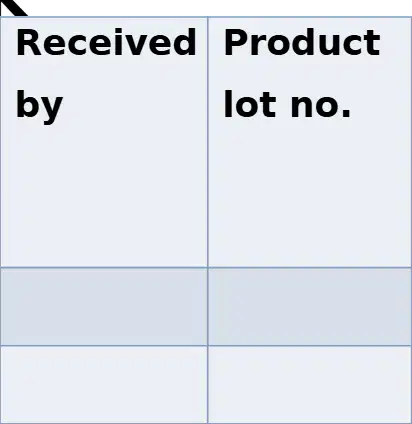
You must trace a defective batch mentioned in several complaints. Which column should you use primarily to link cases to the same batch?
Received by
Date investigation ended
Product lot no.
Report no.

A complaint was received on 10 Jan, investigation started on 12 Jan, and ended on 20 Jan. Which calculation best verifies timeliness using the shown fields?
Compare Received by with Product name.
Subtract Date received from Date investigation started.
Add Report no. to Date investigation ended.
Subtract Date received from Product lot no.
Which document must be available to detail how product complaints are handled and how records are maintained?
A vendor contract specifying support escalation
A Standard Operating Procedure detailing complaint handling
An informal memo outlining general complaint steps
A marketing brief describing customer feedback paths
Who should be designated to handle complaints and decide measures with adequate supporting staff?
An external auditor hired only during inspections
A rotating sales representative without technical training
A person from quality management with relevant experience
A junior intern assigned for temporary assistance
When a defect is suspected in one batch, what is the required action regarding other batches?
Check other batches and investigate potential rework
Delay checks until annual quality review occurs
Notify distributors without internal investigation
Ignore other batches until a recall is announced
Where should the file regarding drug product complaints be maintained?
On a public cloud without site linkage
At the factory site where the product was made
At a remote warehouse unrelated to production
Only at corporate headquarters finance office
For drug products with an expiration date, how long must written complaint records be retained at minimum?
At least 3 years after market launch
At least 1 year after the product expiration
Until first distribution cycle is completed
Exactly 6 months after the complaint receipt
For certain OTC products without an expiration date, what is the minimum retention period for records?
At least 1 year after shipment to retailers
At least 3 years after complete distribution
Exactly 2 years after packaging completion
Until the next manufacturing campaign only
Which activity helps identify specific recurring problems that may require attention or recall?
Annual interview with one distributor representative
Regular review of complaint records for indications
Occasional social media monitoring by marketing
Random customer survey without record analysis
What analysis should be performed to identify possible recurrent causes leading to negative effects on a product?
Trend analysis performed on events and complaints
Cost-only analysis excluding quality metrics
Ad-hoc brainstorming without data collection
Single-case narrative written by production lead
What is the primary objective of an SOP on complaint handling in a company?
Establish vendor onboarding workflow
Detail payroll and salary adjustments
Lay out procedure for investigating complaints
Define roles for marketing campaigns
Which role typically shares responsibility for market complaint handling with the complaint-related department manager?
Human resources coordinator
Product development lead
Sales operations analyst
Quality assurance manager
In a formal complaint process, which document captures investigation outcomes and decisions?
Quality Review Log
Incident Notification Email
Product Complaint Report
Customer Satisfaction Scorecard
Select the best classification bucket for a complaint about incorrect product labeling.
Network infrastructure
Packaging and labeling
Human resources policy
Financial reporting
A valid source of market complaints could be:
Internal salary surveys
Regulatory authority alerts
Daily stand-up notes
Server uptime dashboards
Which timeline expectation is most appropriate for initiating a complaint investigation after receipt?
Within a defined SOP window
After quarterly review cycle
When team workload decreases
Only after sales decline occurs
Who holds accountability to review SOP effectiveness for complaint handling?
Chief Entertainment Officer
Junior procurement assistant
Head of QA/QC/Regulatory
Social media manager
When classifying complaints, which category best fits a report of broken tamper seal on a received product?
Label artwork aesthetics
Product quality and safety
Customer loyalty metrics
Warehouse staffing levels
Which action should occur immediately after a complaint is received?
Escalate to payroll department
Close the ticket without review
Publish on marketing channels
Acknowledge receipt and log details
Which element should be included in the Product Complaint Report to support traceability?
Office floor plan
Employee vacation history
Monthly ad impressions
Complaint ID and dates

