
Font size
 Worksheets
CPUSH MIDTERM EXAM '25 - '26
Total questions: 100
Worksheet time: 2hrs 29mins
How many physical regions can North America be divided into?
Six
Five
Four
Three
What is the primary characteristic of the Canadian Shield?
Dense forests
Rocky landscape with many lakes
Rich deposits of oil
Mountainous terrain
What is the main reason for the formation of deserts in the American southwest?
Rain shadows of nearby mountains
Proximity to the ocean
High altitude
Volcanic activity
What is the largest wetland system in the United States?
The Mississippi Delta
The Florida Everglades
The Great Lakes
The Hudson Bay

Which country is marked by the letter B?
Greenland
Canada
The United States
Mexico

Which tribal region is circled on this map?
Pacific Northwest
Great Plains
Southwest
Eastern Woodlands

Which Great Lake is number 1?
Lake Ontario
Lake Superior
Lake Michigan
Lake Huron

Which Great Lake is number 5?
Lake Ontario
Lake Superior
Lake Huron
Lake Erie
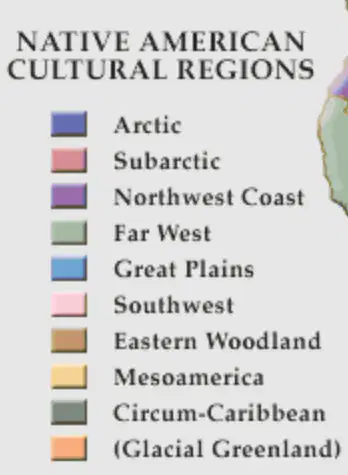
What is this an example of?
compass rose
physical map
map grid
map key

Which Great Lake is number 2?
Huron
Michigan
Ontario
Superior

Which U.S. river is located at letter "C?"
Rio Grande River
Colorado River
Mississippi River
Hudson River
What ocean is on the East Coast of the United States?
Arctic Ocean
Indian Ocean
Pacific Ocean
Atlantic Ocean

The map illustrates
Columbian Exchange of plants and animals
movement of early peoples from Asia
settlement of Europeans in the Americas
extent of the Maya Empire
One way in which the Olmecs and the Hohokam were similar is that they
had developed advanced civilizations before the arrival of Columbus
traveled to the Western Hemisphere from Africa
settled in the desert of the southwestern United States
left no evidence to help us understand their cultures
Which tribes are part of the Arctic/Subarctic region?
Choctaw, Chickasaw, Creek, Seminole, Cherokee
Iroquois and Algonquin
Navajo, Pueblo, Apache, Hopi, Zuni
Eskimo (Inuit and Yupik/Yupiit), Aleut
Who are geographers?
Scientists who explore both the physical properties of Earth's surface and human societies.
People who only study ancient artifacts.
Scientists who only study animal migration.
People who only study the weather.
What do archaeologists search for?
Clues about the earliest humans in history through excavation and analysis of artifacts.
New species of animals.
Weather patterns in ancient times.
Modern technological advancements.
What did the lowered sea levels during the Ice Age reveal?
A bridge of land between Asia and Alaska/North America.
A new continent in the Pacific Ocean.
A chain of volcanic islands.
A desert in South America.
What were people most likely following when they first crossed into the Americas?
Big-game like the woolly mammoth.
Large flocks of birds.
Rivers and lakes.
Groups of other humans.
What is a consequence of the extraction of mammoth tusks from permafrost?
It is extremely bad for the environment.
It increases crop yields.
It improves soil quality.
It helps preserve ancient sites.
How did farming contribute to the development of complex civilizations?
It provided extra food, allowing for permanent settlements and specialized jobs.
It led to the extinction of wild animals.
It caused people to move constantly.
It made hunting unnecessary.
The first Americans arrived in North America as early as ____ years ago.
45,000
5,000
22,000
10,000
Many different native cultures developed in North and South America primarily because
Native American Indians worshiped many gods
a variety of environmental conditions existed throughout this region
Native American Indian groups did not trade with each other
hunting for food was a very important activity
Which 5 nations are historically part of the Wabanaki Confederation?
Abenaki, Cherokee, Maliseet, Penobscot, & Passamaquoddy
Abenaki, Navajo, Maliseet, Iroquois, & Passamaquoddy
Abenaki, MicMac, Maliseet, Penobscot, & Passamaquoddy,
MicMac, Maliseet, Iroquois, & Passamaquoddy
Inuits wore clothing made of seal and caribou skins. Pueblos wore clothing made of woven cotton. Passamaquoddy wore clothing made of deerskin. These differences in clothing were most likely the result of
traditional religious practices
available natural resources
family kinship requirements
competing customs in fashion
Why did the African Slave Trade begin?
A large population loss of indigenous Americans meant there was not enough people to complete the work needed to build 'New Spain'
They wanted to mix cultures
The Spanish wanted to transport the African population to America
The Aztecs were too aggressive and African slaves were easier to obtain
Why did Europeans begin to explore in the 1400s?
What Wabanaki tribe DOES NOT have a reservation in Maine?
Penobscot
Micmac
Passamaquoddy
Abenanki
Why did tribal members of the Wabanaki Confederation create the confederation
To allow them to work together thereby keeping everyone safer and avoiding conflict
So one tribe would have power over all the other tribes
To help improve the language of the Native American people
To record important events and to use as a form of money for trade

The development of these 5 social classes in Spanish controlled Central and South America was the result of
conquest
industrialization
isolationism
patriotism
This treaty signed in 1494 dividing the territories of the New World between Spain and Portugal. Spain received the bulk of territory in the Americas while Portugal was compensated with lands in Africa and Asia.
Treaty of Tordesillas
Treaty of Hispaniola
Virginia Company
Spanish Armada
All of the following are limitations for oral historians that rely on using oral traditions to learn about Native American culture EXCEPT
holders of the information can die
fewer people speak the language
enables people to share their stories in their own words, with their own voices
determining a specific date and location

Base your answer to the question on the passage and your knowledge of social studies.
Which claim about this group of Native Americans is supported by this passage
Acquiring their land is justified.
Women play a significant role in their society.
Their treaties are preserved in writing.
Colonial missionaries need to understand thier beliefs.

Which statement is best supported by the information in the chart
There was steady growth of both European and Native American populations.
Native Americans aided Europeans for almost 90 years.
European colonization had devastating effects on Native Americans.
The French and Indian War impacted both Europeans and Native Americans.
What catastrophic consequence did the enslavement of Africans have on Western Africa?
It led to the disruption of many societies
It improved economic conditions
It increased population growth
It led to peaceful relations with Europe
What is the Columbian Exchange?
The transfer of foods, plants, and animals during the European colonization of the Americas
The migration of American Indian tribes to Europe
The spread of diseases from the Old World to the New World
The exchange of goods between Europe and Asia
Which country was the last among the leading European nations to explore the seas in the early 1400s?
Great Britain
Spain
Portugal
France
What did the encomienda system do?
Forced the natives to work the land and mines
import African slaves
Help fight the Napoleonic wars
Find gold
What indigenous group and empire did Hernan Cortes conquer?
Incas
mulattos
Casta
Aztecs
Many early Native Americans were considered nomads. This means that they:
Did not have a spoken language
Migrated from place to place in search of food and resources
Created permanent settlements
Did not eat meat
Early native American cultures had all of the following in common EXCEPT:
Use of trading networks
Spiritual beliefs
Land can be owned
Strong family ties
How did John Smith's leadership improve the terrible state of the Jamestown colony? He made sure that:
Anyone who didn't work, couldn't eat.
Colonists planted gardens.
Shelters were built.
Fences were put up for protection from Indian attacks.
All of the above
The Virginia House of Burgesses:
Provided an example of limited representative government.
Established the first army in the New World.
Regulated what the people were allowed to eat.
Determined who could leave the colony.

What was the Great Migration of the 1630's?
Increase in Puritans to New England
Increase in slaves to the New World
Migration of people to Jamestown
The attempt to colonize Roanoke
A company made up of a group of shareholders. Each shareholder contributes some money to the company and receives some share of the company's profits and debts.
Joint-stock company
Plymouth
Proprietary colony
Middle Passage
Why was the arrival of Africans important to Jamestown?
It increased the population of settlers who worked
They created families
It helped reduce the over-crowding of the colony
They provided the leadership needed to guide the colony
Under the _____________ , anyone who paid for passage to Virginia received 50 acres of land
headright system
encomienda
Separatist Act
Rule of Thumb
Why did Queen Elizabeth I want to claim parts of North America?
She wanted to increase England's wealth.
She wanted to make allies with the Native Americans.
She was from there originally.
She wanted to move England to North America.
"Puritan colonists moving to the New World were destined by God to create a holy community: a model society for the rest of the world to follow."
City Upon a Hill
Plymouth Rock
The Columbian Exchange
The Great Migration
This native princess was instrumental in helping broker peace between the natives and Jamestown colonists.
Pocahontas
Sacagawea
Squanto
Tecumseh
How did Native Americans help the Pilgrims who settled in what is now Plymouth, Massachusetts?
They sold food to the Pilgrims.
They gave the Pilgrims weapons.
They built tepees for the Pilgrims.
They taught the Pilgrims how to grow food.
How did the economy of the Southern colonies contribute to slavery?
slaves were skilled craftsmen
slaves knew how to trade
ship owners required slaves to do all the fishing
farming required lots of work and a large work force
Which colonial region was known as the "bread basket" colonies because the colonists grew grains like wheat, barley, and oats?
New England Colonies
Middle Colonies
Southern Colonies
Which precedent was established as a result of the John Peter Zenger case (1735)?
universal suffrage
peaceable assembly
right to privacy
freedom of the press
What is Triangle Trade?
The journey of trade between Europe, Africa and the Americas in the 1600-1800s
The journey of trade between Africa and America now
The journey of trade between the 13 colonies in the 1600-1800s
The journey of trade between the Americas and Asia in the 1800s
Which colony had people from the most diverse group of European countries?
New England
Middle
Southern
Northern
It was the first "modern constitution" establishing a democratically controlled government.
House of Burgesses
Orders in council
Mayflower Compact
Fundamental Orders of Connecticut
Religious group known for their tolerance, emphasis on peace, and idealistic Indian policy, who settled heavily in Pennsylvania in the seventeenth and eighteenth centuries.
Puritans
Quakers
Separatists
Catholics
What was the main reason large plantations developed in the South during the colonial period?
British laws promoted the growth of slavery in the South.
Cotton could only be grown in the wetlands.
Southern mountains led to the development of isolated, self-sufficient farms.
The climate in the south provided longer growing seasons.
Which describes the geography of the New England colonies?
No coastline
Rocky soil
Short winters
Tropical climate
A key figure that established Rhode Island promised that people of all religions were welcome.
John Winthrop
Roger Williams
Anne Hutchinson
John Smith
Why were literacy rates (being able to read) so HIGH in New England?
New England did not have TV so they had to read.
Education was highly valued and prioritized in New England. They needed to read the Bible.
The belief that colonies exist to benefit the economy of the mother country is known as
triangular trade
mercantilism
free trade
nativism
Raw materials from the colonies were used to produce_______________________ for export to other European countries and back to the colonists in NA.
manufactured goods
raw tobacco
wealth
goods and services

The impact of mercantilism was that
The rate of slavery in the Americas went down
Trade was limited in the Atlantic
The Colony grew wealthy
The Mother Country grew wealthy
A huge colony formed by the King of England which included land from southern Maine to New Jersey
Declaration of Land
Dominion of New England
Domino Sugar
Dominant English Rulers
Governor appointed by the King of England to govern over the Dominion of England
George Washington
Sir Elton John
Sir Edmund Andros
Sir Edmund Hillary
Congress
Parliament
Mercantile
Monarchy
The French and British claimed the same land.
The French and Indians claimed the same land.
The Indians and British claimed the same land.
The Indians wouldn't sell their land.
William Pitt
Edward Braddock
King George II
George Washington
Which British leader sent money and supplies to North America to help them win the war?
William Pitt
Brad Pitt
Joseph Brant
General Sanders

What was the purpose of the Albany Plan of Union?
To plan an attack on Fort Duquesne.
For the British to join with the Native Americans against the French
For colonies to unite under a central government and prepare for war
For the New England colonies to unite with the Iroquois to fight the French
Who was responsible for the Albany Plan?
William Pitt
Louis XIV
Benjamin Franklin
George Washington
How did the battle for Quebec affect the war?
It led to the end of the French and the Indians because after losing Quebec, France could no longer defend the rest of its South Asian colonies.
It led to the end of the French and the Indians because after losing Quebec, France could no longer defend the rest of its North American territory.
It made the Indians very angry.
George Washington forfeited his Presidency.
What was the main reason that slavery wasn't well established in the North?
Northerners believed slavery was morally wrong
Northerners weren't prejudiced against African Americans
Slavery had never been legal in the North
The North developed an industrial economy that didn't need slaves
Which describes the living conditions of slaves
they were given anything that they needed
they received lots of food and supplies
they got only the basic supplies to survive
they lived in fully furnished homes
How did cotton relate to slavery?
The desire to grow cotton led to increased slavery
It did not relate to slavery
All slaves were required to grow cotton
Cotton was traded for slaves in Africa
Why were African slaves preferred over indentured servants?
African slaves worked harder indentured servants on plantations.
African slaves new how to farm better than indentured servants
African slaves were enslaved permanently, unlike indentured servants.
African slaves worked for less pay than indentured servants.
All of the following were caused by the Atlantic slave trade EXCEPT
racism in the Americas
laws to support slavery in colonial America
a decline in the population of West Africa
an increase in the number of guns brought to Europe
Under the original charter issued by James Oglethorpe, what was banned in Georgia?
Weapons and rum.
Tobacco and fur trading.
Prisons and women.
Slaves and liquor.

NAME of #6
Lake Superior
Platte River
Rio Grande
Ohio River

What colony is this?
Delaware
Rhode Island
Pennsylvania
North Carolina
How did the French and Indian War cause the American Revolution? (Choose 2)
The colonies seperated during the French and Indian War.
This was the first time the colonies united together to fight a common enemy.
The French and Indian war provided Great Britian with a lot of wealth.
The French and Indian war caused Great Britian to go into debt and raised taxes on the colony.

What colony is this?
Virginia
New York
Maryland
New Jersey

What colony is this?
New York
Maryland
Connecticut
New Jersey

What colony is this?
New Hampshire
Massachusetts
New York
Rhode Island
What was the primary purpose of the Treaty of Paris of 1763?
To establish trade routes
To end the French and Indian War
To divide Native American lands
To create new colonies
How did colonists view British troops after the war?
As welcome protectors
With growing resentment
As trading partners
With complete indifference
Which describes the working conditions of slaves
They worked from sun up to sun down
they got multiple breaks throughout the day
they started working at age 18
after 60, slaves were allowed to retire

