
 Worksheets
Magic of Electrons Test Review
Total questions: 40
Worksheet time: 20mins
Name
Class
Date
1.
The smallest part of an element that contains all of the properties of that element.
a)
Atom
b)
Atomic
c)
Atomic Number
d)
Molecule
2.
This is equal to the number of protons (positively charged particles) in the nucleus of an atom.
a)
Atom
b)
Atomic
c)
Atomic Number
d)
Molecule
3.
An electron of an atom, located in the outermost shell (valence shell) of the atom, that can be transferred to or shared with another atom.
a)
Atomic
b)
Neutron
c)
Proton
d)
Valence Electrons
4.
A device or material that permits current to flow through it easily.
a)
Conductor
b)
Current
c)
Insulator
d)
Semi-Conductor
5.
A material that is both a poor conductor and a poor insulator.
a)
Conductor
b)
Current
c)
Insulator
d)
Semi-Conductor
6.
A material which resists the flow of electric current, preventing shorts and shocks.
a)
Conductor
b)
Current
c)
Insulator
d)
Semi-Conductor
7.
A flow of electric charge.
a)
Conductor
b)
Current
c)
Insulator
d)
Semi-Conductor
8.
The pressure from an electrical circuit's power source that pushes charged electrons (current) through a conducting loop, enabling them to do work.
a)
Voltage
b)
Parallel Circuit
c)
Series Circuit
d)
Circuit Diagram
9.
A circuit that contains more than one path for current flow.
a)
Voltage
b)
Parallel Circuit
c)
Series Circuit
d)
Circuit Diagram
10.
A circuit that contains only one path for current flow.
a)
Voltage
b)
Parallel Circuit
c)
Series Circuit
d)
Circuit Diagram
11.
A drawing that traces the path that electron flow will take in an electronic circuit.
a)
Voltage
b)
Parallel Circuit
c)
Series Circuit
d)
Circuit Diagram
12.
This part of an atom has a positive charge.
a)
Proton
b)
Neutron
c)
Electron
d)
Nucleus
13.
This part of an atom has a negative charge.
a)
Electron
b)
Neutron
c)
Proton
d)
Nucleus
14.
This part of an atom has no charge charge.
a)
Electron
b)
Neutron
c)
Proton
d)
Nucleus
15.
The center of an atom consisting of protons and neutrons.
a)
Electron
b)
Neutron
c)
Proton
d)
Nucleus
16.
A device or material that permits current to flow through it easily.
a)
Conductor
b)
Insulator
c)
Speculator
17.
A material used to electrically isolate two conductive surfaces.
a)
Conductor
b)
Insulator
c)
Speculator
18.
Which of the following would be good CONDUCTORS?
a)
Pencil lead, copper, and brass
b)
Silver, plastic and glass
c)
Wood, iron and yarn
19.
Which of the following would be good INSULATORS?
a)
Water, silicone, and iron
b)
Wood, silver, and pencil lead
c)
Rubber, glass, and water
20.
What direction do electrons move when thinking in terms of "Electron Flow"?
a)
From Positive to Negative
b)
From Negative to Positive
c)
They move in both directions to completely fill the wire.
21.
What direction do electrons move when thinking in terms of "Conventional Flow"?
a)
From Positive to Negative
b)
From Negative to Positive
c)
They move in both directions to completely fill the wire.
22.
Caused by an unequal number of protons and electrons is...
a)
Alternating Current (AC)
b)
Current Electricity
c)
Direct Current (DC)
d)
Static Electricity
23.
The movement of electrons through a conductor.
a)
Alternating Current (AC)
b)
Current Electricity
c)
Direct Current (DC)
d)
Static Electricity
24.
Electrons flow in the same direction all the time and found typically in things like batteries.
a)
Alternating Current (AC)
b)
Current Electricity
c)
Direct Current (DC)
d)
Static Electricity
25.
Electrons can flow both directions and found typically in things like lights and things you plug into the wall.
a)
Alternating Current (AC)
b)
Current Electricity
c)
Direct Current (DC)
d)
Static Electricity
26.
What THREE things do you need to to have a circuit?
a)
Source of Electrons
b)
A conductive pathway
c)
Load
d)
Source of Protons
e)
A non conductive pathway
27.
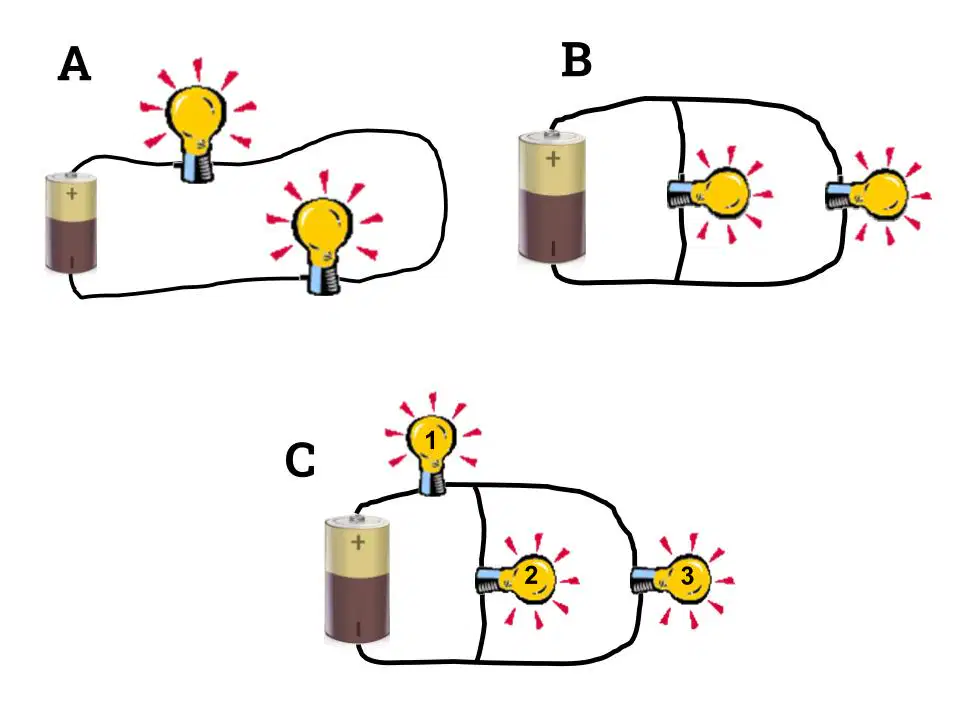
What type of circuit is being displayed in image A?
a)
Parallel
b)
Series
c)
Combination
28.
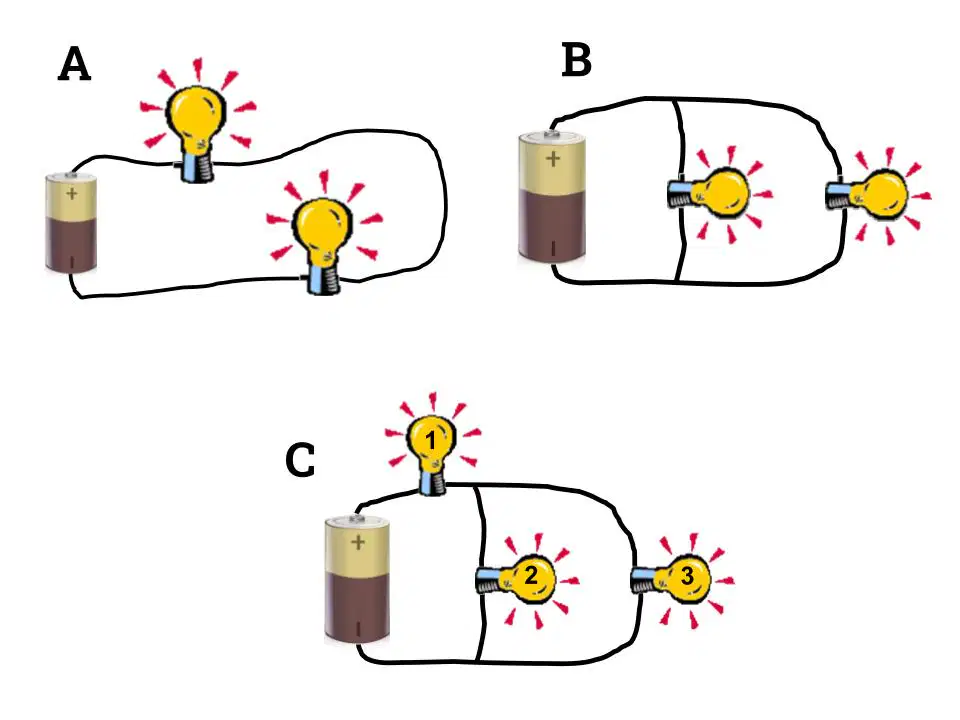
What type of circuit is being displayed in image B?
a)
Parallel
b)
Series
c)
Combination
29.

What type of circuit is being displayed in image C?
a)
Parallel
b)
Series
c)
Combination
30.
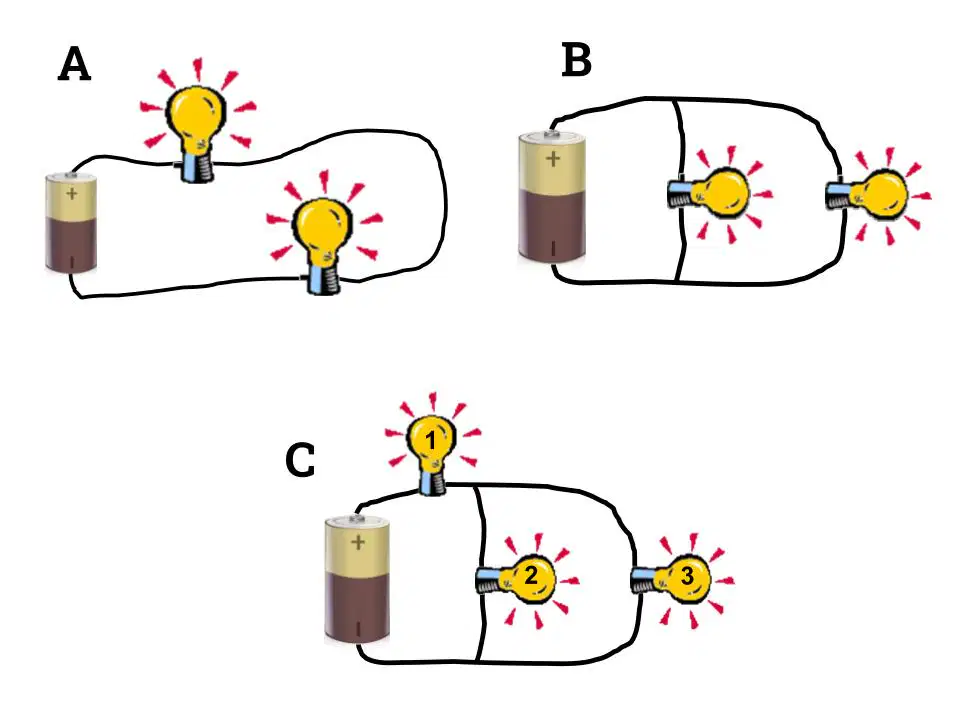
What would happen in image A if you removed one of the lights?
a)
You would see no change in the remaining lights.
b)
The remaining lights would get brighter.
c)
The remaining lights would get more dim.
d)
The remaining lights would go out.
31.

What would happen in image B if you removed one of the lights?
a)
You would see no change in the remaining light.
b)
The remaining light would get brighter.
c)
The remaining light would get more dim.
d)
The remaining light would go out.
32.
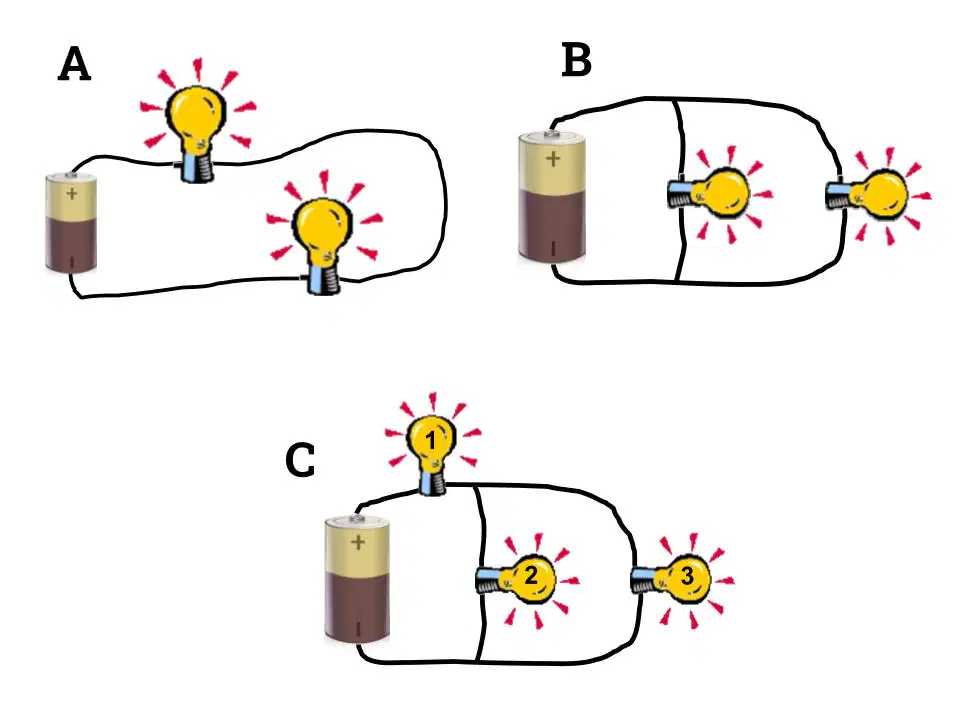
What would happen in image C to bulbs #1 and #3 if you removed bulb #2?
a)
You would see no change in the remaining lights.
b)
The remaining lights would get brighter.
c)
The remaining lights would get more dim.
d)
The remaining lights would go out.
33.
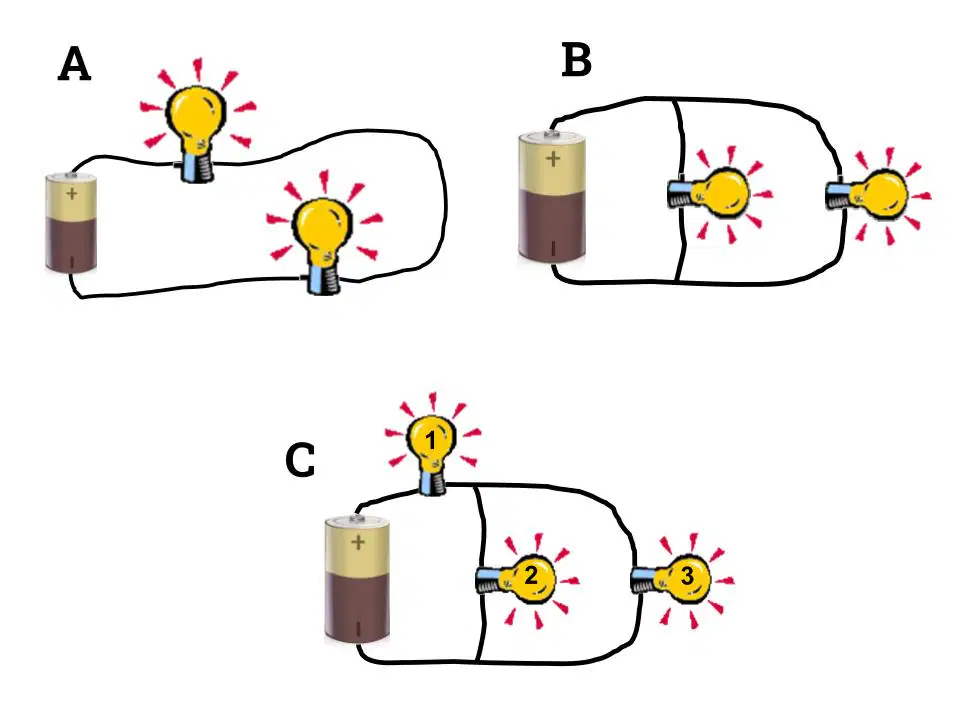
What would happen in image C to bulbs #2 and #3 if you removed bulb #1?
a)
You would see no change in the remaining lights.
b)
The remaining lights would get brighter.
c)
The remaining lights would get more dim.
d)
The remaining lights would go out.
34.
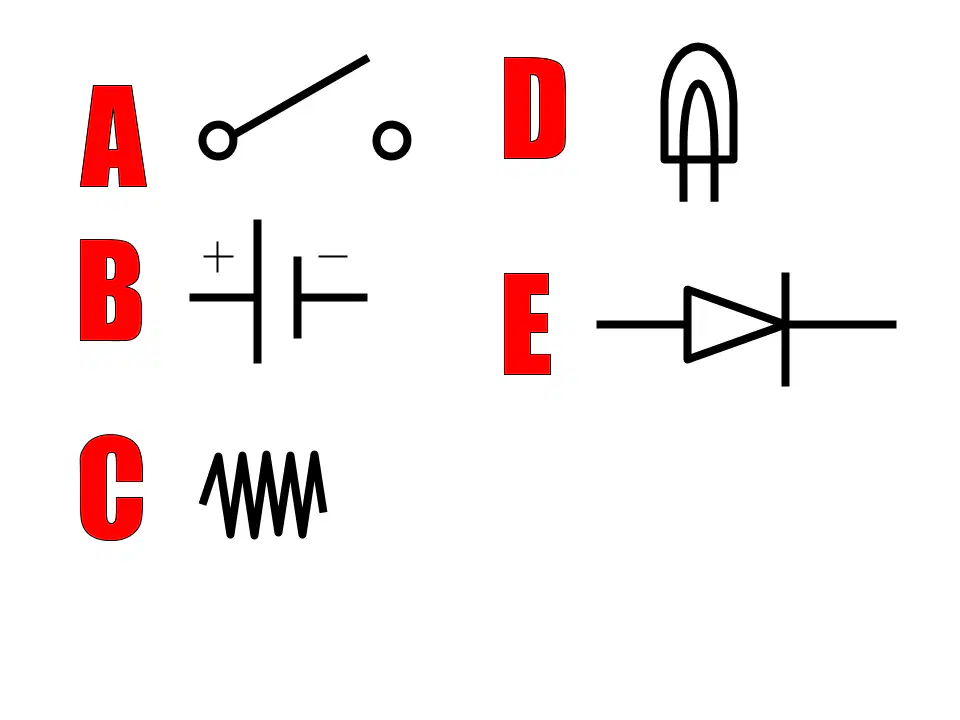
What does Schematic A represent?
a)
Lamp
b)
Battery
c)
Resistor
d)
Diode
e)
Switch
35.
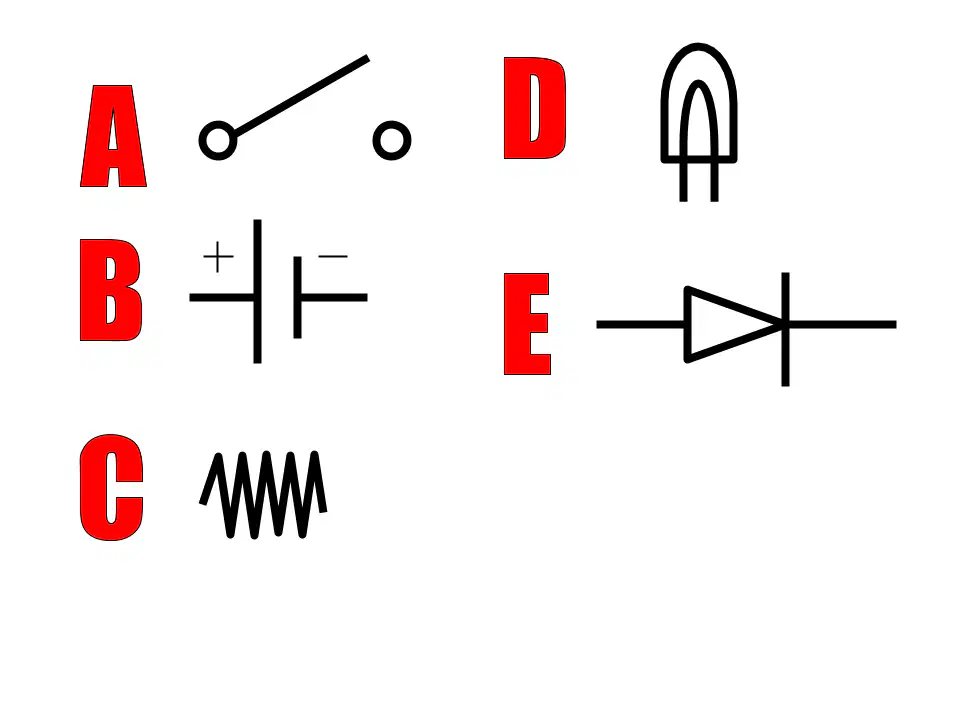
What does Schematic B represent?
a)
Lamp
b)
Battery
c)
Resistor
d)
Diode
e)
Switch
36.
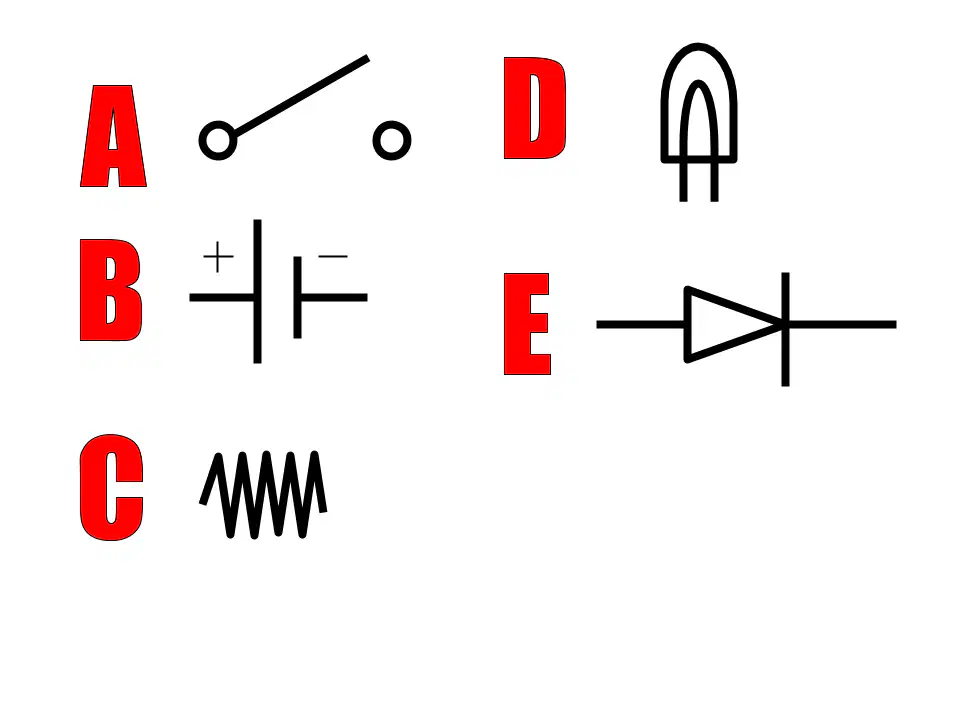
What does Schematic C represent?
a)
Lamp
b)
Battery
c)
Resistor
d)
Diode
e)
Switch
37.
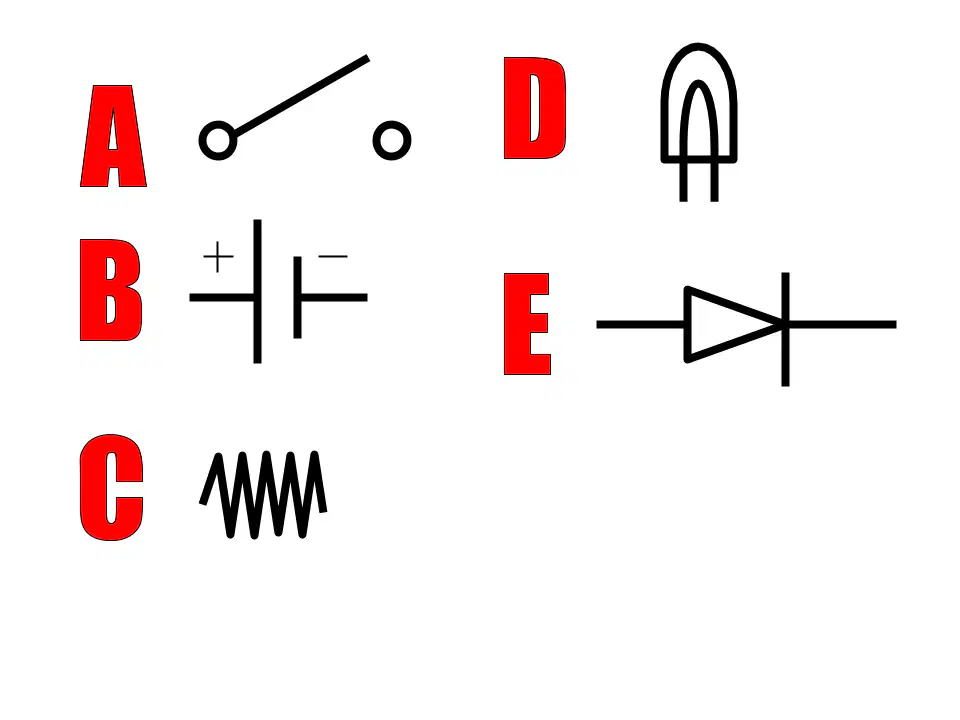
What does Schematic D represent?
a)
Lamp
b)
Battery
c)
Resistor
d)
Diode
e)
Switch
38.
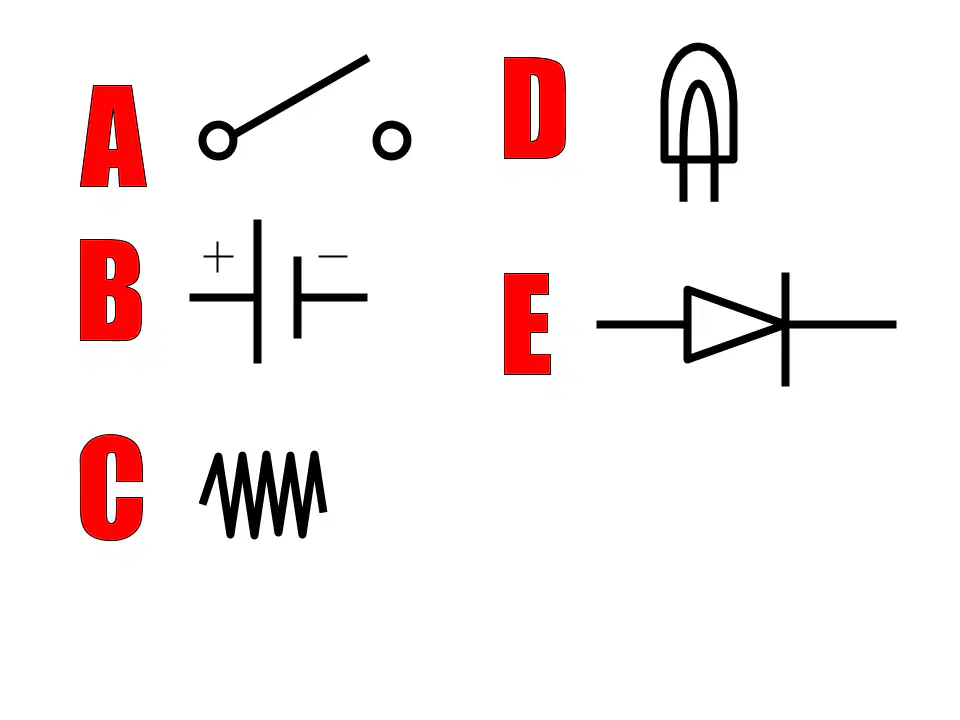
What does Schematic D represent?
a)
Lamp
b)
Battery
c)
Resistor
d)
Diode
e)
Switch
39.

What is the resistance of the resistor in the picture.
a)
25 Ω
b)
400 Ω
c)
4 Ω
d)
2.5 Ω
40.

What is the resistance of the resistor in the picture.
a)
35 KΩ
b)
35 Ω
c)
3.5 KΩ
d)
350 Ω
100 %

