
 Worksheets
Vietnam's Market Economy Quiz
Total questions: 43
Worksheet time: 22mins
What is the main focus of the lesson introduced in the material?
Basic theoretical knowledge of Vietnam's market economy and the relationship of interests in development
History of Vietnam's independence
Environmental issues in Vietnam
Vietnamese literature and poetry
Which of the following is listed as a topic in the table of contents?
Economic relations of interests in Vietnam
Vietnamese cuisine
Ancient Vietnamese architecture
Traditional Vietnamese festivals
According to the introduction, what does the lesson aim to ensure in the development of Vietnam?
Harmony of economic interest relationships
Rapid industrialization
Preservation of cultural heritage
Expansion of international trade
Based on the table of contents, which topic is NOT covered in the lesson?
Vietnamese literature
Market economy oriented towards socialism in Vietnam
Improvement of market economy institutions in Vietnam
Economic interest relationships in Vietnam
Understanding the harmony of economic interest relationships benefits Vietnam's development by:
Increasing the number of festivals celebrated.
Balancing the needs of different groups, promoting sustainable growth.
Reducing the need for government regulation.
Encouraging competition without cooperation.
What is a socialist-oriented market economy according to the provided material?
An economy that operates according to market laws and aims to establish a wealthy, strong, democratic, fair, and civilized society, regulated by the State under the leadership of the Communist Party of Vietnam.
An economy that is completely controlled by the government without market influences.
An economy that only focuses on wealth and ignores democracy and fairness.
An economy that operates without any regulations or leadership.
Which of the following is NOT a characteristic of the society aimed for in a socialist-oriented market economy?
Wealthy
Strong
Unfair
Civilized
According to the material, who regulates the socialist-oriented market economy in Vietnam?
The United Nations
The State under the leadership of the Communist Party of Vietnam
Private corporations
International organizations
The operation of market laws contributes to the establishment of a socialist-oriented society in Vietnam by:
Ignoring market laws and focusing only on government control
Allowing the market to operate freely without any regulations
Operating according to market laws while also aiming for a society that is wealthy, strong, democratic, fair, and civilized, with regulation by the State under the Communist Party's leadership
Focusing only on economic growth and neglecting social values
Balancing market laws and state regulation in a socialist-oriented market economy may lead to which of the following challenges?
There are no challenges because market laws and state regulation always align perfectly.
Balancing market laws and state regulation may lead to conflicts between economic efficiency and social objectives, requiring careful planning and reasoning to ensure both economic growth and social fairness.
The only challenge is the lack of market laws.
The only challenge is too much democracy.
Which of the following statements best describes the characteristics of Vietnam's socialist-oriented market economy?
It only includes the general characteristics of a market economy.
It only has unique characteristics specific to Vietnam.
It must include both the general characteristics of a market economy and the unique characteristics of Vietnam.
It excludes the characteristics of a market economy.
Why is it important for Vietnam's socialist-oriented market economy to have both general and unique characteristics?
To ensure it is identical to other market economies.
To reflect both global economic principles and Vietnam's specific context.
To avoid any influence from international markets.
To focus only on Vietnam's traditions.
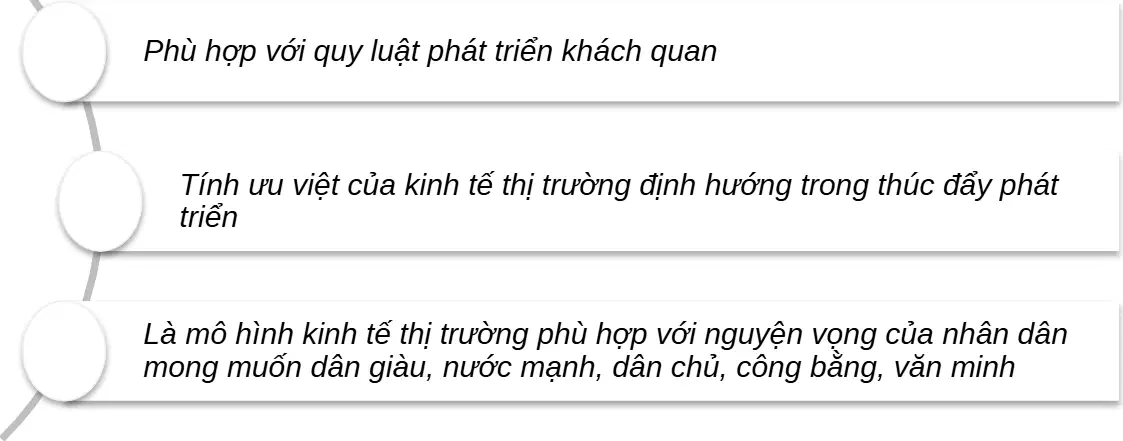
Which of the following statements best describes the objective necessity of a market-oriented economy?
It aligns with the laws of objective development.
It ignores the laws of objective development.
It is based solely on subjective desires.
It does not consider the needs of society.
What is one advantage of a market-oriented economy in promoting development?
It provides superior orientation for economic growth.
It restricts economic growth.
It eliminates competition.
It discourages innovation.
How does a market-oriented economic model meet the aspirations of the people?
By supporting wealth, strength, democracy, equality, and civilization.
By focusing only on individual profit.
By ignoring social justice.
By limiting access to resources.
The market-oriented economic model is suitable for a nation seeking prosperity, strength, democracy, equality, and civilization because:
It creates conditions for comprehensive development aligned with national aspirations.
It focuses only on economic growth without considering social factors.
It restricts opportunities for democratic participation.
It ignores the importance of equality and civilization.
What is the main goal mentioned in the document for developing the economy?
To increase government control over all industries
To develop productive forces, build technical infrastructure of socialism, and improve people's living standards
To promote international trade above all else
To reduce the role of private ownership
Which economic sector is described as playing a leading role in the economy?
Private sector
Foreign sector
State sector
Agricultural sector
According to the document, what is the role of the private economy?
It is the only sector allowed to operate
It is a driving force in the economy
It is not important
It is completely controlled by the state
How is the management of the economy described in the document?
Managed solely by private enterprises
Managed by a socialist rule-of-law state of the people, by the people, and for the people under the leadership of the Communist Party
Managed by foreign investors
Managed by local communities without government involvement
Why is the supervision and ownership by the people emphasized in the management of the economy?
To ensure only the wealthy benefit
To promote democracy, equality, and civilization
To reduce government responsibilities
To encourage foreign investment
Which forms of distribution are mentioned in the context of economic efficiency and welfare?
Distribution according to labor and economic efficiency, distribution according to welfare
Distribution according to age and gender
Distribution according to region and climate
Distribution according to technology and innovation
What is emphasized in the relationship between economic growth and social equity?
Economic development goes hand in hand with progress and social equity
Economic development is independent of social equity
Economic development only focuses on profit
Economic development ignores social progress
It is important to implement multiple forms of distribution in an economy, including distribution according to labor, economic efficiency, and welfare, because:
It increases government control over the economy
It ensures fairness and efficiency in resource allocation
It eliminates competition among workers
It reduces the need for social policies
The combination of economic growth and social equity can contribute to sustainable development in a country by:
Balancing progress with fairness, leading to long-term stability
Focusing only on rapid economic growth
Ignoring the needs of disadvantaged groups
Leading to unequal wealth distribution
What is the main focus of the economic institutional improvement mentioned in the image?
Developing a socialist-oriented market economy in Vietnam
Expanding international trade in Vietnam
Promoting agricultural reforms in Vietnam
Enhancing technological innovation in Vietnam
Why is it necessary to improve the socialist-oriented market economy institution in Vietnam?
To promote economic development and social progress
To increase government control over all businesses
To eliminate private ownership
To restrict foreign investment
What is the main purpose of "Thể chế" in a social system?
To create economic growth
To regulate human activities through rules, laws, and operational mechanisms
To establish international relations
To manage production processes
Which of the following best describes "Thể chế kinh tế"?
A system of cultural traditions
A system of rules, laws, management, and operational mechanisms for regulating economic entities and international relations
A set of educational policies
A method for organizing social events
What distinguishes "Thể chế KTTT định hướng XHCN" from other types of institutions?
It focuses only on individual behavior
It establishes strategic direction, legal systems, and policies to regulate functions, activities, objectives, and relationships of economic entities towards market factors
It ignores international relations
It is limited to local government regulations
How does "Thể chế KTTT định hướng XHCN" contribute to the functioning of a market-oriented socialist economy? (DoK Level 3)
By providing entertainment for citizens
By setting up a system of strategic direction, laws, and policies that regulate the activities and relationships of organizations and economic entities to ensure market factors are established synchronously
By limiting the number of businesses
By focusing only on agricultural production

Which of the following is a reason for improving the socialist-oriented market economy institution?
The institution is fully synchronized
The system is completely effective
The institution is not yet synchronized
All market elements are present
What does the incomplete system of institutions indicate about the socialist-oriented market economy?
The system is fully developed
The system is lacking in some aspects
The system is highly efficient
The system has all market elements
Which of the following best describes the effectiveness of the current institutional system in the socialist-oriented market economy?
Highly effective and efficient
Lacking market elements and types of markets
Fully synchronized with all market elements
Completely developed and efficient
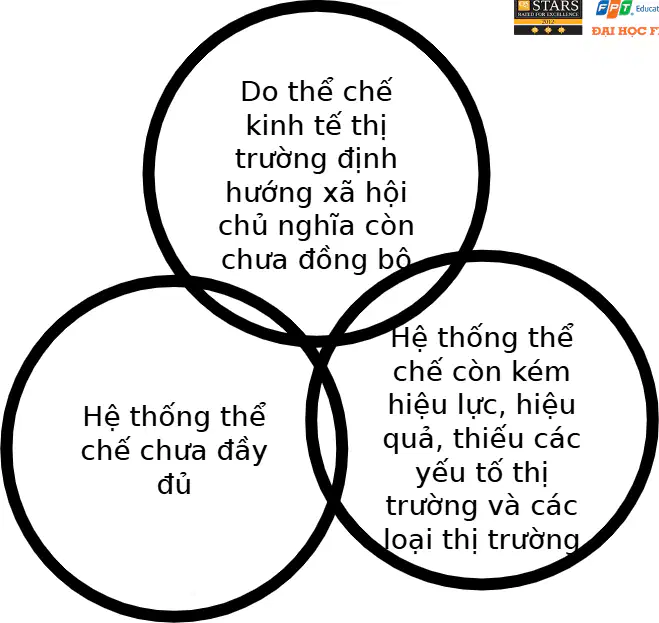
The socialist-oriented market economy institution needs improvement because:
the system is incomplete, not synchronized, and lacks market elements
the institution is already perfect
the system is highly efficient
all market types are present
Which of the following is a key component of economic ownership mentioned in the material?
Political power enhancement
Economic ownership and components
International economic integration
Social justice
What does "Phát triển đồng bộ các yếu tố và các loại thị trường" refer to in the context of economic development?
Developing only the financial market
Developing all factors and types of markets synchronously
Focusing on technological advancement
Enhancing political power
How is economic growth linked according to the material?
With technological progress only
With social justice and progress
With international trade exclusively
With market expansion only
Which concept involves the process of joining the global economy?
Economic ownership
International economic integration
Market development
Political power enhancement
Enhancing political power can contribute to economic development by:
Increasing the number of markets.
Helping create fair economic policies and stability.
Only benefiting the government.
Reducing international cooperation.
What is the definition of "lợi ích" (benefit) according to the provided material?
The satisfaction of human needs, which must be recognized and placed in the context of social relations corresponding to the highest level of development of that society's production.
The process of producing goods for society.
The accumulation of wealth by individuals.
The exchange of goods and services between countries.
Which of the following best describes "lợi ích kinh tế" (economic benefit)?
The benefit gained from physical goods, obtained through economic activities of humans.
The benefit gained from social relationships.
The benefit gained from cultural activities.
The benefit gained from educational achievements.
The satisfaction of human needs is related to the development level of a society's production in that it must be recognized and placed within the context of social relations that match the highest development level of production in that society. Which of the following statements best reflects this relationship?
Satisfaction of needs is determined by government policies.
Satisfaction of needs only depends on individual desires.
Satisfaction of needs must be recognized and placed within the context of social relations that match the highest development level of production in that society.
Satisfaction of needs is unrelated to the development level of production.

