


6th Grade Graduated Cylinder Quizzes
Test your Grade 6 understanding of graduated cylinders with this interactive science quiz designed to assess your knowledge of precise liquid measurement techniques. Practice identifying measurement markings, reading volume accurately, and applying proper graduated cylinder usage through self-paced questions with instant feedback.
30 questions
Graduated Cylinder Practice

Quiz
•
6th Grade

17 questions
Volume/Graduated Cylinder
Quiz
•
6th Grade

14 questions
Volume Graduated Cylinders
Quiz
•
6th Grade

35 questions
Graduated Cylinder Quizizz
Quiz
•
6th Grade

20 questions
Measuring Tools and Units REVIEW
Quiz
•
6th Grade

20 questions
Measure Liquid Volume Quiz
Quiz
•
6th Grade
14 questions
Graduated Cylinder Water Displacement
Quiz
•
6th - 8th Grade
20 questions
Graduated Cylinders & Metric Ruler
Quiz
•
6th - 8th Grade
6 questions
Volume Practice - Cylinders and Graduated Cylinders
Quiz
•
6th - 8th Grade
15 questions
Measurement Tools
Quiz
•
6th - 8th Grade
26 questions
Measurement Practice
Quiz
•
6th - 8th Grade
14 questions
Graduated Cylinders and Balances
Quiz
•
5th - 9th Grade
Explore 6th Grade Graduated Cylinder Quizzes
Graduated cylinder quizzes for Grade 6 students provide comprehensive assessment opportunities that develop essential measurement and laboratory skills in science education. These practice questions focus on reading volume measurements accurately, understanding graduated cylinder markings, and applying proper measurement techniques that form the foundation of scientific investigation. Through targeted assessment activities, students strengthen their understanding of liquid volume measurement, decimal place accuracy, and the relationship between graduated cylinder size and measurement precision. The feedback provided through these quizzes helps students identify areas where they need additional practice with meniscus reading, unit conversions, and proper graduated cylinder handling techniques. Wayground supports teachers with millions of teacher-created graduated cylinder quiz resources that align with Grade 6 science standards and measurement objectives. The platform's robust search and filtering capabilities enable educators to locate specific assessments covering graduated cylinder reading techniques, measurement accuracy, and laboratory safety protocols. Teachers can customize existing quizzes to match their students' skill levels, creating differentiated assessments that support both remediation for struggling learners and enrichment opportunities for advanced students. These digital-first quiz collections offer flexible delivery options that accommodate various classroom environments, while detailed analytics help teachers identify common misconceptions about graduated cylinder usage and plan targeted instruction to reinforce proper measurement techniques and scientific accuracy.
FAQs
How do I teach students to read a graduated cylinder correctly?
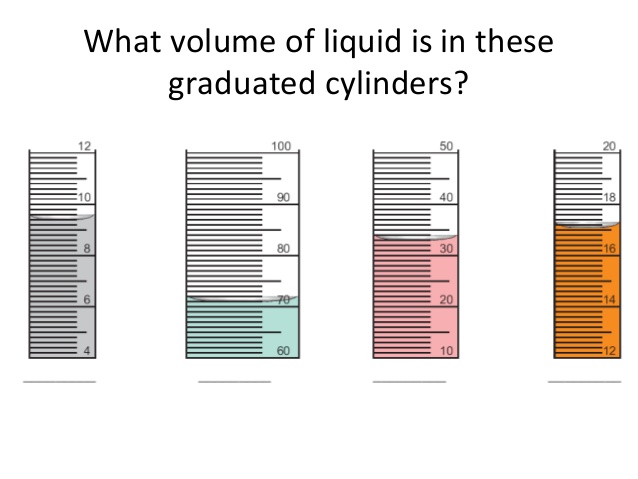
Start by teaching students to position their eyes at the level of the liquid surface, not above or below it. Then introduce the meniscus — the curved surface of the liquid — and explain that students should read from the bottom of the meniscus for most liquids (like water) and the top for mercury. Use visual examples with clearly marked increments before moving to practice problems that require interpolation between lines.
What exercises help students practice reading graduated cylinders?
Effective practice includes quiz problems that show graduated cylinders at various fill levels and ask students to record the volume, starting with whole-number readings before progressing to readings that fall between increment marks. Problems that require unit conversion (e.g., mL to L) and scenarios involving multiple measurement steps build the precision and fluency students need for lab work.
What mistakes do students commonly make when reading graduated cylinders?
The most common error is reading the top of the meniscus rather than the bottom, which consistently produces readings that are too high. Students also frequently misidentify the value of each increment mark, especially when the scale uses intervals of 2 or 5 rather than 1. A third common mistake is parallax error — reading the scale from an angle rather than at eye level — which leads to inaccurate measurements regardless of meniscus awareness.
How do I help struggling students with graduated cylinder measurement?
Break the skill into isolated steps: first practice identifying increment values on different cylinder scales, then practice locating the meniscus, and finally combine both into full readings. Wayground supports accommodations such as Read Aloud for students who benefit from audio support, reduced answer choices to lower cognitive load, and extended time for students who need more processing time when working through measurement problems digitally.
How do I use Wayground's graduated cylinder quizzes in my classroom?
Wayground's graduated cylinder quizzes are available as printable PDFs, making them easy to distribute for in-class lab preparation or homework, and in digital formats for technology-integrated classrooms. Teachers can also host the quizzes as a quiz directly on Wayground, which enables real-time progress tracking. Each quiz includes answer keys, so teachers can use them for self-paced practice, formative assessment, or lab remediation without additional preparation.
At what point in a science unit should I introduce graduated cylinder quizzes?
Graduated cylinder quizzes work best in two phases: first as a pre-lab introduction to familiarize students with reading scales and the meniscus before they handle physical equipment, and again after hands-on lab sessions as reinforcement or error correction. Using quizzes before the lab reduces measurement errors during actual investigations and helps students arrive with baseline fluency rather than learning the skill from scratch in a live setting.

Accessibility
Features
Wayground Super
School & District
Wayground for Business
Create a quiz
Create a presentation
Wayground AI
Subjects
Mathematics
Social Studies
Science
Physics
Chemistry
Biology
About
Our Story
Wayground Blog
Media Kit
Careers
Support
F.A.Q.
Help & Support
Privacy Policy
Terms of Service
Teacher Resources
2026 Wayground


Get our app

