


5th Grade Nets of 3d Figures Quizzes
Test your Grade 5 students' understanding of nets of 3D figures with this comprehensive mathematics quiz. Students will practice identifying and analyzing two-dimensional patterns that fold into three-dimensional shapes through instant feedback and self-paced assessment.

14 questions
Nets of 3D Figures

Quiz
•
5th - 6th Grade
15 questions
Nets of 3D Figures
Quiz
•
4th - 7th Grade

45 questions
Solids and Nets of 3D Figures
Quiz
•
5th Grade

10 questions
Nets
Quiz
•
3rd - 5th Grade

20 questions
3-D Nets
Quiz
•
5th - 8th Grade

11 questions
Math Nets (GMS RL6-5)
Quiz
•
5th - 7th Grade
34 questions
3D Figures, Nets, and Their Properties
Quiz
•
5th Grade
20 questions
Triangle, 3D Shapes and Nets Test
Quiz
•
5th Grade
13 questions
3D Figures and Attributes
Quiz
•
3rd Grade
20 questions
3D shapes & nets
Quiz
•
5th Grade
24 questions
Solid Figures and Nets
Quiz
•
5th Grade
10 questions
Surface Area and Nets
Quiz
•
5th - 6th Grade
Explore 5th Grade Nets of 3d Figures Quizzes
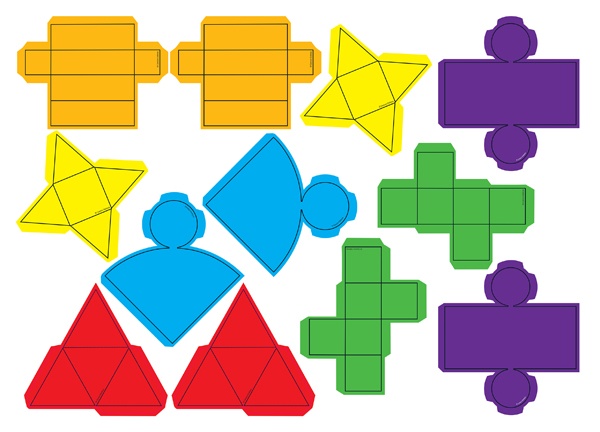
Nets of 3D figures represent a fundamental concept in Grade 5 mathematics that bridges two-dimensional understanding with three-dimensional spatial reasoning. Through Wayground's comprehensive quiz collection, students engage with targeted assessment materials that develop their ability to visualize, analyze, and construct the flat patterns that form solid shapes when folded. These practice questions systematically build understanding of how cubes, rectangular prisms, triangular prisms, and pyramids can be represented as unfolded nets, while providing immediate feedback to reinforce correct spatial visualization skills. Students strengthen their geometric reasoning abilities by identifying which nets will successfully fold into specific 3D shapes and recognizing the relationships between faces, edges, and vertices in both flat and dimensional representations. Wayground's extensive library draws from millions of teacher-created resources specifically designed to support educators in delivering effective nets of 3D figures instruction. The platform's robust search and filtering capabilities enable teachers to locate quiz materials that align with curriculum standards and match their students' specific learning needs. Digital delivery formats allow for immediate scoring and detailed performance analytics, while customization tools enable educators to modify question difficulty, adjust time limits, and create differentiated assessments for diverse learning levels. These quiz collections serve multiple instructional purposes, from initial concept introduction and guided practice to remediation support for struggling learners and enrichment challenges for advanced students, ensuring that spatial visualization skills are thoroughly developed and reinforced across all ability levels.
FAQs
How do I teach nets of 3D figures to fifth graders?
Ask students to predict how a flat pattern will fold before they touch it, then let them cut and assemble the net to verify their reasoning. Compare multiple nets for the same solid so students see that a cube or prism can unfold in more than one valid way.
What exercises help Grade 5 students practice nets of 3D figures?
Effective practice includes deciding whether a net can form a named solid, comparing different valid nets for the same figure, and drawing an original net for a cube, prism, or pyramid. Students should explain which faces meet when folded, not just select an answer.
What mistakes do fifth graders make when working with nets?
A common error is checking the number and shapes of the faces without considering where they are attached. Students may also miss faces that overlap after folding or draw a prism net whose two bases cannot end up opposite each other.
How can I use these Grade 5 nets of 3D figures quizzes?
Use the digital format as a Wayground quiz for prediction and identification tasks, or print the PDF when students need to draw, cut, and fold nets on paper. Printed submissions can then be captured and graded with the Wayground for Teachers app.
How do nets of 3D figures fit into the Grade 5 math curriculum?
The quizzes extend Common Core-aligned geometry work by connecting properties of two-dimensional figures to the structure of three-dimensional solids. Students progress from identifying faces to analyzing how their placement determines whether a net will form a cube, prism, or pyramid.
How can I differentiate nets-of-3D-figures quizzes for mixed-ability classes?
For students who find spatial visualization difficult, use a larger font with wider spacing and allow them to cut and fold the patterns. Advanced students can draw alternate nets for the same solid and justify why each one works; Read Aloud can support students who need help accessing written directions.
What grade level are these nets of 3D figures quizzes for?
These quizzes are intended for Grade 5 students. They move beyond basic recognition by asking learners to analyze net configurations, reject impossible patterns, and create nets for specified three-dimensional figures.

Accessibility
Features
Wayground Super
School & District
Wayground for Business
Create a quiz
Create a presentation
Wayground AI
Subjects
Mathematics
Social Studies
Science
Physics
Chemistry
Biology
About
Our Story
Wayground Blog
Media Kit
Careers
Support
F.A.Q.
Help & Support
Privacy Policy
Terms of Service
Teacher Resources
2026 Wayground


Get our app

