


Nets of 3d Figures Quizzes
Assess your understanding of nets of 3D figures with this interactive mathematics quiz designed to test your spatial reasoning skills. Practice identifying and analyzing two-dimensional nets that fold into three-dimensional shapes through self-paced questions with instant feedback.

14 questions
Nets of 3D Figures

Quiz
•
5th - 6th Grade
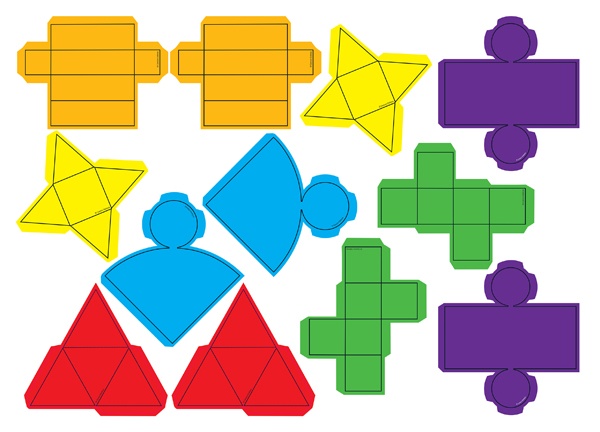
15 questions
Nets of 3D Figures
Quiz
•
4th - 7th Grade

10 questions
Nets of Three Dimensional Shapes
Quiz
•
2nd Grade

12 questions
NETS OF 3-D SHAPES
Quiz
•
2nd Grade

10 questions
Classifying 3D Figures by Edges, Vertices, Faces, and Nets
Quiz
•
1st - 2nd Grade

45 questions
Solids and Nets of 3D Figures
Quiz
•
5th Grade
6 questions
Nets of Figures
Quiz
•
4th - 6th Grade
19 questions
Nets of 3D shapes
Quiz
•
4th Grade
10 questions
3D Shapes
Quiz
•
1st Grade
15 questions
3D Figures Combined Figures
Quiz
•
1st Grade
22 questions
2D and 3D Shapes
Quiz
•
1st Grade
14 questions
3D Figures
Quiz
•
1st - 2nd Grade
Explore Nets of 3d Figures Quizzes
Nets of 3D figures represent a fundamental concept in geometry where students learn to visualize and understand how three-dimensional shapes can be unfolded into two-dimensional patterns. Our comprehensive quiz collection provides targeted assessment opportunities that help students master the challenging skill of identifying which flat patterns can fold into specific 3D shapes like cubes, pyramids, prisms, and cylinders. These practice questions develop critical spatial reasoning abilities as students work through problems involving surface area calculations, shape recognition, and the relationship between 2D and 3D representations. The quizzes offer immediate feedback to reinforce understanding of how faces, edges, and vertices connect when transitioning between net diagrams and their corresponding solid figures. Wayground supports mathematics educators with access to millions of teacher-created quiz resources specifically designed for geometry instruction and nets of 3D figures. Teachers can efficiently search and filter through extensive question banks that align with curriculum standards, allowing them to select assessments that match their students' specific learning needs and skill levels. The platform's differentiation tools enable educators to customize quiz difficulty, adjust time limits, and modify question types to accommodate diverse learning styles within their classrooms. These digital-first quiz formats facilitate both individual practice sessions and collaborative learning environments, while supporting teachers' planning efforts for remediation, enrichment, and ongoing skill reinforcement throughout their geometry units.
FAQs
How can I introduce the concept of 3D figure nets?
Start with a hands-on activity. Give students a small, empty box (like for cereal or tissues) and have them carefully unfold it to reveal its flat 2D net. This tangible experience makes the abstract connection between the 2D pattern and the 3D shape concrete before they move to quizzes.
What exercises help students practice identifying nets?
Effective practice moves from simple to complex. Start with matching a 3D shape to its correct net from a few options. Progress to "will it fold?" exercises where students must analyze a 2D pattern to determine if it will form a closed 3D shape. Finally, challenge them to draw multiple different nets for the same solid, such as a cube.
What are common mistakes students make when working with nets?
A frequent error is misidentifying which 2D patterns can actually fold into a closed 3D shape. For example, students may not recognize that a valid net for a cube requires faces to be arranged so they don't overlap when folded. Another common issue is confusing the nets for similar shapes, like prisms and pyramids.
How do nets of 3D figures fit into the Common Core math standards?
The Common Core State Standards introduce nets in middle school geometry, typically around 6th grade. This topic directly supports the standard of representing three-dimensional figures using two-dimensional nets. It builds a crucial foundation for the later skill of calculating the surface area of these figures by adding up the areas of each face in the net.
How can I use this nets of 3D figures quiz with my class?
Wayground quizzes are flexible for any classroom setup. You can assign them as an interactive digital activity on the platform or download a printable PDF for hands-on paper practice. Every quiz includes a complete answer key for quick grading and feedback.
How can I differentiate this topic for diverse learners?
For students who need support with the visual-spatial aspect, use Wayground's digital "Read Aloud" feature for any accompanying text or provide physical cut-outs of nets to manipulate. To challenge advanced learners, ask them to calculate the surface area from a given net or design their own nets for more complex polyhedra.

Accessibility
Features
Wayground Super
School & District
Wayground for Business
Create a quiz
Create a presentation
Wayground AI
Subjects
Mathematics
Social Studies
Science
Physics
Chemistry
Biology
About
Our Story
Wayground Blog
Media Kit
Careers
Support
F.A.Q.
Help & Support
Privacy Policy
Terms of Service
Teacher Resources
2026 Wayground


Get our app

