


Nets Quizzes
Test your understanding of nets with this interactive geometry quiz featuring practice questions and instant feedback. Assess your ability to identify, visualize, and work with two-dimensional representations of three-dimensional shapes through self-paced assessment.

20 questions
Triangle, 3D Shapes and Nets Test

Quiz
•
5th Grade

14 questions
Nets of 3D Figures
Quiz
•
5th - 6th Grade
15 questions
Nets of 3D Figures
Quiz
•
4th - 7th Grade

20 questions
Nets and Cross Sections of Three Dimensional Shapes
Quiz
•
3rd Grade

20 questions
3D shapes & nets
Quiz
•
5th Grade

10 questions
Nets of Three Dimensional Shapes
Quiz
•
2nd Grade
12 questions
NETS OF 3-D SHAPES
Quiz
•
2nd Grade
10 questions
Nets of Cube
Quiz
•
1st - 5th Grade
23 questions
Solids and Nets
Quiz
•
5th - 6th Grade
10 questions
Classifying 3D Figures by Edges, Vertices, Faces, and Nets
Quiz
•
1st - 2nd Grade
10 questions
Nets
Quiz
•
3rd - 5th Grade
45 questions
Solids and Nets of 3D Figures
Quiz
•
5th Grade
Browse by grade
Explore Nets Quizzes
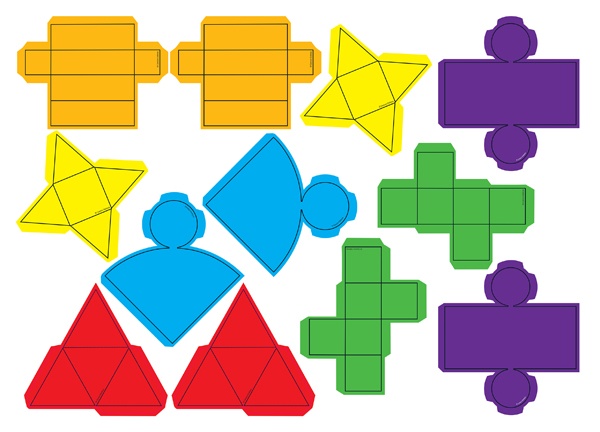
Nets in geometry represent the two-dimensional patterns that can be folded to create three-dimensional shapes, forming a crucial bridge between flat surfaces and spatial visualization. Wayground's comprehensive collection of nets quizzes provides targeted assessment opportunities that help students develop essential spatial reasoning skills while mastering the relationship between 2D patterns and 3D objects. These practice questions challenge learners to identify correct nets for various polyhedra, analyze folding patterns, and visualize how flat surfaces transform into geometric solids. Through immediate feedback and varied question formats, students strengthen their understanding of surface area concepts, geometric properties, and the fundamental connections between different dimensional representations in mathematics. Wayground's extensive library draws from millions of teacher-created resources, offering educators powerful search and filtering capabilities to locate nets quizzes that align with specific curriculum standards and learning objectives. Teachers can customize existing assessments or combine multiple quiz elements to create differentiated experiences that meet diverse student needs, from foundational net identification to advanced spatial reasoning challenges. The platform's flexible digital delivery formats support both individual practice sessions and collaborative classroom activities, while comprehensive analytics help educators identify areas requiring remediation or enrichment. These tools enable mathematics instructors to systematically build students' geometric visualization skills, track progress in spatial understanding, and provide targeted support for learners who struggle with the transition from two-dimensional patterns to three-dimensional thinking.
FAQs
How can I introduce the concept of geometric nets to my students?
Start with a hands-on activity. Bring in small, empty cardboard boxes (like for tea or granola bars) and have students carefully unfold them to reveal their 2D nets. This tangible experience helps make the abstract connection between a 3D object and its flat pattern concrete and memorable.
What types of problems help students practice working with nets?
Effective practice moves from concrete to abstract. Start with identifying the 3D solid a given net will form. Progress to identifying which of several patterns is a valid net for a shape. Finally, challenge students to use a net to calculate the surface area of the corresponding 3D figure.
What's a common mistake students make when identifying nets?
A frequent error is failing to visualize how the net folds, leading to incorrect assumptions about which faces will connect. Students often select nets that have overlapping faces or that leave gaps when folded. For example, they might not recognize that two faces on opposite ends of a long strip will overlap instead of forming the top and bottom of a prism.
How do geometric nets fit into the Common Core math standards?
The study of nets is a key component of the Common Core's geometry progression, primarily addressed in 6th grade. It directly supports the standard of representing three-dimensional figures using two-dimensional nets and using those nets to find surface area. This skill builds on elementary students' work with shapes and provides a foundation for later understanding of volume and more complex geometric properties.
How can I use this nets quiz with my class?
This quiz is designed for flexible use in any classroom. You can assign it as an interactive digital quiz on Wayground for immediate feedback, or you can download the printable PDF for hands-on practice. Every quiz includes a complete answer key, simplifying both instruction and assessment.

Accessibility
Features
Wayground Super
School & District
Wayground for Business
Create a quiz
Create a presentation
Wayground AI
Subjects
Mathematics
Social Studies
Science
Physics
Chemistry
Biology
About
Our Story
Wayground Blog
Media Kit
Careers
Support
F.A.Q.
Help & Support
Privacy Policy
Terms of Service
Teacher Resources
2026 Wayground


Get our app

