


Quadrilateral Hierarchy Quizzes
Test your understanding of quadrilateral hierarchy with this comprehensive mathematics quiz designed to assess your knowledge of how different four-sided shapes relate to one another. Practice identifying relationships between squares, rectangles, rhombuses, parallelograms, and trapezoids through targeted questions with instant feedback.
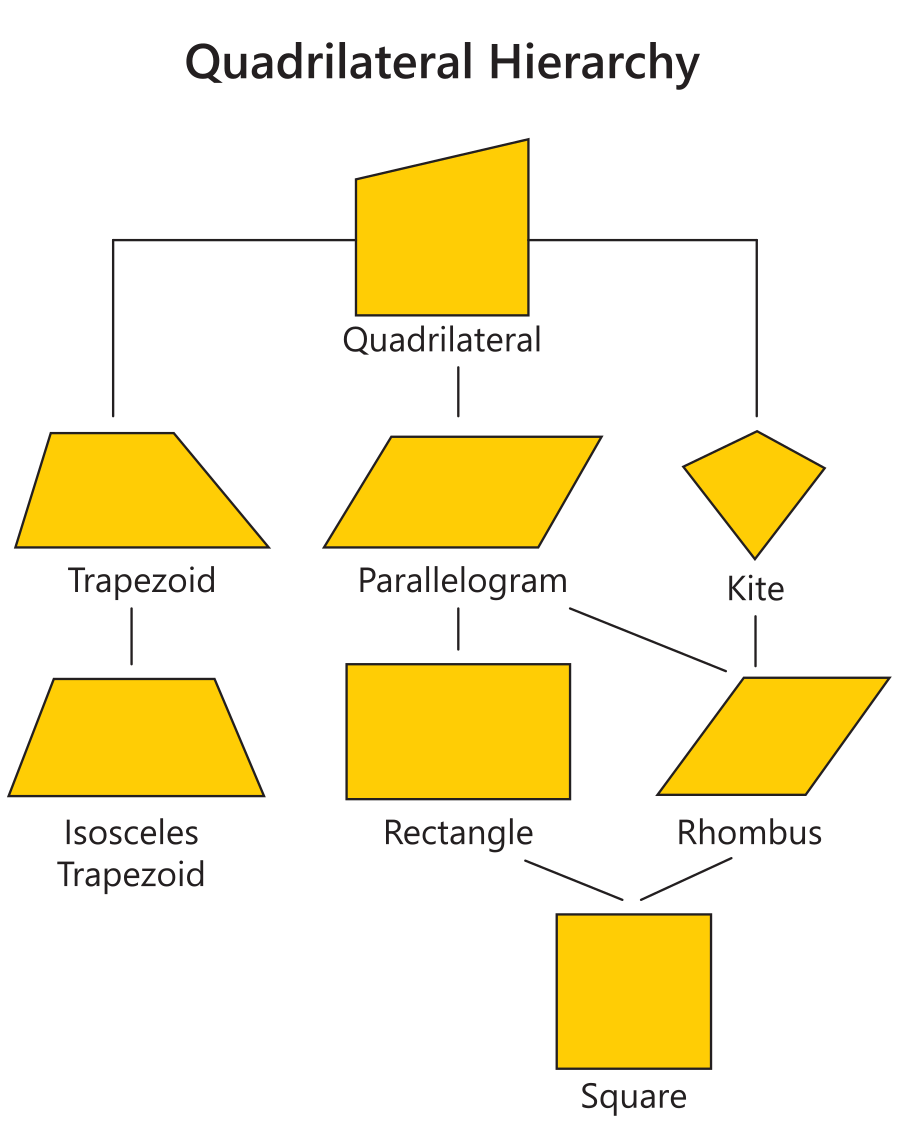
10 questions
Quadrilateral Hierarchy

Quiz
•
5th Grade

20 questions
Blank Quadrilateral Hierarchy
Quiz
•
5th Grade

12 questions
Quadrilateral Hierarchy
Quiz
•
5th Grade

19 questions
Quadrilateral Hierarchy
Quiz
•
4th - 6th Grade

20 questions
Quadrilateral Hierarchy
Quiz
•
5th Grade

20 questions
Quadrilateral Hierarchy
Quiz
•
5th Grade
20 questions
Hierarchy of Quadrilaterals
Quiz
•
5th Grade
10 questions
Quadrilateral Hierarchy
Quiz
•
5th Grade
20 questions
Quadrilateral Identification
Quiz
•
3rd Grade
15 questions
Classifying Quadrilaterals and Review
Quiz
•
3rd Grade
8 questions
Choosing Quadrilaterals
Quiz
•
3rd Grade
20 questions
Categorizing Quadrilaterals
Quiz
•
3rd Grade
Explore Quadrilateral Hierarchy Quizzes
Quadrilateral hierarchy forms a fundamental framework in geometry education, where students explore the relationships and classifications among four-sided polygons. Wayground's comprehensive quiz collection provides targeted assessment opportunities that help students master the intricate connections between parallelograms, rectangles, rhombuses, squares, trapezoids, and kites. These practice questions systematically build understanding of how geometric properties determine classification, enabling students to analyze characteristics such as parallel sides, equal angles, and congruent segments. Through immediate feedback and varied question formats, students develop critical thinking skills necessary to identify, compare, and justify quadrilateral relationships while strengthening their geometric reasoning abilities. Wayground supports mathematics educators with access to millions of teacher-created quiz resources specifically designed to address quadrilateral hierarchy concepts across multiple grade levels and learning objectives. The platform's robust search and filtering capabilities enable teachers to locate standards-aligned assessments that match their specific curriculum requirements, whether focusing on basic shape identification or advanced proof-based reasoning. Customization tools allow educators to differentiate instruction by modifying difficulty levels, adjusting time limits, and selecting question types that best serve diverse learning needs. These digital-first quiz formats provide flexible delivery options for classroom instruction, homework assignments, and remediation activities, empowering teachers to reinforce geometric concepts, identify learning gaps, and provide targeted enrichment opportunities that deepen student comprehension of quadrilateral relationships and properties.
FAQs
How can I teach the quadrilateral hierarchy effectively?
Focus on a property-based approach. Instead of memorizing a chart, have students analyze shapes based on attributes like parallel sides, right angles, and congruent sides. Use visual aids like Venn diagrams to show how categories overlap, for example, demonstrating that the set of squares is a subset of both rectangles and rhombuses.
What exercises help students practice classifying quadrilaterals?
Effective practice moves beyond simple identification. Use sorting activities where students group shapes by properties. "Always, Sometimes, Never" questions are also powerful for testing conceptual understanding (e.g., "A rectangle is _sometimes_ a square").
What are the most common student misconceptions with the quadrilateral hierarchy?
The most common error is treating the categories as mutually exclusive. Students often resist the idea that a square is also a rectangle and a rhombus. They learn visual prototypes and struggle when a shape fits multiple definitions. Emphasize that a square is a *special* or *more specific* type of rectangle.
How does understanding the quadrilateral hierarchy fit into the math curriculum?
This topic is a key part of geometric reasoning within the Common Core State Standards. It begins in early grades with shape identification and progresses to classifying two-dimensional figures in a hierarchy based on their properties in upper elementary and middle school. This skill lays the groundwork for more formal geometric proofs and deductive reasoning.
How can I support students who struggle with the abstract nature of shape hierarchies?
For students who find the vocabulary and logic challenging, use Wayground's digital quiz accommodations. You can enable Read Aloud to help with terms like "parallelogram" and "rhombus," or use Reduced Answer Choices on sorting questions to lower the cognitive load and help them focus on the key properties of each shape.
How can I use this quadrilateral hierarchy quiz in my class?
This quiz can be assigned as an interactive digital quiz on Wayground or downloaded as a printable PDF for in-class work or homework. A complete answer key is included with every quiz, allowing for quick grading and student feedback.

Accessibility
Features
Wayground Super
School & District
Wayground for Business
Create a quiz
Create a presentation
Wayground AI
Subjects
Mathematics
Social Studies
Science
Physics
Chemistry
Biology
About
Our Story
Wayground Blog
Media Kit
Careers
Support
F.A.Q.
Help & Support
Privacy Policy
Terms of Service
Teacher Resources
2026 Wayground


Get our app

