

4th Grade Nets of 3d Figures Quizzes
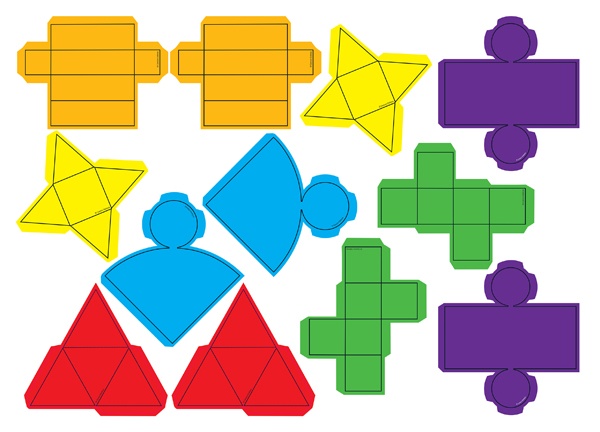
Test your Grade 4 understanding of nets of 3D figures with this interactive quiz designed to assess your ability to identify and work with two-dimensional patterns that fold into three-dimensional shapes. Practice questions provide instant feedback as you explore how squares, triangles, and other flat shapes combine to create cubes, pyramids, and prisms.
15 questions
Nets of 3D Figures

Quiz
•
4th - 7th Grade

6 questions
Nets of Figures
Quiz
•
4th - 6th Grade

19 questions
Nets of 3D shapes
Quiz
•
4th Grade

10 questions
Nets
Quiz
•
3rd - 5th Grade

20 questions
Characteristics of 3D Shapes
Quiz
•
2nd Grade

13 questions
3D Figures and Attributes
Quiz
•
3rd Grade
8 questions
Solid Figure Nets
Quiz
•
4th Grade
15 questions
3d shapes Whole Group End
Quiz
•
4th Grade
Explore 4th Grade Nets of 3d Figures Quizzes
Nets of 3D figures form a fundamental component of Grade 4 geometry education, helping students visualize and understand the relationship between two-dimensional patterns and three-dimensional shapes. Wayground's comprehensive quiz collection provides targeted assessment tools that allow students to practice identifying, analyzing, and constructing nets for various geometric solids including cubes, rectangular prisms, pyramids, and cylinders. These interactive practice questions develop crucial spatial reasoning skills while offering immediate feedback that reinforces understanding of how flat patterns fold into solid figures. Students engage with problems that require them to recognize which nets will successfully form specific 3D shapes, predict missing faces in incomplete nets, and demonstrate their comprehension through varied question formats that build confidence in geometric visualization. Wayground supports educators with access to millions of teacher-created quiz resources specifically designed for elementary geometry instruction, featuring robust search and filtering capabilities that make it easy to locate age-appropriate content aligned with grade-level standards. Teachers can customize existing assessments or create new ones using flexible digital delivery formats that accommodate diverse learning environments, from whole-class instruction to individual practice sessions. The platform's differentiation tools enable educators to modify difficulty levels and question types to meet varying student needs, supporting both remediation for struggling learners and enrichment opportunities for advanced students. These comprehensive quiz collections serve as valuable resources for formative assessment, homework assignments, review sessions, and skill reinforcement activities that strengthen students' geometric thinking and prepare them for more advanced spatial concepts in upper elementary grades.
FAQs
How do I teach nets of 3D figures to fourth graders?
Start with a familiar box: trace its faces, cut along selected edges, and unfold it into a flat net. Have students label matching faces and edges before predicting which patterns will fold into cubes, rectangular prisms, triangular prisms, or pyramids.
What exercises help Grade 4 students practice nets of 3D figures?
Use a progression of three tasks: match a net to its solid, eliminate nets that cannot fold correctly, and draw a net for a given figure. Let students cut out selected patterns to test their predictions and connect mental visualization with hands-on evidence.
What mistakes do students make when identifying nets of 3D figures?
Students often count the correct number of faces but overlook their arrangement. They may choose a cube net with overlapping faces, attach a prism's bases in incompatible positions, or confuse the faces that become opposite when folded.
How can I use these Grade 4 nets of 3D figures quizzes?
Assign a quiz on Wayground as a digital quiz for immediate classroom practice, or download a printable PDF for hands-on folding and offline work. Every quiz includes a complete answer key for checking students' predictions and drawings.
How do nets of 3D figures fit into the Grade 4 math curriculum?
This topic supports Common Core's Grade 4 geometry emphasis on analyzing and classifying shapes by their properties. It builds from recognizing two-dimensional faces and moves toward explaining how those faces connect to form cubes, prisms, and pyramids.
How can I differentiate nets-of-3D-figures practice?
Give students who need concrete support a large-print version with wider spacing so they can label, cut, and fold each face more easily. On digital assignments, Read Aloud can clarify directions, while extended time gives students room to mentally rotate and test each net.
What grade do students learn about nets of 3D figures?
Nets are commonly introduced in upper elementary geometry; this collection is designed for Grade 4. At this stage, students use their knowledge of faces and edges to connect flat patterns with familiar three-dimensional solids.

Accessibility
Features
Wayground Super
School & District
Wayground for Business
Create a quiz
Create a presentation
Wayground AI
Subjects
Mathematics
Social Studies
Science
Physics
Chemistry
Biology
About
Our Story
Wayground Blog
Media Kit
Careers
Support
F.A.Q.
Help & Support
Privacy Policy
Terms of Service
Teacher Resources
2026 Wayground


Get our app

