

Stage Directions

Presentation
•
Arts
•
6th Grade
•
Practice Problem
•
Medium

Sherri Angelotti
Used 162+ times
FREE Resource
15 Slides • 9 Questions
1
Stage Directions
2
3
4
Multiple Select
5
6
7
Multiple Select
8
Multiple Select
9

10
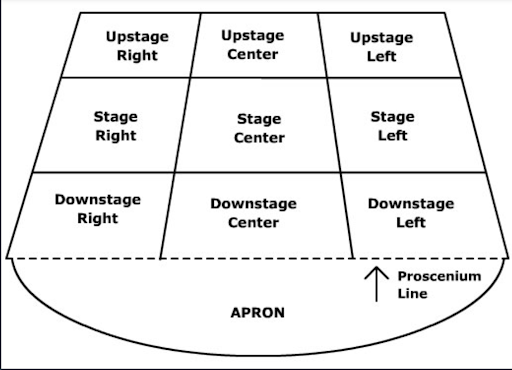
Areas of the stage are based on the actor facing the audience.
So, if you are standing in the center of the stage facing the audience, stage right would be on your right (the audience’s left).
11
Areas of the stage are based on the actor facing the audience.
Downstage would be in front of you toward the audience, Upstage would be behind you away from the audience.
12
Multiple Choice
13
Multiple Select
14
History of stage directions:
In the 1500s, theater stages were raked. Raked meant that the stage was built to slant or slope upwards, away from the audience.
This was done to improve the view and sound for audience.

15
Multiple Choice
16
On a raked stage an actor who is farther from the audience is higher than an actor who is closer to the audience.
This led to "upstage" meaning farther from the audience and "downstage" meaning closer to the audience.

17

18

19
If our actor is center stage and is told to cross downstage left, where would the actor end up?
Find the answer then fill it in the next slide.

20
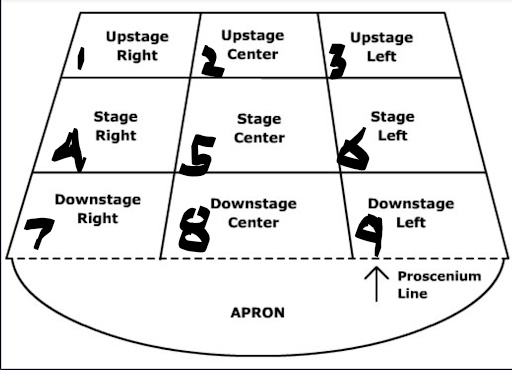
If our actor is Downstage left and is told to cross stage right, where would the actor end up?
21
Multiple Choice

If our actor is Downstage left and is told to cross stage right, where would the actor end up?
22
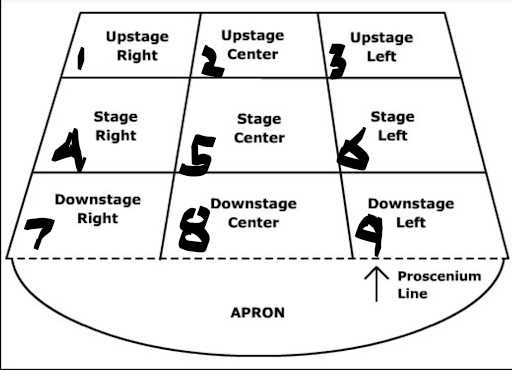
If the director wants our actor all the way on the left side of the stage and halfway between the audience and back of the stage, where would the actor end up?
23
Multiple Choice

If the director wants our actor all the way on the left side of the stage and halfway between the audience and back of the stage, where would the actor end up?
24
Multiple Choice

If our actor is center stage and is told to cross downstage left, on what number would the actor end up?
Stage Directions
Show answer
Auto Play
Slide 1 / 24
SLIDE

