Newton's Laws
Presentation
•
Science
•
9th - 12th Grade
•
Practice Problem
•
Easy
Standards-aligned
Leslie Dunham
Used 9+ times
FREE Resource
13 Slides • 20 Questions
1
Newton's Laws
2
Newton's 1st Law
(Law of Inertia)
"An object in motion stays in motion and an object at rest stays at rest UNLESS acted upon by an UNBALANCED force."
Mass = Inertia (more mass means more inertia)
3
Multiple Choice
Inertia depends on ______
Velocity
Speed
Distance
Mass
4
Multiple Choice
A skateboard rolls down a hill, reaches the level surface and eventually comes to a stop. The fact that the skateboard ultimately stops is best explained by ____.
an unbalanced force would be required to keep the sled moving forward at constant speed
the presence of an unbalanced force (e.g., friction) can cause a moving object to stop
the presence of inertia causes it to stop
the natural tendency of any object is to ultimately stop
5
Multiple Choice
An astronaut kicks a soccer ball in outer space at a location far from significant influences of gravity and air resistance. The soccer ball will _________.
continue in motion with the same speed and direction
eventually stop as its inertia slowly becomes used up
eventually stop since all objects ultimately "lose their steam"
either a, b, or c -- depending on whether the astronaut continues to kick it
6
Multiple Choice
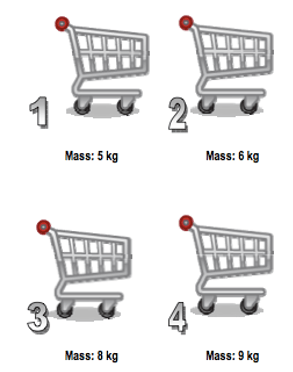
List the objects in order from least to greatest inertia.
CDBA
ABCD
BCDA
CBAD
7
Newton's 2nd Law
(Law of Acceleration)
An object's acceleration is PROPORTIONAL to the Force it expereinces (more force, more acceleration)
An object's acceleration is INVERSELY PROPORTIONAL to its mass (more mass, less acceleration)
8
Newton's 2nd Law
Fnet = ma
a = mFnet
m = aFnet
The man applies 400 N of force to each ball. What is the acceleration of each ball?
9
Newton's 2nd Law
Weight is a force calculated using Newton's 2nd Law (measured in Newtons)
Fg=mg
Fg = weight or force of gravity
m = mass
g = acceleration due to gravity (10 m/s/s on Earth)
10
Multiple Choice
True or False. Acceleration of an object is directly proportional to the net force acting on it
True
False
11
Multiple Choice
Your car has a mass of 2500 kg and a force of 5000 N. How fast will it accelerate?
20 m/s2
0.5 m/s2
2 m/s2
120 N
12
Multiple Choice
13
Multiple Choice
A 25 kg bike accelerates at 10 m/s2. What was the force?
250 N
2.5 N
25 N
15 N
14
Multiple Choice
If the man pushes with an equal amount of force, which object will accelerate more?
Car because it has more mass
Lawnmower because it has less mass
Car because it has less mass
Lawnmower because it has more mass
15
Multiple Choice
What is the weight of a 25 kg object on Earth?
2.5 N
25 N
250 N
2500 N
16
17
Newton's 3rd Law
(Law of Action-Reaction)
"For every force there is an equal and opposite force."
18
Newton's 3rd Law
All forces come in pairs.
If you push down on the Earth, it pushes up on you with exactly the same amount of force.
19
Poll
A bug hits the schoolbus windshield on your ride. What is true of the forces experienced by the bug and the bus windshield?
The bug experiences more force
The bus windshield experiences more force
The bug and the bus windshield experience the exact same amount of force
20
They experience the same force!
Don't confuse the force with the EFFECT of the force...
We know the bug is probably going to get smushed but the bus is fine...that goes back to Newton's 2nd Law!
21
Newton's 3rd Law
Example:
Action force: Your foot pushes down on the earth with 400 N of force.
Reaction force: The earth pushes up on your foot with 400 N of force.
RESULT - you get accelerated forward a lot because you have less mass than the Earth!
22
23
Action - Reaction Pairs
To determine the action-reaction pair and direction, just switch the objects and think about the opposite direction.
Example:
Action: I push forward on a box.
Reaction: The box pushes backwards on me.
24
25
Multiple Choice
26
Multiple Choice
When a person is skateboarding, their leg is pushing BACKWARD against the ground. In turn, the ground pushes __________ against their foot allowing them to skateboard.
DOWN
UP
FORWARD
BACKWARD
27
Multiple Choice
When a bird is flying, their wings are pushing DOWN against the air. In turn, the air pushes __________ against their wings allowing them to fly.
DOWN
UP
FORWARD
BACKWARD
28
Multiple Choice
29
Multiple Choice
When a heavy football player and a light one run into each other, who exerts more force
The light one
Their force are equal
The heavy one
30
Multiple Choice
31
Multiple Choice
32
Multiple Choice
33
Multiple Choice
Newton's Laws

Show answer
Auto Play
Slide 1 / 33
SLIDE

Similar Resources on Wayground
30 questions
Evidence of Evolution
Presentation
•
9th - 12th Grade
30 questions
Eukaryotic Cell Structure
Presentation
•
9th - 12th Grade
25 questions
Biome Quiz Review
Presentation
•
9th - 12th Grade
24 questions
Ecology
Presentation
•
10th - 12th Grade
24 questions
Cell Cycle: Checkpoints and Cancer
Presentation
•
9th - 12th Grade
23 questions
Forensics: Observation
Presentation
•
9th - 12th Grade
23 questions
Plastic Pollution Awareness
Presentation
•
KG - 12th Grade
25 questions
Bohr Models
Presentation
•
10th - 12th Grade
Popular Resources on Wayground
6 questions
Secondary Safety Quiz
Presentation
•
9th - 12th Grade
10 questions
Afterschool Activities & Sports
Quiz
•
6th - 8th Grade
19 questions
ROAR Week 2026
Quiz
•
9th - 12th Grade
20 questions
Lab Safety Quiz
Quiz
•
6th Grade
15 questions
Cool Tool:Chromebook
Quiz
•
6th - 8th Grade
22 questions
would you rather
Quiz
•
3rd - 11th Grade
21 questions
Continents and Oceans
Quiz
•
6th Grade
20 questions
Parts of Speech
Quiz
•
5th Grade
Discover more resources for Science
10 questions
Scientific Method (The scientific method)
Interactive video
•
9th Grade
9 questions
Scientific method
Interactive video
•
9th - 12th Grade
10 questions
Lab Safety Essentials
Interactive video
•
6th - 10th Grade
10 questions
Essential Guidelines for Science Lab Safety
Interactive video
•
6th - 10th Grade
20 questions
States of Matter Quick Check
Quiz
•
9th Grade
14 questions
Flinn Lab Safety
Quiz
•
9th - 12th Grade
10 questions
Exploring the Steps of the Scientific Method for Kids
Interactive video
•
6th - 10th Grade
35 questions
Flinn Lab Safety
Quiz
•
11th Grade