Wave motion CXC
Presentation
•
Physics
•
10th - 12th Grade
•
Medium
Standards-aligned
r Henderson
Used 12+ times
FREE Resource
15 Slides • 35 Questions
1
Wave motion CXC
2
Wave motion
Waves is defined as the propagation of a disturbance that carries the energy and momentum away from the sources of disturbance.
3
Objective :-Students should be able to:
differentiate between types of waves;
4
Waves can be classified based on
topology:- sine wave, square wave, saw tooth wave, etc
transfer of energy :- progressive (travelling) wave or stationary (standing) wave
vibration of particles:- Transverse or longitudinal wave
5
Topology
how the wave looks
6
Net energy transfer
Progressive or travelling wave
standing or stationary wave
7
Vibration of particles
transverse wave: Particles move back and forth perpendicular to wave motion- eg water waves., electromagnetic waves.
longitudinal wave:-Particles move back and forth in direction of wave motion eg sound waves
8
Transverse waves
Particles move back and forth perpendicular to wave motion- eg water waves., electromagnetic waves.
9
Longitudinal waves
Particles move back and forth in direction of wave motion eg sound waves.
10
Multiple Choice
The highest part of a transverse wave is
the crest
the trough
the wave point
the hotel transylvania
11
Multiple Choice
The lowest part of a transverse wave are the
crests
troughs
wave points
low nodules
12
Multiple Choice
The distance between two corresponding parts of a wave is its
amplitude
frequency
wavelength
velocity
13
Multiple Choice
The height of the wave from its resting point is called its
wavelength
amplitude
velocity
frequency
14
Multiple Choice
15
Multiple Choice
Sound waves are which type of waves?
transverse
seismic
longitudinal
frequency
16
Multiple Choice
Electromagnetic waves are which type of waves?
transverse
seismic
longitudinal
frequency
17
Multiple Choice
crest to crest or trough to trough
crest
trough
amplitude
wavelength
18
Multiple Choice
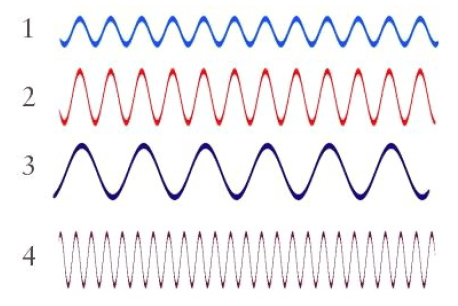
Which wave in the diagram has the greatest wavelength?
1
2
3
4
19
Multiple Choice
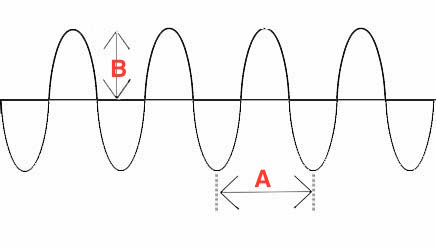
What property of this wave is represented by the letter "A"
amplitude
crest
trough
wavelength
20
Multiple Choice
What is the wavelength of this wave?
3
10
4
8
21
Multiple Choice
What is the amplitude of this wave?
3
-3
6
4
22
Multiple Choice
Longitudinal waves move:
at a right angle compared to the direction the wave is traveling
in a circle compared to the direction the wave is traveling
matter
in the same direction as the wave is traveling
23
Multiple Choice
A wave that appears not to move and to stay in one place is called a _____.
standing wave
longitudinal wave
transverse wave
seismic wave
24
Multiple Choice
True or False - Waves carry the medium, not energy.
true
false
25
Multiple Choice
A disturbance that transfers energy from one place to another. Only energy , not matter, is transferred.
wave
trough
pitch
sound
26
Multiple Choice
27
Multiple Choice
28
Multiple Choice
What type of wave is this?
Transverse
Longitudinal
29
Multiple Choice
What is the amplitude of the wave?
3 cm
8 cm
16 cm
24 cm
30
Multiple Choice
What does a wave carry from place to place?
energy
matter
people
31
Multiple Choice
Transverse waves have:
crests and troughs
troughs and rarefactions
compressions and contractions
rarefactions and crests
32
Multiple Choice
Longitudinal waves have:
crests and troughs
crests and compressions
compressions and rarefactions
troughs and rarefactions
33
Wave motion
Wave Parameters :-the different ways in which we characterize waves
34
Objective :-Students should be able to:
apply speed, frequency, wavelength, period and amplitude;
represent transverse and longitudinal waves in displacement position and displacement-time graphs.
35
Wave parameter
Crest
Trough
Height
Wavelength
Period
Frequency
speed
36
Wave parameter
Period: -is the time it takes a wave to complete one cycle. We measure the period in seconds, and we symbolize it with the capital letter T.
frequency:-is the number of cycles that are completed in a certain amount of time. The symbol for frequency is the lowercase f, and we measure it in cycles per second, which is the same as the unit hertz. A wave with a frequency of 20 Hz completes 20 wave cycles every second.
Amplitude:-the distance between the midline of a wave and its crest or trough
speed:- refers to how fast the wave is moving
wavelength: the distance, measured in the direction of propagation of a wave, between two successive points in the wave that are characterized by the same phase of oscillation.
37
38
Multiple Choice
39
Multiple Choice
A pendulum makes exactly 40 0scillations in 25s. Determine the Frequency!
2,4 hz
2,2 Hz
1,8 Hz
1,6 Hz
40
Multiple Choice
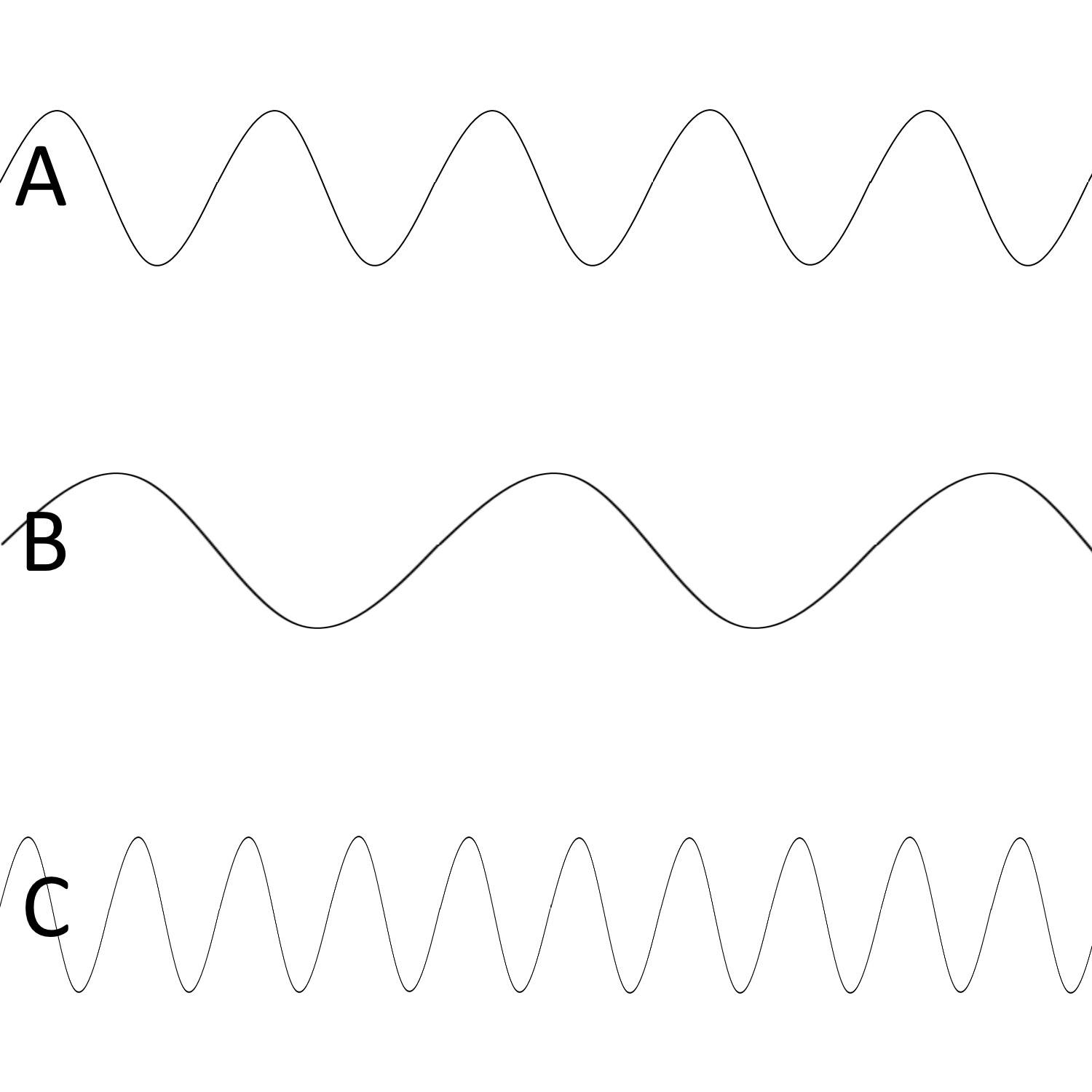
Examine the picture. What is the period of 1 wavelength?
8 seconds
1/8 sec
1/8 Hz
8 Hz
41
Multiple Choice
The period of a wave is 4 seconds. What is the frequency?
1/4 Hz
1/4 sec
4 Hz
2 Hz
42
43
Multiple Choice
How often a wave occurs is the wave's
frequency
amplitude
wavelength
velocity
44
Multiple Choice
What is the wavelength of the wave?
3 cm
8 cm
16 cm
24 cm
45
Multiple Choice
A wave with a wavelength of 42.0 m and a frequency of 250. Hz will be traveling at _____.
10,500 m/s
5.95 m/s
0.168 m/s
none of these
46
Multiple Choice
A wave traveling at 300,000,000 m/s with a frequency of 104,100,000 Hz has a wavelength of _____.
2.88 m
0.347 m
3.12 x 10¹⁶ m
none of these
47
Multiple Choice
A wave traveling at 340. m/s with a wavelength of 7.65 m will have a frequency of _____.
44.4 Hz
0.0225 Hz
2,601 Hz
none of these
48
Multiple Choice
If a wave is traveling at 260 m/s and has a wavelength of 0.8 m, what is its frequency?
208 Hz
325 Hz
430 Hz
160 Hz
49
Multiple Choice
A wave has frequency of 5 Hz and a speed of 25 m/s. What is the wavelength of the wave?
25 m
125 m
5 m
25 m/s
50
Multiple Choice
A guitar string vibrates with a frequency of 320 hz. If the wavelength of the vibration is 0.23 meters what is the speed of the wave?
320.23 m/s
1391.3 hz
73.6 m/hz
73.6 m/s
Wave motion CXC
Show answer
Auto Play
Slide 1 / 50
SLIDE

Similar Resources on Wayground
46 questions
Simple Harmonic Motion & Spring Pendulum Notes
Presentation
•
9th - 11th Grade
45 questions
Motor effect
Presentation
•
10th - 11th Grade
46 questions
Newton's Three Laws of Motion Class Lesson
Presentation
•
9th - 12th Grade
44 questions
6th Grade Chapter 4
Presentation
•
KG - University
48 questions
Biogeochemical Cycles: Nutrient Cycles
Presentation
•
9th - 12th Grade
44 questions
Irregular Present Tense Verbs
Presentation
•
9th - 12th Grade
46 questions
Biomolecule terms - photosynthesis and respiration
Presentation
•
9th - 12th Grade
44 questions
Properties of Water
Presentation
•
9th - 12th Grade
Popular Resources on Wayground
20 questions
STAAR Review Quiz #3
Quiz
•
8th Grade
20 questions
Equivalent Fractions
Quiz
•
3rd Grade
6 questions
Marshmallow Farm Quiz
Quiz
•
2nd - 5th Grade
20 questions
Main Idea and Details
Quiz
•
5th Grade
20 questions
Context Clues
Quiz
•
6th Grade
20 questions
Inferences
Quiz
•
4th Grade
19 questions
Classifying Quadrilaterals
Quiz
•
3rd Grade
12 questions
What makes Nebraska's government unique?
Quiz
•
4th - 5th Grade