Search Header Logo
  1. Resource Library
  2. Science
  3. Earth & Space Science
  4. Relative Dating Fossils
  5. Relative Vs. Absolute Dating
Relative vs. Absolute Dating

Relative vs. Absolute Dating

Assessment

Presentation

•

Science

•

5th - 8th Grade

•

Practice Problem

•

Medium

•
NGSS
4-ESS1-1, 3-LS4-1, MS-ESS1-4

+3

Standards-aligned

Created by

Amy Zuber

Used 198+ times

FREE Resource

16 Slides • 33 Questions

1

Relative vs. Absolute Dating

Slide image

2

Open Ended

How do you think understanding the history of Earth helps us today?

3

Open Ended

Why do you think it is difficult to determine the age of our planet?

4

What is Dating?

  • When geologists date rocks, they are determining how long ago they formed

  • There are two ways to do this: Relative Dating and Absolute Dating

5

Relative Dating

  • When you give the age of a rock or fossil compared to another rock or fossil

  • An actual age in years is not determined: uses words like "older" "or younger" instead of exact numbers

  • Example: Rock A is OLDER than Rock B

6

Multiple Choice

How do geologists use relative dating?

1

Placing rocks in order from youngest to oldest

2

Placing rocks in order by minerals they contain

3

Classifying rocks by different textures

4

Classifying rocks by different isotopes

7

Law of Superposition

The principle that in undisturbed rock layers, the oldest rocks are on the bottom

Slide image

8

Multiple Choice

Question image

Which rock layer in the diagram seems to be the oldest?

1

F

2

E

3

B

4

A

9

Multiple Choice

Question image

According to the law of superposition, which layer is the youngest?

1

A

2

B

3

C

10

Multiple Choice

Relative dating of rock layers tells us that the deeper we dig, _______.

1

the younger the rocks get

2

the smellier the rocks get

3

the harder the rocks get

4

the older the rocks get

11

Law of Crosscutting

If an intrusion or a fault cuts through existing rocks, the intrusion/fault is YOUNGER than the rock it cuts through

Slide image

12

Multiple Choice

How does the law of crosscutting explain the age of a fault?
1
The fault is younger than the rocks above it.
2
The fault is younger than the rocks it cuts through.
3
The fault is older than the rocks above it.
4
The fault is older than the rocks it cuts through.

13

Multiple Choice

Question image

Which layer is YOUNGER? Layer E or Intrusion D?

1

Layer E

2

Intrusion D

14

Multiple Choice

Question image

Which layer is OLDER? Layer E or Intrusion A?

1

Layer E

2

Intrusion A

15

Law of Inclusion

If one rock body contains fragments of another rock body, it must be younger than the fragments of the rock.

Slide image

16

Multiple Choice

Older rocks contained within newer rocks are called...

1

intrusions

2

inclusions

3

fossils

4

faults

17

Absolute Dating

  • Any method of measuring the age of an event or object in years by looking at chemical properties

  • Uses numbers

18

Slide image

19

Multiple Choice

How does absolute age differ from relative age?

1

only absolute dating indicates which rock is older than another

2

only absolute dating finds the age in years

3

only relative dating finds the age in years

20

Carbon Dating

  • Living things use a special kind of carbon in their cells called C14, which is simply a carbon atom that is a little bit heavier than regular carbon.

  • When the organism dies, the C14 will begin to decay into a special kind of nitrogen called N14.

  • Every 5730 years, half of the C14 will decay into N14. This is known as a half-life.

  • By looking at what percent of C14 is in a fossil, scientists can determine the absolute age of when the organism died.

21

Slide image

22

Other Elements used in Radioactive Dating

Slide image

23

Multiple Choice

Question image

Which of the following items can be dated with carbon-14?

1

a. Ceramic pitcher

2

b. Diamond

3

c. Bones

4

d. Statue

24

Multiple Choice

What element is usually used to date fossils?
1
uranium-235
2
carbon-14
3
mercury-203
4
thorium-234

25

Poll

Using relative dating, we know that fossils in rock are older than the rock around them.

Which law supports this?

Law of Superposition

Law of Crosscutting

Law of Inclusion

26

Index Fossils

  • If a type of organism existed for only a short period of time, its fossils would show in a limited range of rock layers.

  • To be useful as an index fossil, it must be widely distributed and represent a type of organism that existed only briefly

27

Index Fossils

Fossils that are found in the rock layers of only one geological age, and can be used to establish the age of the rock layers.

Slide image

28

Multiple Choice

Question image
To be considered an index fossil, it had to have lived for a relatively short period of time.
1
True
2
False

29

Multiple Choice

Question image

Index fossils CAN tell us the age of a rock layer.

1

True

2

False

30

Relative vs. Abolsute Dating

Slide image

31

Multiple Choice

By saying "my dad is 48 and I am 13", it would be...

1

relative dating

2

absolute dating

3

law of superposition

4

law of crosscutting

32

Multiple Choice

By saying: "I am older than my sister," is an example of which type of dating used in Geology:

1

Relative Dating

2

Absolute Dating

3

Chronological Sibling Timelies

4

Fossil Dating

33

What can we learn from this?

  • Absolute Dating helps us determine the age of the Earth. It also helps us determine when specific events in the history of the Earth happened (ex: extinction of dinosaurs)

  • Relative Dating can help us estimate the time span between major earthquakes, storms, tsunamis, etc. It can also help us determine the order the life forms developed on Earth.

34

Practice Questions!

35

Multiple Choice

Trilobites came before dinosaurs because they were found in a lower rock layer.

1

absolute dating

2

relative dating

36

Multiple Choice

The Earth is 4.6 billion years old.

1

absolute dating

2

relative dating

37

Multiple Choice

Question image
The diagram shows fossils in different rock layers. Which of these statements about the age of these fossils is most likely correct?
1
Fossil A and C are the same age
2
Fossil B is older than fossil C
3
Fossils A is older than fossil B
4
Fossil D is older than fossil C

38

Multiple Choice

Question image

In this diagram, what scientific law tells us that rock layer E is older than rock layer C?

1

Cross-cutting

2

Superposition

3

Inclusions

4

Unconformities

39

Multiple Choice

Question image

In the diagram, what scientific law tells us that rock layer D is older than rock layer B?

1

Cross-cutting

2

Inclusions

3

Superposition

4

Unconformities

40

Multiple Choice

Question image

In this diagram, what scientific law tells us that rock layer C is older than rock layer A?

1

Cross-cutting

2

Inclusions

3

Superposition

4

Unconformities

41

Multiple Choice

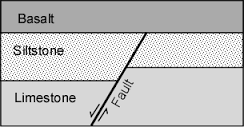
Question image

What are the relative ages of the features in order from oldest to youngest?

1

Limestone, Basalt, Fault, Siltstone

2

Siltstone, Fault, Basalt, Limestone

3

Limestone, Fault, Basalt, Siltstone

4

Limestone, Siltstone, Fault, Basalt

42

Multiple Choice

The Law of Superposition helps scientists to determine what?

1

The absolute age of rock layers

2

The age of fossils

3

The relative age of rock layers

4

the super powers of rocks

43

Multiple Choice

Used to determine whether an object is older or younger than other objects

1

Superposition

2

Relative Dating

3

Fossil

4

Unconformity

44

Multiple Choice

Scientists use carbon dating to measure...

1

relative age

2

absolute age

3

half-lives

4

time of day

45

Multiple Choice

Why can't carbon-14 dating be used on dinosaur remains?

1

The remains of living creatures cannot be accurately dated with carbon-14

2

The carbon-14 isotope did not exist during the age of the dinosaurs.

3

Dinosaurs were reptiles who had no carbon-14 in their systems.

4

Carbon dating is only accurate to 60,000 years ago-- well after the age of the dinosaurs.

46

Multiple Choice

What can you learn about an organism from the amount of carbon-14 in its remains?

1

How long ago it died.

2

What its diet consisted of.

3

Which biological kingdom it belonged to

4

Which living animals it's most closely related to.

47

Multiple Choice

The best index fossils have which two traits?

1

widespread geographically, long lifespan

2

widespread geographically, short lifespan

3

specific place, long lifespan

4

specific place, short lifespan

48

Multiple Choice

Question image

Which of these laws will NOT help to determine if something is an index fossil?

1

Easily recognizable

2

Lives only a short period of time

3

Should have many of the same fossils in many different layers of same outcrop

4

It is widespread

49

Poll

How do you feel about today's lesson?

I'm confused

I need more practice.

I'm a pro!

Relative vs. Absolute Dating

Slide image

Show answer

Auto Play

Slide 1 / 49

SLIDE