
CHAPTER 18 LESSON 1
Presentation
•
History
•
10th Grade
•
Practice Problem
•
Easy
Richard Orton
Used 5+ times
FREE Resource
26 Slides • 9 Questions
1
CHAPTER 18 LESSON 1
Europe in Crisis
2
ESSENTIAL QUESTION
What effect might social, economic, and religious conflicts have on a country?
3
Spain's Conflicts
By 1560, Calvinism and Catholicism had become highly militant, or combative, religions. They were aggressive in winning converts and in eliminating each other's authority. Their struggle was the chief cause of the religious wars that plagued Europe in the sixteenth century.
4
Spain's Militant Catholicism
The greatest supporter of militant Catholicism in the second half of the 1500s was King Philip II. He was the son of Charles V—the Holy Roman Emperor, King of Spain, and Archduke of Austria.
5
Spain's Militant Catholicism
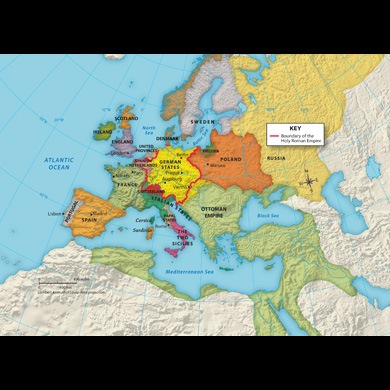
Philip II inherited the kingdoms of Milan, Naples, Sicily, the Netherlands, and Spain and its empire in the Americas from Charles V. Philip, who reigned from 1556 to 1598, ushered in an age of Spanish greatness. To strengthen his control, Philip insisted on strict conformity to Catholicism and strong monarchial authority. He also had the powerful Spanish navy at his command.
6
Spain's Militant Catholicism
Spain saw itself as a nation chosen by God to save Catholic Christianity from Protestant heretics. Philip II, the "Most Catholic King," championed Catholic causes. His actions led to spectacular victories and defeats. Spain's leadership of a Holy League against the Turks resulted in a stunning victory over the Turkish fleet in the Battle of Lepanto in 1571.
7
Open Ended
HUMAN SYSTEMS How might the distribution of Philip's empire have made it difficult to administer?
8
Open Ended
Movement What were some of the problems that an invading force like Spain might encounter as it tried to move many men and supplies over a long distance?
9
Resistance From the Netherlands
One of the richest parts of Philip's empire, the Spanish Netherlands, consisted of 17 provinces (modern-day Netherlands and Belgium). Philip's attempts to strengthen his control in this region caused resentment and opposition from the nobles of the Netherlands.
10
Resistance From the Netherlands
Philip faced growing resistance from the Dutch in the northern provinces led by William the Silent, the prince of Orange. The struggle dragged on until 1609 when a 12-year truce finally ended the war. The northern provinces began to call themselves the United Provinces of the Netherlands and became the core of the modern Dutch state
11
Protestantism in England
Elizabeth Tudor ascended the English throne in 1558. During her reign, the small island kingdom became the leader of the Protestant nations of Europe and laid the foundations for a world empire.
12
Protestantism in England
A new Act of Supremacy named Elizabeth as "the only supreme governor” of both church and state. The Church of England under Queen Elizabeth followed a moderate Protestantism that kept most people satisfied.
13
Defeat of the Spanish Armada
n 1588, Philip II made preparations to send an armada—a fleet of warships—to invade England. A successful invasion of England would mean the overthrow of Protestantism. The fleet that set sail had neither the ships nor the manpower that Philip had planned to send.
14
Defeat of the Spanish Armada
he armada was battered by the faster English ships and sailed back to Spain by a northern route around Scotland and Ireland where it was pounded by storms.
By the end of Philip's reign in 1598, Spain was not the great power that it appeared to be. Spain was the most populous empire in the world, but it was bankrupt
15
Open Ended
Why might the overthrow of Protestantism in England have been important to Philip II?
16
Multiple Choice
Why did Philip II attack England?
A.He wanted to overthrow Protestantism in England.
B.He thought Elizabeth I had become too powerful.
C.He did not believe in the Act of Supremacy.
D.He wanted to add England to his empire.
17
The French Wars of Religion
Of the sixteenth-century religious wars, none was more shattering than the French civil wars known as the French Wars of Religion (1562–1598). Religious conflict was at the center of these wars.
18
Huguenots
Huguenots (HYOO • guh • nahts) were French Protestants influenced by John Calvin. They made up only about 7 percent of the total French population, but 40 to 50 percent of the nobility became Huguenots. This made the Huguenots a powerful political threat to the Crown.
19
Henry IV and the Edict of Nantes
For 30 years, battles raged in France between the Catholics and the Huguenots. In 1589, Henry of Navarre, the Huguenot political leader, succeeded to the throne as Henry IV. He realized that as a Protestant he would never be accepted by Catholic France. Therefore, he converted to Catholicism. When Henry IV was crowned king in 1594, the fighting in France finally came to an end.
20
Henry IV and the Edict of Nantes
To solve the religious problem, Henry IV issued the Edict of Nantes in 1598. The edict recognized Catholicism as the official religion of France. It also gave the Huguenots the right to worship and to enjoy all political privileges such as holding public offices. This edict appeased both Catholics and Huguenots.
21
Multiple Choice
The Edict of Nantes settled civil war in
A.Spain between heretics and Charles V.
B.England between Elizabeth I and Mary I.
C.France between Catholics and Protestants.
D.the Spanish Netherlands between the Netherlands and Belgium.
22
Crises in Europe
In addition to political upheaval and religious warfare, severe economic and social crises plagued Europe in the sixteenth and seventeenth centuries. One major economic problem was inflation, or rising prices. A growing population in the sixteenth century increased the demand for land and food and drove up prices for both.
23
Economic and Social Crises
By 1600, an economic slowdown had begun in parts of Europe. Spain's economy, grown dependent on imported silver, was failing by the 1640s. Its mines were producing less silver. Its fleets were subject to pirate attacks.
24
Economic and Social Crises
Population figures in the 1500s and 1600s reveal Europe's worsening conditions. The 1500s were a period of growing population, possibly due to a warmer climate and increased food supplies. Europe's population probably increased from 60 million in 1500 to 85 million by 1600.
25
The Witchcraft Trials
A belief in witchcraft, or magic, had been part of traditional village culture for centuries. The religious zeal that led to the Inquisition and the hunt for heretics was extended to concern about witchcraft. During the sixteenth and seventeenth centuries, an intense hysteria affected the lives of many Europeans. Perhaps more than a hundred thousand people were charged with witchcraft.
26
The Witchcraft Trials
Under intense torture, accused witches usually confessed to a number of practices. For instance, many said that they had sworn allegiance to the devil and attended sabbats, nightly gatherings at which they feasted and danced. Others admitted to casting evil spells.
27
The Witchcraft Trials
By 1650, the witchcraft hysteria had begun to lessen. As governments grew stronger, fewer officials were willing to disrupt their societies with trials of witches. In addition, attitudes were changing. People found it unreasonable to believe in the old view of a world haunted by evil spirits.
28
Multiple Choice
What effect did stronger governments have on witchcraft trials?
A.Trials increased because governments had more resources.
B.Trials lessened because governments did not want to disrupt societies.
C.Punishment was more severe in order to warn people.
D.Punishment was less severe in order to protect people.
29
The Thirty Years' War
Religious disputes continued in Germany after the Peace of Augsburg in 1555. One reason for the disputes was that the peace settlement had not recognized Calvinism. By the 1600s, Calvinism had spread through Europe.
30
Beginning in 1618 in the Holy Roman Empire, the war first involved the struggle between Catholic forces, led by the Hapsburg Holy Roman emperors, and Protestant (primarily Calvinist) nobles in Bohemia. As Denmark, Sweden, France, and Spain entered the war, the conflict became more political. For instance, France, directed by the Catholic Cardinal Richelieu, fought against the Holy Roman Empire and Spain in an attempt to gain European leadership.
31
All major European powers except England were involved in the plundering and destruction of Germany during the Thirty Years' War. The Peace of Westphalia officially ended the war in 1648 and gave Sweden, France, and their allies new territories. The treaty firmly established the concept of national sovereignty and is regarded by many scholars to herald the rise of the modern state system in Europe.
32
The peace settlement also divided the more than 300 states of the Holy Roman Empire into independent states, each with the freedom to determine their own religion and conduct foreign policy. The Holy Roman Empire ceased to be a political entity. Another 200 years would pass before German unification.
33
Open Ended
Identifying Although the Thirty Years' War started over religion, it was sustained by political conflicts. Identify the political motivations of the war.
34
Multiple Choice
The Holy Roman Empire ceased to exist when
A.Denmark took over the entire territory.
B.it was divided into independent states.
C.England finally won the Thirty Years' War.
D.Cardinal Richelieu became the leader of France
35
Open Ended
What effect might social, economic, and religious conflicts have on a country?
CHAPTER 18 LESSON 1
Europe in Crisis
Show answer
Auto Play
Slide 1 / 35
SLIDE

Similar Resources on Wayground
26 questions
French Revolution Causes Lesson
Lesson
•
10th Grade
31 questions
Intro to Genetics Lesson
Lesson
•
10th Grade
32 questions
Propaganda - Explanation + Guessing Game
Lesson
•
10th Grade
26 questions
Network Topologies-Sta Cruz
Lesson
•
10th Grade
29 questions
Crisis and Absolutism in Europe Part 2
Lesson
•
10th Grade
28 questions
6.1 Intro
Lesson
•
10th Grade
31 questions
SSWH11 Tokugawa_Ming_Qing
Lesson
•
10th Grade
31 questions
Cell division terms 2 - mitosis prep
Lesson
•
10th Grade
Popular Resources on Wayground
15 questions
Fractions on a Number Line
Quiz
•
3rd Grade
14 questions
Boundaries & Healthy Relationships
Lesson
•
6th - 8th Grade
13 questions
SMS Cafeteria Expectations Quiz
Quiz
•
6th - 8th Grade
20 questions
Equivalent Fractions
Quiz
•
3rd Grade
25 questions
Multiplication Facts
Quiz
•
5th Grade
12 questions
SMS Restroom Expectations Quiz
Quiz
•
6th - 8th Grade
20 questions
Main Idea and Details
Quiz
•
5th Grade
10 questions
Pi Day Trivia!
Quiz
•
6th - 9th Grade
Discover more resources for History
7 questions
History of St. Patrick's Day for Kids | Bedtime History
Interactive video
•
1st - 12th Grade
49 questions
AP Psychology - Social Psychology Review
Quiz
•
9th - 12th Grade
14 questions
The Cold War
Quiz
•
KG - University
25 questions
Protestant Reformation
Quiz
•
9th - 12th Grade
8 questions
South African Apartheid
Interactive video
•
9th - 12th Grade
32 questions
Absolutism and the Era of Revolutions
Quiz
•
10th Grade
18 questions
World War 2
Quiz
•
7th - 10th Grade
30 questions
Unit 4 Review
Quiz
•
10th Grade