Search Header Logo
  1. Resource Library
  2. Math
  3. Probability And Statistics
  4. Frequency Distribution
  5. How To Construct A Frequency Distribution Table?
How to construct a Frequency Distribution Table?

How to construct a Frequency Distribution Table?

Assessment

Presentation

Mathematics

11th - 12th Grade

Medium

CCSS
6.SP.B.4, 1.MD.C.4, RI.11-12.7

+8

Standards-aligned

Created by

Elizabeth Borres

Used 3+ times

FREE Resource

15 Slides • 10 Questions

1

How to Construct a Frequency Distribution Table?

Elizabeth Borres

Slide image

2

Unit Test Tomorrow!!!

(Basic Terms, Levels of Measurement)

Slide image

3

At the end of the lesson, students will be able to:

-Construct a FDT.


Slide image

4

Slide image

5

Multiple Choice

A collection of observation produced by sorting them into classes and showing their frequency of occurrence in each class.

1

Statistics table

2

Frequency distribution table

3

Distribution column

4

Frequency Graph

6

Multiple Choice

Which of the following statements corresponds to a frequency distribution?

1

a table that shows the number of times a data entry appears in a data set.

2

a data set that shows the number of data entries that appear in a time.

3

a conclusion drawn from a sample.

4

the boundaries between two consecutive bars.

7

Multiple Choice

Question image

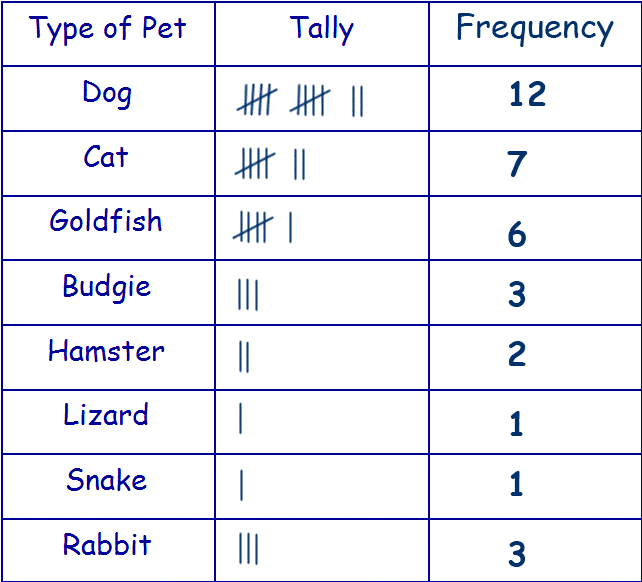
Which pet was chosen by 6 people?

1

Cat

2

Goldfish

3

Hamster

4

Snake

8

Multiple Choice

Question image

Which are the least popular pets?

1

Cats and dogs

2

Goldfish and budgie

3

Lizard and snake

4

Hamster and rabbit

9

Multiple Choice

Question image

Which is the most popular pet?

1

Dog

2

Cat

3

Hamster

4

Rabbit

10

How to construct a Frequency Distribution Table?

(Follow the steps carefully)

11

Slide image

12

Step 1

Decide on the number of classes.

number of classes (k)

(Usually it is given in the problem)

13

Multiple Choice

What do you mean by k in the formula?

1

tally

2

class interval

3

number of classes

4

score

14

Multiple Choice

Question image

Based on the table, what is the number of classes (k)?

1

5

2

10

3

15

4

20

15

Multiple Select

Question image

What is the highest and lowest number in the table? Check both.

1

16

2

17

3

63

4

64

5

66

16

Slide image

17

Step 2

Determine the class interval.


class interval (c.i.) or width (w)


18

Multiple Choice

Is class interval different from the class width?

1

yes

2

no

19

Step 2

Determine the class interval (c.i.) or width (w).

 c.i.=highest score  lowest scorenumber of classesc.i.=\frac{highest\ score\ -\ lowest\ score}{number\ of\ classes} 

 or c.i. = HS LSkor\ c.i.\ =\ \frac{HS\ -LS}{k}  

20

Multiple Choice

Question image

 c.i.=HS  LSkc.i.=\frac{HS\ -\ LS}{k} , use the formula to find for the class interval. 

1

  8.488.4\approx8  

2

 9.499.4\approx9  

3

 10.41010.4\approx10  

4

 11.41111.4\approx11  

21

Slide image

22

 c.i. = 64  175 = 475=9.49c.i.\ =\ \frac{64\ -\ 17}{5}\ =\ \frac{47}{5}=9.4\approx9  

c.i. = 9

23

Step 3

Set the individual class limit.

(Start from the lowest number)


 Lowest number +c.i.  1 Lowest\ number\ +c.i.\ -\ 1\   
 17+91=2517+9-1=25  

24

First class is
17 - 25


 Lowest number +c.i.  1 Lowest\ number\ +c.i.\ -\ 1\   
 17+91=2517+9-1=25  

25

Step 4

Tally the observation into the appropriate classes 

and count the number of tallies in each class.


How to Construct a Frequency Distribution Table?

Elizabeth Borres

Slide image

Show answer

Auto Play

Slide 1 / 25

SLIDE