

2.3 Angle Relationships

Presentation
•
Mathematics
•
8th - 11th Grade
•
Medium
+1
Standards-aligned

Tyler Nutter
Used 5+ times
FREE Resource
11 Slides • 18 Questions
1
2.3 Angle Relationships
2
3

Similar to the ruler postulate, the protractor postulate simply states that we can measure angles (and that for our purposes, those angle measures are positive - no matter which direction we measure from - which is why there are two set of numbers on a protractor!).
4
Multiple Choice

What is the measure of
the given angle?
5
Multiple Choice

What is the measure of
the given angle?
6

Also like its counterpart, the segment addition postulate from yesterday, the angle addition postulate is really telling us that the sum of the measure of two angles make the measure of the larger angle.
7

8

The angle addition postulate can be combined with the ideas of complementary (add to 90 deg.) and supplementary (add to 180 deg.) to give us the supplement theorem and complement theorem. These are just special cases of the angle addition postulate where the sum happens to be 90 or 180. Because these have been proven to always be true, they are considered theorems and not just the angle addition postulate.
9

10
Multiple Choice

11
Multiple Choice

12
Multiple Choice

Calculate m∠DEF.
13
Multiple Choice

Calculate m∠ABC.
14
Multiple Choice
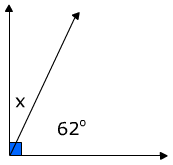
Find the value of x.
15

The first words (reflexive, symmetric, and transitive) should be a bit familiar!
16
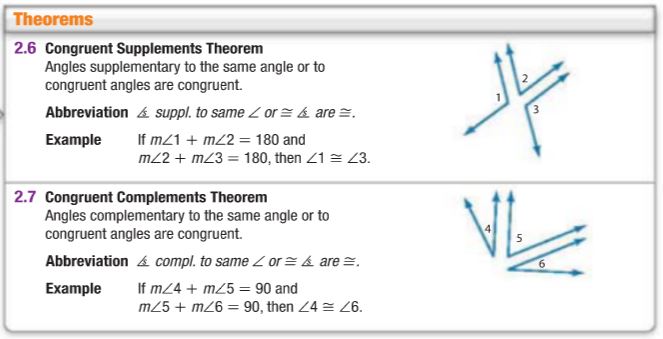
These two theorems are really just extensions of the Transitive property of congruence....but someone felt that it was necessary to call your attention to them specifically.
17

Remember when we talked about the type of angles in the last unit, we mentioned that vertical angles are always congruent. **This is a theorem that you MIGHT be asked to prove on the summative :-)
18

These 5 theorems might all seem like common sense, but remember that they have been proven so that we can build on only thoughts that are supported by proof or postulate.
19
Multiple Choice
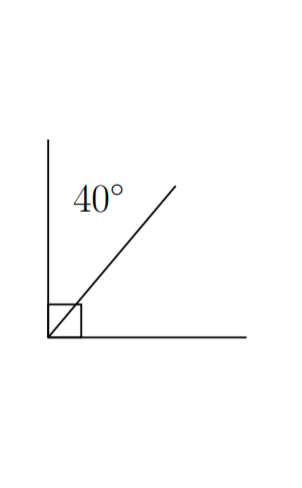
20
Multiple Choice

21
Multiple Choice

Find the value of ∠A.
22
Multiple Choice

23
Multiple Choice

What is the justification?
24
Multiple Choice

25
Multiple Choice
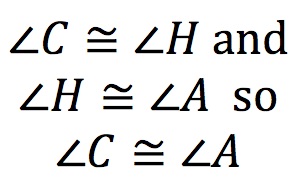
What is the reasoning?
26
Multiple Choice

Given: <1 and <3 are vertical angles. What should you conclude by the vertical angles theorem?
27
Multiple Choice

28
Multiple Choice

Match the correct words into the blanks for statement 5 and statement 7.
29
Multiple Choice
Give the reason for statement #6
2.3 Angle Relationships
Show answer
Auto Play
Slide 1 / 29
SLIDE

