Search Header Logo
Differential Reinforcement

Differential Reinforcement

Assessment

Presentation

Education

Professional Development

Medium

Created by

Mary Nolan

Used 16+ times

FREE Resource

11 Slides • 2 Questions

1

Differential Reinforcement

Rachel, Scott, Mary, Bri
Slide image

2

What is Differential Reinforcement (DR) 

  • DR is an intervention that reinforces one type of behavior while putting all other responses on extinction.

  • Differential reinforcement uses positive reductive procedures to reduce or eliminate interfering behavior (e.g., tantrums, aggression, self-injury, stereotypes).

3

Multiple Choice

Which of the following behaviors would not improve with the use of DR?

1

Hitting a student

2

Getting up from a seat

3

Performing poorly on a math test.

4

Inappropriate sensory seeking (ie. rubbing hair off head)

4

How does it relate to my classroom?

  • General Education and Special Education classrooms:

  • Gen ed/Sped classrooms all have behaviors that we as educators wish to replace.

  • DR can be used in all types of classrooms and with all types of students.

5

Terms to know:

  • Interfering Behavior

  • Alternate Behavior

6

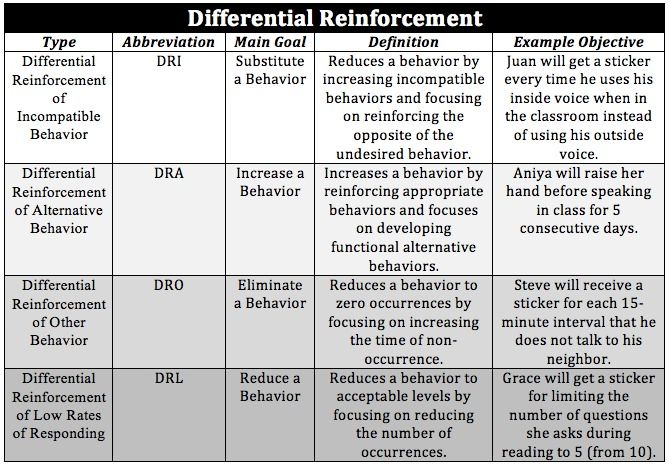
Procedures

  • DRO-Main goal is to eliminate the interfering behavior

  • DRL- Main goal is to reduce the interfering behavior

  • DRI- Main goal is to substitute the interfering behavior

  • DRA- Main goal is to substitute the interfering behavior

7

Slide image

8

Scheduling:

  • Fixed-ratio

  • DRO

  • DRA

9

Multiple Choice

Ms. Lexi is focusing on reducing the number of times Bentley goes to the water fountain during a class period. Ms. Lexi collected baseline data and it shows that Bentley gets a drink an average of 11 times per 30-minute class period.

1

DRI

2

DRO

3

DRL

10

How do we implement it?

  • Identify the interfering behavior.

  • Collect data on the behavior.

  • Determine the function of the behavior.

  • Teach the alternate behavior.

  • Collect data on alternate behavior.

  • Reinforce when appropriate per procedure type.

  • Re-evaluate after a set time frame to determine if it is working.

11

Case Study

Ryan

Slide image

12

Questions?

Thank you for your attendance and active participation in today's professional development presentation!

Slide image

13

Post Test!

Differential Reinforcement

Rachel, Scott, Mary, Bri

Slide image

Show answer

Auto Play

Slide 1 / 13

SLIDE